
Full body exercises are some of the most efficient movements for building strength, improving fitness, and supporting fat loss because they train multiple major muscle groups at once. These exercises allow you to work your legs, upper body, back, shoulders, and core in a single workout, making them ideal for busy people who want results without long gym sessions.
Understanding how full body exercises work is important because they improve functional strength, boost metabolism, support better posture, and help you move more confidently in everyday life. In this guide, you’ll learn 12 of the best full body exercises, how to perform them correctly, and how they fit into a safe, effective fitness routine.
What Are Full Body Exercises?
Full body exercises are movements that train multiple major muscle groups at the same time, making them some of the most efficient and effective exercises for strength, mobility, and overall fitness. These exercises use large, compound patterns—such as squatting, pushing, pulling, and hinging—that improve functional movement and help you get more results in less time.
Key Characteristics of Full Body Exercises
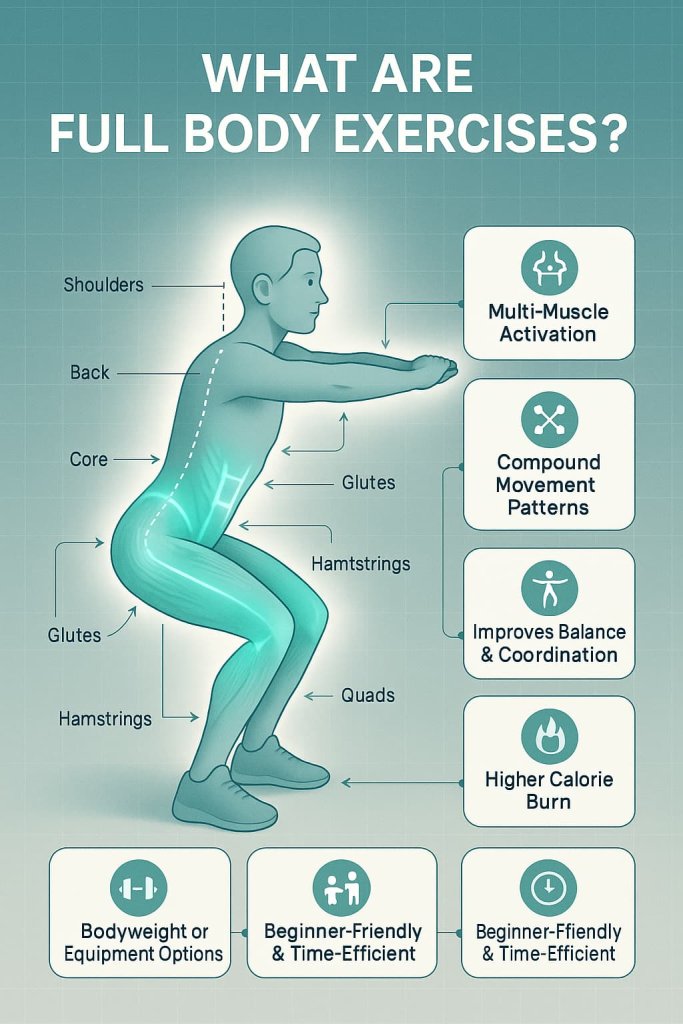
- Work several major muscle groups simultaneously
- Use multi-joint, compound movement patterns
- Improve coordination, balance, and functional strength
- Increase heart rate and calorie burn more than isolated movements
- Can be performed with bodyweight, dumbbells, or gym equipment
- Suitable for beginners, busy individuals, and home workouts
12 Best Full Body Exercises
A foundational lower-body exercise that also engages your core and back for stability. Helps build strength for everyday movements like standing, lifting, and climbing.
1. Squat
Why it works:
A foundational movement that strengthens the legs, hips, and core while improving balance and functional strength.
Muscles worked:
Quads, glutes, hamstrings, core, lower back.
How to do it:
- Stand with feet shoulder-width apart.
- Sit your hips back and bend your knees.
- Lower until thighs are parallel to the floor.
- Push through your heels to stand tall.
Trainer Tip:
Keep your chest lifted and knees aligned with your toes to avoid joint strain.
2. Deadlift (Bodyweight, Dumbbell, or Barbell)
Why it works:
A powerful posterior-chain exercise that builds overall strength and enhances hip hinge mechanics.
Muscles worked:
Hamstrings, glutes, lower back, core, lats, forearms.
How to do it:
- Stand with feet hip-width apart.
- Hold weights or hinge at the hips if bodyweight only.
- Keep spine neutral as you lower the torso.
- Stand tall by driving hips forward.
Trainer Tip:
Imagine “pushing the floor away” to maintain proper form.
3. Lunge
Why it works:
Improves lower-body strength while training balance, coordination, and unilateral stability.
Muscles worked:
Glutes, hamstrings, quads, calves, core.
How to do it:
- Step forward with one leg.
- Bend both knees to 90 degrees.
- Push through the front heel to return to start.
- Switch sides.
Trainer Tip:
Keep your torso vertical to protect your knees and hips.
4. Push-Up
Why it works:
A classic upper-body and core builder that requires no equipment and strengthens pushing muscles.
Muscles worked:
Chest, triceps, shoulders, core, serratus anterior.
How to do it:
- Place hands under shoulders.
- Keep body straight head to heels.
- Lower chest with elbows at a 45-degree angle.
- Push back up.
Trainer Tip:
If needed, modify on knees without letting your hips sag.
5.Bent-Over Row (Dumbbell or Barbell)
Why it works:
Strengthens the back and improves posture and pulling strength—key for balanced training.
Muscles worked:
Lats, rhomboids, traps, rear delts, biceps, core.
How to do it:
- Hinge at the hips with a flat back.
- Hold weights beneath shoulders.
- Pull elbows toward your ribs.
- Lower slowly with control.
Trainer Tip:
Avoid rounding your spine; keep your core braced throughout.
6. Overhead Press
Why it works:
A full-body press that strengthens the shoulders and upper chest while demanding core stability.
Muscles worked:
Shoulders, upper chest, triceps, core.
How to do it:
- Stand tall holding weights at shoulder height.
- Press up overhead until arms straighten.
- Lower with control.
Trainer Tip:
Squeeze your glutes lightly to protect your lower back.
7. Pull-Up or Assisted Pull-Up
Why it works:
A powerful upper-body pulling movement that builds back, arm, and grip strength.
Muscles worked:
Lats, biceps, traps, rear delts, core, forearms.
How to do it:
- Hang from a bar with shoulder-width grip.
- Pull your chest toward the bar.
- Lower slowly.
Trainer Tip:
If needed, use bands or an assisted pull-up machine.
8. Hip Thrust or Glute Bridge
Why it works:
Strengthens the glutes, which support hip extension, posture, and lower-body power.
Muscles worked:
Glutes, hamstrings, core.
How to do it:
- Lie down with knees bent or position upper back on a bench.
- Drive hips upward.
- Squeeze glutes at the top.
- Lower slowly.
Trainer Tip:
Don’t arch your lower back—focus on glute squeeze, not height.
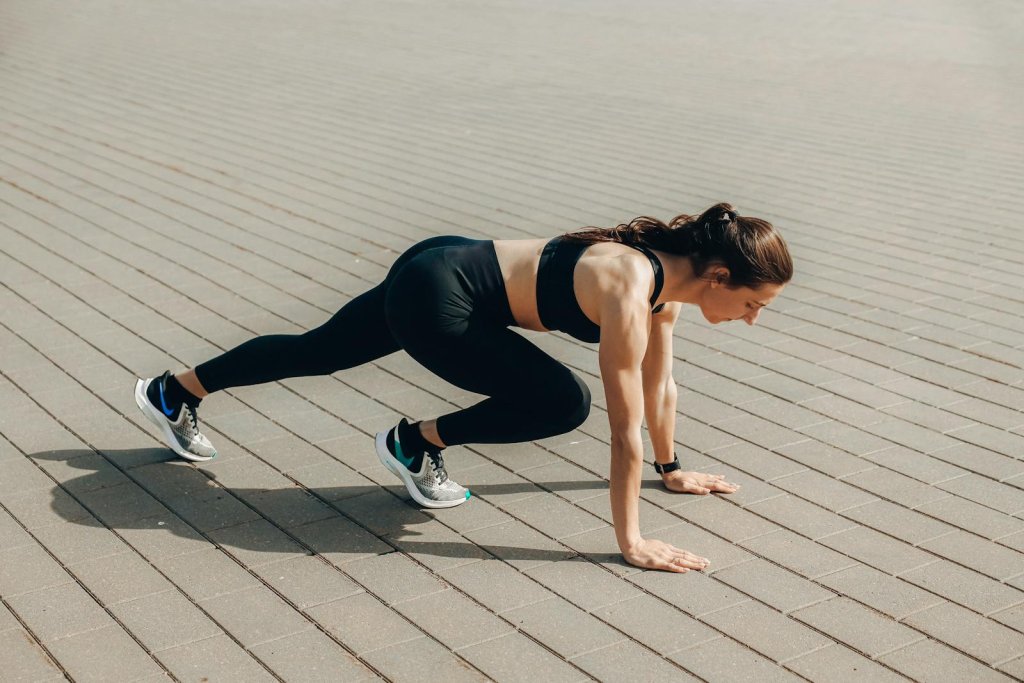
9. Mountain Climbers
Why it works:
A dynamic core and cardio movement that boosts heart rate while strengthening shoulders and abs.
Muscles worked:
Core, shoulders, hip flexors, quads.
How to do it:
- Start in plank position.
- Drive one knee toward your chest.
- Switch legs quickly in a running motion.
- Keep hips stable.
Trainer Tip:
Move at a controlled pace to maintain form.
10. Plank
Why it works:
Builds full-body stability and strengthens deep core muscles essential for movement efficiency.
Muscles worked:
Core, shoulders, glutes, lower back.
How to do it:
- Place elbows under shoulders.
- Keep body straight from head to heels.
- Hold without letting hips drop.
Trainer Tip:
Imagine pulling your elbows toward your toes to activate your core.
11. Burpee
Why it works:
A high-intensity, full-body movement that challenges strength, endurance, and explosiveness.
Muscles worked:
Chest, shoulders, triceps, core, quads, glutes, hamstrings.
How to do it:
- Drop into a squat.
- Kick feet back into plank.
- Do a push-up (optional).
- Jump back to standing.
Trainer Tip:
Use low-impact modifications if you experience knee or wrist discomfort.
12. Farmer’s Carry
Why it works:
Improves grip strength, core stability, and total-body control—ideal for functional fitness.
Muscles worked:
Core, forearms, traps, shoulders, glutes.
How to do it:
- Hold weights at your sides.
- Stand tall with shoulders back.
- Walk slowly with controlled steps.
Trainer Tip:
Focus on posture—avoid leaning or swaying.
How Often Should You Do Full Body Exercises?
For most adults, 2–3 full-body workouts per week is recommended for general fitness and strength. This matches ACSM and CDC guidelines, which advise training all major muscle groups at least twice weekly.
- Beginner: 2 sessions/week
- Intermediate: 3–4 sessions/week
- Advanced: 3–5 sessions/week depending on recovery
Benefits of Full Body Exercises
Full body workouts may help:
- Build total-body strength
- Support fat loss when paired with a balanced diet
- Improve posture and joint stability
- Enhance everyday movement (lifting, bending, carrying)
- Strengthen the core for better balance
- Improve metabolism and reduce inactivity-related stiffness
- Save time by training the entire body in a single session
Common Mistakes to Avoid
- Lifting too heavy before learning proper form
- Holding your breath (avoid excessive bracing)
- Rounding the back during hip-hinge movements
- Not warming up or cooling down
- Training too many days without rest
- Neglecting upper-back exercises, causing muscle imbalance
Safety Tips
- If you have joint pain, heart conditions, recent surgery, or chronic illness, consult a healthcare professional before starting.
- Begin with lighter weights or bodyweight variations.
- Maintain controlled movements—avoid jerking or rushing.
- Stop immediately if you feel sharp pain or dizziness.
FAQ
1. Are full body workouts good for beginners?
Yes. Beginners benefit from full body routines because they learn foundational movements and improve strength with fewer weekly sessions.
2. How long should a full body workout be?
Most sessions take 30–45 minutes, depending on exercise selection and rest periods.
3. Can full body workouts help with fat loss?
They may support fat loss when combined with a calorie-controlled diet and regular cardio activity.
4. Can I do full body workouts every day?
Not recommended—your muscles need recovery. Aim for 2–3 days per week.
5. Do I need equipment?
No. You can do many full body exercises with just bodyweight; weights can be added as you progress.
6. Are full body workouts better than split workouts?
Both work. Research shows results are similar when weekly volume is matched. Full body routines are simply more time-efficient.
7. What’s the best warm-up?
A light cardio warm-up (1–2 minutes) followed by dynamic movements like leg swings, arm circles, and hip hinges.
Conclusion
Full body exercises are a simple and efficient way to build strength, support fat loss, and improve overall fitness. By using movements that train multiple muscle groups at once, you can get strong, balanced results with fewer weekly workouts. Start with the basics, focus on proper form, and train consistently to see steady progress.
References
- ACSM – Progression Models in Resistance Training for Healthy Adults
- CDC – Physical Activity Guidelines for Adults
- Physical Activity Guidelines for Americans, 2nd Edition (U.S. HHS)
- Ramos-Campo et al., 2024 – Efficacy of Split Versus Full-Body Resistance Training
- Evangelista et al., 2021 – Split or Full-Body Workout Routine: Which Is Best to Increase Muscle Strength?
- Paluch et al., 2024 – Resistance Exercise Training and Cardiovascular Health (AHA Statement)
- National Institute on Aging – Exercise and Physical Activity for Older Adults
- CDC – What Counts as Muscle-Strengthening Activity?