
Scapular stabilization exercises are targeted movements that train the shoulder blades to stay controlled and properly positioned during arm motion, helping support shoulder strength, posture, and pain-free movement.
Understanding and practicing these exercises matters because poor scapular control is commonly linked to shoulder discomfort, inefficient movement, and reduced performance in daily tasks and exercise.
When performed correctly, scapular stabilization exercises focus on coordination, endurance, and posture rather than heavy load. Leading exercise and rehabilitation organizations consistently recommend combining scapular control with rotator cuff and upper-body strengthening for long-term shoulder health.
What Are Scapular Stabilization Exercises?
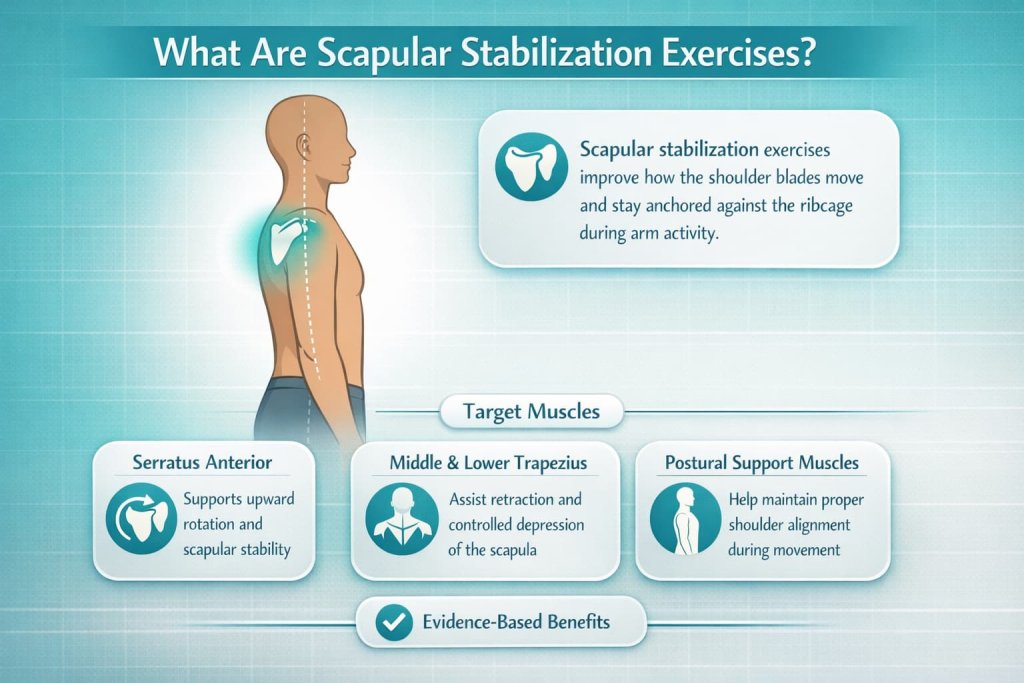
Scapular stabilization exercises are movements designed to improve how the shoulder blades (scapulae) move and stay anchored against the ribcage during arm activity. Instead of isolating the arms or chest, these exercises emphasize controlled scapular motion.
They typically target:
- Serratus anterior for upward rotation and stability
- Middle and lower trapezius for retraction and depression
- Postural muscles that support shoulder alignment
Organizations such as the American College of Sports Medicine emphasize that scapular control is a key component of safe and effective upper-body training.
10 Best Scapular Stabilization Exercises
These scapular stabilization exercises focus on improving shoulder blade control, posture, and movement quality. They are designed to support strong, stable shoulders using controlled, low-impact movements suitable for most fitness levels.
1. Scapular Wall Slides
Why it works:
Scapular wall slides encourage coordinated upward rotation of the shoulder blades while maintaining a neutral spine. The wall provides feedback that helps limit compensation from the lower back or neck, making this exercise ideal for learning proper scapular mechanics.
Muscles worked:
This exercise primarily targets the serratus anterior and lower trapezius, with assistance from the middle trapezius and rotator cuff muscles for joint control.
How to do it:
- Stand with your back, head, and hips lightly against a wall
- Bend elbows to 90 degrees with forearms against the wall
- Gently set your shoulder blades down and slightly back
- Slide arms upward while keeping ribs down and neck relaxed
- Slowly return to the starting position with control
Trainer Tip:
If your ribs flare or shoulders shrug, reduce the range of motion and focus on smoother, slower movement.
2. Prone Y Raise
Why it works:
The prone Y raise emphasizes lower trapezius activation, which plays a key role in scapular depression and upward rotation during overhead movements. It helps balance dominant upper trapezius activity.
Muscles worked:
Lower trapezius is the primary muscle, with support from the middle trapezius, posterior deltoids, and rotator cuff.
How to do it:
- Lie face down on a bench or mat
- Raise arms overhead in a Y shape with thumbs pointing upward
- Gently draw shoulder blades down and together
- Lift arms slightly off the surface without arching the lower back
- Lower slowly and repeat
Trainer Tip:
Think “long arms, heavy shoulders” to avoid excessive neck tension.
3. Resistance Band Row (Scapular Focus)
Why it works:
This variation prioritizes scapular retraction before elbow movement, reinforcing proper sequencing between the shoulder blades and arms during pulling tasks.
Muscles worked:
Middle trapezius and rhomboids are the main contributors, supported by the posterior deltoids and biceps.
How to do it:
- Anchor a resistance band at chest height
- Hold handles with arms extended and chest tall
- Initiate movement by pulling shoulder blades together
- Bend elbows only after the scapulae begin retracting
- Slowly return to the start under control
Trainer Tip:
Pause briefly at the end of each row to build scapular endurance rather than adding more resistance.
4. Push-Up Plus
Why it works:
The “plus” phase adds active scapular protraction at the top of the push-up, making this one of the most effective closed-chain exercises for serratus anterior activation.
Muscles worked:
Serratus anterior is the primary muscle, with assistance from the chest, triceps, core, and shoulder stabilizers.
How to do it:
- Start in a push-up or knee-supported plank position
- Lower into a standard push-up with control
- At the top, actively push the floor away to spread shoulder blades
- Hold briefly, then repeat
Trainer Tip:
If full push-ups are challenging, perform this exercise from the knees or against a wall.
5. Prone T Raise
Why it works:
The prone T raise strengthens scapular retractors and improves endurance needed for maintaining upright posture during prolonged sitting or standing.
Muscles worked:
Middle trapezius is the primary muscle, with support from rhomboids and posterior deltoids.
How to do it:
- Lie face down with arms extended out to the sides
- Thumbs point upward to encourage external rotation
- Gently squeeze shoulder blades together
- Lift arms slightly off the surface
- Lower slowly with control
Trainer Tip:
Use very light weights or bodyweight only; form quality matters more than resistance.
6. Scapular Retraction Hold
Why it works:
Isometric holds improve endurance of the postural muscles responsible for maintaining scapular position during daily activities and lifting.
Muscles worked:
Middle trapezius and rhomboids are emphasized, with postural support from the lower trapezius.
How to do it:
- Sit or stand tall with arms at your sides
- Gently pull shoulder blades toward each other
- Keep neck relaxed and ribs down
- Hold the position for 10–30 seconds
- Relax and repeat
Trainer Tip:
This is not a maximal squeeze—aim for controlled, sustainable tension.
7. Wall-Supported Serratus Punch
Why it works:
This exercise isolates controlled scapular protraction without loading the shoulder joint heavily, making it suitable for beginners or recovery phases.
Muscles worked:
Serratus anterior is the primary muscle, with light assistance from the chest and anterior deltoids.
How to do it:
- Stand facing a wall with hands at shoulder height
- Keep elbows slightly bent
- Push hands into the wall, allowing shoulder blades to move forward
- Slowly return to the neutral position
- Repeat with smooth control
Trainer Tip:
Avoid shrugging; the movement should come from the shoulder blades, not the neck.
8. Quadruped Scapular Control
Why it works:
This low-load, closed-chain position enhances scapular awareness and coordination while reducing stress on the shoulder joint.
Muscles worked:
Serratus anterior and trapezius muscles work together, with core muscles providing stability.
How to do it:
- Start on hands and knees with spine neutral
- Keep elbows straight but not locked
- Slowly let chest sink slightly as shoulder blades retract
- Push the floor away to protract the scapulae
- Move slowly between positions
Trainer Tip:
Think of gently “gliding” the shoulder blades rather than forcing large movements.
9. Band-Assisted External Rotation with Set Scapula
Why it works:
This exercise integrates scapular positioning with rotator cuff strengthening, reinforcing shoulder stability during arm rotation.
Muscles worked:
Infraspinatus and teres minor are primary, with stabilization from the middle and lower trapezius.
How to do it:
- Anchor a band at elbow height
- Stand sideways with elbow bent to 90 degrees
- Set shoulder blade gently down and back
- Rotate forearm outward while keeping elbow tucked
- Return slowly to start
Trainer Tip:
If the shoulder blade moves excessively, reduce resistance and slow the tempo.
10. Farmer Carry (Light Load, Posture Emphasis)
Why it works:
Farmer carries train scapular stability in a functional, upright position that mimics real-world carrying tasks.
Muscles worked:
Lower trapezius, serratus anterior, grip muscles, core, and postural stabilizers all contribute.
How to do it:
- Hold light dumbbells or kettlebells at your sides
- Stand tall with shoulders relaxed and set
- Walk slowly while maintaining upright posture
- Avoid leaning or shrugging
- Continue for time or distance
Trainer Tip:
Start lighter than you think—posture quality is the priority, not load.
How Often Should You Do Scapular Stabilization Exercises?
Most conditioning and rehabilitation programs recommend:
- 2–4 sessions per week
- 1–3 sets of 8–15 controlled repetitions
- Emphasis on slow tempo and posture awareness
The American Academy of Orthopaedic Surgeons includes similar frequency guidelines in its shoulder conditioning resources.
Common Mistakes to Avoid
- Over-shrugging the shoulders
- Using excessive resistance too early
- Rushing repetitions
- Arching the lower back to compensate
- Ignoring posture and breathing
Quality of movement is more important than load for scapular stabilization.
Why Scapular Stabilization Exercises Matter
Poor scapular control may contribute to:
- Rounded shoulders and forward head posture
- Reduced shoulder strength and endurance
- Early fatigue during lifting or overhead tasks
- Increased strain on the neck and shoulder joints
Clinical and fitness research suggests that scapular-focused exercise programs may help improve shoulder function and movement quality when combined with proper technique and progression.
Key Muscles Involved in Scapular Stabilization
Scapular stabilization exercises primarily involve:
- Serratus anterior
- Middle trapezius
- Lower trapezius
- Rhomboids (supporting role)
- Rotator cuff muscles (secondary stabilizers)
The National Institutes of Health highlights coordinated muscle activation around joints as an important factor in joint stability and injury prevention.
Who Can Benefit Most?
Scapular stabilization exercises may be especially useful for:
- Desk workers with rounded-shoulder posture
- Recreational lifters and athletes
- Individuals returning from shoulder discomfort
- Older adults focusing on posture and joint control
Public health and fitness guidelines consistently support multicomponent exercise programs that include posture, mobility, and strength.
Scapular Stabilization vs Strength Training — What’s the Difference?
Scapular stabilization and traditional strength training serve different but complementary purposes for shoulder health.
Scapular stabilization exercises focus on how well the shoulder blades move and stay controlled on the ribcage. The emphasis is on coordination, posture, and endurance rather than lifting heavy weight.
Strength training focuses on building muscle strength and force through exercises like presses, rows, and pull-downs, assuming the shoulder blades can already move efficiently.
Key differences:
- Scapular stabilization emphasizes control, alignment, and movement quality
- Strength training emphasizes load, power, and muscle development
- Stabilization exercises use lighter resistance and slower tempo
- Strength training typically uses heavier resistance
For best results, many programs combine both—using scapular stabilization to support safe, effective strength training and long-term shoulder function.
Frequently Asked Questions
Are scapular stabilization exercises good for shoulder pain?
They may help support shoulder comfort and function when performed correctly and as part of a balanced program.
Can beginners do scapular stabilization exercises?
Yes. Many exercises use bodyweight or light resistance and are suitable for beginners.
Do I need equipment?
Most exercises can be done with bodyweight or inexpensive resistance bands.
How long before results are noticeable?
Posture awareness and movement control may improve within a few weeks of consistent practice.
Should these replace regular shoulder workouts?
No. They work best when paired with general upper-body strength and mobility exercises.
Can these exercises help posture?
Yes. Improved scapular control is closely linked to better upper-body posture.
Conclusion
Scapular stabilization exercises play a critical role in building strong, stable, and pain-free shoulders. By focusing on control, endurance, and posture rather than heavy load, these exercises support better movement quality in daily life and training.
If you want healthier shoulders and better posture, start integrating scapular stabilization exercises into your routine 2–4 times per week and progress gradually with proper form.
This content is for informational purposes only and not medical advice.
References
- Rotator Cuff and Shoulder Conditioning Program (OrthoInfo – AAOS)
- Rotator Cuff and Shoulder Conditioning Program (AAOS PDF)
- Shoulder “12” Rotator Cuff and Scapular Strengthening Program (Mass General Hospital PDF)
- Rotator Cuff and Scapular Strengthening Home Program (Mass General Hospital PDF)
- Scapular Stabilization for Shoulder Pain: Putting the Cart Before the Horse (International Journal of Sports Physical Therapy, 2025)
- Effect of Scapular Stabilization Exercises on Subacromial Pain Syndrome (Frontiers in Neurology, 2024)
- The Efficacy of Exercise Therapy for Rotator Cuff–Related Shoulder Pain: FITT Factors (JOSPT, 2024)
- Systematic Review: Exercises That Produce Optimal Muscle Ratios of the Scapular Stabilizers (PMC, 2016)