
Forward head posture exercises can help retrain your deep neck muscles, improve upper-back support, and make it easier to “stack” your head over your shoulders. In plain terms: the right combination of chin-tuck control, upper-back strength, and chest/thoracic mobility is the fastest, most reliable approach used in posture-focused rehab programs. According to the Cleveland Clinic, posture-focused exercises can support better alignment and reduce strain from prolonged sitting.

Forward head posture (often called “tech neck”) usually isn’t one tight muscle—it’s a pattern. That’s why the best results typically come from a small set of exercises that train both control and support, not just stretching.
What forward head posture is and why it happens
Forward head posture means your head sits in front of your shoulders more than ideal. Over time, this can increase strain on the neck and upper back, especially with long hours of screens, slouched sitting, or weak upper-back support.
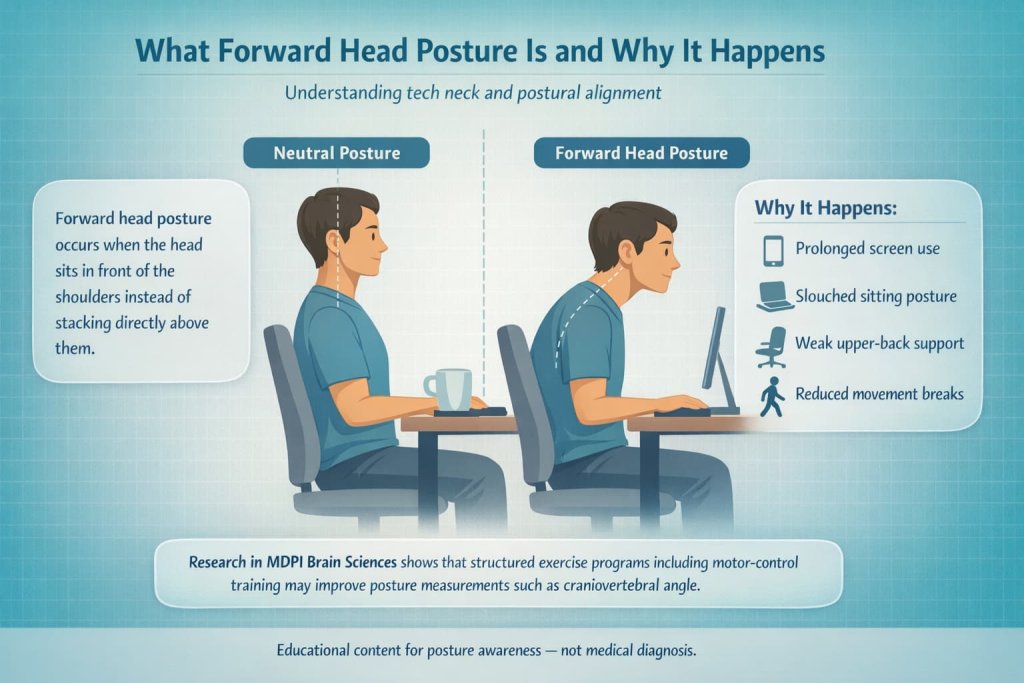
Recent research published in MDPI Brain Sciences shows that structured exercise programs can improve posture measurements such as craniovertebral angle, particularly when motor-control training is included.
Symptoms and Risk Factors of Forward Head Posture
Forward head posture may lead to gradual neck strain and reduced postural endurance, especially with long screen use.
Common Symptoms
- Neck and upper-back tension
- Base-of-skull headaches
- Rounded shoulders
- Stiffness after sitting
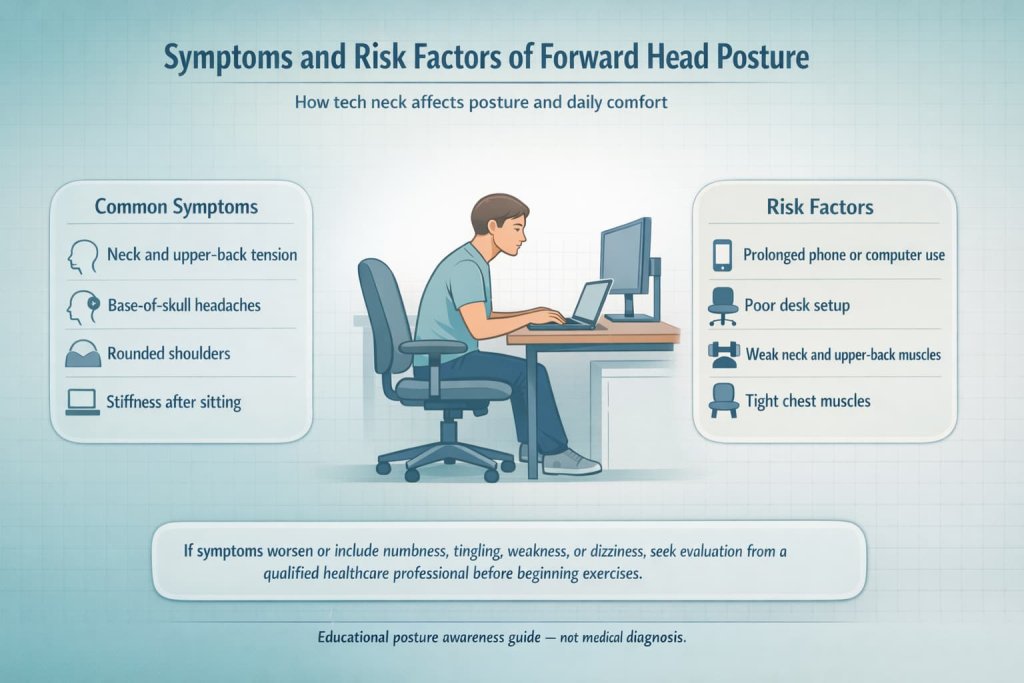
Risk Factors
- Prolonged phone or computer use
- Poor desk setup
- Weak neck and upper-back muscles
- Tight chest muscles
If symptoms worsen or include numbness, tingling, weakness, or dizziness, consult a qualified healthcare professional before starting exercises.
5 best forward head posture exercises
These five cover the most important targets: deep neck flexors, scapular/upper-back control, thoracic extension, and chest tightness.
1) Chin Tuck (Deep Neck Flexor Reset)
How to do it:
- Sit tall or lie on your back with your head supported.
- Gently glide your chin straight back (like making a “double chin”).
- Keep your eyes level; don’t look down.
- Hold 3–5 seconds, relax.
- Do 8–12 reps.
Why it works:
This exercise trains the deep cervical flexors that help center and support your neck. Research discussed in the Journal of Orthopaedic & Sports Physical Therapy highlights how deep neck flexor control relates to forward head posture mechanics and improved neck stability.
Trainer Tip:
Think “slide back,” not “nod down.” If your throat muscles bulge or your chin points downward, reduce the range and slow the movement.
2) Wall Posture Hold (Head-Over-Shoulders Drill)
How to do it:
- Stand with your back against a wall.
- Set ribs stacked over hips (avoid arching your lower back).
- Lightly tuck your chin and gently draw the back of your head toward the wall.
- Hold 20–40 seconds while breathing normally.
- Repeat 2–3 times.
Why it works:
The wall provides real-time feedback for alignment and helps you feel what neutral stacked posture should feel like. This improves awareness and carryover into daily sitting and standing.
Trainer Tip:
Avoid forcing your head backward. Aim for a subtle lengthening through the back of the neck rather than pressing hard into the wall.
3) Scapular Retraction (Shoulder Blade Squeeze)
How to do it:
- Sit or stand tall with arms relaxed by your sides.
- Gently squeeze your shoulder blades back and slightly downward.
- Hold 2–3 seconds.
- Relax fully before the next rep.
- Perform 10–15 reps.
Why it works:
Forward head posture often appears with rounded shoulders and weak scapular support. Research published in SAGE Journals suggests that comprehensive upper-back and postural strengthening programs can improve forward head posture outcomes more effectively than neck-only exercises.
Trainer Tip:
Do not shrug your shoulders upward. If tension builds in your upper traps, reset and reduce the squeeze intensity.
4) Thoracic Extension (Upper-Back Opener)
How to do it:
- Sit on a chair with a firm back or position a foam roller behind your upper back.
- Support your head gently with your hands.
- Slowly extend your upper back over the support.
- Keep the movement small and controlled.
- Perform 6–10 slow repetitions.
Why it works:
A stiff thoracic spine often causes the neck to compensate by moving forward. Improving upper-back mobility supports better head-over-shoulders alignment during screen use and daily activities.
Trainer Tip:
Keep the motion focused in your upper back. Avoid excessive lower-back arching or rib flaring.
5) Doorway Pec Stretch (Chest Tightness Reset)
How to do it:
- Place your forearm on a doorway with your elbow at shoulder height.
- Step forward gently until you feel a mild stretch in the chest.
- Hold for 20–30 seconds.
- Repeat 2–3 times per side.
Why it works:
Tight pectoral muscles can pull the shoulders forward, making forward head posture harder to correct. Pairing chest mobility with strengthening exercises improves alignment more effectively than stretching alone.
Trainer Tip:
Keep the stretch comfortable. If you feel shoulder pinching, lower your elbow slightly and reduce the forward step.
How to use these exercises for faster results
A simple structure that works well:
- Do the Chin Tuck first (control)
- Add Wall Posture Hold (positioning)
- Then Scapular Retraction (support)
- Finish with Thoracic Extension and Doorway Pec Stretch (mobility)
Ongoing research registered on ClinicalTrials.gov shows continued interest in comparing deep neck flexor strengthening and motor-learning-based approaches, highlighting the importance of proper retraining rather than random exercise selection.
Sample weekly plan for forward head posture exercises
- 3–5 days/week
- Chin Tuck: 2 sets of 8–12
- Wall Posture Hold: 2 holds of 20–40 sec
- Scapular Retraction: 2 sets of 10–15
- Thoracic Extension: 1–2 sets of 6–10
- Doorway Pec Stretch: 2 holds of 20–30 sec/side
If you sit for long hours, add one “mini reset” daily: 5 chin tucks + 10 scap squeezes.
Quick safety checklist before you start
- Keep movements gentle and controlled—no forcing end range.
- Stop if you get dizziness, tingling, arm numbness, or sharp pain.
- If you have a recent injury, nerve symptoms, or a medical condition affecting your neck, get professional guidance first.
Common mistakes that slow progress
- Turning the chin tuck into a hard neck bend
- Overstretching the neck instead of training control
- Shrugging during scapular work
- Only stretching and skipping strengthening
- Trying to “hold perfect posture” all day instead of doing short resets
When to seek professional guidance
Get checked by a qualified clinician if you have:
- Numbness, tingling, or weakness into the arm/hand
- Dizziness, balance issues, or headache patterns that worsen with exercises
- Pain after a fall/accident or symptoms that are rapidly worsening
People also ask about forward head posture exercises
How long does it take to fix forward head posture?
Most people notice easier upright posture within a few weeks, but visible alignment changes typically require consistent practice over several weeks.
Are chin tucks enough?
They’re a strong foundation, but combining them with upper-back strengthening and thoracic mobility work usually produces better results.
Can forward head posture cause neck pain?
It can contribute to strain in some individuals, particularly with prolonged sitting and reduced muscular endurance.
Should I stretch my neck to fix tech neck?
Gentle mobility may help, but deep neck control and upper-back strength are usually more important than aggressive neck stretching.
What if I want something more science-based?
Current research continues to compare strengthening and motor-learning approaches, emphasizing quality of movement and consistency.
FAQs
1) How often should I do forward head posture exercises?
3–5 days per week works well for most people.
2) What’s the single best exercise?
The chin tuck is often the starting point because it targets deep neck stabilizers.
3) Why do my upper traps feel tight?
They may be compensating for weak mid-back or deep neck muscles.
4) Should I exercise if I have headaches?
If headaches are frequent or severe, consult a healthcare provider before starting.
5) Do posture braces fix forward head posture?
They may provide reminders, but long-term change usually comes from exercise and habit retraining.
6) Can desk workers benefit most?
Yes. Those who spend long hours at screens often see meaningful improvement with consistent posture exercises.
7) How can I track progress?
Notice reduced tension, improved sitting endurance, and compare side-view posture photos weekly.
Conclusion
Forward head posture improves fastest when you combine deep neck control, upper-back strengthening, and thoracic/chest mobility. Practice these forward head posture exercises consistently, focus on quality movement, and build posture endurance gradually.
This content is for informational purposes only and not medical advice.
References
- PubMed Central. Effect of deep cervical flexor training on forward head posture outcomes (adolescents). Available from: PubMed Central
- PubMed Central. Systematic review/meta-analysis on exercise interventions (strengthening and stretching) for forward head posture and craniovertebral angle. Available from: PubMed Central
- Journal of the Korean Society of Physical Medicine. Deep cervical flexor exercise with visual guidance and posture-related effects (2019). Available from: Journal of the Korean Society of Physical Medicine