
Scapula exercises are movements that train your shoulder blades to move and stabilize efficiently, which supports shoulder control, posture, and comfort during lifting, reaching, and daily activities. When the scapula does not move or anchor well, the shoulder joint often compensates—especially during overhead motion.
For this reason, shoulder-conditioning programs from the American Academy of Orthopaedic Surgeons and Mass General routinely include scapula-focused strengthening and control exercises.
Below is a practical, progressive list you can use at home or in the gym, along with programming tips, common mistakes, and safety guidance.
What Are Scapula Exercises?
Scapula exercises focus on improving how the shoulder blades move and stabilize during arm and upper-body movement. Instead of training the arms alone, they help the scapula provide a steady base for efficient shoulder function, as commonly emphasized in guidance from the American Academy of Orthopaedic Surgeons.
Key goals include:
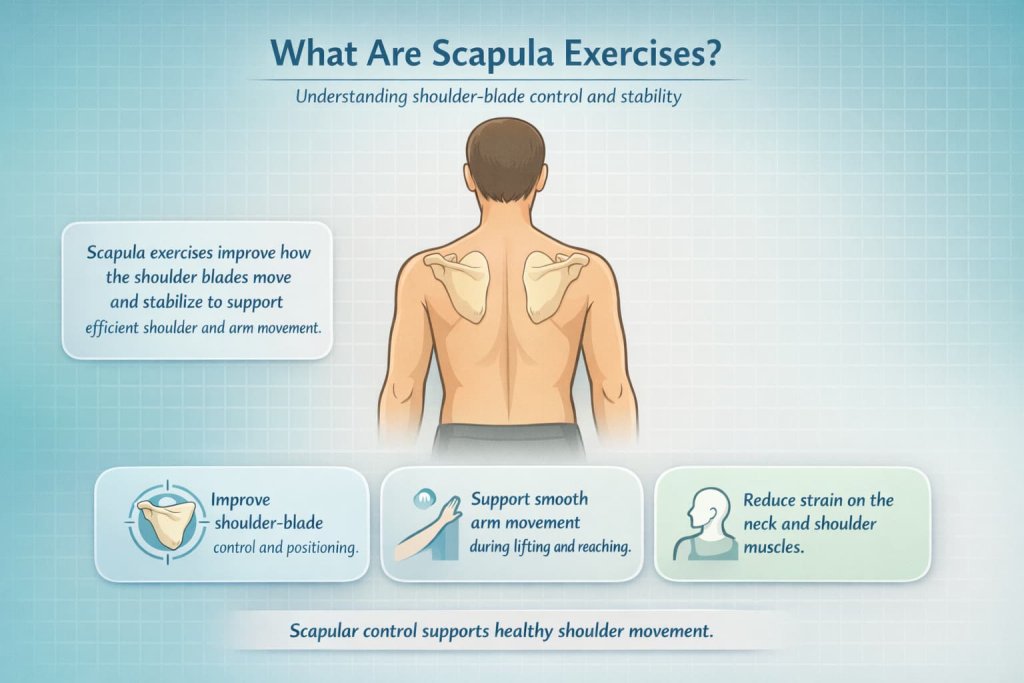
- Improving shoulder-blade control and positioning
- Supporting smooth arm movement during lifting and reaching
- Reducing unnecessary strain on the neck and shoulder muscles
Why Scapula Exercises Matter for Shoulder Stability and Comfort
The shoulder blade plays a central role in how the shoulder joint handles load. When scapular control or endurance is limited, other tissues may compensate. Scapula exercises help support balanced shoulder mechanics, which is frequently highlighted in clinical exercise research from the Journal of Orthopaedic & Sports Physical Therapy.
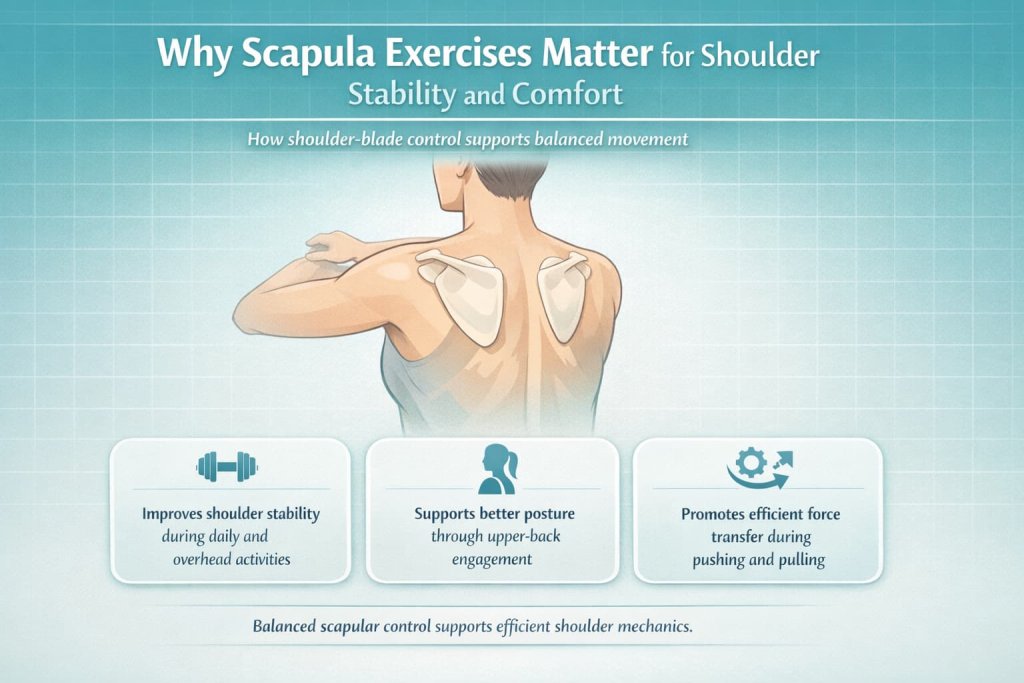
Potential benefits include:
- Improved shoulder stability during daily and overhead activities
- Better posture support through upper-back engagement
- More efficient force transfer during pushing and pulling
The 12 best scapula exercises
The 12 best scapula exercises focus on improving shoulder-blade control, stability, and coordination to support efficient, comfortable shoulder movement. Together, they help build strength and endurance in key stabilizing muscles while reducing unnecessary strain during daily activities and training.
1. Scapular Setting
Why it works:
Scapular setting teaches low-load awareness and control of shoulder-blade position without excessive muscle tension. It helps establish a neutral scapular resting position, which supports efficient shoulder movement during reaching, lifting, and posture tasks. This foundational drill is commonly emphasized in shoulder programs recommended by the American Academy of Orthopaedic Surgeons because it reduces compensatory shrugging and overuse of the neck muscles.
Muscles worked:
Lower trapezius, mid trapezius, serratus anterior (light activation)
Trainer Tip:
Think “length through the neck” rather than squeezing the shoulder blades together forcefully.
How to do it:
- Stand tall with ribs stacked over the pelvis
- Let shoulders relax naturally away from the ears
- Gently draw the shoulder blades slightly down and back
- Maintain relaxed breathing
- Hold for 5–10 seconds
- Repeat 5–10 times
2. Wall Slide With Lift-Off
Why it works:
Wall slides promote coordinated scapular upward rotation and posterior tilt as the arms elevate. Adding a lift-off challenges active control at the top of the range, where scapular stability is often lost. This pattern supports smoother overhead movement and better shoulder mechanics.
Muscles worked:
Serratus anterior, lower trapezius
Trainer Tip:
If you feel neck tension or shrugging, reduce the range and slow the movement.
How to do it:
- Place forearms on a wall at shoulder height
- Lightly press forearms into the wall
- Slide arms upward while keeping shoulders relaxed
- At the top, gently lift forearms off the wall
- Lower with control
- Perform 8–12 reps
3. Serratus Wall Press (Isometric)
Why it works:
This isometric exercise activates the serratus anterior without joint movement, making it useful in early-stage shoulder conditioning. It helps improve scapular protraction control, which supports shoulder stability during pushing and reaching activities.
Muscles worked:
Serratus anterior
Trainer Tip:
You should feel steady effort along the side of the ribcage, not strain in the neck.
How to do it:
- Stand facing a wall with palms at shoulder height
- Keep elbows slightly bent
- Push the wall away to gently spread the shoulder blades
- Maintain relaxed breathing
- Hold for 20–30 seconds
- Repeat 2–3 times
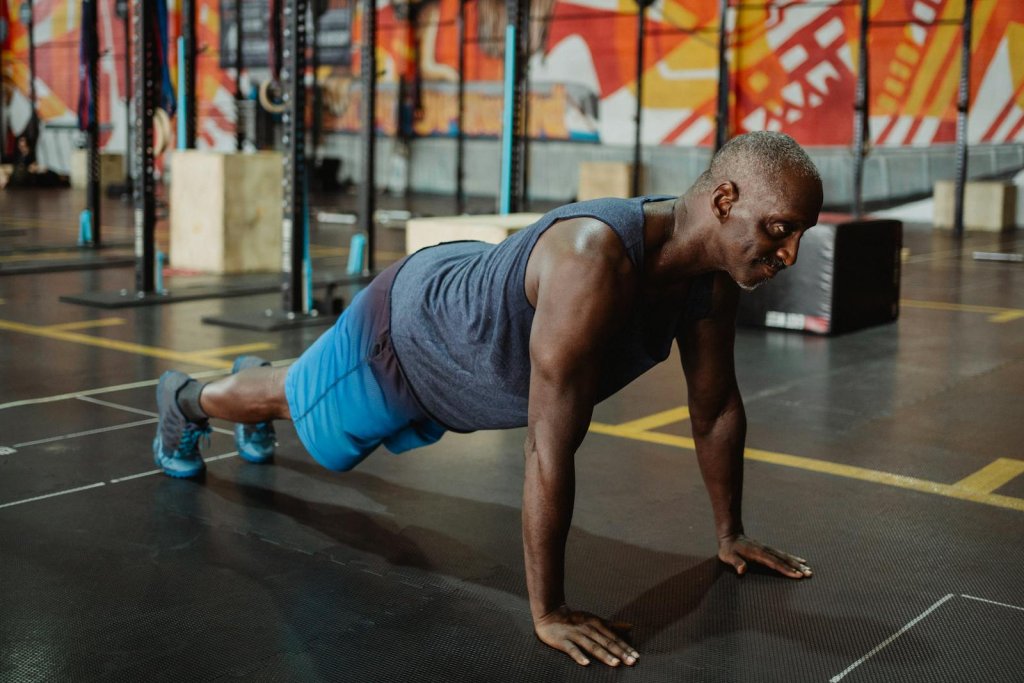
4. Scapular Push-Up (Push-Up Plus)
Why it works:
This exercise trains scapular protraction and control in a closed-chain position, helping the shoulder blades move independently of the elbows. It is frequently used in shoulder strengthening progressions from Mass General to build serratus anterior endurance.
Muscles worked:
Serratus anterior, scapular stabilizers
Trainer Tip:
Elbows stay straight—only the shoulder blades move.
How to do it:
- Start in a plank position (knees down if needed)
- Allow the chest to sink slightly as shoulder blades come together
- Push the floor away to spread the shoulder blades
- Maintain a steady trunk position
- Perform 8–12 slow reps
5. Band Scapular Retraction
Why it works:
This drill improves scapular retraction endurance and control, which supports posture and pulling mechanics. It reinforces coordinated shoulder-blade movement before the arms bend, reducing compensatory patterns.
Muscles worked:
Mid trapezius, rhomboids
Trainer Tip:
Keep ribs down—don’t arch the lower back to increase range.
How to do it:
- Hold a resistance band with arms straight in front of you
- Draw the shoulder blades back first
- Pull the band slightly apart
- Pause briefly
- Return slowly
- Perform 2 sets of 10–15 reps
6. Band Pull-Apart
Why it works:
Band pull-aparts reinforce upper-back endurance and scapular control using a simple, accessible tool. They help balance pressing movements and support sustained posture during daily activities.
Muscles worked:
Mid trapezius, rear deltoid, rhomboids
Trainer Tip:
Stop the movement if your shoulders start rising toward your ears.
How to do it:
- Hold the band at shoulder height with arms straight
- Pull the band apart until arms open wide
- Pause briefly at the end range
- Return slowly
- Perform 8–15 reps
7. Prone Row
Why it works:
Prone rowing encourages proper scapular setting before arm movement, reinforcing efficient pulling mechanics. It is commonly included in shoulder home programs to build controlled strength without excessive momentum.
Muscles worked:
Mid trapezius, rhomboids, latissimus dorsi (secondary)
Trainer Tip:
Lead the movement with the elbow, not the hand.
How to do it:
- Lie face down with one arm hanging toward the floor
- Gently set the shoulder blade
- Row the elbow toward your side
- Lower slowly with control
- Perform 8–12 reps per side
8. Prone T Raise
Why it works:
This exercise targets scapular retraction endurance and supports posterior shoulder strength, which is important for posture and shoulder balance during repetitive arm use.
Muscles worked:
Mid trapezius, rear deltoid
Trainer Tip:
Thumbs pointing up may feel more comfortable for many people.
How to do it:
- Lie face down with arms out to the sides
- Gently set the shoulder blades
- Lift arms a few inches off the surface
- Pause briefly
- Lower with control
- Perform 8–12 reps
9. Prone Y Raise
Why it works:
Prone Y raises emphasize lower trapezius activation, which supports upward rotation and control during overhead arm movements. This muscle is often underactive in people with shoulder discomfort.
Muscles worked:
Lower trapezius, serratus anterior (synergy)
Trainer Tip:
Quality matters more than height—keep the movement small and controlled.
How to do it:
- Lie face down with arms overhead in a Y shape
- Keep shoulders relaxed away from ears
- Lift arms slightly and pause
- Lower slowly
- Perform 6–10 reps
10. Face Pull
Why it works:
Face pulls strengthen scapular retraction while integrating shoulder rotation control, supporting balanced pulling mechanics and shoulder resilience.
Muscles worked:
Mid trapezius, rear deltoid, rotator cuff (support role)
Trainer Tip:
Pull toward eye level rather than the chest to keep tension where it belongs.
How to do it:
- Anchor a band at face height
- Pull toward your face with elbows slightly out
- Gently squeeze shoulder blades
- Return slowly
- Perform 8–12 reps
11. Scaption Raise
Why it works:
Scaption follows the natural plane of the shoulder joint, encouraging smooth arm elevation with coordinated scapular support. This pattern is commonly included in shoulder conditioning programs.
Muscles worked:
Deltoid with scapular stabilizers assisting
Trainer Tip:
Light weight and smooth motion are more effective than heavy loading.
How to do it:
- Hold light dumbbells or no weight
- Raise arms about 30 degrees forward from your sides
- Keep shoulders relaxed
- Lower slowly
- Perform 8–12 reps
12. Farmer Carry With Scapular Control
Why it works:
Farmer carries build real-world scapular stability under load, reinforcing posture and shoulder control during walking, carrying, and daily lifting tasks.
Muscles worked:
Lower trapezius, serratus anterior, core stabilizers, grip
Trainer Tip:
If posture changes or shoulders shrug, the load is too heavy.
How to do it:
- Hold dumbbells at your sides
- Gently set shoulder blades down and back
- Walk tall for 20–40 seconds
- Rest and repeat for 2–3 rounds
Quick safety check before you start
Use extra caution and consider professional guidance if you have:
- Sudden or unexplained loss of shoulder strength
- Numbness, tingling, or pain spreading into the arm or hand
- Worsening night pain, visible swelling, or unexplained symptoms
- Recent shoulder surgery or provider-specific movement restrictions
The American Academy of Orthopaedic Surgeons emphasizes that shoulder-conditioning programs should be individualized and supervised when symptoms are persistent or complex.
How to Progress Scapula Exercises Safely
Progression should prioritize control before resistance. Most shoulder programs recommend gradual increases only when movement quality remains consistent.
General progression principles:
- Start with low-load or bodyweight exercises
- Increase reps or hold time before adding resistance
- Advance only if neck remains relaxed and shoulders stay down
- Reduce load if shrugging or compensation appears
How to use these scapula exercises
A structure consistent with many rehabilitation-style programs:
- Perform 2–3 sessions per week for strengthening
- Use 8–12 controlled reps for dynamic movements
- Use 20–40 seconds for isometric holds
- Progress resistance only when shoulder blades stay controlled without shrugging
Home programs from AAOS and Mass General commonly follow this gradual, quality-first approach.
Who Should Be Cautious With Scapula Exercises
While scapula exercises are generally well tolerated, some individuals may benefit from extra guidance or modified loading.
Use caution if you:
- Have ongoing or worsening shoulder pain
- Experience numbness, tingling, or weakness in the arm
- Are recovering from shoulder surgery or recent injury
- Notice sharp pain or loss of control during exercises
If symptoms persist or increase, professional assessment can help determine appropriate exercise selection and progression.
Common mistakes that limit results
- Shrugging shoulders toward the ears
- Moving too quickly and losing scapular control
- Over-arching the lower back for overhead range
- Forcing aggressive shoulder-blade pinching on every rep
Clinical discussions of scapular dyskinesis consistently emphasize movement quality over load.
Simple progression plan
- Weeks 1–2: Scapular setting, serratus wall press, band retraction
- Weeks 3–4: Add wall slides, scapular push-ups, band pull-aparts
- Weeks 5–6: Add prone T/Y raises, face pulls, loaded carries
Exercise therapy is widely supported in clinical literature, including guidance from the Journal of Orthopaedic & Sports Physical Therapy, as a primary strategy for improving shoulder strength, control, and function over time.
FAQs
Are scapula exercises good for posture?
They may help when posture issues are linked to weak scapular endurance or poor shoulder-blade control, especially when done consistently.
How often should scapula exercises be done?
Most people benefit from 2–3 sessions per week for strengthening, with light activation drills used more frequently if comfortable.
What is scapular dyskinesis?
It refers to altered or poorly controlled scapular movement. It does not automatically indicate injury but may be relevant when shoulder symptoms are present.
Which scapula exercises target the serratus anterior best?
Common options include serratus wall presses, wall slides, and scapular push-ups, progressed gradually with good control.
Should scapula exercises cause pain?
They should feel like muscular effort, not sharp or worsening pain. Reduce load or range if symptoms increase.
Can these be done with rotator cuff or impingement symptoms?
Many shoulder programs include scapular strengthening, but exercise selection and range should be individualized when symptoms are present.
Conclusion
Scapula exercises are a practical way to support shoulder stability, posture, and movement control. Focus on low-load quality first, progress gradually, and prioritize smooth shoulder-blade motion without shrugging. If symptoms persist or worsen, individualized guidance helps ensure safe and effective progression.
This content is for informational purposes only and not medical advice.
References
- AAOS PDF: Shoulder Conditioning Program
- Mass General Sports Medicine: Rotator Cuff and Scapular Strengthening Home Program (PDF)
- PubMed: JOSPT 2024 systematic review record
- Kibler et al. (2013): Scapular Dyskinesis Consensus Statement (PDF)
- JOSPT: Serratus Anterior Activation During Wall Slide Exercises (2006)