
Yes — resistance band chest exercises can effectively build strength and muscle when you use the right tension and proper technique.
They provide constant resistance, challenge stabilizer muscles, and allow chest-focused training without a bench or heavy weights. Whether you train at home, in a small space, or on the go, bands make chest training accessible and joint-friendly.

Understanding how resistance band chest exercises work helps you build strength safely. You’ll learn the best movements, proper setup, common mistakes, ideal programming, safety tips, and current expert-backed recommendations.
Below, you’ll find a complete, easy-to-follow structure covering band types, benefits, technique cues, and the 12 best Resistance Band chest exercises using the standard format.
Are Resistance Bands Effective for Building Chest Muscle?
Research shows that resistance bands may build muscle and strength similarly to free weights when intensity is matched. Studies comparing band-resisted push-ups to bench press show similar EMG activation of the pectoralis major.
Why they work:
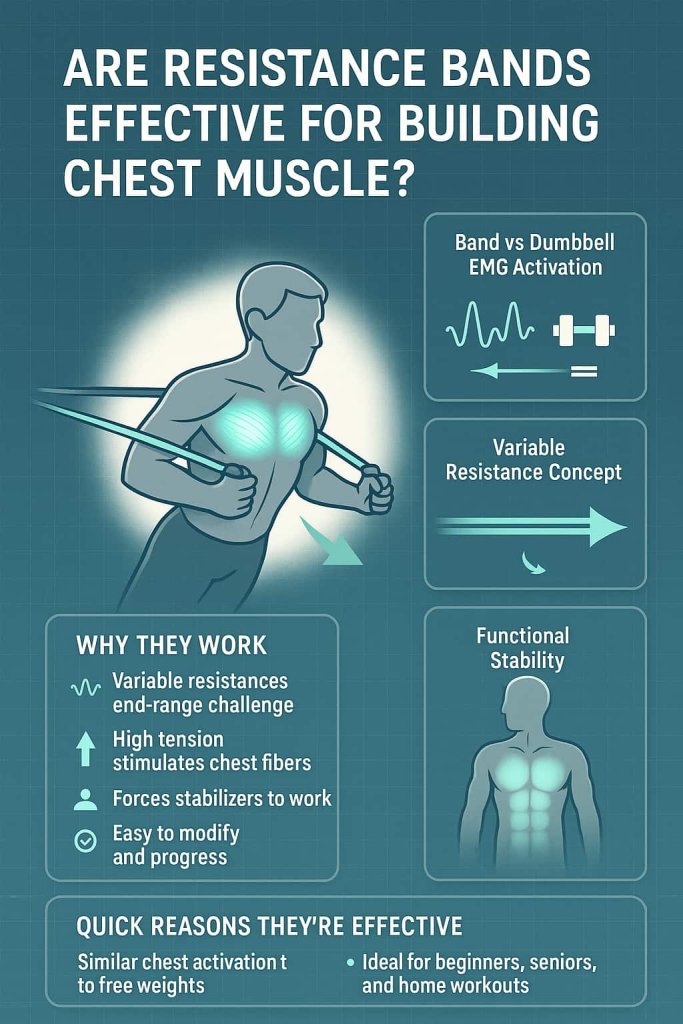
- Variable resistance increases challenge at the end range
- High tension when stretched stimulates chest fibers
- Bands force muscles to stabilize, improving functional strength
- You can adjust tension instantly
Quick reasons they’re effective
- Similar muscle activation to dumbbells (when effort is equal)
- Joint-friendly for people with shoulder discomfort
- Easy to adjust load without equipment
- Ideal for beginners, seniors, and home workouts
12 Best Resistance Band Chest Exercises to Build Strength Anywhere
These resistance band chest exercises help you build strength, muscle, and stability without needing a gym or heavy weights. Each move targets different parts of the chest to improve size, power, and functional upper-body performance.
1. Standing Resistance Band Chest Press
Why it works:
This movement mimics a cable chest press by providing forward, horizontal resistance. As the band stretches, tension increases, forcing the chest to work harder through the full range of motion. It’s excellent for strength, muscle engagement, and controlled pressing.
Muscles worked:
Pectoralis major, anterior delts, triceps.
How to do it:
- Anchor the band securely at chest height behind you.
- Grab the handles and step forward to create tension.
- Hold the handles at chest level with elbows bent.
- Press your arms straight forward until fully extended.
- Slowly return to the starting position with control.
Trainer Tip:
Take a small step forward to increase tension, and keep your core tight to avoid leaning back.
2. Single-Arm Chest Press (Standing)
Why it works:
Training one side at a time increases core activation because your torso must resist rotation. It also helps fix muscle imbalances and improves shoulder stability.
Muscles worked:
Pecs, anterior delts, obliques.
How to do it:
- Anchor the band behind you at chest height.
- Hold one handle and step forward into a stable stance.
- Press your arm straight ahead while keeping your torso still.
- Return slowly without letting the band pull you back.
Trainer Tip:
Keep ribs down and avoid arching your lower back when pressing.
3. High-to-Low Chest Fly
Why it works:
This downward arc motion emphasizes the lower chest fibers, helping shape the bottom portion of the pectorals.
Muscles worked:
Lower pecs, anterior delts.
How to do it:
- Anchor the band high above shoulder level.
- With a slight bend in your elbows, pull both arms downward in an arc.
- Bring hands together near hip level.
- Return slowly until arms open back up.
Trainer Tip:
Do not let hands cross at the bottom; stop when your palms meet.
4. Low-to-High Chest Fly
Why it works:
This upward motion targets the upper chest, creating a lifting pattern similar to incline cable flies.
Muscles worked:
Upper pecs, front delts.
How to do it:
- Anchor the band low to the ground.
- Grip the handles and lift arms upward in a sweeping arc.
- Bring hands together at chest or eye level.
- Control the descent back to the start.
Trainer Tip:
Keep wrists straight to reduce strain and maintain proper alignment.
5. Standing Chest Fly (Mid-Anchor)
Why it works:
A perfect cable-fly alternative that creates tension during both the stretch and squeeze phases, making it ideal for chest shaping.
Muscles worked:
Middle pec fibers.
How to do it:
- Anchor the band at chest height.
- Step forward and open arms wide with a soft elbow bend.
- Bring hands together in front of your chest.
- Slowly return to the wide-arm position.
Trainer Tip:
Keep elbows slightly bent throughout the movement to protect joints.
6. Band-Resisted Push-Ups
Why it works:
Adding a band increases tension at the top of the push-up, making it more challenging than bodyweight alone. Research shows band push-ups can match bench-press EMG activation when resistance is high.
Muscles worked:
Pecs, delts, triceps, core.
How to do it:
- Loop the band across your upper back.
- Hold the ends securely under your palms.
- Perform a standard push-up.
- Push explosively upward while maintaining control.
Trainer Tip:
Brace your core to prevent hips from sagging or lifting.
7. Kneeling Resistance Band Chest Press
Why it works:
Kneeling reduces the ability to cheat with your legs, increasing core stability and chest engagement.
Muscles worked:
Pecs, triceps.
How to do it:
- Kneel with band anchored behind you.
- Hold handles at chest height.
- Press forward until arms are straight.
- Return slowly while maintaining posture.
Trainer Tip:
Squeeze glutes and keep torso tall to avoid arching.
8. Seated Chest Press (Band Around Back)
Why it works:
Great when you don’t have an anchor point. The band placement behind your back recreates a press while giving constant resistance.
Muscles worked:
Pecs, triceps.
How to do it:
- Sit tall with feet planted.
- Wrap the band around your upper back.
- Hold the ends and press forward.
- Control the return movement.
Trainer Tip:
Keep elbows slightly below shoulder height to reduce shoulder strain.
9. Split-Stance Chest Press
Why it works:
The staggered stance improves balance and adds slight anti-rotation work, increasing core activation while pressing.
Muscles worked:
Pecs, triceps, core.
How to do it:
- Stand with one foot forward.
- Hold handles at chest level with band anchored behind.
- Press forward without letting your body sway.
- Switch legs and repeat.
Trainer Tip:
Squeeze glutes and keep hips square to prevent twisting.
10. Lying Chest Fly (Band Under Back)
Why it works:
Provides a deep chest stretch and mimics a dumbbell fly without weights. Increased tension at the top improves chest contraction.
Muscles worked:
Pectoralis major (all fibers).
How to do it:
- Lie on your back with knees bent.
- Loop the band under your shoulder blades.
- With arms slightly bent, open arms wide.
- Bring hands together above chest.
Trainer Tip:
Lower arms only until you feel a stretch — avoid overstretching joints.
11. Band Squeeze Press
Why it works:
Focuses heavily on the inner chest by maintaining inward pressure while pressing forward. Great for muscle definition.
Muscles worked:
Inner pecs, front delts.
How to do it:
- Hold the band between your palms with slight tension.
- Press your hands together while extending arms forward.
- Return slowly while keeping inward squeeze.
Trainer Tip:
Keep constant inward pressure to maximize activation.
12. Band Pullover
Why it works:
Trains the upper chest, lats, and serratus anterior. It supports ribcage expansion and improves upper-body stability.
Muscles worked:
Upper pecs, lats, serratus anterior.
How to do it:
- Anchor the band overhead.
- Hold the handles or ends with arms extended.
- Pull arms down in a smooth arc toward your hips.
- Control the return.
Trainer Tip:
Keep ribs down the entire time to avoid over-arching your lower back.
How to Choose the Right Resistance Band for Chest Workouts
Selecting the correct band ensures safe and effective training.
What to look for:
- Tube bands with handles: Best for presses and flies.
- Loop “power” bands: Great for push-ups or anchored presses.
- Light to medium tension: For beginners.
- Heavy bands: For advanced pressing.
Tips:
- Check bands for cracks or thinning.
- Use a secure door anchor or sturdy pole.
- Choose the thinnest band that still challenges you at 10–15 reps.
How Often Should You Do Resistance Band Chest Exercises?
Following ACSM guidelines:
- 2–3 sessions per week
- 8–15 reps, 2–4 sets
- 60–90 seconds rest
- Train close to fatigue while maintaining form
This frequency supports chest strength, muscle development, and functional performance.
Common Mistakes to Avoid
- Not anchoring the band securely
- Standing too close or too far, reducing tension
- Bending wrists or flaring elbows excessively
- Using bands that are too light
- Letting the band snap back during the negative phase
- Skipping warm-ups
FAQ
1. Can resistance bands really build chest muscle?
Yes. Studies show similar activation to free weights when working near fatigue.
2. How many chest exercises should I do with bands?
2–4 exercises per session are enough for most people.
3. Are band chest exercises safe for beginners?
Yes — they are joint-friendly and adjustable.
4. Can I do band chest workouts without an anchor?
Yes. Wrap the band around your back for presses and flies.
5. How long does it take to see results?
Most people notice strength changes in 3–6 weeks with consistency.
6. Are band push-ups effective?
Yes. Research shows they can match bench-press activation when resistance is high.
7. Can seniors perform these exercises?
Yes — but start with lighter tension and avoid high strain.
Conclusion
Resistance band chest exercises are a powerful, accessible way to build upper-body strength anywhere. With proper technique and consistent progression, bands can activate the chest as effectively as traditional weights while being easier on your joints. Start with a few exercises, increase band tension gradually, and train 2–3 times weekly for best results.
References
- Seguin RC et al. – Upper-Extremity Elastic Resistance Training in Older Adults (Systematic Review & Meta-Analysis)
- Martins WR et al. – Elastic Resistance Training to Increase Muscle Strength in Older Adults (Systematic Review & Meta-Analysis)
- Li A et al. (2024) – Effects of Elastic Band Resistance Training on Physical and Mental Health in the Elderly (Meta-Analysis)
- Calatayud J et al. – Bench Press and Push-Up at Comparable Levels of Muscle Activity Result in Similar Strength Gains
- Performance Health / TheraBand – Elastic Band Push-Up as Effective as Bench Press Exercise (EMG Summary)
- American College of Sports Medicine – Progression Models in Resistance Training for Healthy Adults (Position Stand)
- CDC – Physical Activity Guidelines for Adults (Strength Training 2+ Days/Week)