
Yes — resistance band exercises can help men build serious strength, size, and power when performed with enough tension and proper progression.
This means you don’t need a full gym or heavy weights to develop muscle. Modern research shows that when intensity is matched, resistance bands can stimulate strength gains similar to free weights.
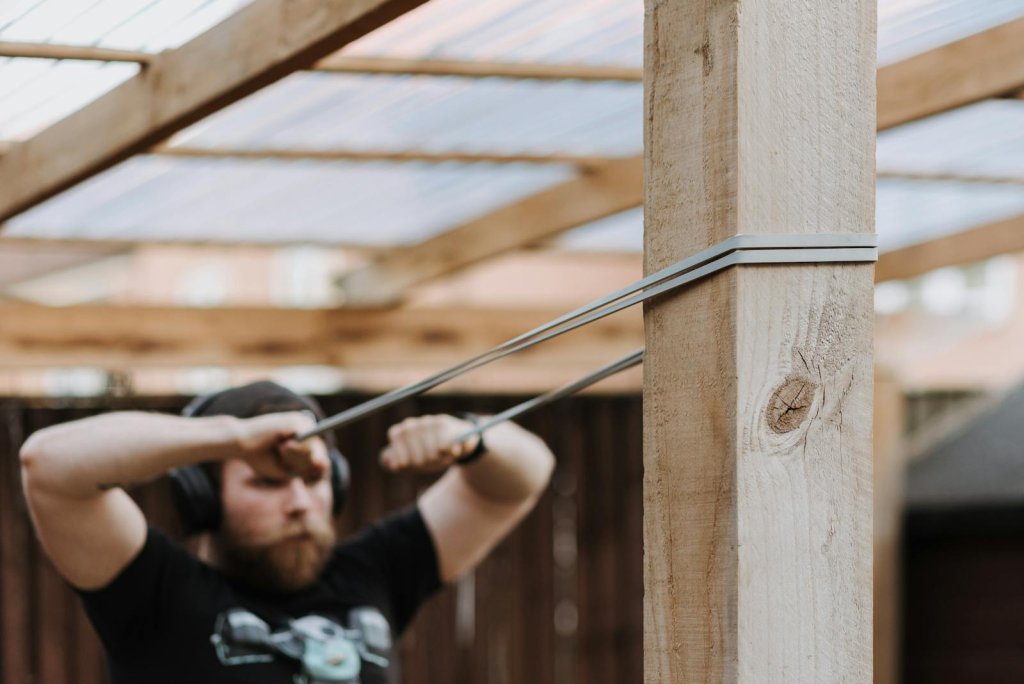
Understanding how to use bands correctly helps men increase muscle mass, improve mobility, reduce joint stress, and train anywhere. With the right exercises and weekly structure, bands become highly effective for building your chest, back, arms, legs, and overall physique.
In this guide, you’ll learn the 15 best resistance band exercises for men, how to do them, their benefits, safety tips, recommended reps/sets, and the latest research-backed training guidelines.
Why Resistance Band Exercises for Men Matter
Resistance band exercises matter for men because they offer a joint-friendly, affordable, and highly effective way to build strength and muscle without heavy equipment. Research shows that when intensity is matched, bands can deliver strength and hypertrophy results comparable to free weights, making them ideal for home, travel, or small-space training.
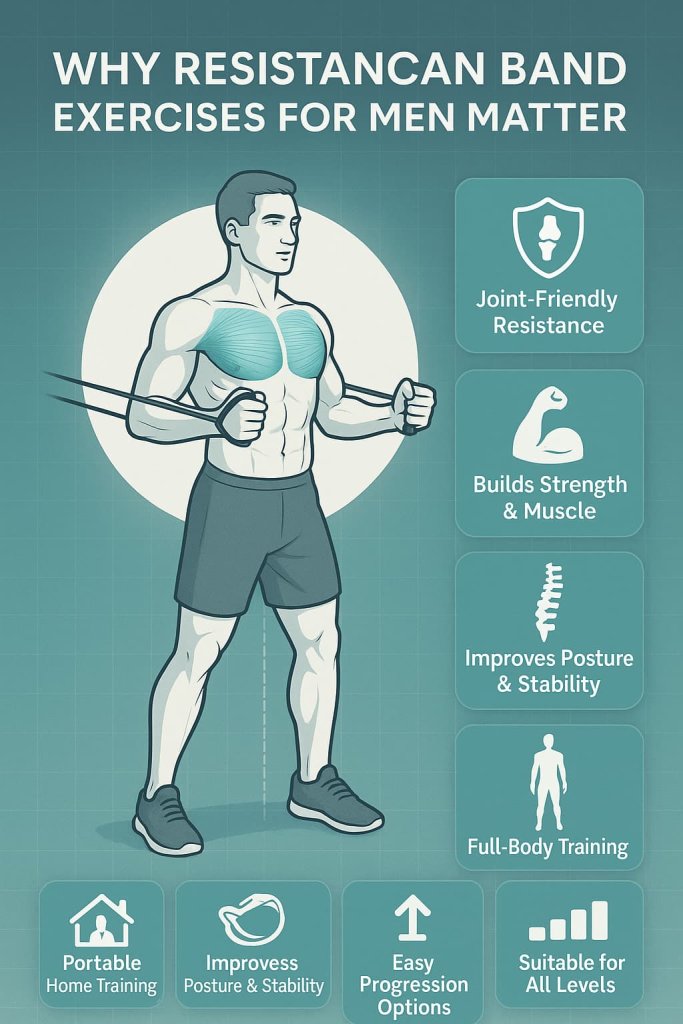
They also strengthen stabilizer muscles that machines often miss, supporting better posture, shoulder health, core stability, and overall movement control. Whether the goal is building a stronger chest, back, core, or legs, resistance bands provide a safe, scalable option for men at any fitness level.
Key reasons they matter for men:
- Provide joint-friendly resistance that reduces strain on shoulders, elbows, and knees
- Match free-weight strength and muscle-building results when effort is equal
- Offer portable, space-efficient training for home, travel, or small rooms
- Improve stabilizer muscle strength for posture and injury prevention
- Support full-body training including chest, back, legs, shoulders, arms, and core
- Allow easy progression by stepping farther, slowing tempo, or using thicker bands
- Suitable for all fitness levels, from beginners to advanced lifters
15 Best Resistance Band Exercises for Men
Build strength, muscle, and functional power anywhere using these simple but highly effective resistance band movements. Each exercise helps men target major muscle groups safely, improve performance, and train without needing heavy weights.
1. Resistance Band Chest Press
Why it works:
Provides strong horizontal pressing resistance similar to a dumbbell or cable press, helping men build chest, shoulder, and tricep strength without joint strain. The band increases tension as you extend, maximizing end-range chest activation.
Muscles worked:
Pectoralis major, anterior deltoids, triceps, serratus anterior.
How to do it:
- Wrap the band around your upper back.
- Hold the ends in each hand at chest height.
- Press your arms forward until fully extended.
- Slowly return with control, keeping elbows slightly bent.
Trainer Tip:
Keep your wrists straight and focus on squeezing your chest at the end of each press.
2. Banded Push-Up
Why it works:
Adding band resistance boosts the difficulty of push-ups, increasing pec and tricep activation—especially in the top half of the movement where bands are strongest.
Muscles worked:
Chest, triceps, front delts, core.
How to do it:
- Loop a long band around your upper back.
- Hold each end under your palms on the floor.
- Lower into a push-up with elbows at 45 degrees.
- Press up powerfully against the band’s resistance.
Trainer Tip:
Drive through your palms and keep your core tight to avoid sagging hips.
3. Resistance Band Row
Why it works:
Strengthens the upper back while improving posture and shoulder stability. Constant band tension helps activate neglected mid-back muscles.
Muscles worked:
Rhomboids, lats, rear delts, traps, biceps.
How to do it:
- Anchor the band at chest height.
- Hold both handles and step back for tension.
- Pull elbows straight back, squeezing shoulder blades.
- Return slowly to full reach.
Trainer Tip:
Keep shoulders down and avoid shrugging to target the upper back properly.
4. Lat Pulldown With Band
Why it works:
Mimics cable pulldowns, helping widen your back and build V-taper strength without heavy equipment.
Muscles worked:
Lats, biceps, rear delts, mid traps.
How to do it:
- Anchor the band overhead securely.
- Grab both ends with arms extended upward.
- Pull down toward your chest.
- Slowly return to the starting position.
Trainer Tip:
Lead with your elbows—not your hands—to better engage your lats.
5. Banded Deadlift
Why it works:
Provides hip-dominant strength training for glutes and hamstrings. Bands offer smoother resistance and help develop explosive power.
Muscles worked:
Glutes, hamstrings, lower back, core, traps.
How to do it:
- Stand on a heavy band with feet hip-width apart.
- Grab the top of the band with both hands.
- Hinge at the hips and lower slightly.
- Stand tall by driving hips forward.
Trainer Tip:
Push the floor away and keep your spine neutral through the entire movement.
6. Resistance Band Squat
Why it works:
Strengthens the quads and glutes while promoting proper squat mechanics. Band tension increases as you stand, boosting leg power.
Muscles worked:
Quads, glutes, hamstrings, core.
How to do it:
- Stand on the band and hold handles at your shoulders.
- Lower into a squat with your chest lifted.
- Push through heels to stand tall.
Trainer Tip:
Drive your knees slightly outward to prevent collapsing inward.
7. Banded Romanian Deadlift (RDL)
Why it works:
Isolates the posterior chain and builds strong, resilient hamstrings—essential for athletic performance.
Muscles worked:
Hamstrings, glutes, spinal erectors.
How to do it:
- Stand on the band with feet hip-width apart.
- Hold the band ends with both hands.
- Hinge at the hips while keeping a flat back.
- Return by squeezing your glutes.
Trainer Tip:
Keep the band taut throughout for continuous hamstring tension.
8. Resistance Band Bicep Curl
Why it works:
Creates constant tension on the biceps—something dumbbells don’t always provide—leading to better growth and definition.
Muscles worked:
Biceps brachii, brachialis, forearm flexors.
How to do it:
- Stand on the band with palms up.
- Curl the handles toward your shoulders.
- Lower slowly to maintain tension.
Trainer Tip:
Keep elbows pinned to your sides to isolate your biceps.
9. Resistance Band Tricep Pushdown
Why it works:
Targets the long head of the triceps, helping men build thicker and stronger upper arms.
Muscles worked:
Triceps (long, medial, lateral heads).
How to do it:
- Anchor the band overhead.
- Hold both ends with elbows tucked in.
- Push downward until arms are straight.
- Return with slow control.
Trainer Tip:
Keep shoulders still—only your forearms should move.
10. Banded Face Pull
Why it works:
One of the best exercises for shoulder health, posture, and balancing out heavy pressing work.
Muscles worked:
Rear delts, mid traps, rotator cuff, rhomboids.
How to do it:
- Anchor the band at eye level.
- Grab the handles with an overhand grip.
- Pull toward your face with elbows high.
- Return slowly to full reach.
Trainer Tip:
Focus on squeezing the rear delts at the peak of each rep.
11. Standing Resistance Band Shoulder Press
Why it works:
Improves overhead strength and deltoid size, while forcing your core to stabilize the movement.
Muscles worked:
Shoulders, upper traps, triceps, core.
How to do it:
- Stand on the band and hold handles at shoulder height.
- Press upward until arms are extended.
- Lower back to shoulder height.
Trainer Tip:
Avoid overarching your lower back—brace your core firmly.
12. Banded Lateral Raise
Why it works:
Isolates the side delts, helping build broader, wider-looking shoulders.
Muscles worked:
Lateral deltoids, upper traps (secondary).
How to do it:
- Stand on the band with arms at your sides.
- Raise both arms outward to shoulder height.
- Lower with control.
Trainer Tip:
Lead with your elbows, not your hands, to better activate the delts.
13. Resistance Band Split Squat
Why it works:
Unilateral training boosts balance, leg strength, and athletic power while correcting muscle imbalances.
Muscles worked:
Quads, glutes, hamstrings, hip stabilizers.
How to do it:
- Place the band under your front foot.
- Hold the handles at shoulder level.
- Lower into a lunge with a tall chest.
- Push through the front heel to rise.
Trainer Tip:
Keep 80% of your weight on the front leg for maximum activation.
14. Banded Glute Bridge
Why it works:
Creates high glute activation and supports hip strength, helping improve posture and lower-body power.
Muscles worked:
Glutes, hamstrings, lower back.
How to do it:
- Loop a mini band around your thighs.
- Lie on your back with knees bent.
- Lift hips upward, squeezing glutes.
- Lower and repeat.
Trainer Tip:
Push knees outward against the band to increase glute recruitment.
15. Band Pallof Press
Why it works:
One of the best anti-rotation core exercises, enhancing stability and protecting the spine during heavy lifting.
Muscles worked:
Obliques, transverse abdominis, deep core stabilizers, glutes.
How to do it:
- Anchor the band at chest height.
- Stand sideways and hold the handle close to your chest.
- Press arms straight out, resisting rotation.
- Return slowly.
Trainer Tip:
Keep hips square and ribs down to maximize core engagement.
How Often Should Men Do Resistance Band Workouts?
Most men will get optimal results training with resistance bands 2–3 days per week per muscle group, following general guidelines from ACSM and strength-training research.
A balanced weekly approach may look like:
- Full-body workouts: 2–3 days per week
- Upper/lower split: 4 days per week total
- Push/pull/legs: 3 days per week (ideal for band-only programs)
Recommended training structure:
- Sets: 10–20 total sets per muscle group weekly
- Reps: 8–15 for hypertrophy, 10–20 for endurance
- Rest: 60–90 seconds between sets
- Intensity: Last reps should feel challenging but controlled
- Progression: Increase band tension, add reps, slow eccentrics, or add sets
This frequency supports muscle growth, strength, mobility, and long-term fitness without overtraining.
Sample 3-Day Men’s Resistance Band Workout Plan
Day 1 – Push (Chest, Shoulders, Triceps)
- Chest Press – 3×12
- Shoulder Press – 3×10
- Banded Push-Up – 3×10–12
- Tricep Pushdown – 3×12–15
- Lateral Raise – 3×12
Day 2 – Pull (Back, Biceps)
- Band Row – 4×10–12
- Lat Pulldown – 3×12
- Face Pull – 3×15
- Bicep Curl – 3×12–15
- Pallof Press – 3×10/side
Day 3 – Legs & Core
- Band Squat – 4×12
- RDL – 3×10
- Split Squat – 3×10 each
- Glute Bridge – 3×15
- Core Anti-Rotation Press – 3×12
Common Mistakes Men Make With Resistance Bands
Men often make a few simple but important mistakes that reduce results or increase injury risk. Understanding these errors can help improve form, safety, and overall training effectiveness.
Common mistakes include:
- Using the wrong band thickness
A band that’s too light or too heavy prevents proper resistance. The last 2–3 reps should feel challenging. - Overstretching the band
Stretching a band beyond its safe range weakens the material and increases the risk of snapping. - Poor anchoring
Attaching a band to an unstable or unsafe point can cause unexpected recoil or uneven tension. - Relying on momentum
Fast, swinging reps reduce muscle activation. Slow, controlled movements maximize tension. - Neglecting full range of motion
Partial reps limit strength development and reduce the effectiveness of the exercise. - Ignoring posture
Rounded shoulders, flared ribs, or hyperextended backs shift stress away from the target muscles.
Correcting these mistakes ensures better muscle activation, safer training sessions, and more consistent progress over time.
Safety Tips for Resistance Band Training
- Check your band for tears before each workout
- Anchor securely to avoid snap-back injuries
- Keep movements slow and controlled
- Stop if you feel sharp pain
- Maintain good posture and alignment
- Keep elbows slightly bent during presses and pulls
FAQs
1. Can men build muscle using only resistance bands?
Yes. Studies show that resistance bands can build muscle similarly to free weights when intensity is high enough.
2. How often should men do resistance band workouts?
Aim for 2–3 sessions per week per muscle group.
3. Are resistance bands good for beginners?
Yes, they’re joint-friendly, easy to use, and adjust instantly.
4. Which bands are best for men?
Long-loop bands and tube sets with handles provide the most versatility for strength building.
5. Can resistance bands replace a gym membership?
For many men—yes. Bands can effectively train all major muscle groups.
6. What thickness of band should I use?
Use lighter bands for shoulders and arms; medium to heavy for legs and glutes.
7. Are resistance band workouts safe for older men?
Yes, when performed with proper form and moderate intensity.
Conclusion
Resistance band training offers men a simple, effective way to build strength, improve mobility, and train safely anywhere. With consistent effort and proper technique, bands can deliver real results without the need for heavy weights. Use the exercises and guidelines in this article to create a balanced routine and continue progressing over time.
References
- Lopes JSS et al. (2019). Effects of training with elastic resistance versus conventional resistance on muscular strength: A systematic review and meta-analysis. SAGE Open Medicine.
Key use: Supports your claim that bands can match free weights for strength.
Effects of training with elastic resistance versus conventional resistance on muscular strength - Stanković D et al. (2025). Effects of Elastic Band Training on Physical Performance in Team Sport Athletes. Sports.
Key use: Backs up points on power, speed, and athletic performance with bands.
Effects of Elastic Band Training on Physical Performance in Team Sport Athletes - Currier BS et al. (2023). Resistance training prescription for muscle strength and hypertrophy: A systematic review and meta-analysis. British Journal of Sports Medicine.
Key use: General evidence that properly programmed resistance training (including bands) builds muscle and strength.
Resistance training prescription for muscle strength and hypertrophy - American College of Sports Medicine (ACSM). Progression Models in Resistance Training for Healthy Adults (Position Stand, 2009).
Key use: Your sets, reps, frequency, and progression guidelines.
ACSM Position Stand: Progression Models in Resistance Training for Healthy Adults - Centers for Disease Control and Prevention (CDC). Physical Activity Guidelines for Adults.
Key use: Supports your weekly activity and muscle-strengthening recommendations.
CDC Physical Activity Guidelines for Adults - World Health Organization (WHO). Physical Activity for Adults 18–64.
Key use: Global guideline for aerobic and muscle-strengthening frequency (2+ days per week).
WHO Physical Activity Recommendations for Adults - American Heart Association. Strength and Resistance Training Exercise.
Key use: Health benefits of strength training, heart health, and general recommendations.
Strength and Resistance Training Exercise – American Heart Association