
Battle rope exercises are high-intensity, full-body movements that build strength, power, and cardiovascular fitness at the same time. They combine rapid upper-body actions with lower-body stability and core control, making them one of the most time-efficient conditioning tools available.
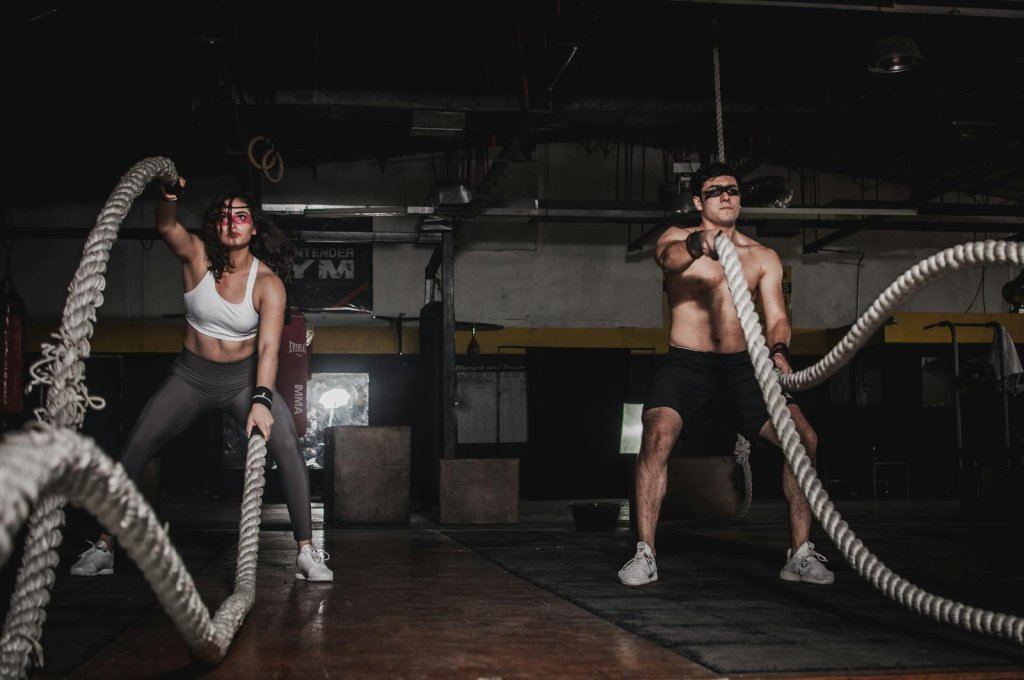
Understanding how to use battle ropes correctly matters because they allow you to train strength and cardio together, support calorie burn in short sessions, and fit well into modern HIIT-style workouts. With the right exercise selection, technique, and programming, battle rope training can be both effective and joint-friendly.
What Are Battle Rope Exercises?
Battle rope exercises are dynamic movements performed using heavy, anchored ropes. You create waves, slams, circles, or pulls by moving the ropes with your arms while maintaining an athletic stance.
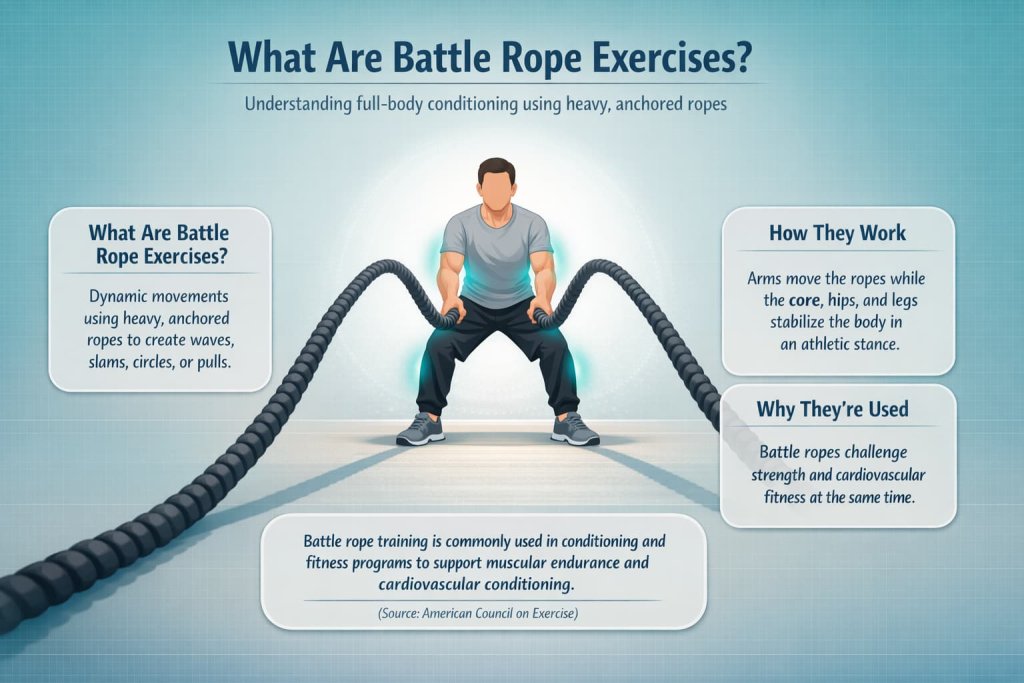
Unlike traditional cardio machines, battle ropes require your arms, shoulders, core, hips, and legs to work together. This whole-body demand is why they are widely used in conditioning, athletic training, and general fitness programs.
Fitness education resources from the American Council on Exercise describe battle ropes as a versatile tool for improving muscular endurance and cardiovascular conditioning simultaneously.
14 Best Battle Rope Exercises
Below are the most effective battle rope exercises, organized for full-body strength, power, and conditioning.
1. Alternating Waves
A foundational battle rope movement using alternating arm action.
How to do it
- Stand with feet shoulder-width apart and knees slightly bent
- Hold one rope end in each hand with a neutral grip
- Rapidly raise and lower your arms one at a time to create continuous waves
Why it works
Alternating waves create constant upper-body tension while elevating heart rate. The alternating pattern also challenges coordination and core stability as your body resists rotation.
Muscles worked
Shoulders, forearms, core stabilizers
Trainer Tip
Keep your ribs stacked over your pelvis and avoid leaning back as fatigue builds.
2. Double-Arm Waves
Both arms move together to create larger, more powerful rope waves.
How to do it
- Grip both rope ends firmly
- Lift both arms together and drive them down forcefully
- Maintain a consistent rhythm and posture
Why it works
Moving both arms simultaneously increases force output and places greater demand on the shoulders and core, making it more power-focused than alternating waves.
Muscles worked
Shoulders, upper back, core
Trainer Tip
Generate power from your hips and knees, not just your arms.
3. Power Slams
A forceful overhead slam using full-body engagement.
How to do it
- Lift both rope ends overhead with arms extended
- Slam the ropes forcefully toward the floor
- Reset quickly and repeat with control
Why it works
Power slams emphasize explosive strength and rapid force production while driving heart rate up quickly.
Muscles worked
Lats, shoulders, core, glutes
Trainer Tip
Brace your core before each slam to avoid excessive spinal extension.
4. Alternating Slams
Single-arm slams performed in an alternating pattern.
How to do it
- Slam one rope end at a time
- Keep the non-working arm steady
- Alternate sides in a controlled rhythm
Why it works
This unilateral movement increases core engagement and helps correct side-to-side strength imbalances.
Muscles worked
Shoulders, obliques, core
Trainer Tip
Resist the urge to twist aggressively through your torso.
5. Side-to-Side Waves
Waves are driven laterally rather than vertically.
How to do it
- Move both arms together from side to side
- Shift weight slightly through your hips
- Maintain an athletic stance
Why it works
Side-to-side waves challenge lateral core stability and improve coordination between the upper and lower body.
Muscles worked
Obliques, shoulders, hips
Trainer Tip
Control the movement through your core instead of swinging your hips.
6. Outside Circles
Large circular rope motions moving outward.
How to do it
- Draw wide circles outward with both arms
- Keep tension in the ropes at all times
- Maintain a steady pace
Why it works
Outside circles train shoulder endurance and control through a large range of motion under load.
Muscles worked
Shoulders, upper back, arms
Trainer Tip
Shrink the circles if shoulder fatigue compromises form.
7. Inside Circles
Circular rope movements performed inward.
How to do it
- Rotate both arms inward in controlled circles
- Keep elbows slightly bent
- Maintain even rope tension
Why it works
Inside circles balance shoulder activation and challenge smaller stabilizing muscles.
Muscles worked
Deltoids, forearms, core
Trainer Tip
Prioritize smooth, controlled motion over speed.
8. Battle Rope Squat Waves
Lower-body strength combined with rope waves.
How to do it
- Perform alternating waves
- Lower into a squat
- Stand back up while maintaining waves
Why it works
This movement integrates lower-body strength with upper-body conditioning for full-body demand.
Muscles worked
Quads, glutes, shoulders, core
Trainer Tip
Keep your chest tall and heels grounded throughout the squat.
9. Battle Rope Lunges
Lunges paired with rope waves.
How to do it
- Step into a forward or reverse lunge
- Perform alternating waves during the lunge
- Switch legs evenly
Why it works
Lunges with waves increase balance demands and improve coordination under fatigue.
Muscles worked
Glutes, legs, shoulders, core
Trainer Tip
Shorten the wave height if balance becomes unstable.
10. Jumping Jack Waves
Adds a light plyometric element.
How to do it
- Perform small jumping jacks
- Maintain alternating rope waves
- Land softly with control
Why it works
This exercise significantly increases cardiovascular intensity and total-body coordination.
Muscles worked
Full body
Trainer Tip
Step jacks are a good alternative for lower-impact needs.
11. Seated Waves
Performed from a seated position.
How to do it
- Sit tall with legs extended or bent
- Grip both rope ends
- Create alternating waves
Why it works
Seated waves remove lower-body assistance, forcing greater reliance on the core and upper body.
Muscles worked
Core, shoulders, arms
Trainer Tip
Keep your spine upright to avoid excessive lower-back strain.
12. Half-Kneeling Waves
One knee down, one foot forward.
How to do it
- Kneel with one knee on the floor
- Maintain upright posture
- Perform controlled waves
Why it works
The half-kneeling position challenges hip stability and core control while limiting momentum.
Muscles worked
Core, shoulders, hips
Trainer Tip
Alternate knee positions to maintain balanced development.
13. Burpee to Waves
A high-intensity combination movement.
How to do it
- Perform a burpee
- Stand and immediately transition to waves
- Repeat for time or reps
Why it works
This combination dramatically increases metabolic demand and total-body fatigue.
Muscles worked
Full body
Trainer Tip
Short intervals help maintain good technique.
14. Finisher Intervals
Timed wave bursts used at the end of workouts.
How to do it
- Perform waves for 15–30 seconds
- Rest briefly
- Repeat for multiple rounds
Why it works
Short, intense intervals efficiently raise heart rate and reinforce conditioning under fatigue.
Muscles worked
Full body
Trainer Tip
Focus on consistent wave quality rather than maximum speed.
How Often Should You Do Battle Rope Exercises?
Most people benefit from moderate weekly frequency.
General guidelines:
- 2–3 sessions per week
- Rest days between intense sessions
- Short, focused workouts over long sessions
- Reduce frequency if recovery feels limited
How to Program Battle Rope Exercises
Professional guidance summarized by the National Strength and Conditioning Association suggests using battle ropes in short, intense intervals.
Common programming options include:
- 10–20 seconds of work with 40–60 seconds rest (beginners)
- 20–30 seconds of work with equal rest (intermediate)
- Circuits combined with strength exercises
Battle ropes work well as finishers or as the main conditioning focus on non-lifting days.
Benefits of Battle Rope Exercises
Battle rope exercises combine strength and cardiovascular training in a time-efficient format.
Key benefits include:
- Elevates heart rate quickly for conditioning
- Builds shoulder, arm, and grip endurance
- Improves core stability and coordination
- Allows intensity to be easily scaled
- Works well for short HIIT-style workouts
Beginner vs Intermediate vs Advanced Battle Rope Programming
Battle rope training should match your experience level and recovery capacity.
Beginner
- Short intervals (10–15 seconds)
- Longer rest periods
- Simple movements like alternating waves
- 1–2 sessions per week
Intermediate
- Moderate intervals (20–30 seconds)
- Shorter rest periods
- Added movements such as slams and squats
- 2–3 sessions per week
Advanced
- High-intensity intervals
- Complex combinations and explosive patterns
- Minimal rest between rounds
- Adequate recovery between sessions
Common Mistakes to Avoid With Battle Rope Exercises
Poor technique can reduce effectiveness and increase strain.
Avoid these common mistakes:
- Using only the arms instead of the whole body
- Excessive lower-back arching
- Gripping the ropes too tightly
- Moving too fast without control
- Performing long sessions without rest
Who Should Avoid or Modify Battle Rope Exercises
Some individuals may need adjustments or professional guidance.
Consider modifying or avoiding if you have:
- Ongoing shoulder, elbow, or wrist pain
- Lower-back discomfort during movement
- Recent surgery or unresolved injury
- Very low cardiovascular conditioning
Safety Guidelines Before Starting Battle Rope Exercises
To reduce injury risk:
- Warm up shoulders, hips, and spine
- Maintain an athletic stance with knees slightly bent
- Avoid excessive spinal twisting
- Stop if shoulder or lower-back pain appears
Individuals with existing shoulder, elbow, or back conditions should modify intensity or consult a qualified professional.
Frequently Asked Questions
Are battle rope exercises good for fat loss?
They can contribute to fat loss when combined with appropriate nutrition and consistent training.
How long should a battle rope workout be?
Most effective sessions range from 10 to 30 minutes.
Do battle ropes build muscle?
They primarily build muscular endurance and power, with some strength benefits.
Are battle rope exercises bad for shoulders?
When performed with proper form and appropriate volume, they are generally shoulder-friendly.
Can beginners use battle ropes?
Yes. Beginners should start with shorter intervals and lighter ropes.
How often can I do battle rope workouts?
Two to three times per week is common, depending on recovery.
Conclusion
Battle rope exercises offer a powerful way to train strength, endurance, and conditioning in a single workout. With scalable intensity and endless variations, they fit well into modern fitness routines for beginners and advanced trainees alike.
If you want efficient, full-body training that challenges both muscles and cardiovascular fitness, battle rope exercises are a practical option worth adding to your program.
References
- Metabolic cost of rope training (PubMed)
- NSCA: Utilizing Battling Rope Exercises for HIIT and SMIT (article)
- ACE: Battle Rope Ready (research-based workout)
- ACE Sponsored Research: Intensity and Energy Expenditure of Battle Rope Exercise
- Adult Physical Activity Guidelines (CDC)
- Physical Activity Recommendations for Adults (American Heart Association)
- ACSM Physical Activity Guidelines Resource