
CrossFit exercises are functional, high-intensity movements that train strength, endurance, power, and coordination at the same time. They combine weightlifting, gymnastics, and conditioning patterns to improve how your body performs in real-life and athletic tasks.
Understanding CrossFit exercises matters because proper movement selection, scaling, and technique help you train effectively while reducing unnecessary injury risk. This guide walks you through the best exercises, how they work, who they’re for, and how to use them safely—based on established coaching principles from CrossFit and public-health guidelines.
What Are CrossFit Exercises?
CrossFit exercises are functional movements performed at varied intensities. They are drawn from:
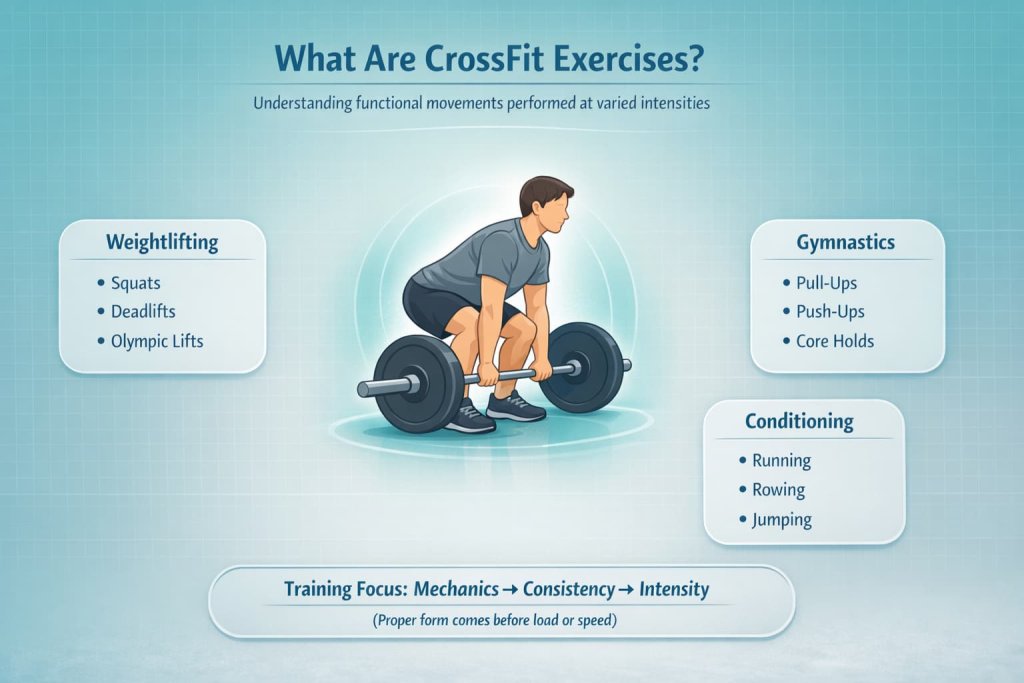
- Weightlifting (squats, deadlifts, Olympic lifts)
- Gymnastics (pull-ups, push-ups, core holds)
- Conditioning (running, rowing, jumping)
CrossFit’s training model emphasizes mechanics first, then consistency, then intensity, meaning proper form is prioritized before adding load or speed.
16 Best CrossFit Exercises
These exercises represent the core movements used in CrossFit training to build full-body strength, conditioning, power, and coordination. They combine barbell lifts, bodyweight skills, and conditioning tools that can be scaled for beginners through advanced athletes.
1. Air Squat
How to do it
- Stand with feet shoulder-width apart and toes slightly turned out
- Brace your core and keep your chest tall
- Push hips back and bend knees to lower into a squat
- Keep heels flat and knees tracking over toes
- Stand back up by driving through your heels
Why it works
The air squat reinforces proper squat mechanics using body weight only, making it ideal for building foundational lower-body strength and movement control. It teaches coordination between the hips, knees, and ankles while promoting joint mobility and balance.
Muscles worked
Quadriceps, glutes, hamstrings, calves, core stabilizers.
Trainer Tip
Focus on depth and control before speed. Quality reps matter more than high volume.
2. Front Squat
How to do it
- Rack the barbell across the front of your shoulders
- Keep elbows high and chest upright
- Sit down into a squat while maintaining a neutral spine
- Drive up through the mid-foot to stand
Why it works
Placing the load in front shifts demand to the core and upper back while encouraging an upright torso. This improves posture, trunk strength, and squat mechanics under load.
Muscles worked
Quadriceps, glutes, core, upper back.
Trainer Tip
If wrist mobility limits you, use a cross-arm grip or lifting straps.
3. Deadlift
How to do it
- Stand with feet hip-width apart and bar over mid-foot
- Hinge at the hips and grip the bar
- Brace your core and flatten your back
- Push through your heels and extend hips and knees
- Lower the bar with control
Why it works
The deadlift trains one of the most fundamental human movements—lifting from the ground—while building total posterior-chain strength and functional power.
Muscles worked
Glutes, hamstrings, spinal erectors, lats, core.
Trainer Tip
Maintain a neutral spine throughout the lift; never sacrifice form for heavier weight.
4. Push Press
How to do it
- Hold the barbell at shoulder height
- Dip slightly by bending knees
- Drive forcefully upward using legs
- Press the bar overhead to full lockout
Why it works
The push press uses lower-body power to assist the upper-body press, allowing heavier loads and improving power transfer between the legs and arms.
Muscles worked
Shoulders, triceps, glutes, quadriceps, core.
Trainer Tip
The dip should be vertical—avoid leaning forward.
5. Push Jerk
How to do it
- Start with the bar at shoulder height
- Perform a quick dip and explosive drive
- Drop under the bar into a partial squat
- Stand up fully to finish the rep
Why it works
The push jerk emphasizes speed, timing, and coordination, making it a powerful movement for developing explosive strength and athletic performance.
Muscles worked
Shoulders, triceps, glutes, quadriceps, calves, core.
Trainer Tip
Think “drive, drop, stand” to keep the movement smooth and efficient.
6. Overhead Squat
How to do it
- Hold the bar overhead with arms locked out
- Set feet slightly wider than shoulder width
- Squat down while keeping the bar centered over mid-foot
- Stand up maintaining overhead stability
Why it works
The overhead squat demands mobility, balance, and total-body control, making it one of the most technically challenging and rewarding CrossFit movements.
Muscles worked
Quadriceps, glutes, shoulders, upper back, core.
Trainer Tip
If depth is limited, address shoulder, hip, and ankle mobility first.
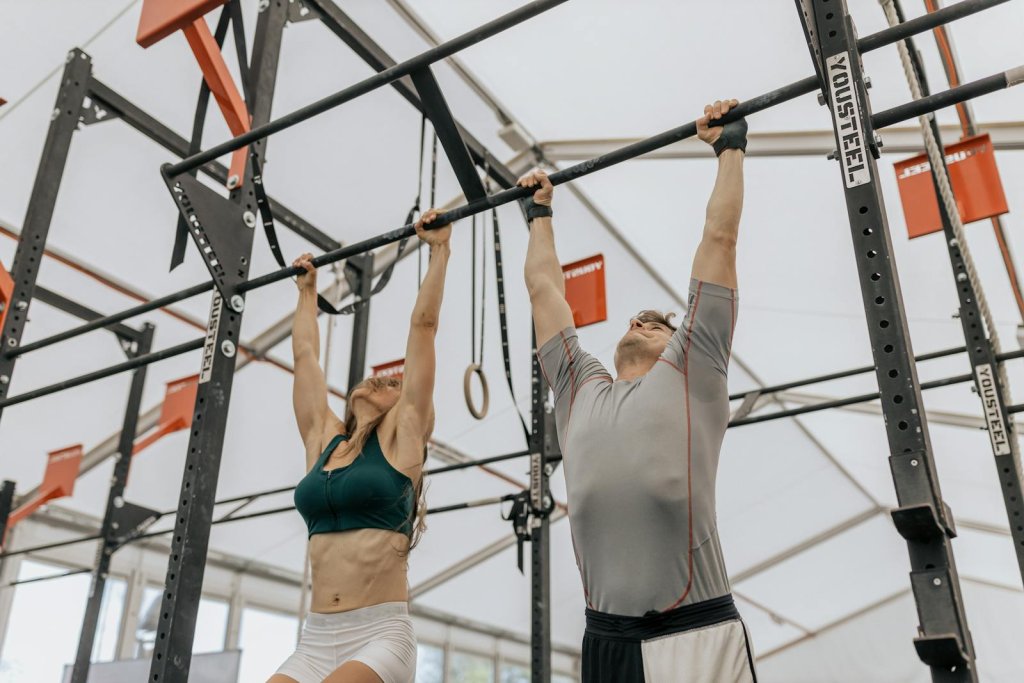
7. Pull-Up
How to do it
- Hang from the bar with full arm extension
- Engage shoulders and core
- Pull chest toward the bar
- Lower back down under control
Why it works
Pull-ups develop upper-body pulling strength and shoulder stability using body weight, translating well to both athletic and daily activities.
Muscles worked
Latissimus dorsi, biceps, shoulders, forearms, core.
Trainer Tip
Use band assistance or ring rows if strict pull-ups are not yet achievable.
8. Toes-to-Bar
How to do it
- Hang from the pull-up bar
- Engage core and shoulders
- Lift legs to bring toes to the bar
- Lower legs under control
Why it works
This movement combines core strength, grip endurance, and shoulder stability while reinforcing coordinated kip mechanics.
Muscles worked
Abdominals, hip flexors, shoulders, forearms.
Trainer Tip
Start with knee raises before progressing to full toes-to-bar.
9. Push-Up
How to do it
- Start in a plank position
- Keep body in a straight line
- Lower chest toward the floor
- Press back up to full arm extension
Why it works
Push-ups build upper-body and core strength while allowing easy scaling for all fitness levels.
Muscles worked
Chest, shoulders, triceps, core.
Trainer Tip
Maintain a rigid plank—avoid sagging hips or flared elbows.
10. Burpee
How to do it
- Squat down and place hands on the floor
- Kick feet back into a plank
- Lower chest to the floor
- Jump feet back in and stand up
- Finish with a jump
Why it works
Burpees combine strength and conditioning, rapidly increasing heart rate while reinforcing efficient transitions from ground to standing.
Muscles worked
Full body: legs, chest, shoulders, arms, core.
Trainer Tip
Breathe rhythmically to avoid early fatigue during high reps.
11. Box Jump
How to do it
- Stand facing the box
- Swing arms and jump explosively
- Land softly with full foot on the box
- Stand tall before stepping down
Why it works
Box jumps develop explosive power while reinforcing safe landing mechanics when performed correctly.
Muscles worked
Glutes, quadriceps, calves, core.
Trainer Tip
Step down instead of jumping down to reduce joint stress.
12. Wall Ball Shot
How to do it
- Hold the medicine ball at chest height
- Squat down to full depth
- Drive up and throw the ball to the target
- Catch the ball and repeat
Why it works
Wall balls blend strength and conditioning, challenging leg endurance and coordination under fatigue.
Muscles worked
Quadriceps, glutes, shoulders, core.
Trainer Tip
Use leg drive first—arms finish the throw.
13. Kettlebell Swing
How to do it
- Hinge at the hips holding the kettlebell
- Drive hips forward explosively
- Let the kettlebell float to chest height
- Return to hinge position
Why it works
The swing builds hip power and cardiovascular endurance while reinforcing efficient hinge mechanics.
Muscles worked
Glutes, hamstrings, lower back, core.
Trainer Tip
This is a hip hinge, not a squat—avoid bending knees excessively.
14. Medicine Ball Clean
How to do it
- Start with the ball on the floor
- Lift it using a deadlift motion
- Extend hips and pull the ball upward
- Catch it in a front squat position
Why it works
This movement teaches pulling mechanics and coordination in a low-skill, beginner-friendly format.
Muscles worked
Glutes, hamstrings, quadriceps, shoulders, core.
Trainer Tip
Keep the ball close to your body for smoother transitions.
15. Double-Under
How to do it
- Hold jump rope handles at hip height
- Jump slightly higher than normal
- Spin the rope twice per jump
- Land softly on the balls of your feet
Why it works
Double-unders improve coordination, timing, and cardiovascular efficiency under fatigue.
Muscles worked
Calves, quadriceps, shoulders, forearms.
Trainer Tip
Practice single jumps and timing drills before progressing.
16. Row (Ergometer)
How to do it
- Start with knees bent and arms straight
- Push through legs first
- Lean back slightly and pull handle to chest
- Reverse the sequence to return
Why it works
Rowing delivers full-body conditioning with minimal impact while allowing precise control over intensity.
Muscles worked
Quadriceps, glutes, back, shoulders, arms.
Trainer Tip
Remember the sequence: legs, hips, arms—then reverse.
How to Program CrossFit Exercises Safely
Safe CrossFit programming focuses on progression, recovery, and movement quality rather than constant high intensity.
- Prioritize proper form before increasing weight or speed
- Train 3–5 days per week, adjusting volume to your fitness level
- Increase load and intensity gradually over time
- Alternate strength-focused days with conditioning or skill work
- Scale exercises when fatigued or learning new movements
- Include warm-ups, mobility work, and recovery days
Consistent, well-paced programming helps support strength and conditioning gains while reducing unnecessary injury risk.
How CrossFit Exercises Are Programmed
CrossFit workouts typically use:
- Low to moderate repetitions for strength-focused sessions
- Higher repetitions or timed intervals for conditioning
- Scaled loads and variations to match individual ability
Certified CrossFit coaching emphasizes progressive loading, rest management, and movement quality before intensity.
Why CrossFit Exercises Matter for Full-Body Fitness
CrossFit exercises matter because they train multiple muscle groups and energy systems simultaneously. When programmed and scaled correctly, they may help support:
- Total-body strength and muscular endurance
- Cardiovascular conditioning
- Coordination, balance, and mobility
- Time-efficient training for busy schedules
Public-health organizations such as the World Health Organization and the Centers for Disease Control and Prevention recommend adults perform muscle-strengthening activities involving major muscle groups at least two days per week—goals that well-designed CrossFit workouts can meet.
Who Should Avoid or Modify CrossFit Exercises
CrossFit exercises can be scaled, but some individuals should modify training:
- Beginners without foundational movement training
- Those returning from injury or surgery
- Individuals with joint pain, mobility limitations, or cardiovascular concerns
Working with qualified coaches and healthcare professionals helps ensure exercises are adapted appropriately.
Common Mistakes to Avoid With CrossFit Exercises
- Prioritizing speed over proper form
- Adding load too quickly
- Ignoring mobility and warm-up work
- Training through pain or excessive fatigue
Correct technique and smart progression are key to long-term results.
Frequently Asked Questions
Are CrossFit exercises suitable for beginners?
Yes, when movements are scaled and taught progressively by qualified coaches.
Do CrossFit exercises build muscle?
They may help support muscle growth when combined with appropriate loading, volume, and recovery.
How often should I do CrossFit workouts?
Most people train 3–5 days per week, depending on recovery and fitness level.
Are CrossFit exercises only for athletes?
No. CrossFit is designed to be scalable for general fitness, not just competitive athletes.
Can CrossFit exercises improve cardio fitness?
Yes. Many workouts challenge both aerobic and anaerobic systems.
Do I need special equipment for CrossFit?
Some exercises use barbells or kettlebells, but many can be adapted using bodyweight or minimal equipment.
Conclusion
CrossFit exercises offer a structured, scalable way to train strength, conditioning, and functional movement together. When performed with proper technique, progressive loading, and smart coaching, they can support well-rounded fitness across a wide range of ability levels. If you’re new, start slow, focus on form, and consider professional guidance to get the most benefit safely.