
Yoga ball exercises are effective movements performed on a stability (Swiss) ball that challenge your core, balance, and muscle control by adding controlled instability. This instability forces more muscles—especially deep core stabilizers—to work together, which is why yoga ball exercises are widely used in fitness training, physical therapy, and rehabilitation programs.
Understanding how to use a yoga ball correctly matters because the benefits depend on exercise selection, proper form, and appropriate progression. When used well, yoga ball exercises can support core strength, balance, posture, and full-body coordination while remaining low-impact and joint-friendly.
What Are Yoga Ball Exercises?
Yoga ball exercises are strength, stability, and mobility movements performed using a large inflatable ball designed to create instability. The ball is often called a stability ball, Swiss ball, or exercise ball.
These exercises typically focus on:
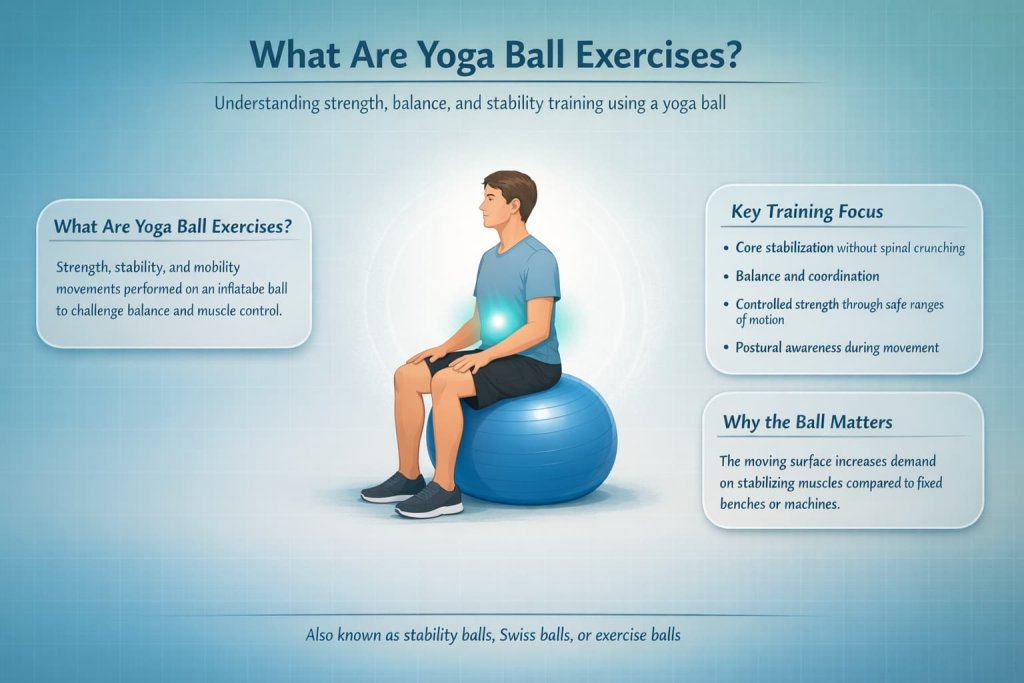
- Core stabilization rather than crunching or bending the spine
- Balance and coordination
- Controlled strength through a safe range of motion
- Postural awareness during movement
Unlike machines or fixed benches, a yoga ball moves with you, which increases the demand on stabilizing muscles.
11 Best Yoga Ball Exercises
These yoga ball exercises focus on building core strength, improving balance, and enhancing full-body stability using controlled, low-impact movements. They are suitable for beginners to advanced users when performed with proper form and progression.
1. Stability Ball Plank
How to do it
- Place your forearms on the center of the ball
- Extend your legs behind you with toes on the floor
- Stack shoulders directly over elbows
- Brace your core and squeeze your glutes
- Hold a straight line from head to heels without sagging
Why it works
The unstable surface forces your deep core muscles to continuously adjust, improving core endurance and trunk stability more than a standard plank.
Muscles worked
Abdominals, transverse abdominis, shoulders, glutes
Trainer Tip
Start with a wider foot stance to increase stability, then narrow your feet as control improves.
2. Stability Ball Crunch
How to do it
- Sit on the ball and slowly walk your feet forward
- Let your lower back rest comfortably on the ball
- Place hands lightly behind your head or across your chest
- Curl your torso upward while keeping your neck relaxed
- Lower back down with control
Why it works
The curved surface allows greater spinal movement, increasing abdominal engagement while reducing strain compared to floor crunches.
Muscles worked
Rectus abdominis, obliques
Trainer Tip
Focus on lifting your ribcage rather than pulling your head forward.
3. Stability Ball Rollout
How to do it
- Kneel on the floor with forearms resting on the ball
- Brace your core and keep hips slightly tucked
- Roll the ball forward by extending your arms
- Stop before your lower back arches
- Pull the ball back to the starting position
Why it works
This exercise challenges anti-extension strength, training the core to resist lower-back arching during movement.
Muscles worked
Deep abdominals, lats, shoulders
Trainer Tip
Shorter rollouts build control before progressing to longer ranges.
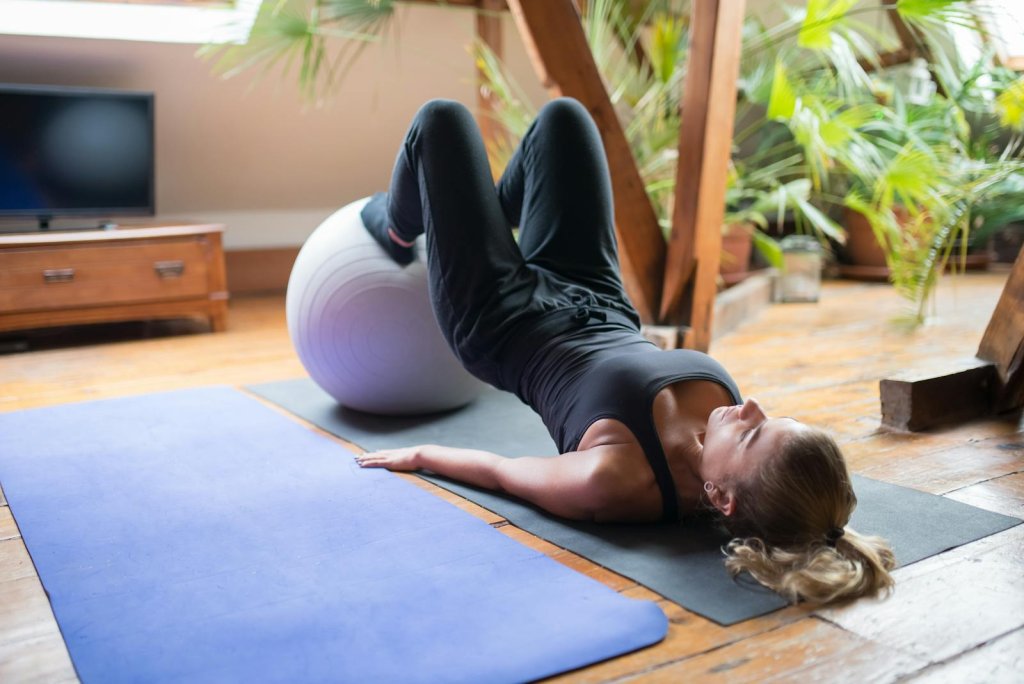
4. Stability Ball Glute Bridge
How to do it
- Lie on your back with heels placed on the ball
- Arms rest at your sides for balance
- Drive heels into the ball and lift hips upward
- Squeeze glutes at the top
- Lower hips slowly back down
Why it works
The unstable ball increases glute and core activation while reinforcing proper hip extension mechanics.
Muscles worked
Glutes, hamstrings, core stabilizers
Trainer Tip
Keep ribs down and avoid arching your lower back at the top.
5. Stability Ball Hamstring Curl
How to do it
- Begin in a bridge position with heels on the ball
- Lift hips and keep them elevated
- Bend knees to roll the ball toward your body
- Extend legs back out slowly
- Lower hips only after completing reps
Why it works
Combining hip extension with knee flexion strengthens the hamstrings while challenging pelvic stability.
Muscles worked
Hamstrings, glutes, core
Trainer Tip
If full curls are too difficult, reduce the range or perform with hips slightly lower.
6. Wall Squat With Yoga Ball
How to do it
- Place the ball between your lower back and the wall
- Stand with feet shoulder-width apart
- Lower into a squat by bending hips and knees
- Keep chest upright as the ball rolls
- Push through heels to return to standing
Why it works
The ball supports spinal alignment while reinforcing proper squat depth and knee tracking.
Muscles worked
Quadriceps, glutes
Trainer Tip
Pause briefly at the bottom to improve control and strength.
7. Stability Ball Push-Up
How to do it
- Place both hands on top of the ball
- Walk feet back into a plank position
- Lower chest toward the ball with elbows controlled
- Press up while keeping core tight
- Maintain steady breathing throughout
Why it works
The moving surface increases shoulder and core stabilization demands compared to floor push-ups.
Muscles worked
Chest, shoulders, triceps, core
Trainer Tip
If balance is difficult, start with knees on the floor.
8. Seated Ball March
How to do it
- Sit tall on the center of the ball
- Keep feet flat and spine neutral
- Lift one foot slightly off the floor
- Lower it and switch sides
- Avoid leaning or twisting
Why it works
This movement improves balance, posture, and low-level core activation during upright sitting.
Muscles worked
Core stabilizers, hip flexors
Trainer Tip
Slow tempo increases difficulty more than lifting the leg higher.
9. Stability Ball Back Extension
How to do it
- Lie face-down over the ball with feet anchored
- Hands rest behind head or crossed on chest
- Gently lift chest a few inches
- Keep neck aligned with spine
- Lower slowly with control
Why it works
Strengthens muscles that support the spine, improving postural endurance.
Muscles worked
Lower back extensors, glutes
Trainer Tip
Lift only to a neutral spine—avoid hyperextension.
10. Stability Ball Pike
How to do it
- Start in a plank with feet on the ball
- Brace your core and shoulders
- Lift hips upward toward the ceiling
- Keep legs straight if possible
- Lower back to plank under control
Why it works
The pike combines dynamic core control with shoulder stability, making it an advanced progression.
Muscles worked
Abdominals, shoulders
Trainer Tip
Master ball planks before attempting this movement.
11. Stability Ball Dead Bug
How to do it
- Lie on your back with arms and knees bent
- Hold the ball between hands and knees
- Press gently into the ball
- Extend opposite arm and leg
- Return and alternate sides
Why it works
This exercise reinforces coordinated core control while minimizing spinal stress.
Muscles worked
Deep abdominals, hip flexors
Trainer Tip
Move slowly and maintain pressure on the ball for constant engagement.
How to Choose the Right Yoga Ball Size
A common guideline is sitting on the ball with hips and knees at roughly 90 degrees.
Typical sizing:
- Under 5’4”: 45–55 cm
- 5’4”–5’11”: 65 cm
- Over 6’: 75 cm
Always choose an anti-burst ball with a non-slip surface.
Why Yoga Ball Exercises Important
Training on an unstable surface changes how your muscles work together. Research summarized in strength and conditioning literature shows that stability-based exercises may increase trunk muscle activation in certain movements, while also improving balance and neuromuscular control when used appropriately.
Yoga ball exercises may help support:
- Core control during daily activities
- Balance and body awareness
- Muscle coordination across joints
- Low-impact strength training options
Public health recommendations from the World Health Organization and the CDC encourage adults to include muscle-strengthening activities at least two days per week as part of an active lifestyle.
Who Can Benefit From Yoga Ball Exercises?
Yoga ball exercises may be helpful for:
- Beginners learning core control
- Office workers seeking posture support
- Older adults focusing on balance
- Athletes using stability as accessory training
Individuals with acute injuries or balance disorders should consult a qualified professional before starting.
Safety Guidelines Before Starting Yoga Ball Exercises
Using a yoga (stability) ball adds controlled instability, which can be helpful—but only when basic safety principles are followed. These guidelines support effective training while reducing unnecessary risk.
- Choose the right ball size and type: When seated, hips and knees should be near 90 degrees. Use an anti-burst, non-slip ball rated for your body weight.
- Start with stable progressions: Begin with supported or floor-based versions before advancing to fully unstable movements.
- Maintain controlled movement: Move slowly and deliberately. Avoid bouncing, jerking, or using momentum.
- Brace your core and breathe: Lightly engage the abdominal muscles and avoid holding your breath during effort.
- Use a clear, non-slip surface: Train on a flat floor with enough space to prevent falls or collisions.
- Stop if form breaks down: If you can’t maintain alignment (neutral spine, steady hips), regress the exercise.
Who Should Avoid or Modify Yoga Ball Exercises
Yoga ball exercises are not appropriate for everyone in their standard form. Modifications—or professional guidance—may be needed in the following situations:
- People with acute injuries: Recent back, hip, knee, or shoulder injuries may worsen with unstable loading.
- Individuals with significant balance disorders: The added instability can increase fall risk.
- Those recovering from surgery: Post-surgical restrictions often limit unstable or load-bearing movements.
- Uncontrolled pain or neurological conditions: Symptoms that affect coordination or sensation require caution.
- During pregnancy: Some positions and balance demands may not be appropriate; modifications and professional advice are recommended.
- Beginners without core control: Foundational strength should be built first using stable surfaces.
If you fall into any of these groups, consider regressed versions, reduced range of motion, or guidance from a qualified fitness or healthcare professional before incorporating yoga ball exercises.
Common Mistakes to Avoid
- Using a ball that’s too large or too small
- Rushing movements
- Holding breath during exercises
- Treating instability as a replacement for all strength training
FAQs About Yoga Ball Exercises
Are yoga ball exercises good for beginners?
Yes, when started with basic movements and proper support.
Do yoga ball exercises build muscle?
They can support muscle endurance and coordination but may not maximize heavy strength gains.
How often should I do yoga ball exercises?
Two to three sessions per week fits well within general activity guidelines.
Is a yoga ball safe?
When properly sized and used on a non-slip surface, it is generally safe.
Can yoga ball exercises help posture?
They may support postural awareness by engaging stabilizing muscles.
Are yoga balls the same as Swiss balls?
Yes, the terms are often used interchangeably.
Conclusion
Yoga ball exercises offer a practical, low-impact way to challenge your core, balance, and full-body coordination. When selected thoughtfully and performed with control, they can complement traditional strength training and support long-term movement quality. Start with simple exercises, progress gradually, and focus on form for the best results.
References
- CDC: Adult Physical Activity Guidelines
- Physical Activity Guidelines for Americans, 2nd Edition (PDF)
- WHO Guidelines on Physical Activity and Sedentary Behaviour (PDF)
- Core Stability Exercises On and Off a Swiss Ball (Marshall & Murphy, 2005) — PubMed
- Unstable-Surface Strength Training: Systematic Review & Meta-analysis (Behm et al., 2015) — PubMed
- ACE: Stability Ball Exercise Library (Equipment Page)
- ACE: Stability Ball Hamstring Curl (Exercise How-To)
- NIOSH/CDC: Unstable Sitting in the Workplace (Safety Evidence Review)