
Squat exercises for seniors are safe and effective when performed with proper support, controlled movement, and age-appropriate variations. These exercises strengthen the legs and hips, support balance, and help older adults maintain independence in daily activities such as standing up, sitting down, and climbing stairs.
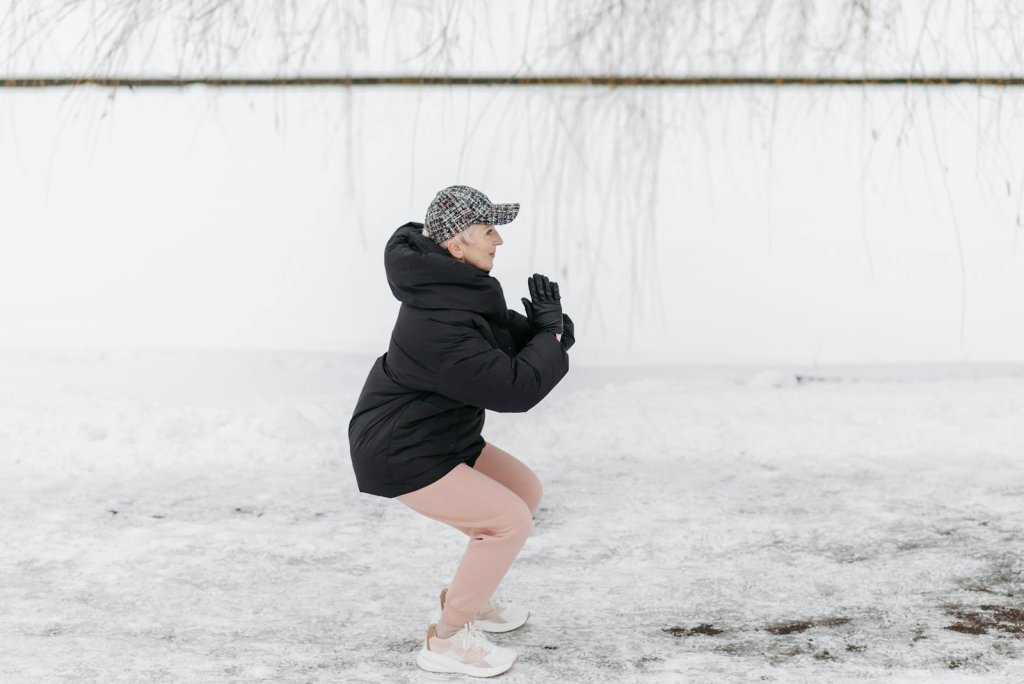
Understanding how to choose the right squat variation matters because lower-body strength and balance are closely linked to mobility and fall risk as we age.
What Are Squat Exercises for Seniors?
Squat exercises for seniors are modified lower-body movements designed to strengthen the thighs, hips, and glutes while prioritizing joint safety and balance support. Unlike deep or fast squats used in athletic training, senior-focused squats emphasize:
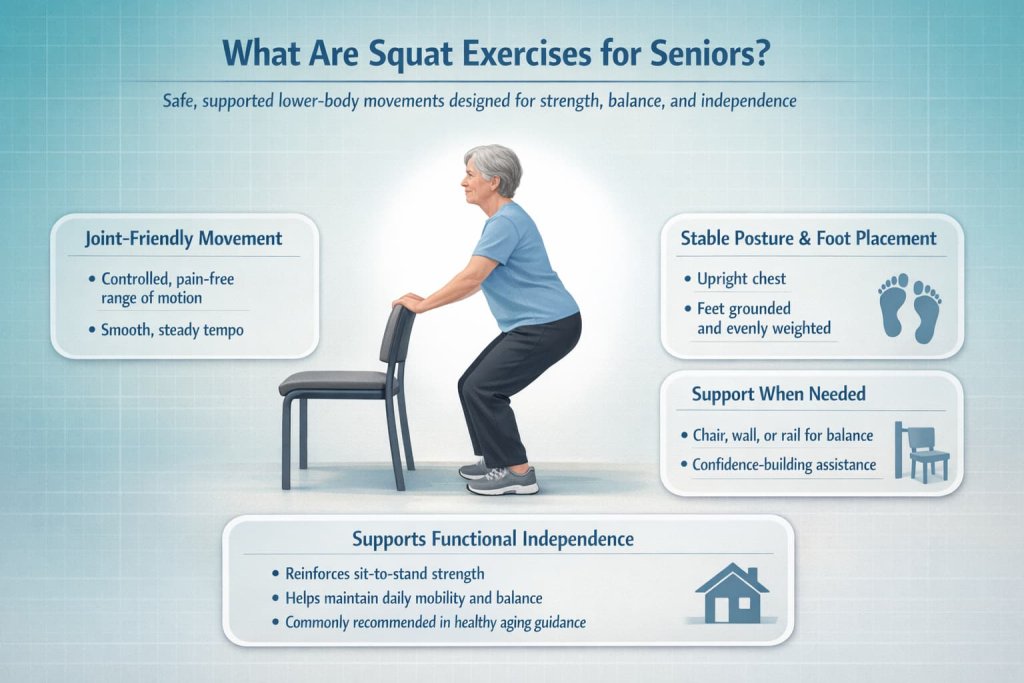
- Controlled, pain-free range of motion
- Upright posture and stable foot placement
- External support (chair, wall, or rail) when needed
According to guidance from the Mayo Clinic, sit-to-stand and squat-style movements are foundational for maintaining functional independence in older adults.
Why Squat Exercises Matter for Seniors
Regular squat training may help seniors:
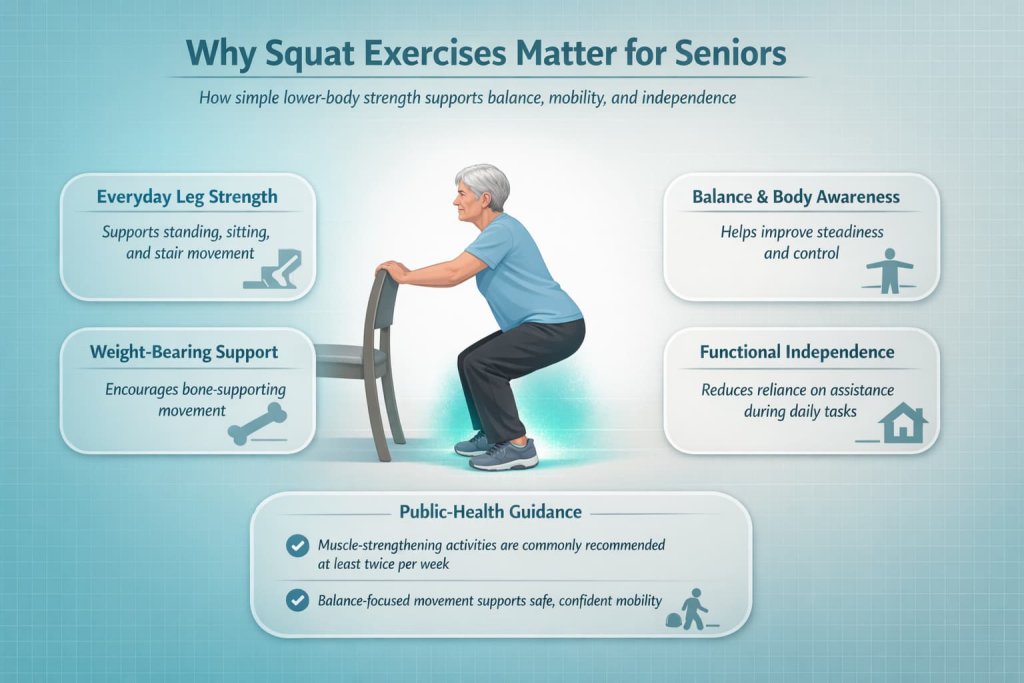
- Support leg strength needed for daily tasks
- Improve balance and body awareness
- Maintain bone density through weight-bearing movement
- Reduce reliance on assistance for sitting and standing
Public-health guidelines recommend including muscle-strengthening activities at least two days per week for older adults, along with balance-focused movement.
10 Safe Squat Exercises for Seniors
These squat exercises are designed to support leg strength, balance, and everyday mobility in older adults. Each variation can be adjusted using a chair, wall, or support to prioritize comfort and safety.
1. Chair Squat (Sit-to-Stand)
A foundational squat variation that uses a chair to guide depth and provide confidence.
How to do it
- Stand in front of a sturdy chair with feet about hip-width apart
- Push your hips back and bend your knees to lower toward the seat
- Lightly touch the chair without fully sitting down
- Press through your heels and straighten your legs to stand back up
Why it works
This movement closely mirrors everyday actions such as sitting down and standing up. Because it reinforces a familiar pattern, it helps seniors build usable leg strength that directly supports daily independence.
Muscles worked
Quadriceps, glutes, hamstrings, and core stabilizers.
Trainer Tip
If balance feels uncertain, use armrests or place hands lightly on your thighs to assist without fully relying on the arms.
2. Box Squat
A controlled squat performed to a raised surface to limit depth and joint stress.
How to do it
- Stand in front of a box, bench, or stacked cushions
- Sit your hips back slowly until they touch the surface
- Pause briefly, then press through your heels to stand
- Keep your chest upright throughout the movement
Why it works
By controlling how deep you squat, box squats reduce strain on the knees while still strengthening the legs and hips. This makes them ideal for seniors rebuilding confidence with squatting motions.
Muscles worked
Glutes, quadriceps, hamstrings.
Trainer Tip
Choose a height that allows you to stand back up smoothly. Lower the box only when strength and control improve.
3. Supported Squat (Holding a Chair or Rail)
A squat variation that uses external support to improve stability.
How to do it
- Hold the back of a chair, railing, or stable surface
- Lower into a squat at a comfortable depth
- Keep weight evenly distributed across both feet
- Push through your heels to return to standing
Why it works
Support reduces balance demands, allowing you to focus on proper movement and muscle engagement. This makes it safer for seniors who feel unsteady during free-standing squats.
Muscles worked
Quadriceps, glutes, hamstrings, and core stabilizers.
Trainer Tip
Use the support lightly—avoid pulling yourself up with the arms.
4. Wall Squat (Partial Depth)
A controlled squat that uses a wall for guidance and support.
How to do it
- Stand with your back flat against a wall
- Step feet slightly forward
- Slide down into a shallow squat
- Hold briefly, then push back up to standing
Why it works
The wall helps guide posture and limits forward lean, which reduces balance demands. Partial depth keeps the movement joint-friendly while still building strength.
Muscles worked
Quadriceps, glutes.
Trainer Tip
Stop the descent as soon as you feel discomfort—depth is not required for benefit.
5. Counter-Supported Squat
A practical at-home squat using a kitchen counter for stability.
How to do it
- Stand facing a counter and hold it with both hands
- Sit your hips back into a shallow squat
- Keep your torso upright and knees aligned
- Press through your heels to stand
Why it works
This variation allows seniors to practice squats safely at home while maintaining confidence and control, especially during early stages of training.
Muscles worked
Quadriceps, glutes, hips.
Trainer Tip
Avoid leaning heavily on the counter—use it for balance, not support.
6. Narrow-Stance Chair Squat
A slightly more challenging squat variation that reduces the base of support.
How to do it
- Stand in front of a chair with feet closer together
- Lower into a controlled chair squat
- Lightly touch the chair, then stand back up
Why it works
Bringing the feet closer increases balance demand and inner-thigh activation without removing the safety of the chair.
Muscles worked
Quadriceps, inner thighs, glutes.
Trainer Tip
If balance feels compromised, return to a wider stance immediately.
7. Wide-Stance Squat (Supported)
A squat variation that emphasizes hip engagement.
How to do it
- Take a wider-than-hip-width stance
- Hold a chair or rail for support
- Sit hips back into a shallow squat
- Stand up slowly and with control
Why it works
A wider stance increases hip involvement and helps improve lateral stability, which is important for side-to-side movement and balance.
Muscles worked
Glutes, inner thighs, quadriceps.
Trainer Tip
Keep knees tracking in the same direction as the toes to avoid joint stress.
8. Heel-Elevated Chair Squat
A modified chair squat that assists limited ankle mobility.
How to do it
- Place heels on a small wedge or book
- Stand in front of a chair
- Perform a controlled chair squat
- Press through the heels to stand
Why it works
Elevating the heels may make squatting more comfortable for seniors with reduced ankle flexibility, allowing better posture during the movement.
Muscles worked
Quadriceps, glutes.
Trainer Tip
Use the smallest lift possible and ensure the surface is stable.
9. Slow-Tempo Squat
A squat performed at a deliberately slow pace.
How to do it
- Lower into a supported squat over 3–4 seconds
- Pause briefly at the bottom
- Stand up slowly over 3–4 seconds
Why it works
Moving slowly increases time under tension, which supports strength gains without needing heavier resistance.
Muscles worked
Quadriceps, glutes, hamstrings, core.
Trainer Tip
Breathe steadily—exhale as you stand up.
10. Sit-to-Stand With Pause
A functional squat emphasizing control and posture.
How to do it
- Sit fully on a chair with feet planted
- Stand up smoothly
- Pause for 2 seconds while upright
- Sit back down with control
Why it works
The pause reinforces postural alignment and balance while strengthening the muscles used for daily transitions.
Muscles worked
Glutes, quadriceps, core.
Trainer Tip
Use the pause to reset posture before beginning the next repetition.
How Often Should Seniors Do Squat Exercises?
Most seniors can safely perform squat exercises 2–3 times per week, allowing at least one rest day between sessions. A typical starting point may include:
- 1–3 sets
- 8–12 controlled repetitions
- Light support as needed
Progress gradually by improving control, depth, or repetitions rather than adding speed or load.
Safety Guidelines Before Starting Squat Exercises
Following basic safety guidelines helps ensure squat exercises remain comfortable and appropriate for seniors.
- Use a sturdy chair, wall, or counter for balance support
- Move slowly and stay within a pain-free range of motion
- Keep feet flat and evenly weighted on the floor
- Maintain an upright chest and controlled posture
- Stop the exercise if sharp pain, dizziness, or instability occurs
Proper footwear and a non-slip surface further support safe movement.
How to Progress Squat Exercises Safely Over Time
Progression should focus on control and confidence rather than intensity.
- Increase repetitions before increasing squat depth
- Improve posture and balance before reducing external support
- Slow the lowering and rising phase to increase challenge
- Add brief pauses at the top or bottom of the movement
Small, gradual changes help support long-term strength without unnecessary joint stress.
Common Mistakes to Avoid With Squat Exercises
Avoiding common errors helps reduce strain and supports proper movement patterns.
- Squatting deeper than comfortable or pain-free
- Allowing knees to collapse inward
- Leaning excessively on support surfaces
- Holding the breath during movement
- Rushing repetitions or using momentum
Focus on slow, controlled motion with steady breathing.
Who Should Be Extra Cautious or Seek Professional Guidance
Some individuals may benefit from additional guidance before performing squat exercises, including those who:
- Experience ongoing joint or balance concerns
- Have recently undergone surgery or injury
- Feel pain during everyday sit-to-stand movements
- Have conditions affecting mobility or coordination
A qualified healthcare or fitness professional can help determine appropriate modifications or alternatives.
Frequently Asked Questions
Are squat exercises safe for seniors?
Yes, when modified appropriately and performed with support, squats are widely considered safe for older adults.
Are chair squats effective?
Chair squats are highly effective for building functional strength used in daily activities.
How deep should seniors squat?
Only as deep as comfortable and pain-free. Shallow squats are still beneficial.
Can seniors do squats with knee pain?
Some variations may be suitable, but knee pain should be discussed with a qualified professional.
How many squats should seniors do?
Many seniors start with 8–12 repetitions per set, depending on comfort and ability.
Do squats help with balance?
Squats may support balance by strengthening the legs and improving body control.
Conclusion
Squat exercises for seniors are a practical, evidence-based way to support strength, balance, and independence. By starting with supported variations and progressing gradually, older adults can safely include squats as part of a well-rounded movement routine. If you are unsure which variation is best for you, consider consulting a qualified fitness or healthcare professional before beginning.
References
- Older Adult Physical Activity Guidelines (65+) – CDC
- WHO Guidelines on Physical Activity and Sedentary Behaviour (PDF) – World Health Organization
- Physical Activity Guidelines for Americans, 2nd Edition (PDF) – U.S. Department of Health and Human Services
- Exercise and Physical Activity for Older Adults (PDF) – National Institute on Aging
- STEADI: Older Adult Fall Prevention – CDC
- Fall Prevention Exercises (Strength + Balance) – Johns Hopkins Medicine
- 30-Second Chair Stand Test (Assessment PDF) – CDC STEADI
- Falls Prevention in Community-Dwelling Older Adults: Interventions – USPSTF