
Plank variations are bodyweight exercises that train your core to resist movement, build total-body stability, and support better posture without equipment. They challenge the abdominal muscles, lower back, shoulders, and glutes at the same time, making them one of the most efficient ways to develop core strength.
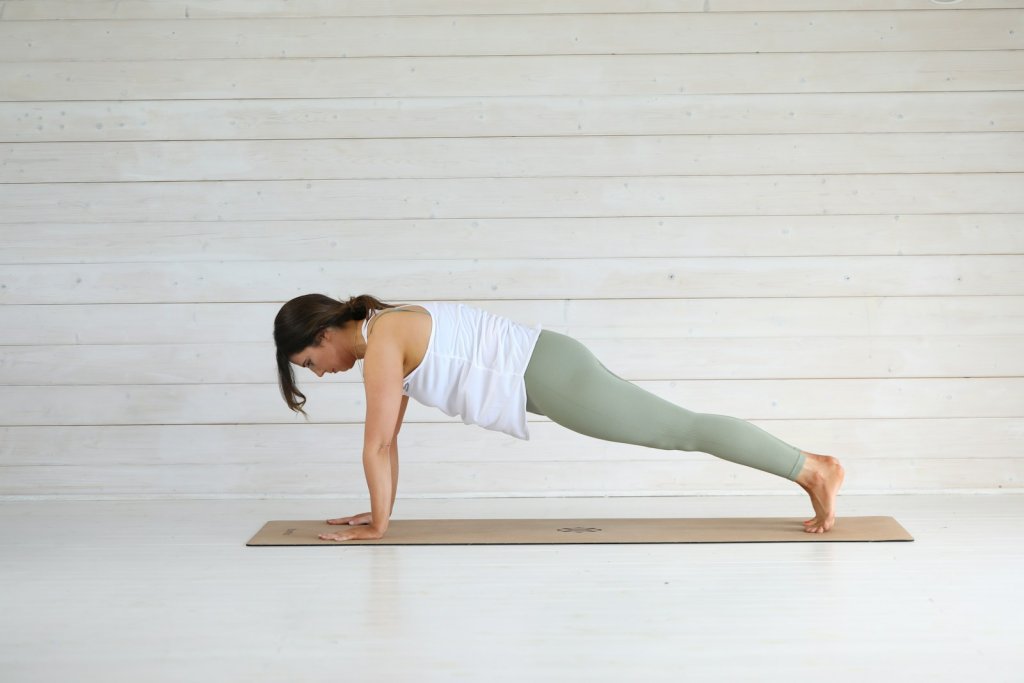
Understanding plank variations matters because the core is not just about visible abs—it plays a key role in spinal stability, balance, and force transfer during daily activities and exercise.
This guide breaks down the 16 best plank variations, explains who they are for, how often to do them, and how to use them safely for long-term core strength.
What Are Plank Variations?
Plank variations are modifications of the traditional plank that change body position, movement, or load to target different core stability demands. Instead of holding one static position, variations introduce:
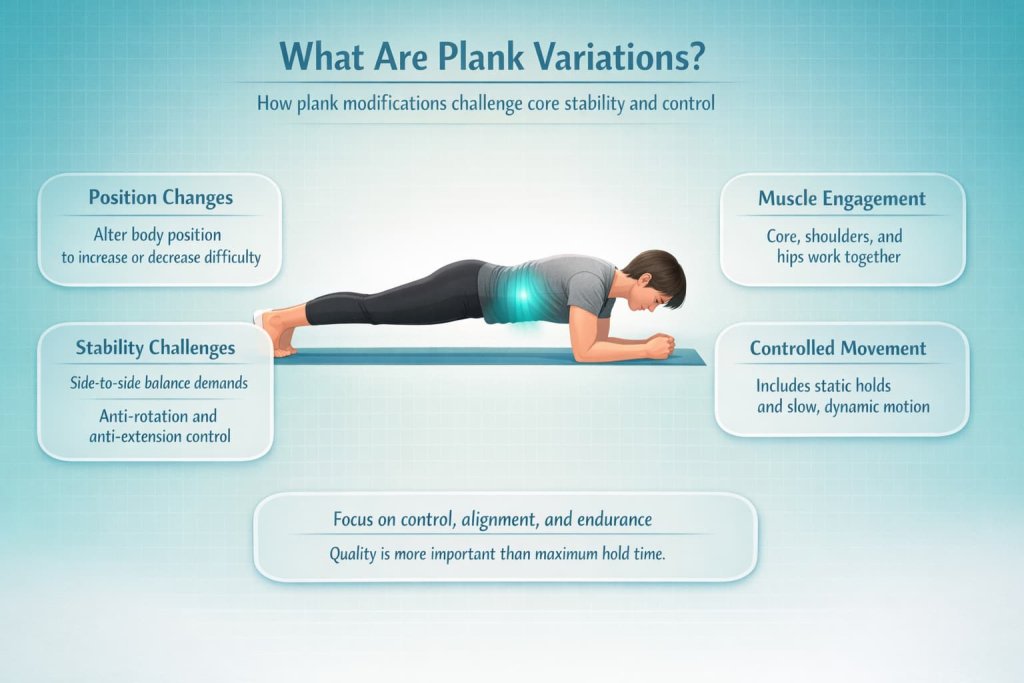
- Side-to-side stability challenges
- Anti-rotation and anti-extension demands
- Shoulder and hip engagement
- Controlled dynamic movement
According to guidance from the Mayo Clinic, core exercises should emphasize control, alignment, and endurance rather than maximum hold times. Plank variations allow this progression safely.
16 Best Plank Variations for Total Core Strength and Stability
These plank variations are designed to challenge core strength, stability, and control without equipment. Each option can be scaled to match different fitness levels while emphasizing proper alignment and safe progression.
1. Forearm Plank
How to do it:
- Place forearms on the floor with elbows under shoulders
- Extend legs back, resting on toes
- Keep body in a straight line from head to heels
- Brace the core and squeeze the glutes
- Breathe steadily while holding the position
Why it works:
The forearm plank trains the core to resist spinal extension under bodyweight. Because there is no movement, the muscles must stay continuously active, improving endurance and postural control.
Muscles worked:
Abdominals (transverse abdominis, rectus abdominis), obliques, glutes, lower back, shoulders.
Trainer Tip:
Think about gently pulling your elbows toward your toes to increase core tension without moving.
2. High Plank
How to do it:
- Start on hands and toes, wrists under shoulders
- Extend legs fully behind you
- Keep spine neutral and hips level
- Engage core and glutes
- Maintain controlled breathing
Why it works:
The high plank increases upper-body loading compared to the forearm plank, forcing the shoulders and arms to support bodyweight while the core stabilizes the spine.
Muscles worked:
Core muscles, shoulders, chest, triceps, glutes.
Trainer Tip:
Press the floor away with your hands to prevent shoulder collapse.
3. Side Plank
How to do it:
- Lie on one side with elbow under shoulder
- Stack feet or place top foot slightly forward
- Lift hips until body forms a straight line
- Keep neck neutral and core braced
Why it works:
Side planks train lateral core stability by resisting side-bending forces, which is essential for balance and injury prevention.
Muscles worked:
Obliques, transverse abdominis, glutes, shoulders.
Trainer Tip:
Imagine lifting your waist away from the floor rather than just pushing hips up.
4. Side Plank With Knee Support
How to do it:
- Bend bottom knee and place it on the floor
- Stack shoulders and hips
- Lift hips while keeping spine aligned
- Hold with steady breathing
Why it works:
This variation reduces load while preserving the core stability benefits of a full side plank, making it ideal for beginners.
Muscles worked:
Obliques, core stabilizers, shoulders.
Trainer Tip:
Focus on alignment first; strength will follow.
5. Side Plank Reach-Through
How to do it:
- Start in a side plank position
- Extend top arm upward
- Rotate torso and reach arm under the body
- Return slowly to the start position
Why it works:
Adding rotation challenges the obliques through controlled movement, improving rotational stability and coordination.
Muscles worked:
Obliques, shoulders, deep core stabilizers.
Trainer Tip:
Move slowly and control the rotation—avoid rushing.
6. Plank With Shoulder Taps
How to do it:
- Start in a high plank
- Lift one hand to tap the opposite shoulder
- Alternate sides while keeping hips stable
- Maintain a wide stance if needed
Why it works:
This variation increases anti-rotation demand, forcing the core to stabilize while weight shifts between arms.
Muscles worked:
Core stabilizers, shoulders, arms, glutes.
Trainer Tip:
Widen your feet to reduce hip sway if control is difficult.
7. Plank Up-Downs
How to do it:
- Start in a forearm plank
- Press up to one hand, then the other
- Lower back down to forearms
- Alternate lead arms each repetition
Why it works:
Plank up-downs blend core stability with upper-body strength, increasing muscular endurance and coordination.
Muscles worked:
Core, shoulders, triceps, chest.
Trainer Tip:
Keep hips as still as possible during transitions.
8. Reverse Plank
How to do it:
- Sit with legs extended and hands behind hips
- Press through hands and heels
- Lift hips until body forms a straight line
- Keep chest open and neck neutral
Why it works:
Reverse planks emphasize posterior-chain support, balancing traditional front-core work.
Muscles worked:
Glutes, hamstrings, lower back, shoulders, core.
Trainer Tip:
Drive hips upward instead of letting them sag.
9. Elevated Plank
How to do it:
- Place hands or forearms on a bench or step
- Extend legs back into plank position
- Keep spine neutral and core engaged
- Hold with steady breathing
Why it works:
Elevation reduces load, making planks more accessible while reinforcing correct alignment.
Muscles worked:
Core, shoulders, glutes.
Trainer Tip:
Lower the height gradually as strength improves.
10. Plank With Alternating Leg Lift
How to do it:
- Start in a forearm or high plank
- Lift one leg without shifting hips
- Lower and switch sides
- Move slowly and deliberately
Why it works:
Removing one point of contact increases pelvic and core stability demands.
Muscles worked:
Core stabilizers, glutes, shoulders.
Trainer Tip:
Lift only as high as you can without arching the back.
11. Plank March
How to do it:
- Begin in a high plank
- Lift one knee toward chest slightly
- Return foot to floor and alternate sides
- Maintain steady tempo
Why it works:
Plank marching introduces controlled movement that improves balance and coordination.
Muscles worked:
Core, hip flexors, shoulders, glutes.
Trainer Tip:
Move slowly to maximize control rather than speed.
12. Plank Pull-Through
How to do it:
- Start in a high plank with an object beside you
- Reach across body and pull object underneath
- Alternate sides without twisting hips
Why it works:
This variation strongly challenges anti-rotation strength and unilateral control.
Muscles worked:
Obliques, deep core muscles, shoulders.
Trainer Tip:
Use a light object first to master stability.
13. Wide-Base Plank
How to do it:
- Place feet wider than shoulder width
- Maintain neutral spine
- Hold with steady breathing
Why it works:
Widening the base increases stability, making this version suitable for beginners.
Muscles worked:
Core, shoulders, glutes.
Trainer Tip:
Use this as a stepping stone toward more challenging planks.
14. Long-Lever Plank
How to do it:
- Start in forearm plank
- Move elbows slightly forward of shoulders
- Maintain tight core and neutral spine
Why it works:
Increasing lever length raises torque on the core, significantly increasing difficulty without movement.
Muscles worked:
Deep core stabilizers, shoulders, glutes.
Trainer Tip:
Shorten hold times—this variation is demanding.
15. Stability Ball Plank
How to do it:
- Place forearms on stability ball
- Extend legs into plank position
- Keep hips steady and core braced
Why it works:
Unstable surfaces increase neuromuscular demand, requiring constant micro-adjustments.
Muscles worked:
Core stabilizers, shoulders, glutes.
Trainer Tip:
Focus on stillness, not movement.
16. Stir-the-Pot Plank
How to do it:
- Start in a forearm plank on a stability ball
- Move forearms in small circular motions
- Keep hips and spine stable
Why it works:
This dynamic variation challenges the entire trunk through controlled instability.
Muscles worked:
Core, shoulders, glutes, back stabilizers.
Trainer Tip:
Start with small circles before increasing range.
How to Choose the Right Plank Variation
Choosing the right plank variation depends on your experience level and movement control.
- Beginners: Elevated planks, knee-supported side planks
- Intermediate: Shoulder taps, plank up-downs
- Advanced: Long-lever planks, stability-ball variations
Quality of movement is more important than duration or difficulty.
How Often Should You Do Plank Variations?
Most public-health and fitness guidelines suggest:
- 2–4 days per week
- 2–4 sets per variation
- 15–45 seconds per set, depending on control
The World Health Organization recommends combining muscle-strengthening exercises with aerobic activity for overall health.
Why Plank Variations Are Important for Core Strength
Plank variations matter because they train the core the way it functions in real life—by stabilizing the spine while the arms and legs move.
They may help support:
- Better posture and spinal alignment
- Improved balance and coordination
- Reduced stress on the lower back during movement
- Safer strength training and daily lifting tasks
The American College of Sports Medicine consistently emphasizes trunk stability as a foundation for efficient movement and injury risk reduction.
How Plank Variations Support Total Core Strength
Plank variations build total core strength by training the body to stabilize the spine and control movement rather than create motion.
They support core function by:
- Resisting lower-back arching (anti-extension)
- Preventing unwanted twisting (anti-rotation)
- Improving side-to-side stability (anti-lateral flexion)
- Engaging the core, hips, and shoulders together
How Long Should You Hold Plank Variations?
Plank variations should be held only while proper form and steady breathing are maintained.
General guidelines often include:
- Beginners: 10–20 seconds
- Intermediate: 20–40 seconds
- Advanced: 30–60 seconds or shorter holds with harder variations
Good alignment matters more than longer hold times.
Common Mistakes to Avoid With Plank Variations
- Letting the lower back sag or over-arch
- Holding the breath instead of breathing steadily
- Rushing through dynamic variations
- Prioritizing time over form
Proper alignment always comes first.
Who Should Be Cautious or Modify Plank Exercises
Plank variations may need modification for people who:
- Have ongoing lower-back pain
- Are recovering from shoulder or wrist injuries
- Experience poor balance or dizziness
Consult a qualified professional if pain or discomfort occurs during core training.
Frequently Asked Questions About Plank Variations
Are plank variations better than regular planks?
Plank variations challenge the core in multiple ways, which may improve overall stability more than holding a single static plank.
How long should I hold a plank variation?
Most people benefit from controlled holds of 15–45 seconds rather than maximum time.
Do plank variations work the lower back?
They engage muscles that support the spine, but they are stabilization exercises—not back extensions.
Can beginners do plank variations?
Yes. Many variations are scalable and beginner-friendly when performed with proper form.
Should I do planks every day?
Light plank work can be done frequently, but rest days help prevent overuse.
Are planks enough for core strength?
They are effective, but best results come from combining planks with other controlled core exercises.
Conclusion
Plank variations are one of the most efficient ways to build total core strength, improve stability, and support healthy movement patterns. By progressing gradually and focusing on control rather than duration, you can safely challenge your core at any fitness level.
If you are building a balanced workout routine, plank variations are a reliable, equipment-free option worth including consistently.
References
- WHO Fact Sheet: Physical Activity (June 26, 2024)
- CDC: Adult Physical Activity Guidelines Overview (Dec 20, 2023)
- Physical Activity Guidelines for Americans, 2nd Edition (Official PDF)
- Mayo Clinic: Core Exercises—Why Strengthen Your Core
- ACSM Health & Fitness Journal: Core Training—Separating Fact From Fiction
- Sports Physical Therapy Review: A Comprehensive Approach to Core Training (2023, PMC)
- Study: Comparing Trunk Stability Exercises Using Ultrasound (2024, PMC)
- Systematic Review/Meta-Analysis: Stable vs Unstable Surfaces and EMG Activity (2024, PubMed)