
Gluteal tendinopathy exercises focus on gradually strengthening the hip abductor muscles—especially the gluteus medius and minimus—to support the outer hip and improve load tolerance. Understanding and applying the right exercises matters because poorly managed loading and prolonged irritation around the hip tendons are common reasons symptoms linger.
What Is Gluteal Tendinopathy?
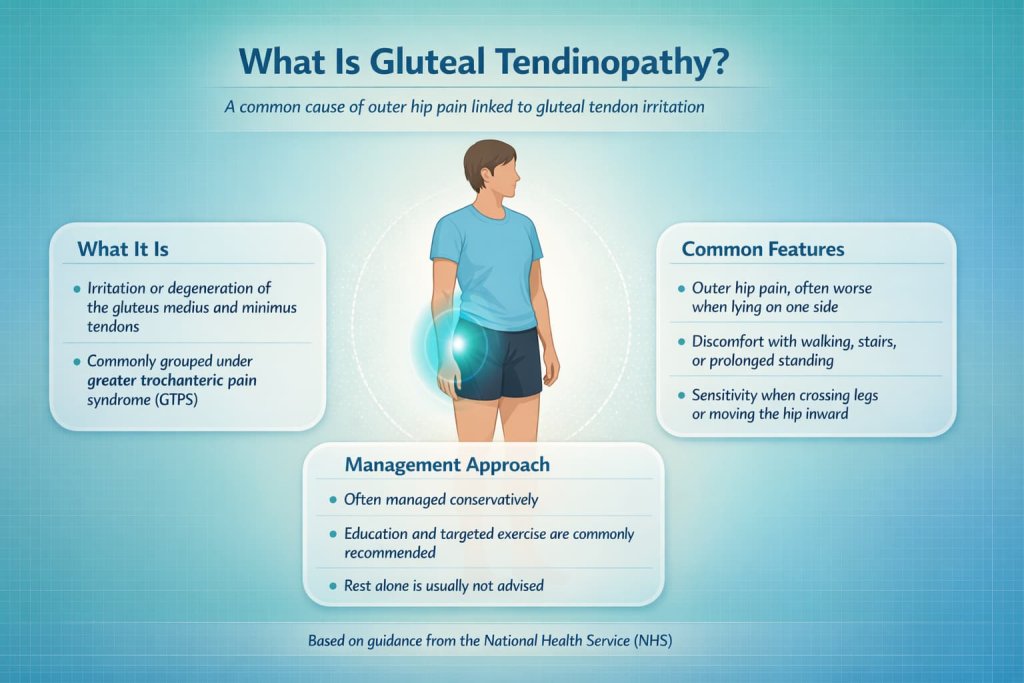
Gluteal tendinopathy is a condition involving irritation or degeneration of the gluteus medius and/or gluteus minimus tendons where they attach near the greater trochanter on the outside of the hip. It is commonly discussed under the umbrella of greater trochanteric pain syndrome (GTPS).
Common features include:
- Outer hip pain, often worse when lying on the affected side
- Discomfort during walking, stair climbing, or prolonged standing
- Sensitivity with positions that place the hip in adduction (for example, crossing legs)
According to guidance from the National Health Service, most cases are managed conservatively with education and exercise rather than rest alone.
6 Best Gluteal Tendinopathy Exercises
Below are six commonly recommended exercises used in physiotherapy programs. They move from low-load to more functional strengthening.
1. Side-Lying Hip Abduction
How to do it
- Lie on your non-painful side with your body in a straight line from head to feet
- Bend the bottom knee slightly for balance while keeping the top leg straight
- Stack your hips directly on top of each other and gently brace your core
- Slowly lift the top leg slightly backward and upward, keeping toes facing forward
- Pause briefly at the top, then lower the leg with full control
Why it works:
This exercise strengthens the gluteus medius in a position that minimizes excessive compression on the outer hip. It helps improve lateral hip stability, which is essential for walking, standing, and single-leg activities commonly affected in gluteal tendinopathy.
Trainer Tip:
Lift the leg only as high as you can without tilting your pelvis or rolling backward—quality of movement matters more than height.
2. Isometric Wall Hip Abduction Hold
How to do it
- Stand sideways next to a wall with the affected side closest to the wall
- Bend the knee slightly and place the outer thigh or knee gently against the wall
- Press into the wall without allowing your body to move
- Maintain upright posture with hips level and core lightly engaged
- Hold the contraction, then relax and repeat
Why it works:
Isometric exercises load the tendon without joint movement, which may help reduce pain sensitivity while maintaining muscle activation. This makes it a useful option during more irritable phases of gluteal tendinopathy.
Trainer Tip:
Aim for a steady, moderate effort—this should feel controlled and supportive, not like maximal pushing.
3. Glute Bridge (Neutral Hip Position)
How to do it
- Lie on your back with knees bent and feet flat on the floor
- Place feet hip-width apart and keep your pelvis in a neutral position
- Gently brace your core and squeeze your glutes
- Lift your hips until your shoulders, hips, and knees form a straight line
- Lower slowly back to the floor with control
Why it works:
The glute bridge builds foundational hip extension strength while keeping the hips in a neutral position, reducing lateral compression at the outer hip. Strong gluteus maximus support can also reduce excessive load on the smaller lateral hip tendons.
Trainer Tip:
Keep your ribs down and avoid arching your lower back at the top of the movement.
4. Standing Hip Abduction With Band
How to do it
- Stand upright with a resistance band around your ankles or thighs
- Hold onto a wall or chair for balance if needed
- Shift weight onto the non-working leg
- Move the working leg slightly out to the side while keeping toes forward
- Slowly return to the starting position
Why it works:
This exercise challenges the gluteus medius in a functional standing position, helping transfer strength gains to real-life activities such as walking and standing on one leg.
Trainer Tip:
Move slowly and deliberately—avoid leaning your torso or letting the pelvis drop.
5. Sit-to-Stand (Hip-Focused)
How to do it
- Sit on a chair with feet placed hip-width apart
- Position feet slightly under the knees
- Lean forward slightly from the hips while keeping the spine neutral
- Press through your heels to stand up
- Sit back down slowly with control
Why it works:
Sit-to-stand strengthens the hips in a movement pattern used throughout daily life. It helps improve tolerance to compressive and tensile loads at the hip when performed with good alignment.
Trainer Tip:
Focus on even weight distribution between both legs and keep knees tracking in line with toes.
6. Step-Up (Low Height)
How to do it
- Stand facing a low step or platform
- Place the affected leg fully on the step
- Press through the heel to lift your body upward
- Bring the opposite foot up to stand tall
- Step down slowly, maintaining control
Why it works:
Step-ups gradually reintroduce controlled load similar to stair climbing, a common trigger activity for gluteal tendinopathy. This exercise helps rebuild strength and confidence in single-leg support.
Trainer Tip:
Start with a low step and progress height only if pain remains mild and settles after exercise.
Why Exercise Matters for Gluteal Tendinopathy
Exercise does not “fix” a tendon overnight, but it supports the tendon’s ability to tolerate everyday loads. Research and clinical guidelines show that well-chosen strengthening programs may help by:
- Improving hip and pelvic stability during walking and standing
- Reducing excessive compression at the outer hip
- Gradually restoring strength in the gluteal muscles
- Supporting long-term symptom control better than passive treatments alone
A landmark randomized controlled trial published in the BMJ found that an education-plus-exercise program led to better long-term outcomes than corticosteroid injections for people with gluteal tendinopathy/GTPS.
How Often Should You Do Gluteal Tendinopathy Exercises?
Most clinical programs recommend:
- 2–3 sessions per week for strengthening exercises
- Light activation or isometrics on off days if tolerated
Guidance from NHS physiotherapy resources emphasizes patience and gradual progression rather than daily high-load training.
Activities and Positions That May Aggravate Gluteal Tendinopathy
Some everyday movements and postures can increase stress on the outer hip tendons, especially during more sensitive phases of gluteal tendinopathy. Guidance from the National Health Service and Mayo Clinic emphasizes modifying these triggers rather than avoiding activity altogether.
Common aggravating factors include:
- Crossing legs or standing with weight shifted onto one hip
- Lying directly on the painful side without support
- Aggressive hip stretches that pull the leg across the body
- Sudden increases in walking, hills, or stair use
Reducing time spent in these positions while continuing appropriate strengthening may help manage symptoms more effectively.
Safety Guidelines Before Starting Gluteal Tendinopathy Exercises
Before beginning any exercise program, keep these evidence-based principles in mind:
- Avoid exercises or positions that significantly increase outer hip pain
- Progress load gradually; discomfort during exercise should remain mild and settle afterward
- Avoid prolonged hip adduction early on (for example, hanging on one hip or crossing legs)
- Consistency matters more than intensity
Clinical advice from Mayo Clinic emphasizes symptom-guided progression rather than pushing through pain during tendon rehabilitation.
When to Seek Professional Guidance
You should consider seeing a physiotherapist or healthcare professional if:
- Pain worsens despite consistent exercise
- Night pain or walking tolerance continues to decline
- You are unsure how to progress load safely
The Mayo Clinic notes that persistent lateral hip pain warrants individualized assessment.
Frequently Asked Questions
Can exercises cure gluteal tendinopathy?
Exercises do not cure the condition, but they may help improve load tolerance, strength, and long-term symptom control.
Should I stretch with gluteal tendinopathy?
Aggressive lateral hip stretching is often discouraged early, as it may increase tendon compression.
Is walking good for gluteal tendinopathy?
Walking is usually encouraged within pain limits, especially with good posture and gradual progression.
How long does improvement take?
Many people notice changes over several weeks, with continued improvement over months when exercises are consistent.
Are injections better than exercise?
Evidence published in the BMJ shows better long-term outcomes with education and exercise compared to injections.
Can I exercise at home?
Yes. Most gluteal tendinopathy exercises are home-based and require minimal equipment.
Conclusion
Gluteal tendinopathy exercises play a key role in supporting hip strength, improving movement tolerance, and managing outer hip pain over time. When performed consistently and progressed carefully, these exercises align with current clinical guidance and research.
If symptoms persist or worsen, working with a qualified professional can help tailor the program to your needs.
References
- PubMed: Education plus exercise vs injection for gluteal tendinopathy (Mellor et al., 2018)
- Exercises for greater trochanteric pain syndrome (NHS inform)
- Greater trochanteric pain syndrome overview (NHS inform, updated 2025)
- Gluteal tendinopathy management concepts (JOSPT, 2015)
- Greater Trochanteric Pain Syndrome clinical practice guideline (OSU Wexner, PDF)
- GTPS patient leaflet including aggravating postures and activity modifications (Royal Berkshire NHS, PDF, Nov 2024)
- Cost-effectiveness of education plus exercise for persistent gluteal tendinopathy (Journal of Physiotherapy, 2023)