
The cat cow stretch exercise is a gentle, low-impact movement that improves spinal mobility, posture awareness, and breathing coordination in just a few minutes a day. Understanding how to perform it correctly matters because your spine moves through flexion and extension every day—during sitting, standing, lifting, and exercise. When practiced regularly, cat cow supports healthier movement patterns, helps reduce stiffness, and prepares your body for both workouts and daily tasks.
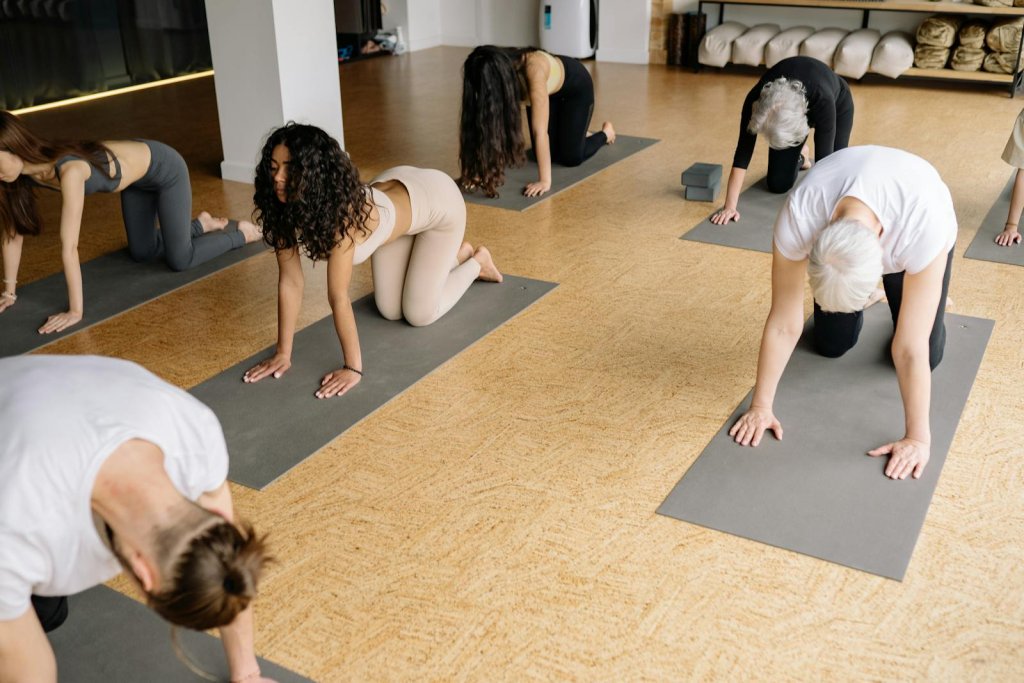
This guide explains what the cat cow stretch is, how it works, its benefits, proper form, safety considerations, and common mistakes—using evidence-based guidance from trusted health and fitness organizations.
What Is the Cat Cow Stretch Exercise?
The cat cow stretch is a controlled spinal movement commonly used in yoga, warm-ups, and mobility routines. It alternates between two positions performed on hands and knees:
- Cat position: the spine rounds gently upward
- Cow position: the spine arches gently downward
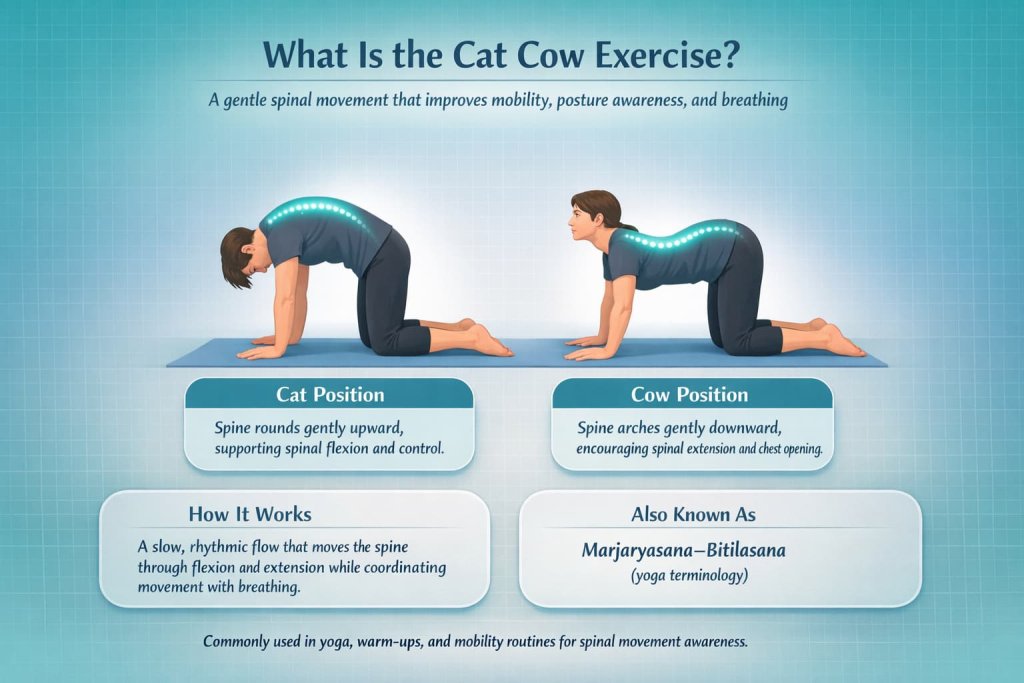
This rhythmic flow moves the spine through flexion and extension while coordinating movement with breathing. In yoga, the movement is known as Marjaryasana–Bitilasana, but in fitness and rehabilitation settings, it is often referred to simply as the cat cow exercise.
How to Do the Cat Cow Exercise Correctly
Starting position
- Begin on hands and knees (tabletop position)
- Hands under shoulders, knees under hips
- Spine neutral, neck relaxed
Cat phase (spinal flexion)
- Exhale slowly
- Gently round your spine upward
- Draw your chin slightly toward your chest
- Avoid forcing the movement
Cow phase (spinal extension)
- Inhale slowly
- Gently arch your back
- Lift your chest and tailbone
- Keep the neck long rather than collapsing backward
Most clinical and fitness guidelines recommend 5–10 slow repetitions, moving smoothly with each breath.
How the Cat Cow Stretch Exercise Works
The cat cow exercise works by gently mobilizing the spine through its natural ranges of motion while encouraging coordinated breathing.
During the movement:
- The spine moves segment by segment rather than as a rigid unit
- Core muscles provide light stabilization
- Deep spinal muscles assist with controlled movement
- Breathing reinforces relaxation and body awareness
Unlike static stretching, this dynamic approach helps “wake up” the nervous system and joints, making it especially useful at the start of a workout or after long periods of sitting.
Benefits of the Cat Cow Stretch Exercise
Improves spinal mobility and flexibility
Regularly moving the spine through controlled flexion and extension may help reduce stiffness and support smoother movement throughout the day.
Supports posture awareness
The exercise improves awareness of neutral spine positioning, which can carry over into sitting, standing, and lifting habits.
Encourages gentle core activation
While not a strength exercise, cat cow lightly engages abdominal and back muscles that support spinal alignment.
Promotes relaxation and breathing control
Breath-linked movement encourages slower breathing patterns that may help reduce tension and improve focus.
The National Center for Complementary and Integrative Health notes that gentle yoga-based movements may provide small but meaningful benefits for back comfort and overall well-being when practiced consistently.
Muscles Involved in the Cat Cow Stretch Exercise
The cat cow exercise involves several muscle groups working together:
- Deep spinal stabilizers
- Abdominal muscles
- Hip flexors and extensors (light engagement)
- Muscles supporting the neck and shoulders
Because the movement is low load, it is suitable for beginners and often used in rehabilitation and mobility programs.
When to Do the Cat Cow Exercise (Best Times & Use Cases)
The cat cow exercise is most effective when used as a gentle mobility and movement-prep tool rather than a standalone workout. Because it focuses on controlled spinal motion and breathing, timing matters more than intensity.
Common and appropriate times to do the cat cow exercise include:
- Morning mobility routine: Helps ease spinal stiffness after sleep and prepares the back for daily movement
- Warm-up before exercise: Useful before strength training, yoga, Pilates, or cardio to gently mobilize the spine
- During long sitting breaks: Can help counter prolonged sitting by restoring spinal movement and posture awareness
- Cool-down or relaxation sessions: Slow, breath-focused repetitions may help reduce tension at the end of the day
- Rehabilitation or mobility programs: Often included in low-load movement plans designed to improve spinal control
Because the movement is low impact, it can be performed daily or even multiple times per day, as long as it remains comfortable and controlled.
How Often Should You Do the Cat Cow Stretch Exercise?
For general mobility and posture support:
- Daily or near-daily practice
- 1–2 short sets of 5–10 repetitions
It can be used:
- As a morning mobility exercise
- During work breaks
- As part of a warm-up or cool-down routine
Consistency matters more than intensity for long-term spinal health benefits.
Who Should Avoid or Modify the Cat Cow Exercise
The cat cow exercise is generally safe, but not everyone should perform it in the standard hands-and-knees position without adjustments. Modifications or professional guidance may be appropriate in certain situations.
You should avoid or modify the cat cow exercise if you:
- Have recent spinal surgery or acute spinal injury
- Experience sharp, worsening, or radiating pain during spinal movement
- Have a diagnosed disc herniation with movement-related symptoms
- Have wrist, knee, or shoulder pain that makes the tabletop position uncomfortable
- Are in later stages of pregnancy, where spinal positioning may need adjustment
Possible modifications include:
- Performing a seated cat cow on a chair
- Using padding under the knees or wrists
- Reducing range of motion and moving more slowly
If you have an existing medical condition or are unsure whether this exercise is appropriate, consult a qualified healthcare or movement professional before adding it to your routine.
Common Mistakes to Avoid
- Moving too fast without breath control
- Forcing range of motion beyond comfort
- Collapsing through the shoulders
- Excessively dropping the head in cow position
Frequently Asked Questions
Is the cat cow exercise good for beginners?
Yes. The cat cow exercise is beginner-friendly and commonly used as an introduction to spinal mobility and movement awareness.
Can cat cow help with back stiffness?
It may help reduce feelings of stiffness by gently moving the spine through comfortable ranges of motion.
Should I feel pain during the cat cow exercise?
No. The movement should feel smooth and comfortable. Stop if you experience pain.
Can seniors do the cat cow exercise?
Many older adults can perform modified versions, such as seated or supported cat cow, depending on mobility and comfort.
How long does it take to see benefits?
Some people notice improved mobility and comfort within days, while posture awareness typically improves with consistent practice over weeks.
Is cat cow considered strength training?
No. It is primarily a mobility and movement-control exercise, not a strength-building movement.
Conclusion
The cat cow stretch exercise is one of the simplest ways to support spinal mobility, posture awareness, and breathing coordination. With minimal equipment and low physical demand, it fits easily into daily routines and complements both fitness and recovery programs. Practiced slowly and consistently, it can help your spine move more comfortably throughout the day.
If you’re building a balanced mobility or warm-up routine, adding cat cow is a practical, evidence-informed place to start.
References
- Yoga: Effectiveness and Safety (NCCIH/NIH)
- Yoga for Pain: What the Science Says (NCCIH/NIH Clinical Digest)
- American College of Physicians Guideline News Release: Treating Nonradicular Low Back Pain (ACP)
- Noninvasive Treatments for Acute, Subacute, and Chronic Low Back Pain: ACP Clinical Practice Guideline (PubMed)
- Adult Physical Activity Guidelines Overview (CDC)
- WHO Guidelines on Physical Activity and Sedentary Behaviour (World Health Organization)