
Low impact exercises are workouts that improve strength, mobility, and cardiovascular fitness while placing minimal stress on your joints. They are ideal if you want to stay active, build muscle, and move better without high-impact stress on your knees, hips, or spine.
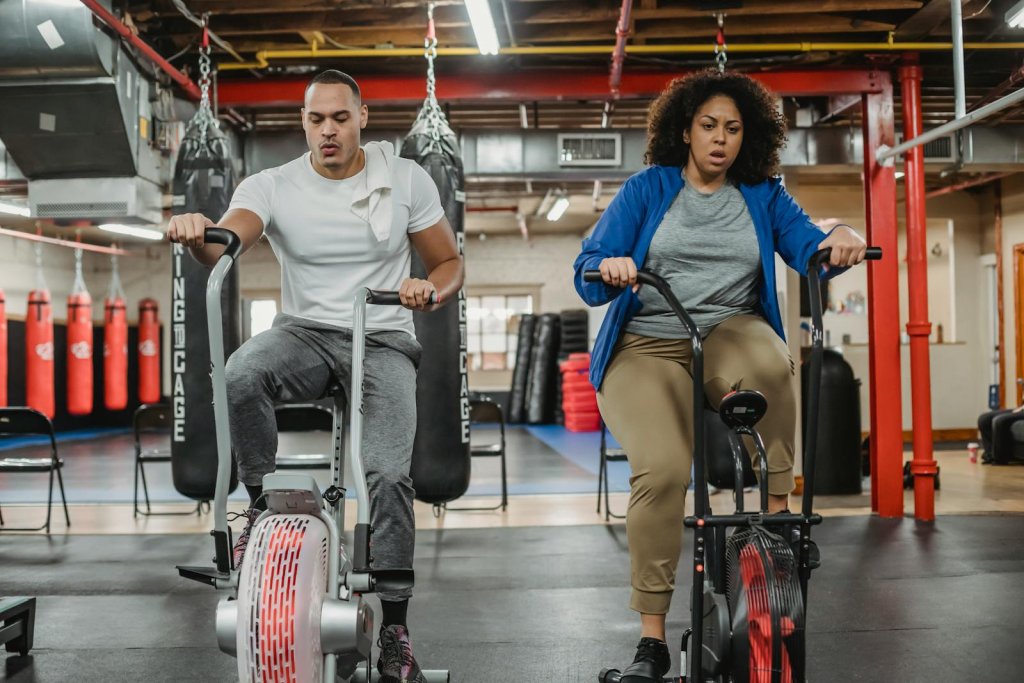
Understanding low impact exercises matters because they allow you to train consistently, reduce joint strain, and support long-term fitness. These exercises can improve strength, balance, and endurance while remaining accessible for beginners, older adults, and anyone seeking joint-friendly movement.
This guide covers the 10 best low impact exercises, why they work, muscles involved, and how to perform them safely.
What Are Low Impact Exercises
Low impact exercises are movements that reduce ground reaction forces and joint loading. This usually means:
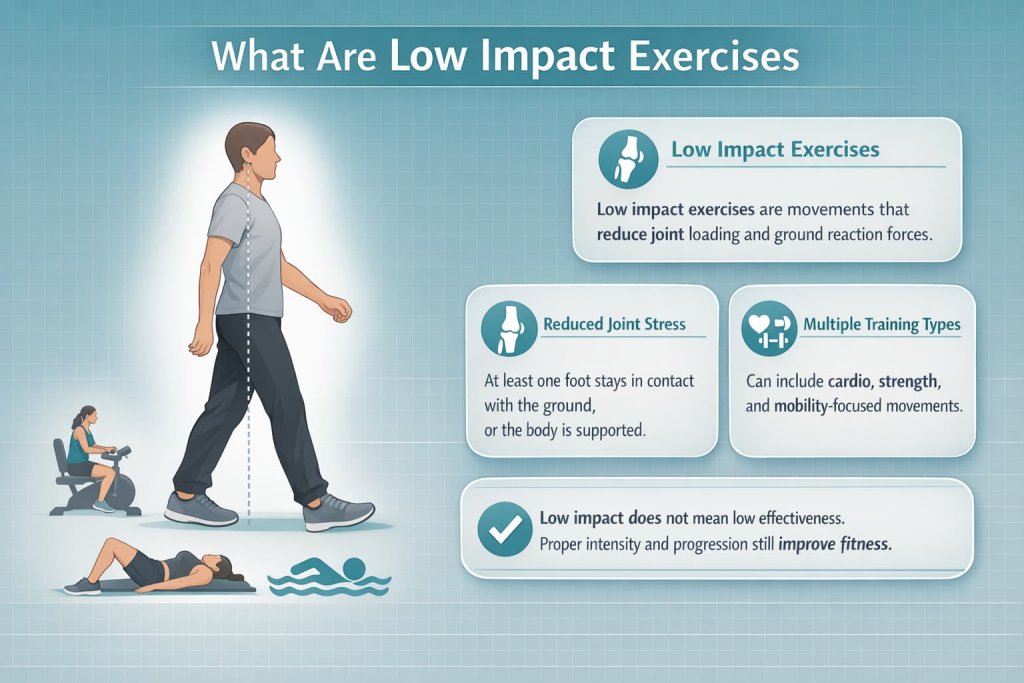
- At least one foot stays in contact with the ground, or
- The body is supported (seated, lying, or in water)
They can include cardio, strength, and mobility-focused movements. Despite being “low impact,” these exercises can still effectively improve fitness when performed with proper intensity and progression.
Benefits of Low Impact Exercises
Regular low impact training may help support:
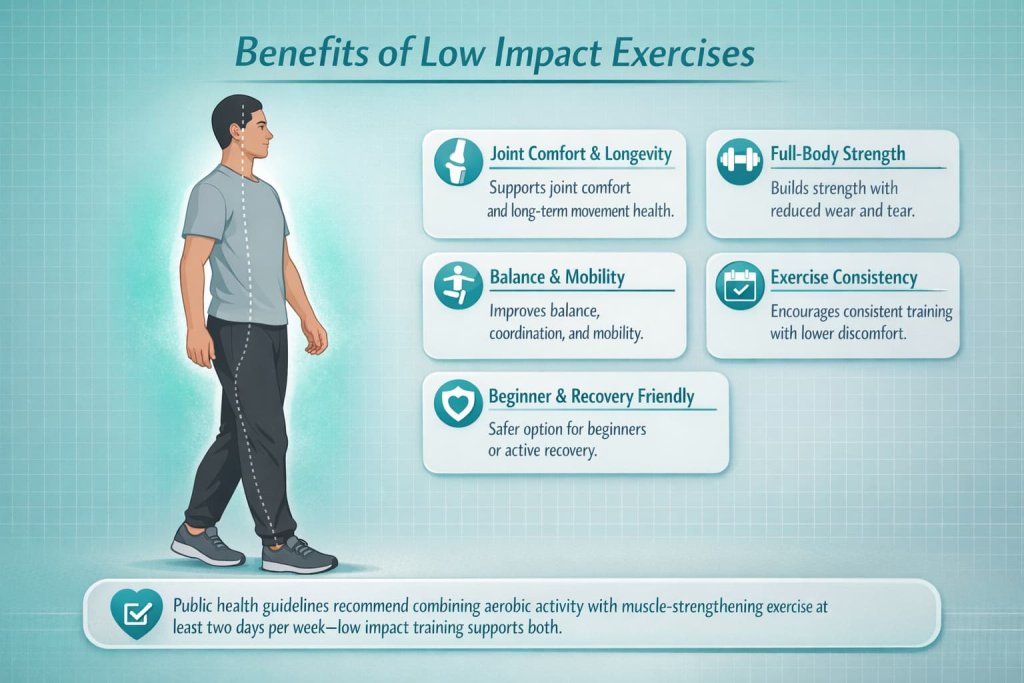
- Joint comfort and long-term movement health
- Full-body strength with reduced wear and tear
- Improved balance, coordination, and mobility
- Consistent exercise adherence due to lower discomfort
- Safer training for beginners or during active recovery
Public health guidelines from the CDC and WHO recommend combining aerobic activity with muscle-strengthening exercise at least two days per week, which low impact workouts can easily support.
10 Best Low Impact Exercises for Full-Body Strength and Mobility
These low impact exercises are designed to build full-body strength, improve mobility, and support joint health without excessive stress. They are suitable for beginners, older adults, and anyone seeking safe, sustainable fitness progress.
1. Walking
Why it works:
Walking is one of the most accessible low impact exercises and provides consistent cardiovascular stimulation without excessive joint loading. Because it mimics natural gait patterns, it helps improve endurance, circulation, and movement efficiency while remaining easy to recover from. Walking can be scaled for intensity through speed, incline, or duration.
Muscles worked:
Glutes, quadriceps, hamstrings, calves, core.
How to do it:
- Walk tall with relaxed shoulders and head facing forward
- Swing arms naturally in rhythm with your steps
- Maintain a brisk but comfortable pace that slightly elevates breathing
Trainer Tip:
Increasing stride speed or walking on a gentle incline boosts intensity without adding impact stress.
2. Cycling (Stationary or Outdoor)
Why it works:
Cycling allows you to train the lower body and cardiovascular system while minimizing stress on the knees and hips. The seated position reduces weight-bearing forces, making cycling suitable for longer sessions and consistent training volume.
Muscles worked:
Quadriceps, hamstrings, glutes, calves.
How to do it:
- Adjust seat height so knees remain slightly bent at the bottom of the pedal stroke
- Push through the mid-foot with smooth, circular motion
- Maintain steady, controlled pedaling cadence
Trainer Tip:
Use light to moderate resistance to improve leg strength rather than pedaling faster.
3. Swimming
Why it works:
Swimming uses water buoyancy to support body weight, significantly reducing joint stress while still challenging muscles through resistance. It engages multiple muscle groups at once and supports cardiovascular conditioning with minimal impact.
Muscles worked:
Shoulders, back, chest, core, hips, legs.
How to do it:
- Choose a stroke that feels comfortable and controlled
- Focus on steady breathing patterns
- Maintain a smooth, consistent rhythm
Trainer Tip:
Water resistance increases muscular demand without joint strain, making swimming effective even at moderate speeds.
4. Chair Squats
Why it works:
Chair squats reinforce a fundamental daily movement pattern—sitting and standing—while strengthening the lower body in a controlled manner. Using a chair limits depth and provides a safety reference, reducing strain on the knees and hips.
Muscles worked:
Quadriceps, glutes, hamstrings, core.
How to do it:
- Sit back toward the chair while keeping weight balanced
- Lightly touch the seat without fully relaxing
- Stand up by pressing through the heels
Trainer Tip:
Maintain an upright chest and keep knees aligned forward throughout the movement.
5. Step-Ups
Why it works:
Step-ups build unilateral leg strength and balance while keeping impact low. The controlled upward and downward motion strengthens muscles used in stair climbing and daily activities.
Muscles worked:
Glutes, quadriceps, hamstrings, calves.
How to do it:
- Step onto a low, stable platform
- Push through the lead foot to stand tall
- Step down slowly with control
Trainer Tip:
Start with a low step height and increase only when balance and control improve.
6. Glute Bridges
Why it works:
Glute bridges target hip extension while keeping the spine supported on the floor. This makes them an effective low impact option for strengthening the hips without compressive spinal loading.
Muscles worked:
Glutes, hamstrings, core.
How to do it:
- Lie on your back with knees bent and feet flat
- Press heels firmly into the floor
- Lift hips while keeping ribs down and core engaged
Trainer Tip:
Pause briefly at the top to improve glute activation and control.
7. Resistance Band Rows
Why it works:
Resistance band rows provide smooth, joint-friendly resistance that strengthens the upper back and improves posture. Bands allow gradual tension changes, reducing stress on the shoulders and elbows.
Muscles worked:
Upper back, lats, rear shoulders, arms.
How to do it:
- Anchor the band securely at chest height
- Pull elbows back while squeezing shoulder blades together
- Control the return to the starting position
Trainer Tip:
Avoid shrugging the shoulders—focus on pulling with the back muscles.
8. Bird Dog
Why it works:
Bird dog enhances core stability and coordination by training opposite-side limb control. It challenges balance and spinal stability without placing direct load on the spine.
Muscles worked:
Core, glutes, lower back, shoulders.
How to do it:
- Start on hands and knees with a neutral spine
- Extend the opposite arm and leg simultaneously
- Hold briefly, then switch sides
Trainer Tip:
Keep hips level and movements slow to maintain control.
9. Elliptical Trainer
Why it works:
Elliptical trainers mimic running mechanics while eliminating ground impact. This allows for longer cardio sessions that engage both upper and lower body muscles.
Muscles worked:
Legs, glutes, arms, core.
How to do it:
- Stand tall with light hand contact on the handles
- Push and pull smoothly through the stride
- Adjust resistance to match fitness level
Trainer Tip:
Increase resistance rather than speed to reduce joint stress.
10. Tai Chi
Why it works:
Tai chi emphasizes slow, flowing movements that improve balance, mobility, and body awareness. Its controlled pace makes it especially effective for developing coordination and stability.
Muscles worked:
Legs, core, stabilizing muscles.
How to do it:
- Move slowly between postures
- Focus on posture and breathing
- Maintain relaxed, controlled motion
Trainer Tip:
Approach tai chi as both balance training and mindful movement practice.
How Often Should You Do Low Impact Exercises
Most healthy adults can perform low impact exercises regularly as part of a balanced routine.
General guidance supported by the CDC and WHO includes:
- 150–300 minutes per week of moderate-intensity activity
- Muscle-strengthening exercises at least 2 days per week
- Balance-focused movements if stability is a goal
Low impact workouts can be performed more frequently than high-impact sessions, provided intensity and volume are managed appropriately.
Common Mistakes to Avoid With Low Impact Exercises
Even low impact training can be ineffective or uncomfortable if done incorrectly. Common mistakes include:
- Assuming low impact means low effort
- Rushing through movements without control
- Ignoring posture and alignment
- Avoiding resistance or strength work entirely
- Increasing volume too quickly
Good form and gradual progression are essential for results and safety.
Who Should Choose Low Impact Exercises
Low impact exercises are appropriate for a wide range of individuals, including:
- Beginners starting a fitness routine
- Adults returning to exercise after time off
- People seeking joint-friendly training options
- Older adults focusing on balance and mobility
- Individuals who prefer steady, controlled workouts
Choosing low impact exercise is often about sustainability. The ability to train regularly matters more than intensity alone.
How to Progress Low Impact Exercises Safely
Progression is necessary to continue seeing improvements, even with low impact workouts. Safe progression focuses on control rather than speed or impact.
Effective progression strategies include:
- Increasing repetitions or time under tension
- Adding light resistance (bands, dumbbells, machines)
- Slowing the tempo for better muscle engagement
- Improving balance or single-leg control
- Increasing session duration gradually
Who Should Be Cautious or Modify Low Impact Exercises
Low impact exercise is generally safe, but extra care may be needed if you:
- Experience persistent joint pain or swelling
- Have balance limitations
- Are returning after injury or surgery
- Feel dizziness, sharp pain, or instability during movement
Exercises should be stopped if discomfort increases or movement feels uncontrolled. Modifications and gradual progression are recommended rather than pushing through pain.
Frequently Asked Questions About Low Impact Exercises
Are low impact exercises enough to build strength
Yes. Strength improvements depend on resistance, volume, and consistency—not impact level.
Do low impact exercises improve mobility
Many low impact movements actively support joint range of motion and control.
Can low impact exercises replace high-impact workouts
They can meet fitness guidelines when properly programmed, especially for joint-friendly training.
Are low impact exercises suitable for daily workouts
In many cases, yes, as long as intensity and recovery are managed.
Do low impact exercises help with balance
Many low impact exercises challenge coordination and stability when performed with control.
Conclusion
Low impact exercises provide an effective way to build strength, improve mobility, and stay active without unnecessary joint stress. When programmed thoughtfully, they support long-term fitness, consistency, and movement quality.
If your goal is sustainable, full-body conditioning with reduced impact, low impact exercises are a practical and reliable choice.
References
- CDC: Adult Physical Activity Guidelines (CDC, Dec 20, 2023).
- WHO: Physical Activity Fact Sheet (WHO, Jun 26, 2024).
- American Heart Association: Physical Activity Recommendations for Adults (AHA, Jan 19, 2024).
- Mayo Clinic: Exercising With Arthritis (Mayo Clinic, accessed 2025).
- CDC: About Physical Activity and Arthritis (CDC, Feb 14, 2024).
- Arthritis Foundation: Water Exercise Benefits for Arthritis (Arthritis Foundation, accessed 2025).
- ACSM Position Stand: Progression Models in Resistance Training for Healthy Adults (PubMed) (Med Sci Sports Exerc, 2009).
- BMJ Open: Tai Chi for Preventing Falls in Older Adults (Systematic Review and Meta-analysis) (BMJ Open, 2017).