
Knee strengthening exercises for osteoarthritis help support the muscles around the knee joint, which can reduce pain, improve stability, and make daily movement easier. Strengthening the quadriceps, hamstrings, glutes, and surrounding muscles reduces stress on the knee joint itself—an approach consistently recommended in clinical guidelines for knee osteoarthritis.
Understanding how and why these exercises work is important because osteoarthritis is a long-term joint condition. The right exercise routine can help you stay active, maintain function, and manage symptoms safely over time. Most programs focus on low-impact strengthening, controlled movement, and gradual progression, often alongside walking or other gentle aerobic activity.
This guide explains the 10 best knee strengthening exercises for osteoarthritis, how to perform them safely, and who should be cautious.
What Are Knee Strengthening Exercises for Osteoarthritis?
Knee strengthening exercises osteoarthritis are controlled, joint-friendly movements designed to build strength in the muscles that support and stabilize the knee. These muscles help absorb load, guide proper joint motion, and reduce excessive stress on worn cartilage.
Most programs emphasize:
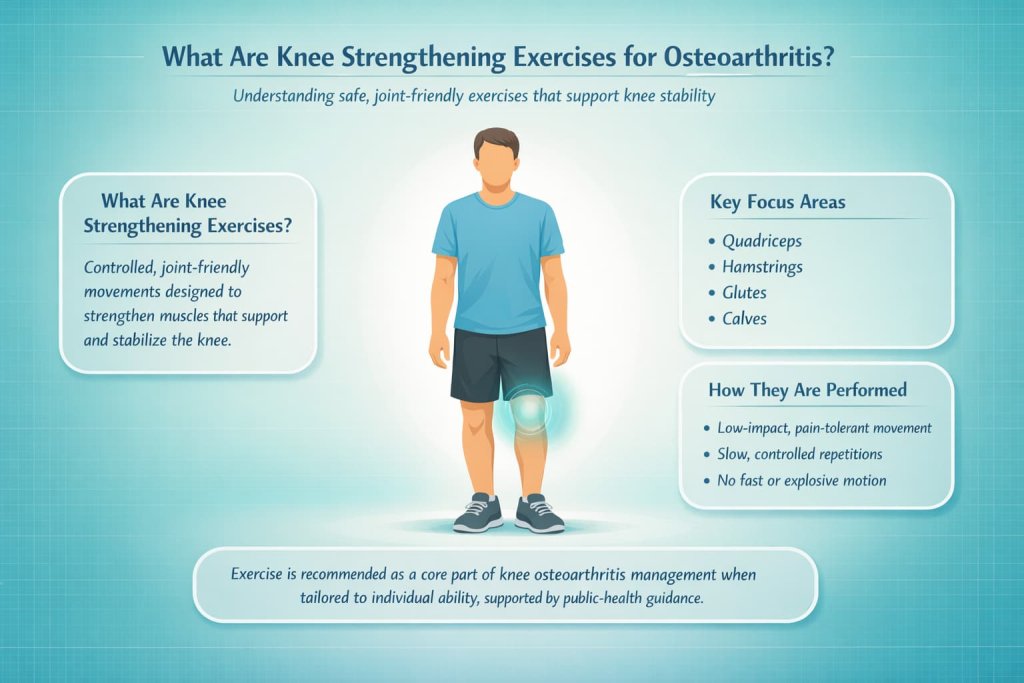
- Low-impact, pain-tolerant movement
- Strengthening of the quadriceps, hamstrings, glutes, and calves
- Slow, controlled repetitions rather than fast or explosive motion
Clinical guidance from the Centers for Disease Control and Prevention and the World Health Organization supports exercise as a core part of osteoarthritis management when tailored to individual ability.
10 Best Knee Strengthening Exercises for Osteoarthritis
These low-impact exercises focus on strengthening the muscles that support the knee joint, which may help improve stability and daily movement. When performed consistently and within a comfortable range, they can play a supportive role in managing osteoarthritis-related knee discomfort.
1. Quad Sets
How to do it:
- Sit or lie down with your leg straight and supported.
- Tighten the muscle on the front of your thigh.
- Press the back of your knee gently toward the surface.
- Hold the contraction for 5–10 seconds.
- Relax and repeat.
Why it works:
Quad sets activate the quadriceps without bending the knee, which makes them especially useful during pain flares or early rehabilitation when joint movement is limited.
Muscles worked:
Quadriceps.
Trainer Tip:
Focus on muscle tension, not force. You should feel the thigh tighten without pushing through knee discomfort.
2. Straight-Leg Raises
How to do it:
- Lie on your back with one knee bent and the other leg straight.
- Tighten the thigh of the straight leg.
- Slowly lift the straight leg to the height of the opposite knee.
- Hold briefly, then lower with control.
- Repeat before switching sides.
Why it works:
This exercise strengthens the quadriceps while keeping the knee joint stable, helping support the knee without excessive joint loading.
Muscles worked:
Quadriceps, hip flexors.
Trainer Tip:
Lift slowly and avoid swinging the leg. Control matters more than height.
3. Seated Knee Extensions
How to do it:
- Sit upright in a chair with feet flat on the floor.
- Slowly straighten one knee until the leg is extended.
- Hold the position briefly.
- Lower the foot back down with control.
- Alternate sides.
Why it works:
Seated knee extensions strengthen the quadriceps through a controlled range of motion, supporting knee function during daily activities like walking and standing.
Muscles worked:
Quadriceps.
Trainer Tip:
Stop just before discomfort and avoid locking the knee at the top.
4. Sit-to-Stand (Chair Squats)
How to do it:
- Sit on a sturdy chair with feet hip-width apart.
- Lean slightly forward and press through your heels.
- Stand up slowly.
- Lower yourself back to the chair with control.
- Repeat.
Why it works:
This functional movement builds strength needed for everyday tasks such as standing up, sitting down, and climbing stairs.
Muscles worked:
Quadriceps, glutes, hamstrings.
Trainer Tip:
Use a higher chair or armrests if knee pain or balance limits control.
5. Step-Ups (Low Height)
How to do it:
- Stand facing a low step or platform.
- Place one foot fully on the step.
- Push through that foot to step up.
- Step back down slowly.
- Complete reps, then switch sides.
Why it works:
Step-ups improve knee stability and single-leg strength, which are essential for stair climbing and balance.
Muscles worked:
Quadriceps, glutes, calves.
Trainer Tip:
Start with the lowest step possible and increase height only if pain remains manageable.
6. Hamstring Curls (Standing or Prone)
How to do it:
- Stand holding a chair or lie face down.
- Slowly bend one knee, bringing the heel toward your body.
- Pause briefly.
- Lower the leg with control.
- Repeat on the other side.
Why it works:
Strengthening the hamstrings balances quadriceps dominance and supports smoother knee joint control.
Muscles worked:
Hamstrings.
Trainer Tip:
Move slowly and avoid arching the lower back during the curl.
7. Glute Bridges
How to do it:
- Lie on your back with knees bent and feet flat.
- Tighten your glutes and gently brace your core.
- Lift your hips until your body forms a straight line.
- Hold briefly.
- Lower slowly and repeat.
Why it works:
Strong glutes reduce excessive load on the knees by improving hip and pelvic control during movement.
Muscles worked:
Glutes, hamstrings, core.
Trainer Tip:
Think “hips up, ribs down” to avoid overextending the lower back.
8. Wall Sits (Partial Depth)
How to do it:
- Stand with your back against a wall.
- Slide down slightly into a partial squat.
- Keep feet forward and knees aligned.
- Hold the position for a short time.
- Slowly stand back up.
Why it works:
Wall sits build quadriceps endurance while limiting knee movement, which can be helpful for managing osteoarthritis symptoms.
Muscles worked:
Quadriceps, glutes.
Trainer Tip:
Only lower as far as comfortable—depth is not required for benefit.
9. Calf Raises
How to do it:
- Stand near a wall or counter for support.
- Slowly rise onto your toes.
- Pause briefly at the top.
- Lower your heels back down with control.
- Repeat.
Why it works:
Calf strength improves shock absorption and supports smoother walking mechanics, reducing stress on the knee.
Muscles worked:
Gastrocnemius, soleus.
Trainer Tip:
Focus on slow, controlled movement rather than speed.
10. Side-Lying Leg Raises
How to do it:
- Lie on your side with legs stacked.
- Keep the bottom leg bent and top leg straight.
- Lift the top leg slightly upward and back.
- Lower slowly and repeat.
- Switch sides.
Why it works:
Strong hip abductors help maintain proper knee alignment during walking and standing activities.
Muscles worked:
Hip abductors (gluteus medius).
Trainer Tip:
Keep your toes facing forward to avoid shifting work away from the hip.
How Often Should You Do Knee Strengthening Exercises?
Most guidelines suggest:
- 2–3 sessions per week for strengthening
- 1–3 sets of 8–12 slow, controlled repetitions
- Gradual progression based on comfort and tolerance
Consistency matters more than intensity. Mild muscle soreness is normal, but sharp or worsening joint pain is not.
Why Strengthening Exercises Matter for Knee Osteoarthritis
Muscle weakness around the knee is linked with greater pain and functional limitation in osteoarthritis. Strengthening exercises may help by:
- Improving joint stability
- Reducing stress on damaged cartilage
- Supporting safer walking, standing, and stair use
According to the American Academy of Orthopaedic Surgeons, exercise is recommended as a first-line, non-surgical approach for knee osteoarthritis.
Who Can Benefit From Knee Strengthening Exercises for Osteoarthritis?
These exercises may be helpful for:
- Adults with mild to moderate knee osteoarthritis
- Older adults aiming to maintain mobility
- People experiencing knee stiffness or weakness during daily activities
Programs should always be adapted to individual pain levels and functional ability.
How to Warm Up Before Knee Strengthening Exercises
Warming up prepares your joints, muscles, and nervous system for movement and may help reduce stiffness and discomfort associated with knee osteoarthritis. A proper warm-up increases blood flow, improves joint lubrication, and allows muscles to activate more smoothly before strengthening work.
A simple warm-up should last 5–10 minutes and stay within a comfortable, pain-free range.
Effective warm-up options include:
- Gentle walking on a flat surface or treadmill
- Seated or standing knee bends with controlled range
- Slow marching in place
- Light cycling on a stationary bike
- Ankle pumps and heel-to-toe movements
The goal is not to stretch aggressively or fatigue the muscles. Instead, focus on gradual movement that reduces stiffness and helps your knees feel more prepared for exercise.
If pain increases during the warm-up, reduce the range of motion or slow the pace before continuing.
Common Mistakes to Avoid With Knee Osteoarthritis Exercises
Even well-chosen exercises can become less effective or uncomfortable if performed incorrectly. Avoiding common mistakes can help protect your joints and improve long-term results.
Common mistakes include:
- Exercising through sharp or worsening knee pain
- Moving too quickly or using momentum instead of control
- Skipping warm-ups before strengthening sessions
- Holding breath during exercises, which can increase tension
- Progressing resistance or volume too quickly
- Ignoring hip and calf strength, which support knee alignment
- Continuing exercises during significant swelling or joint flare-ups
Knee osteoarthritis responds best to slow, controlled, and consistent movement. More intensity is not always better. Small, steady improvements in strength and control are more beneficial than pushing through discomfort.
When in doubt, reducing intensity or seeking guidance from a qualified professional can help ensure exercises remain safe and appropriate.
Who Should Be Careful or Seek Guidance First?
Extra caution is advised for:
- Severe or rapidly worsening knee pain
- Significant swelling, locking, or joint instability
- Recent knee surgery or injury
Frequently Asked Questions
Do knee strengthening exercises cure osteoarthritis?
No. Osteoarthritis is a chronic condition, but strengthening exercises may help manage symptoms and improve function.
Can I do these exercises every day?
Light exercises like quad sets can be done daily, but most strengthening routines are best performed 2–3 times per week.
Should exercises hurt if I have osteoarthritis?
Exercises should stay within a tolerable, pain-free or low-pain range. Sharp or increasing pain is a sign to stop.
Are weights necessary for knee osteoarthritis exercises?
No. Bodyweight exercises are effective, especially at the beginner level. Resistance can be added gradually if tolerated.
Is walking enough for knee osteoarthritis?
Walking is beneficial for overall joint health, but strengthening exercises provide additional support and stability for the knee.
How long before I notice improvement?
Many people notice better strength or function within 6–8 weeks of consistent exercise.
Conclusion
Knee strengthening exercises for osteoarthritis focus on building supportive muscle strength, improving stability, and promoting safer movement. When performed consistently and within a comfortable range, these exercises can play an important role in long-term knee health and daily function.
If you’re unsure where to start or have persistent pain, consider consulting a qualified healthcare or rehabilitation professional for individualized guidance.
References
- 2019 American College of Rheumatology/Arthritis Foundation Guideline for Osteoarthritis Management (Hand, Hip, Knee)
- AAOS Clinical Practice Guideline: Management of Osteoarthritis of the Knee (Non-Arthroplasty), 3rd Edition (PDF)
- NICE Guideline NG226: Osteoarthritis in Over 16s—Diagnosis and Management
- NICE NG226 Recommendations: Therapeutic Exercise for Osteoarthritis
- Cochrane Review (2024): Exercise for Osteoarthritis of the Knee
- BMJ Systematic Review & Network Meta-Analysis (2025): Comparative Efficacy of Exercise Modalities in Knee Osteoarthritis
- OARSI Guidelines (2019): Non-Surgical Management of Knee, Hip, and Polyarticular Osteoarthritis (PubMed)
- NHS Inform: Exercises to Help with Osteoarthritis of the Knee