
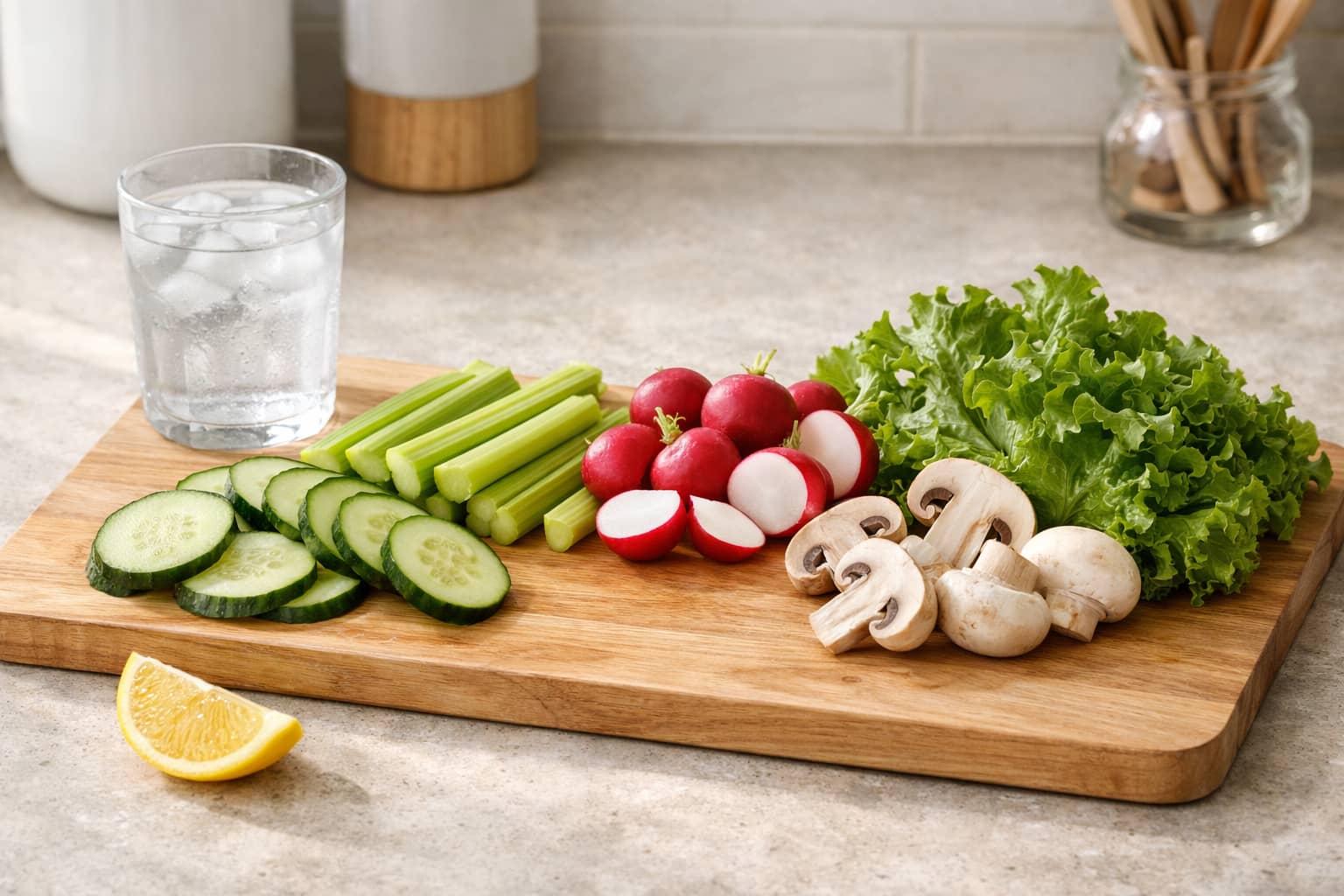
There are almost no truly “zero calorie foods” in real life—most are simply very low-calorie foods or products that can round down to 0 calories on the label. Understanding the difference matters for nutrition and overall wellness because it helps you build satisfying meals, manage portions realistically, and avoid getting misled by marketing.
What “zero calorie foods” really means
“Zero calories” on a label can be rounding, not true zero
In the U.S., a product can use terms like “zero calories” or “calorie free” when it contains less than 5 calories per labeled serving (and per reference amount customarily consumed). According to the Cornell Law School Legal Information Institute, this is the regulatory basis for calorie-free claims.
That same rounding logic is why tiny serving sizes can look “free” on paper. According to the FDA, foods with less than 5 calories may be expressed as 0 calories on the Nutrition Facts label.
Serving size is the make-or-break detail
If you eat multiple servings, those “rounded down” calories can add up. This is especially common with items used in small amounts (sprays, sweeteners, drink mixes), where the labeled serving may be much smaller than what people actually use.
Zero-calorie foods vs zero-calorie products
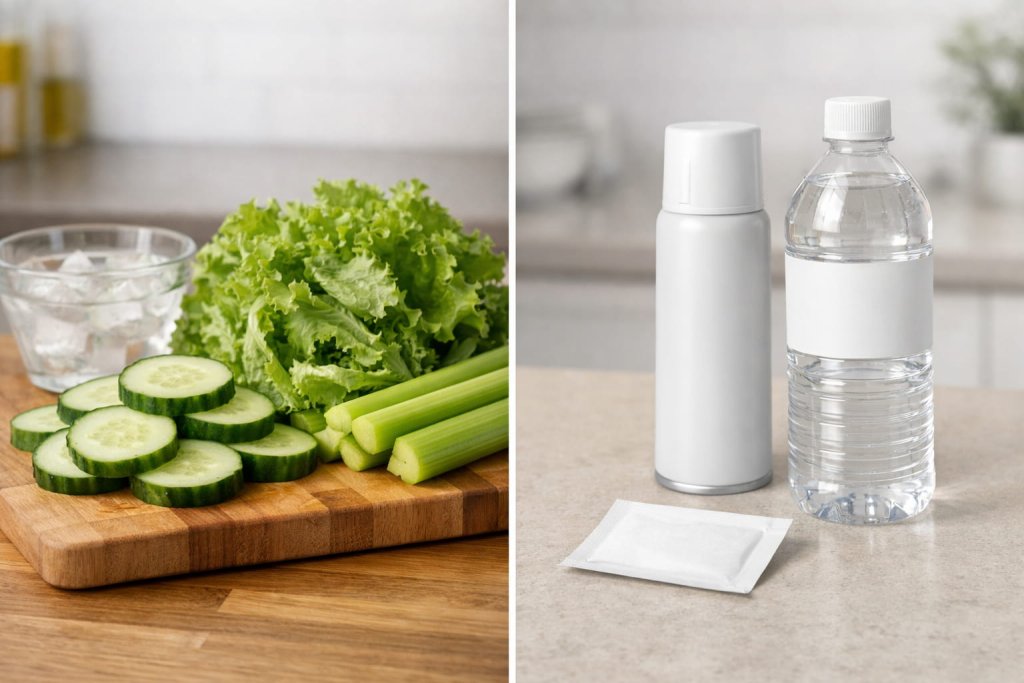
Many people search “zero calorie foods” expecting a list of foods, but it helps to separate near-zero foods from zero-calorie labeled products.
- “Near-zero foods” are mostly watery, high-volume vegetables (like cucumber, lettuce, celery, mushrooms). They’re not truly calorie-free, but they’re very low in calories per serving and can add crunch and volume to meals.
- “Zero-calorie” items are often products (sweeteners, flavored waters, sprays, drink mixes) that may show 0 calories due to label rounding and small serving sizes.
Quick reminder: always check serving size and how many servings you actually use—several servings can turn “0” into a meaningful number.
“Zero calories” or “calorie free” product list table
In the U.S., “calorie free/zero calories” claims generally mean less than 5 calories per labeled serving, and labels may show 0 calories when a serving contains under 5 calories (per FDA rounding rules). According to the Cornell Law School Legal Information Institute and the FDA, serving size is what makes most “0 calorie” products possible.
| “Zero-calorie” product type | Common examples (generic) | Why it can show 0 calories | What to check before you rely on “0” | Practical wellness tip |
|---|---|---|---|---|
| Water | Plain bottled/tap water | No meaningful energy content | Add-ins (sweetened flavorings) | Make this your default drink |
| Unsweetened sparkling water | Plain carbonated water | Typically no calories | “Unsweetened” vs “sweetened” | Great swap for soda cravings |
| Unsweetened tea | Hot/iced tea (no sugar) | Very low energy if unsweetened | Bottled teas often add sugar | Brew at home for control |
| Black coffee | Coffee without sugar/cream | Very low energy if plain | Creamers, syrups, sugar | If you add milk, measure it |
| Diet/“zero” soda | Zero-sugar soft drinks | Sweetened without sugar | Serving size; caffeine content | Better than full-sugar soda, but not a “health food” |
| Zero-sugar flavored water | Flavored water with non-nutritive sweeteners | Often rounds to 0 | Sweeteners used; serving size | If it increases cravings, use less often |
| Powdered drink mix (sugar-free) | “Zero sugar” packets for water | Small serving sizes can round to 0 | How many packets you use | Use 1 packet first; don’t double by habit |
| Tabletop sweeteners | Packets, drops (sucralose/stevia/saccharin, etc.) | Tiny amounts per serving; rounding | Serving size (how many packets) | Keep it occasional; focus on less sweet over time |
| “Zero calorie” syrup | Sugar-free pancake/coffee syrups | Very small servings; sugar alcohols/sweeteners | Serving size; carbs/sugar alcohols | Measure; it’s easy to pour 3–4 servings |
| Cooking spray | Nonstick spray | Extremely small serving size; rounds to 0 | Serving size vs real use time | Spray briefly; use a measured teaspoon of oil when needed |
| Sugar-free gelatin mix | “Sugar-free” gelatin desserts | Often very low per serving | Serving size; added ingredients/toppings | Keep toppings light (fruit vs whipped toppings) |
| Light salad dressing “0 cal” claim | Some “fat-free/light” dressings | Rounding + small serving sizes | Serving size and added sugars | Use vinegar/lemon + herbs when possible |
The biggest marketing myths to avoid
Myth 1: “Negative calorie foods” burn more than they contain
The “negative calorie foods” idea (often linked to celery) doesn’t hold up in real-world biology. Your body does spend energy digesting food, but that cost is typically only a fraction of the calories in the food itself.
According to the National Institutes of Health, diet-induced thermogenesis (also called the thermic effect of food) is commonly reported below about 10% of the energy content of food in many study designs. That’s why very low-calorie vegetables can support a calorie deficit overall, but they aren’t “magic” foods that erase calories.
A human study that directly tested the celery myth found the same practical outcome. According to Cambridge University Press (Proceedings of the Nutrition Society), celery consumption did not produce a negative energy balance in healthy women—meaning celery was not a “negative calorie” food, even though the digestion cost for celery can be relatively high compared with its small calorie content.
Myth 2: “Zero calorie” automatically means “better for wellness”
A “0 calorie” label doesn’t automatically make something a better everyday choice. For overall wellness, what matters most is your overall pattern: enough fiber, protein, and nutrient-rich foods, plus balanced meals you can stick with.
Zero calorie foods list: what’s closest to zero
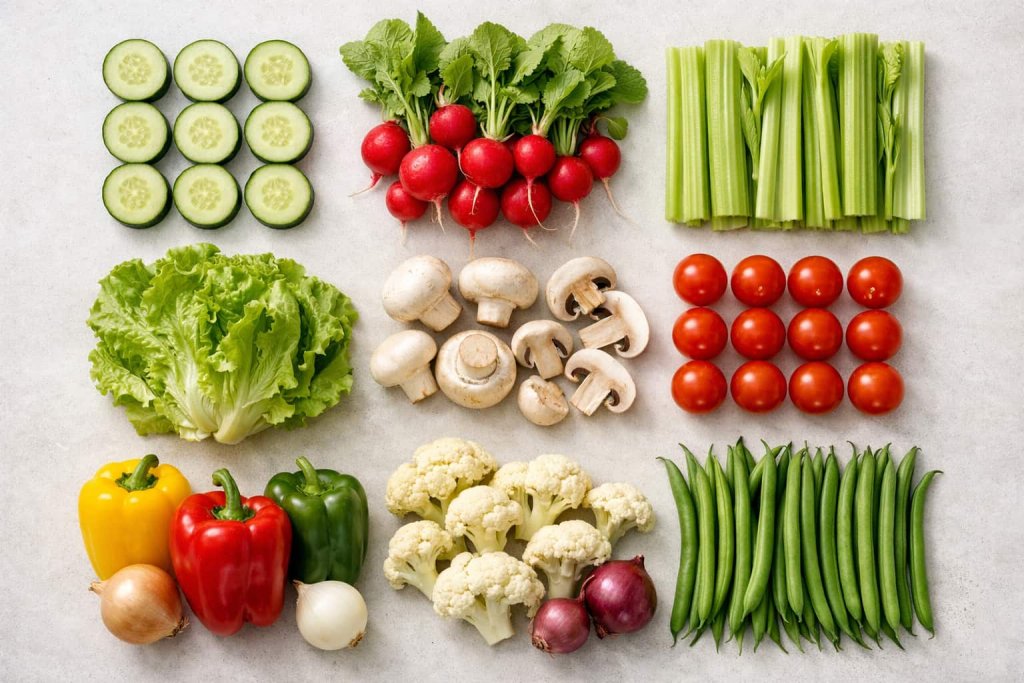
These are very low-calorie vegetables that add volume and crunch, which may help you feel more satisfied while supporting a nutrient-dense eating pattern.
Very low-calorie vegetables (real numbers)
The table below uses the FDA raw vegetable nutrition information for common servings (most are about 10–30 calories, with a few still-low options up to 45).
| Food | Serving size (FDA) | Calories |
|---|---|---|
| Cucumber | 1/3 medium (99 g) | 10 |
| Iceberg lettuce | 1/6 medium head (89 g) | 10 |
| Radishes | 7 radishes (85 g) | 10 |
| Green onion | 1/4 cup chopped (25 g) | 10 |
| Celery | 2 medium stalks (110 g) | 15 |
| Leaf lettuce | 1 1/2 cups shredded (85 g) | 15 |
| Asparagus | 5 spears (93 g) | 20 |
| Green (snap) beans | 3/4 cup cut (83 g) | 20 |
| Mushrooms | 5 medium (84 g) | 20 |
| Summer squash | 1/2 medium (98 g) | 20 |
| Tomato | 1 medium (148 g) | 25 |
| Bell pepper | 1 medium (148 g) | 25 |
| Cauliflower | 1/6 medium head (99 g) | 25 |
| Green cabbage | 1/12 medium head (84 g) | 25 |
| Carrot | 1 carrot, 7″ long, 1 1/4″ diameter (78 g) | 30 |
| Broccoli | 1 medium stalk (148 g) | 45 |
| Onion | 1 medium (148 g) | 45 |
What about “zero calorie” drinks?
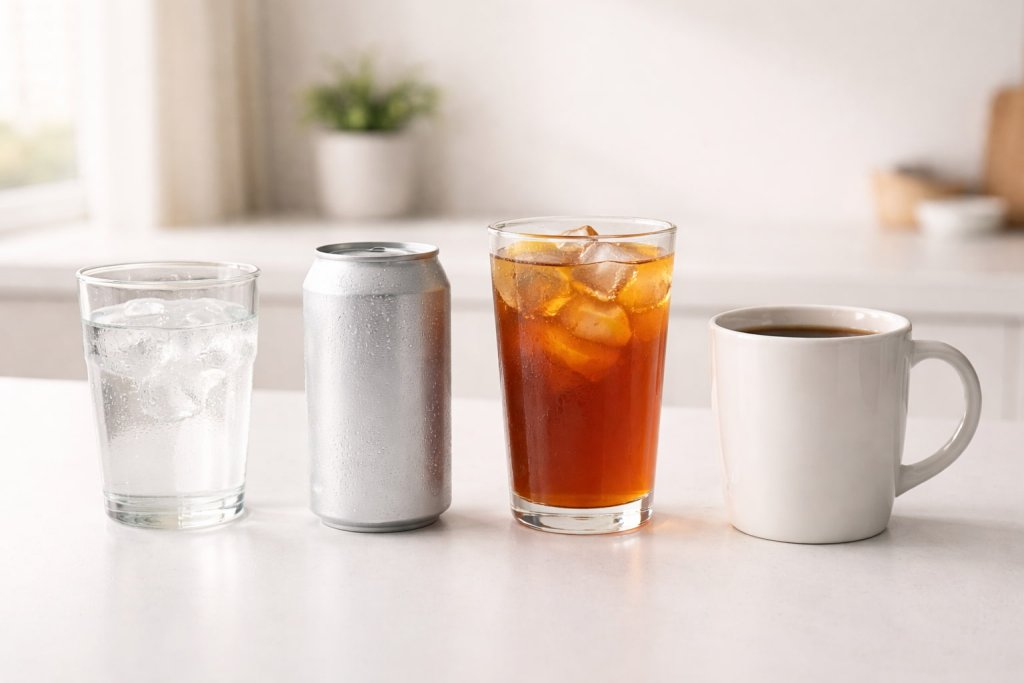
Plain water is effectively calorie-free for practical purposes. Unsweetened tea and black coffee are typically very low in calories, but add-ins (sugar, cream, flavored syrups) change that fast.
Zero calorie drinks and what changes the calories fast
Most “zero calorie drinks” are truly zero or close to it only when they’re unsweetened and uncreamed.
Best zero/near-zero options:
- Water (still or sparkling)
- Unsweetened tea (hot or iced)
- Black coffee (or coffee with minimal add-ins)
What changes the calories fast:
- Sugar, honey, sweetened creamers
- Milk/cream added in larger amounts
- Flavored syrups and whipped toppings
- Juice “splashes” and sweetened mixers
Note: Energy drinks or sodas labeled “0” can be a better choice than full-sugar versions, but they aren’t automatically “health foods.” Treat them as an occasional tool, not the foundation of a wellness routine.
Why these foods can support fullness and wellness
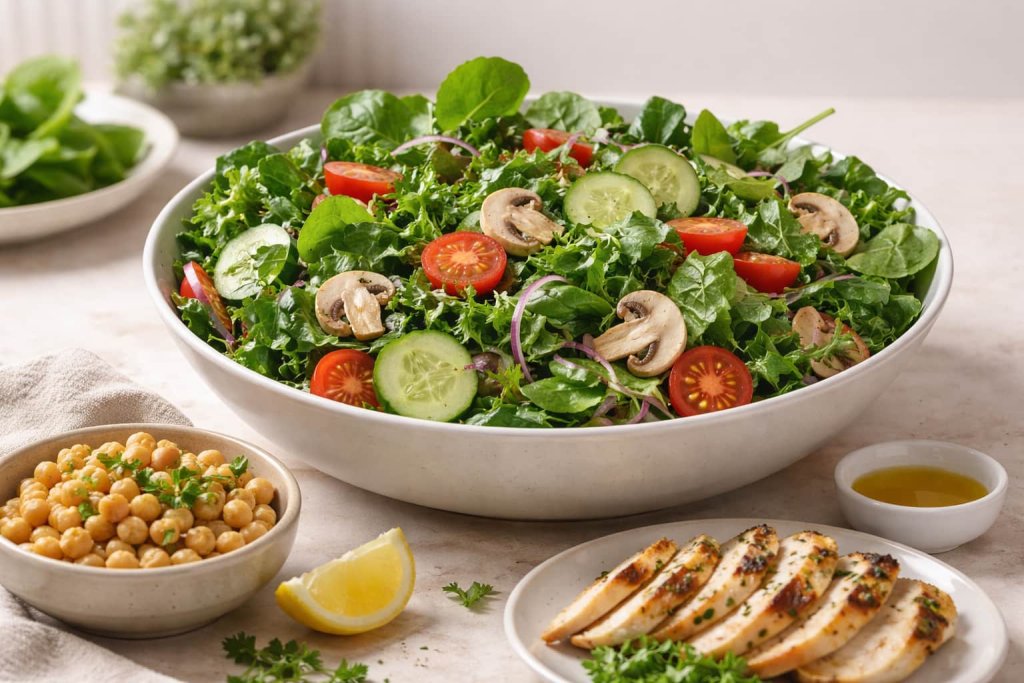
Very low-calorie vegetables tend to be high in water and/or fiber, which increases food volume without adding many calories. That “volume effect” is one reason they’re commonly used in balanced eating patterns.
According to the Mayo Clinic, fruits and vegetables often have high water and fiber content that provides volume and weight but relatively few calories, which supports a lower energy density eating approach.
How to use “near-zero” foods in real meals
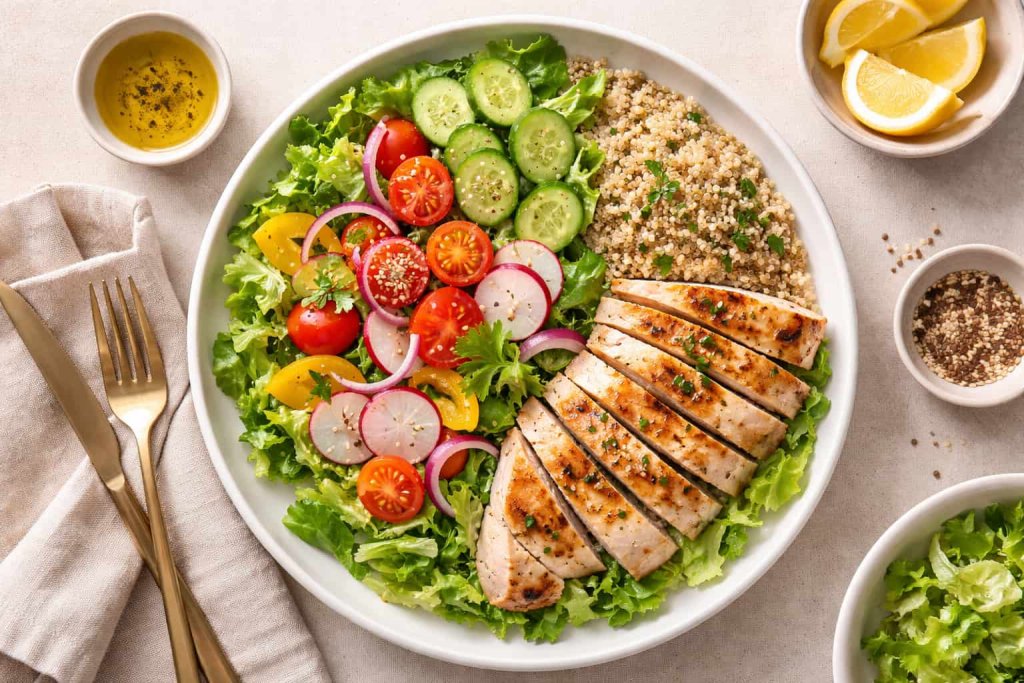
Build a wellness-friendly plate (simple and realistic)
Use very low-calorie vegetables as the base, then add the nutrients your body needs for a balanced meal.
- Start with 1–2 cups of non-starchy vegetables (salad, cucumbers, mushrooms, tomatoes)
- Add a protein source (beans/lentils, fish, eggs, poultry, tofu)
- Add a fiber-rich carb if it fits your needs (oats, whole grains, potatoes, fruit)
- Include healthy fats in reasonable amounts (olive oil, nuts, seeds, avocado)
This approach supports overall wellness because you get volume plus key nutrients, instead of chasing “zero calories.”
Best ways to eat these vegetables
To make very low-calorie vegetables enjoyable and easy to repeat, rely on flavor boosts that don’t add many calories:
Best low-cal flavor boosts:
- Lemon or lime juice
- Vinegar (balsamic, red wine, rice vinegar)
- Fresh herbs (cilantro, parsley, basil)
- Spices (pepper, paprika, chili flakes, garlic powder)
- Salsa or pico de gallo
Watch-outs: dressings, sauces, and dips can be calorie-dense. If you use them, try measuring, choosing lighter options, or using “flavor-forward” swaps like lemon + herbs.
Easy examples (no complicated tracking)
- Crunchy snack: cucumber + tomatoes + a yogurt-based dip
- Big salad meal: leaf lettuce + mushrooms + tomatoes + beans + olive oil/lemon dressing
- Stir-fry base: mushrooms + green beans + onions, then add tofu or chicken and a whole grain side
How to use very low-calorie foods without under-eating
Very low-calorie vegetables can support wellness because they add volume, but they work best when you use them to build meals, not replace them.
- Use these foods to add volume and crunch, especially if you like larger portions.
- For satisfaction, pair them with protein + fiber + healthy fats (for example: beans, eggs, fish/tofu, whole grains, olive oil, nuts/seeds).
- If you feel low energy, dizzy, or constantly hungry, consider adjusting your meal balance and talk to a qualified clinician.
How to spot “zero calorie” marketing fast
Quick label checklist
- Check the serving size first (is it unrealistically small?)
- Look for the calories per serving (0 can mean “under 5”)
- Multiply if you typically use more than one serving
According to the FDA Food Labeling Guide, values under 5 calories may be shown as 0, which is why serving size behavior matters.
Common mistakes
Common mistakes that can derail “zero calorie” expectations:
- Assuming “0 calories” means unlimited
- Ignoring serving size (and how many servings you actually use)
- Drinking calories through add-ins (cream, sugar, syrups, juice)
- Overusing dressings, sauces, and dips while focusing only on vegetables
People also ask about zero calorie foods
Are there any truly zero calorie foods?
Practically, water is the closest. Most foods contain at least some calories, even if very small.
Is celery a zero calorie food?
No. It’s very low-calorie, but not zero. According to the FDA raw vegetable nutrition information, 2 medium stalks of celery have 15 calories.
Do “zero calorie” sweeteners count?
They can still contribute calories depending on the product, serving size, and how much you use. The main point is to verify serving size and ingredients rather than relying on the front label.
Can low-calorie vegetables help with weight goals?
They may help by adding volume and supporting fullness in meals. According to the Mayo Clinic, low energy density foods (often fruits and vegetables) can help you feel full on fewer calories.
FAQ
1) What is the best “zero calorie foods list” that’s actually accurate?
An accurate list focuses on very low-calorie vegetables (like cucumber, lettuce, celery, radishes, mushrooms) rather than claiming foods are literally calorie-free.
2) Why do some foods say 0 calories but still have ingredients with calories?
Because label rules allow rounding down when calories are very low per serving. According to the FDA Food Labeling Guide, products under 5 calories per serving may be listed as 0.
3) Are “negative calorie foods” real?
Evidence does not support the claim. According to the National Institutes of Health, digestion energy is typically a small percentage of intake, not enough to “cancel out” the food.
4) What’s the best way to use very low-calorie foods for overall wellness?
Use them to increase vegetable intake and meal volume, then add protein, fiber-rich carbs, and healthy fats for balance.
5) Where can I check exact calories for foods?
For detailed nutrition data, use USDA FoodData Central.
6) Are “zero calorie” products always a good choice?
Not automatically. Wellness depends on overall diet quality and balance, not only calories.
7) What are the best “zero calorie snacks” that feel filling?
Most “zero calorie snacks” are really very low-calorie snacks. For the most filling results, pair crunchy vegetables with a small protein or fiber boost:
- Cucumber + tomatoes + a yogurt-based dip
- Leafy salad + beans or chickpeas
- Celery + a measured portion of hummus
These options keep calories relatively low while supporting satisfaction.
8) Do zero-calorie sweeteners affect appetite?
It varies from person to person. Some people find zero-calorie sweeteners help them reduce added sugar, while others notice more cravings or snacking later. The most practical approach is to watch your own patterns—if it increases cravings, consider using it less often and focusing more on unsweetened foods and drinks.
Conclusion
“Zero calorie foods” are mostly a label shortcut or a way of describing very low-calorie vegetables, not a literal nutrition category. If you use these foods to add volume, crunch, and variety—while still building balanced meals—you’ll get a more realistic, wellness-friendly strategy than chasing marketing claims.
References
- FDA
- FDA
- Cornell Law School Legal Information Institute
- USDA FoodData Central
- Mayo Clinic
- National Institutes of Health
This content is for informational purposes only and not medical advice.