
Tricep tendonitis exercises are designed to reduce elbow pain while gradually restoring strength and load tolerance in the triceps tendon. When selected and progressed correctly, these exercises may help improve daily function, support a safe return to training, and reduce symptom flare-ups over time.

Understanding and using the right exercises matters because tricep tendon pain is often related to how the tendon handles load—not just inflammation.
What Are Tricep Tendonitis Exercises?
Tricep tendonitis exercises focus on gradually loading the triceps tendon at the elbow to improve strength, coordination, and tolerance to everyday and athletic demands. Clinically, this condition is often referred to as triceps tendinopathy, reflecting changes in tendon structure and load capacity rather than short-term inflammation alone.
These exercises typically aim to:
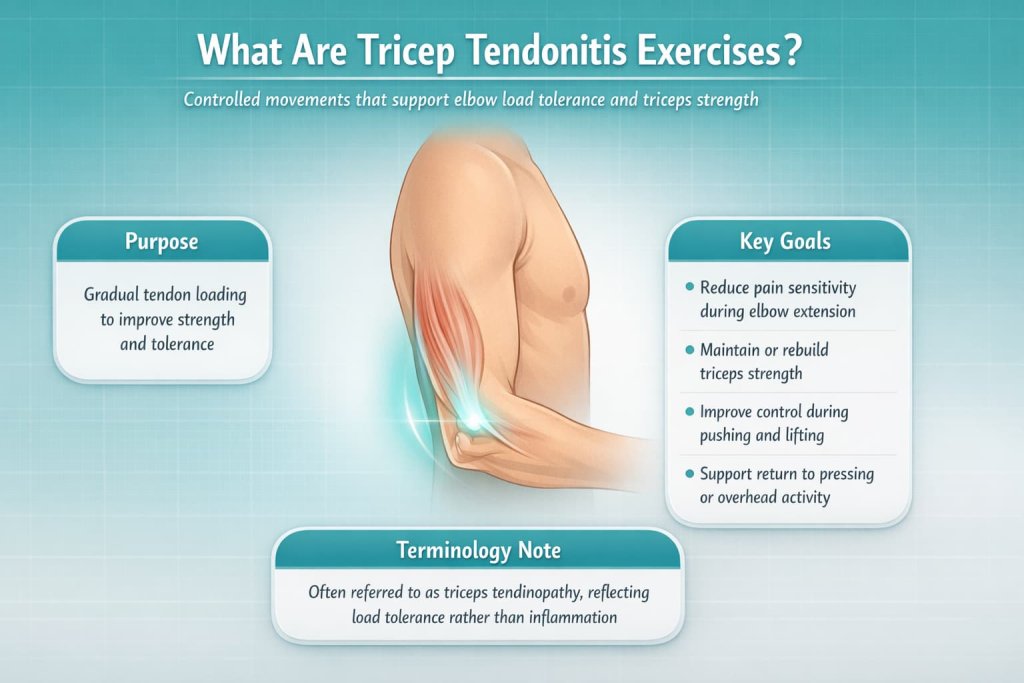
- Reduce pain sensitivity during elbow extension
- Maintain or rebuild triceps strength
- Improve elbow control during pushing and lifting tasks
- Support a safe return to pressing or overhead activities
Why Exercise Matters for Tricep Tendonitis
Exercise does not “repair” a tendon overnight. Instead, appropriate loading may help by:
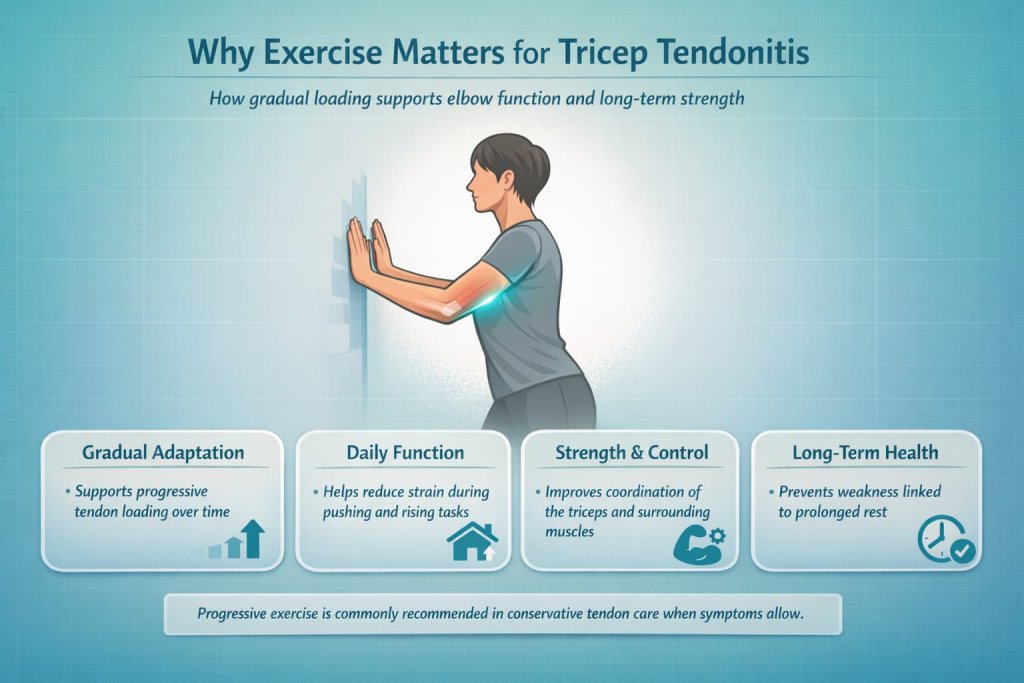
- Supporting gradual tendon adaptation to stress
- Reducing excessive strain during daily tasks like pushing or rising from a chair
- Improving strength and coordination of the triceps and surrounding muscles
- Preventing long-term weakness from prolonged rest
Clinical guidance from sources such as the Mayo Clinic and Cleveland Clinic consistently emphasizes progressive exercise as part of conservative tendon care when symptoms allow.
11 Best Tricep Tendonitis Exercises
These exercises are selected to gradually load the triceps tendon, helping reduce elbow pain while restoring strength and control. They progress from low-stress isometrics to more functional movements based on tolerance.
1. Isometric Triceps Push-Down Hold
How to do it
- Attach a light cable or resistance band at chest height
- Stand tall with elbows tucked close to your sides
- Push the handle or band downward until elbows are nearly straight
- Hold this position without movement for 30–45 seconds
- Relax, rest briefly, and repeat for multiple holds
Why it works
Isometric loading allows the triceps tendon to experience tension without joint movement. This type of contraction is commonly used early in tendon rehab because it may help reduce pain sensitivity while preserving muscle activation and confidence around elbow extension.
Trainer Tip
Aim for a firm but tolerable effort—about 5–6 out of 10. If shaking or sharp pain appears, reduce resistance.
2. Assisted Bench Dip (Partial Range)
How to do it
- Sit on the edge of a bench with hands next to your hips
- Place feet flat on the floor to assist with bodyweight support
- Slowly bend your elbows, lowering only a short distance
- Press back up using your arms and legs together
- Repeat for controlled repetitions
Why it works
This movement introduces elbow extension under bodyweight in a modified range. By limiting depth and using leg assistance, you can begin rebuilding triceps strength without overloading the tendon.
Trainer Tip
Keep the range shallow at first. You should feel effort, not joint strain or pinching at the elbow.
3. Resistance Band Triceps Extension
How to do it
- Anchor a resistance band overhead
- Hold the band with elbows bent and tucked near your sides
- Slowly extend your elbows downward
- Pause briefly at the bottom
- Return to the starting position with control
Why it works
Resistance bands provide smooth, adjustable tension, making them ideal for gradual tendon loading. The slow tempo helps the tendon adapt to stress without sudden spikes in force.
Trainer Tip
Control the return phase carefully—this is where tendons often receive the most beneficial stimulus.
4. Dumbbell Floor Skull Crushers
How to do it
- Lie on your back on the floor holding light dumbbells
- Bend elbows so the weights move toward your shoulders
- Allow elbows to gently contact the floor
- Extend elbows to press the dumbbells back up
- Repeat with slow, steady control
Why it works
The floor limits how far the elbows can bend, reducing stress on the tendon while still allowing meaningful triceps strengthening. This makes it safer than full-range skull crushers during rehab.
Trainer Tip
Use lighter weights than you think you need. Tendons respond better to consistency than heavy loads early on.
5. Close-Grip Push-Up (Incline)
How to do it
- Place hands close together on a wall, bench, or elevated surface
- Keep your body in a straight line
- Lower your chest toward your hands under control
- Push back up smoothly
- Adjust incline height as needed
Why it works
An incline reduces the amount of bodyweight passing through the elbows, allowing you to load the triceps while keeping stress manageable.
Trainer Tip
If pain increases, raise the incline rather than forcing reps on a lower surface.
6. Cable Rope Triceps Push-Down
How to do it
- Attach a rope handle to a cable machine
- Stand tall with elbows bent and tucked in
- Extend elbows downward while separating the rope slightly
- Control the movement back to the start
- Repeat with steady tempo
Why it works
Cable resistance allows precise load adjustments and consistent tension, which is ideal for progressive strengthening as tolerance improves.
Trainer Tip
Stop just short of aggressive lockout to avoid unnecessary tendon compression.
7. Overhead Band Triceps Extension (Light)
How to do it
- Hold a light resistance band overhead
- Keep elbows pointed upward
- Slowly extend elbows until arms are straight
- Return to the starting position under control
- Repeat for smooth repetitions
Why it works
This position emphasizes the long head of the triceps, which crosses the shoulder joint. Training it carefully can improve overall triceps load-sharing.
Trainer Tip
Skip this exercise if overhead positions aggravate your elbow or shoulder.
8. Eccentric Triceps Extension
How to do it
- Use both arms to lift a dumbbell or cable handle
- Shift to one arm
- Slowly lower the weight over 4–5 seconds
- Use both arms again to reset
- Repeat for controlled reps
Why it works
Eccentric loading is frequently used in tendon rehab because it places controlled tension on the tendon during lengthening, which may support tendon adaptation.
Trainer Tip
Discomfort should stay mild. Sharp pain is a sign to reduce load or stop.
9. Stability Ball Bench Press (Light)
How to do it
- Sit on a stability ball and walk feet forward until upper back is supported
- Hold light dumbbells at chest level
- Press weights upward with controlled elbow extension
- Lower slowly back to the start
- Maintain balance throughout
Why it works
The unstable surface reduces absolute load while encouraging controlled triceps engagement and joint awareness.
Trainer Tip
If balance becomes challenging, switch to a bench to keep focus on elbow control.
10. Straight-Arm Cable Push-Down
How to do it
- Stand facing a cable machine with arms straight
- Hold the bar or rope with elbows extended
- Push the handle down toward your thighs
- Focus on shoulder movement while keeping elbows stable
- Return slowly
Why it works
This exercise minimizes elbow motion while still activating the triceps, making it useful during flare-ups or recovery days.
Trainer Tip
Think about pushing the arms “long,” not bending the elbows.
11. Light Medicine Ball Chest Pass (Advanced)
How to do it
- Stand a short distance from a wall
- Hold a light medicine ball at chest level
- Gently pass the ball forward to the wall
- Catch the rebound softly
- Repeat with relaxed rhythm
Why it works
This drill introduces low-level power and speed, helping prepare the triceps tendon for real-world or sport-related demands once pain is well controlled.
Trainer Tip
Only progress to this stage after basic strength work feels comfortable and pain remains stable.
How Often to Perform Tricep Tendonitis Exercises
General programming guidance:
- Isometric exercises: daily or up to 2–3 times per day
- Strengthening exercises: 2–3 non-consecutive days per week
- Mobility work: daily, as tolerated
Adjust frequency based on symptoms and overall activity level.
Understanding Tricep Tendonitis and Elbow Pain
Tricep tendonitis refers to pain and sensitivity where the triceps tendon attaches near the elbow. In many cases, this discomfort is linked to how the tendon responds to repeated or excessive load rather than inflammation alone.
Key points to understand:
- Elbow pain often develops after repeated pushing, pressing, or sudden increases in training volume
- Tendon tissue adapts slowly and may become painful when load exceeds current tolerance
- Pain does not always indicate tissue damage but can reflect reduced load capacity
- Gradual, well-managed exercise is commonly favored over complete rest
Exercise Progression Strategy for Tricep Tendonitis
Effective rehab follows a gradual progression that matches tendon tolerance and symptom response.
Typical progression includes:
- Isometric exercises to introduce load with minimal joint movement
- Slow strengthening exercises using light to moderate resistance
- Controlled full-range movements as pain and strength improve
- Advanced or dynamic loading only after symptoms are well controlled
Progression should be based on symptom response rather than a fixed timeline.
Safety Guidelines Before Starting Tricep Tendonitis Exercises
Before beginning any tricep tendonitis exercise program, keep these safety principles in mind:
- Work within mild to moderate discomfort, not sharp or worsening pain
- Avoid sudden increases in weight, volume, or training frequency
- Prioritize slow, controlled movement over speed or momentum
- Allow adequate recovery between strength sessions (often 48 hours)
- Stop and seek professional guidance if pain rapidly worsens or strength drops suddenly
How to Know If an Exercise Is Too Much
An exercise may be exceeding your current tolerance if:
- Elbow pain increases significantly during the movement
- Pain continues to worsen for more than 24 hours afterward
- You notice reduced elbow control or grip strength
- Swelling or sharp pain appears around the elbow
Mild soreness is common, but symptoms should settle back to baseline within a day.
Who Should Avoid or Modify These Exercises
You should modify or delay exercises if you have:
- Sudden loss of elbow strength
- Significant swelling or bruising
- Suspected tendon tear or recent trauma
- Pain that continues to worsen despite reduced load
In these cases, assessment by a qualified healthcare professional is recommended.
Common Mistakes During Tricep Tendonitis Rehab
Several common errors can delay recovery or trigger flare-ups.
Watch out for:
- Advancing resistance too quickly
- Training through sharp or worsening pain
- Locking out the elbow aggressively during exercises
- Performing high-volume pressing without adequate recovery
- Skipping early-stage isometric or control-focused work
Consistent, moderate loading is typically more effective than pushing through pain.
When to Seek Medical or Physical Therapy Guidance
While many people improve with conservative exercise, professional evaluation is important in certain situations.
Seek guidance if:
- Elbow pain persists or worsens after several weeks of reduced load and exercise
- You experience sudden loss of strength or function
- Swelling, bruising, or sharp pain develops
- Daily activities become increasingly difficult
- You are unsure how to progress exercises safely
Early assessment can help rule out more serious issues and guide appropriate progression.
Frequently Asked Questions
How long does tricep tendonitis take to improve with exercise?
Many people notice improvement within 6–12 weeks with consistent, well-managed loading, though timelines vary.
Should I completely rest my triceps?
Complete rest is rarely recommended long term. Modified activity with appropriate exercise is usually more effective.
Can I train other body parts?
Yes, as long as activities do not aggravate elbow pain.
Are stretches helpful for tricep tendonitis?
Gentle stretching may support comfort, but strengthening is typically the priority.
Can exercises prevent tricep tendonitis from coming back?
Progressive strengthening and smart load management may reduce recurrence risk.
Is pain during exercise always bad?
Mild discomfort can be acceptable, but sharp or worsening pain is not.
Conclusion
Tricep tendonitis exercises work best when they are progressive, controlled, and matched to your current tolerance. By starting with isometrics, gradually adding strengthening, and progressing carefully, many people are able to reduce elbow pain and regain confidence in pushing and lifting tasks.
If symptoms persist or worsen, consider seeking guidance from a qualified healthcare professional to ensure the program is appropriate for your situation.
References
- Ohio State University Wexner Medical Center – Tendinopathy Clinical Practice Guideline (PDF)
- British Journal of Sports Medicine – Isometric exercise induces analgesia and reduces inhibition in patellar tendinopathy (Rio et al., 2015) (PDF)
- PubMed – Isometric exercise induces analgesia and reduces inhibition in patellar tendinopathy (Rio et al., 2015)
- PubMed – Is tendon pathology a continuum? (Cook & Purdam, 2009)
- British Journal of Sports Medicine – Revisiting the continuum model of tendon pathology (Cook et al., 2016)
- PubMed Central – Rehabilitation of a Partially Torn Distal Triceps Tendon (Case report)