
Patellofemoral syndrome exercises focus on strengthening the quadriceps and hip muscles while improving lower-limb control so front-of-knee pain becomes more manageable during daily activities such as stairs, squats, and running.
Current best-practice guidance published in the British Journal of Sports Medicine emphasizes exercise therapy combined with education as the foundation for managing patellofemoral pain. Understanding how to load the knee gradually helps reduce symptom flare-ups and supports long-term knee function.
This guide walks you through a clear, progressive exercise approach you can use at home or in the gym, based on widely accepted clinical recommendations.
What Is Patellofemoral Syndrome
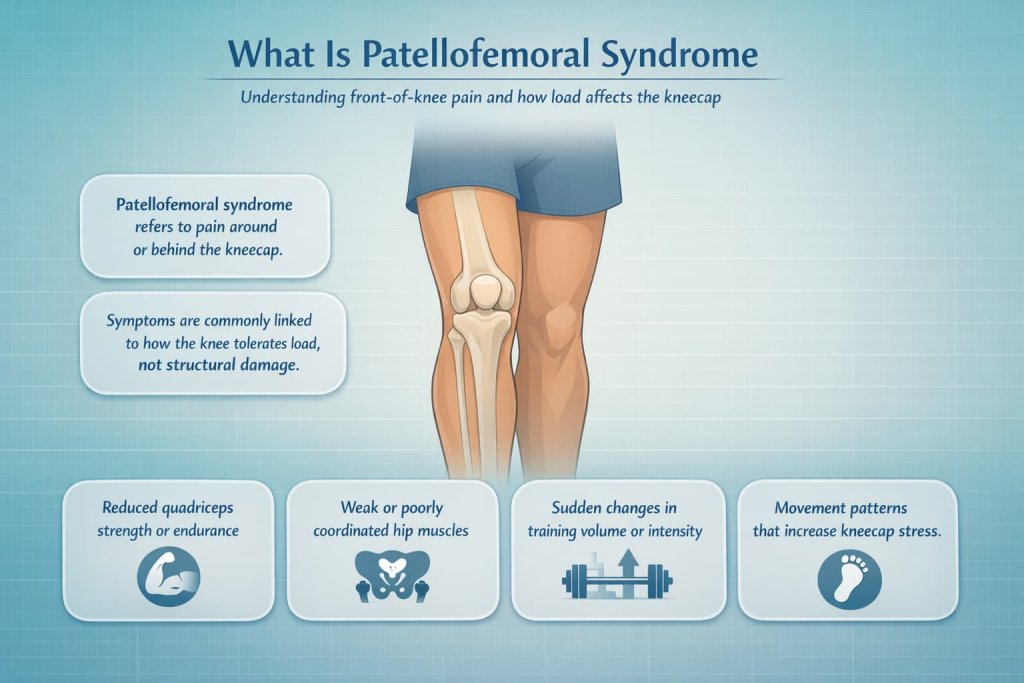
Patellofemoral syndrome—often referred to as patellofemoral pain—describes pain around or behind the kneecap that typically worsens with knee-bending activities such as squatting, stair climbing, running, jumping, or prolonged sitting. Clinical descriptions summarized in JOSPT note that symptoms are usually related to how the knee tolerates load rather than structural damage.
Common contributing factors include:
- Reduced quadriceps strength or endurance
- Weak or poorly coordinated hip muscles
- Changes in training volume or intensity
- Movement patterns that increase stress at the kneecap
10 Best Patellofemoral Syndrome Exercises
Use these exercises as a progressive toolkit to support knee strength, control, and stability. Start with low-load movements and gradually advance based on comfort and consistency.
1) Quad Set With Towel Roll
How to do it
- Sit or lie with one leg straight and a small towel rolled under the knee
- Tighten the front thigh muscle to gently press the knee down into the towel
- Hold the contraction for 5–10 seconds while breathing normally
- Fully relax the leg
- Repeat 8–12 controlled repetitions
Why it works
This exercise promotes early quadriceps activation without requiring knee bending, which keeps patellofemoral joint stress low. It is commonly used in early-stage knee rehabilitation to restore muscle engagement when symptoms are irritable.
Muscles worked
The quadriceps group, particularly the knee extensors responsible for stabilizing the kneecap.
Trainer Tip
Focus on a smooth, steady contraction rather than pushing hard into the towel. Quality activation matters more than force.
2) Straight Leg Raise
How to do it
- Lie on your back with one knee bent and the other leg straight
- Tighten the thigh of the straight leg before lifting
- Raise the straight leg until it reaches the height of the opposite knee
- Lower slowly with control
- Repeat 8–12 repetitions
Why it works
The straight leg raise strengthens the quadriceps while minimizing knee joint movement, making it a useful progression from quad sets when pain limits bending-based exercises.
Muscles worked
Quadriceps and hip flexors.
Trainer Tip
If knee discomfort appears, reduce the lifting height and slow down the lowering phase to improve control.
3) Side-Lying Hip Abduction
How to do it
- Lie on your side with hips stacked and the bottom knee bent
- Keep the top leg straight and slightly behind your body line
- Lift the top leg upward without rolling the hips backward
- Lower slowly and with control
- Perform 10–15 repetitions per side
Why it works
Hip abductor strength plays a key role in controlling thigh position during walking, stairs, and squatting. Improved hip control can reduce excessive knee stress during functional movements.
Muscles worked
Gluteus medius and lateral hip stabilizers.
Trainer Tip
Imagine keeping your hips stacked like plates. If your torso rolls backward, the target muscles are no longer doing the work.
4) Clamshell
How to do it
- Lie on your side with hips and knees bent about 45 degrees
- Keep your feet together and your pelvis steady
- Lift the top knee while keeping the hips stacked
- Lower slowly and repeat
- Perform 12–20 repetitions per side
Why it works
Clamshells help improve hip rotation control, which influences how the knee tracks during bending and weight-bearing activities.
Muscles worked
Gluteus medius and deep hip rotators.
Trainer Tip
Only add a resistance band once you can keep the pelvis completely still throughout the movement.
5) Glute Bridge
How to do it
- Lie on your back with knees bent and feet flat on the floor
- Brace your core and squeeze your glutes
- Lift your hips until your shoulders, hips, and knees form a straight line
- Pause briefly at the top
- Lower with control and repeat 10–15 times
Why it works
Strengthening the posterior hip muscles can reduce over-reliance on the quadriceps and decrease stress on the front of the knee during daily activities.
Muscles worked
Gluteus maximus, hamstrings, and trunk stabilizers.
Trainer Tip
If you feel the exercise mainly in your hamstrings, bring your feet slightly closer to your hips and focus on glute contraction.
6) Spanish Squat Isometric
How to do it
- Anchor a thick band or strap behind your knees
- Step back until the band supports you
- Sit into an upright squat position with your torso tall
- Hold the position for 20–45 seconds
- Rest and repeat for 3–5 total holds
Why it works
The Spanish squat allows the quadriceps to be loaded in a supported position, often making it more comfortable for people with patellofemoral pain while still building strength.
Muscles worked
Quadriceps.
Trainer Tip
Distribute your weight evenly through the entire foot and avoid rising onto your toes during the hold.
7) Wall Sit
How to do it
- Stand with your back against a wall
- Slide down into a partial squat position
- Keep feet flat and knees aligned over the toes
- Hold for 20–45 seconds
- Repeat 3–5 times
Why it works
Wall sits build quadriceps endurance in a stable, predictable position that allows controlled loading of the knee.
Muscles worked
Quadriceps and glutes.
Trainer Tip
Begin with a higher position if symptoms increase at deeper knee angles.
8) Step-Up
How to do it
- Stand in front of a low step or platform
- Step up using one leg while keeping the knee aligned over the toes
- Stand tall at the top
- Step down slowly and with control
- Perform 8–12 repetitions per side
Why it works
Step-ups strengthen the knee and hip in a functional pattern that closely mimics daily activities such as stair climbing.
Muscles worked
Quadriceps, glutes, and calves.
Trainer Tip
Choose the lowest step height that allows good control before progressing higher.
9) Step-Down
How to do it
- Stand on a low step using one leg
- Slowly lower the opposite heel toward the floor
- Lightly tap the heel down
- Return to the starting position with control
- Perform 6–10 repetitions per side
Why it works
This exercise emphasizes eccentric control of the quadriceps, which is essential for managing stairs and downhill movements.
Muscles worked
Quadriceps, glutes, and hip stabilizers.
Trainer Tip
Move slowly and deliberately—speed reduces control and increases knee stress.
10) Sit-to-Stand
How to do it
- Sit upright on a chair with feet under your knees
- Lean slightly forward and stand up
- Avoid using your hands if possible
- Sit back down slowly with control
- Repeat 8–12 repetitions
Why it works
Sit-to-stand strengthens the quads and hips using a real-life movement pattern, making strength gains highly transferable to daily activities.
Muscles worked
Quadriceps, glutes, and trunk stabilizers.
Trainer Tip
If pain increases, use a higher chair or add a cushion to reduce knee bend depth.
Why Patellofemoral Syndrome Exercises Matter
Exercise therapy is consistently recommended as the primary management strategy because it may help improve function and reduce symptoms over time. A best-practice guide from the British Journal of Sports Medicine highlights knee-targeted strengthening as the core intervention, often combined with hip-focused exercises and patient education.
Clinical summaries published by the American Academy of Family Physicians also support combining quadriceps and hip strengthening to improve knee loading during functional activities such as walking, stair use, and running.
How to Structure These Exercises Into a Routine
Guideline summaries from the American Academy of Family Physicians note that higher-volume strengthening performed several times per week may be effective when symptoms allow.
A simple structure:
- 3 strength days per week
- 2 quad-focused exercises
- 2 hip-focused exercises
- 1–2 functional movements
Progress by increasing repetitions first, then resistance, then range of motion.
Who Should Be Careful Before Doing These Exercises
These exercises may require modification or professional input if you:
- Have noticeable knee swelling, warmth, or redness
- Experience knee locking, catching, or instability
- Recently had a knee injury, fall, or surgery
- Feel sharp or worsening pain during daily activities
- Are unsure whether your pain is coming from the kneecap area
How to Use These Patellofemoral Syndrome Exercises Safely
Follow these general safety guidelines when performing the exercises:
- Start with low-load movements and progress gradually
- Mild discomfort during exercise may be acceptable
- Symptoms should return close to baseline within 24 hours
- Increase only one variable at a time (reps, resistance, or depth)
- Stop or regress the exercise if pain steadily worsens
When to Seek Professional Guidance
Consider evaluation by a qualified healthcare or rehabilitation professional if:
- Pain limits walking, stairs, or work activities
- Symptoms do not improve with consistent exercise
- Knee swelling or instability occurs repeatedly
- Pain changes location or intensity over time
- You need individualized assessment or exercise progression
Common Mistakes to Avoid
- Progressing depth or load too quickly
- Allowing the knee to collapse inward
- Ignoring hip strengthening
- Increasing running or stair volume too fast
These patterns are consistently highlighted in professional guidance from JOSPT and the British Journal of Sports Medicine.
Quick Pain Rules for Progressing Safely
Use these commonly accepted rehabilitation principles:
- Mild discomfort during exercise can be acceptable
- Symptoms should return close to baseline within 24 hours
- Increase only one variable at a time (reps, resistance, depth, or frequency)
Frequently Asked Questions
How long does improvement usually take?
Most people notice gradual changes over several weeks rather than days, especially when exercises are progressed consistently.
Are squats bad for patellofemoral syndrome?
Not necessarily. Shallow squats or isometric variations are often used early and progressed carefully.
Do hip exercises really matter?
Yes. Many clinical guidelines emphasize hip strength because it influences knee loading mechanics.
Can I still run?
Some people can continue running with reduced volume and intensity, but strength work should be prioritized if symptoms worsen.
Should I stretch too?
Stretching may feel helpful, but strengthening and load management are usually the main focus.
When should I see a physical therapist?
If pain limits daily activity or does not improve with structured exercise, professional assessment can help individualize progressions.
Conclusion
Patellofemoral syndrome exercises are most effective when they focus on quadriceps strength, hip control, and gradual exposure to functional movements. Start conservatively, progress based on symptoms, and prioritize consistency over intensity. Evidence-based guidance consistently supports exercise therapy combined with education as the core strategy for managing patellofemoral pain.
This content is for informational purposes only and not medical advice.
References
- Cochrane: Exercise therapy for patellofemoral pain
- NHS Inform: Exercises for patellofemoral knee pain
- Mass General Brigham: Rehabilitation protocol for patellofemoral pain syndrome (PDF)
- American Academy of Orthopaedic Surgeons: Patellofemoral pain syndrome overview
- Cleveland Clinic: Patellofemoral pain syndrome (PFPS)