
The step up exercise is a highly effective lower-body movement that strengthens your legs, improves balance, and supports everyday mobility using minimal equipment.
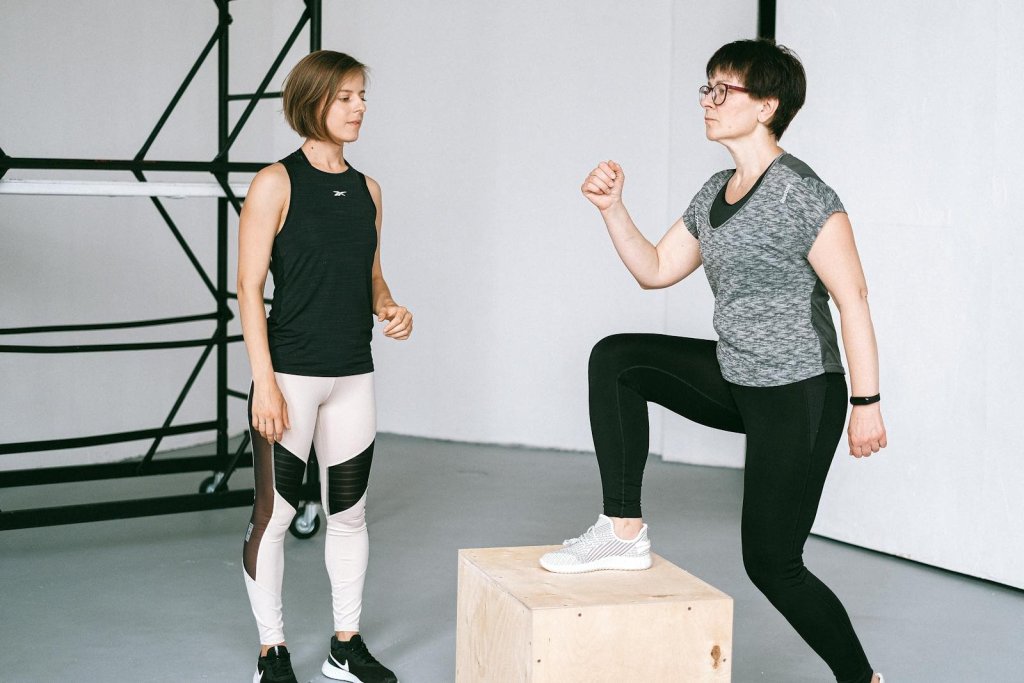
Understanding how to perform step ups correctly matters because this simple exercise targets major muscles used for walking, stairs, and standing up—making it valuable for beginners, active adults, and older individuals alike.
What Is the Step Up Exercise?
The step up exercise is a lower-body strength movement where you step onto an elevated surface—such as a box, stair, or bench—using one leg, then stand fully upright before stepping back down with control.
Unlike machines or complex lifts, step ups closely mimic real-world actions like climbing stairs or stepping onto a curb. This makes them a practical and joint-friendly option for building strength that carries over to daily life.
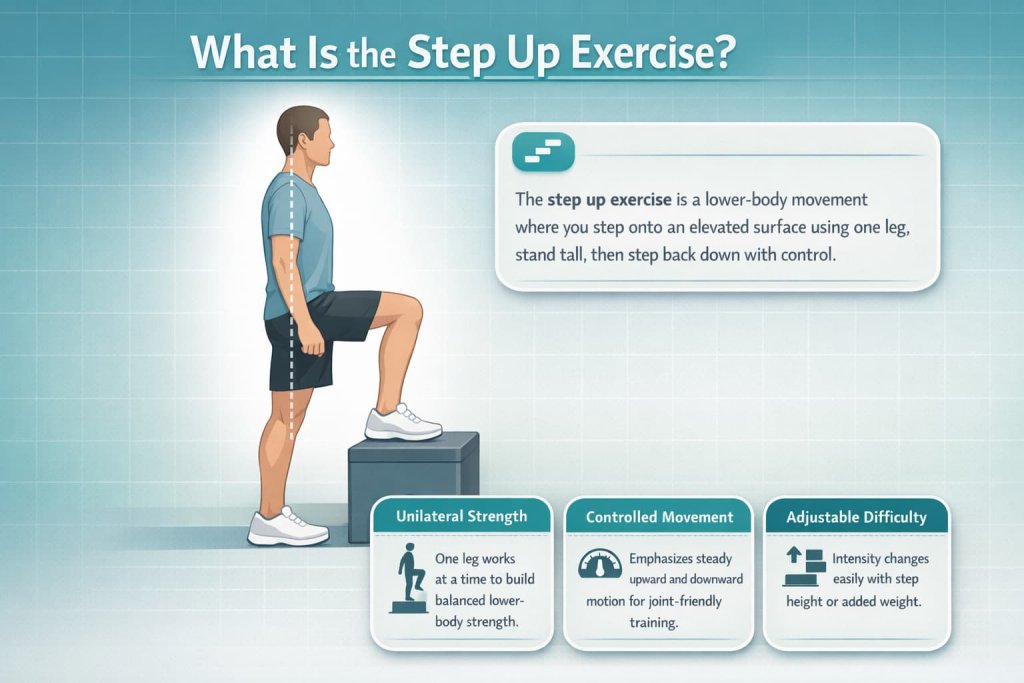
Key characteristics of the step up exercise include:
- One leg works at a time (unilateral movement)
- Controlled upward and downward motion
- Adjustable difficulty based on step height and added load
How to Do the Step Up Exercise Correctly
How to do it
- Stand facing a sturdy step, box, or stair
- Place your entire foot on the step, keeping the heel flat
- Press through the lead foot to stand fully on the step
- Keep your torso upright and hips level
- Slowly step back down under control
- Complete all reps on one side before switching legs
Choose a step height that allows you to move without pain or loss of balance. Many beginners start with a step between 6–12 inches high.
Step Up Exercise Variations
Once basic step ups feel comfortable, using variations allows you to increase challenge, shift muscle emphasis, or better match individual needs such as balance, knee comfort, or strength progression. Below is an expanded, structured breakdown of the most effective step up exercise variations, following your requested format.
1. Low Step Ups
Why it works:
Low step ups reduce joint demand while still training the primary movement pattern of stepping and standing. They are commonly used in beginner programs, knee-friendly routines, and early-stage rehabilitation because they allow controlled loading without excessive knee or hip flexion.
Muscles worked:
Quadriceps, gluteus maximus, hamstrings, calves, and core stabilizers.
How to do it:
- Use a low step or platform (4–6 inches high)
- Place the full foot on the step with the heel down
- Press through the lead leg to stand fully upright
- Step down slowly and under control
- Complete all reps on one side before switching
Trainer Tip:
Focus on slow lowering (eccentric control). This phase builds strength and stability even at lower step heights.
2. Weighted Step Ups
Why it works:
Adding external load increases strength demands on the legs and hips without requiring complex equipment. Weighted step ups are an effective way to progress lower-body strength while still training balance and coordination.
Muscles worked:
Gluteus maximus, quadriceps, hamstrings, calves, and core muscles for posture and load control.
How to do it:
- Hold dumbbells at your sides or a kettlebell close to the chest
- Step onto a stable platform with one foot
- Drive through the lead leg to stand tall
- Keep the torso upright and hips level
- Step down slowly before repeating
Trainer Tip:
Increase weight only after you can complete all reps with full control and no push-off from the trailing leg.
3. Lateral Step Ups
Why it works:
Lateral step ups emphasize side-to-side hip control, which is essential for balance, walking on uneven surfaces, and injury prevention. They place greater demand on the hip stabilizers than forward step ups.
Muscles worked:
Gluteus medius, gluteus maximus, quadriceps, and lateral hip stabilizers.
How to do it:
- Stand sideways next to the step
- Place the inside foot fully on the platform
- Press through that leg to lift your body up
- Bring the opposite foot onto the step
- Step back down with control
Trainer Tip:
Keep the knee tracking straight and avoid letting it collapse inward during the step-up phase.
4. Slow-Tempo Step Ups
Why it works:
Slowing the movement increases time under tension, which can enhance muscle control and strength without increasing load. This variation is especially useful when equipment is limited.
Muscles worked:
Quadriceps, glutes, hamstrings, calves, and core stabilizers.
How to do it:
- Step up using a normal platform height
- Take 3–4 seconds to stand up
- Pause briefly at the top
- Lower back down over 3–4 seconds
- Maintain steady breathing throughout
Trainer Tip:
Count the tempo out loud or mentally to avoid rushing, especially during the lowering phase.
5. Knee-Drive Step Ups
Why it works:
Adding a knee drive increases balance, coordination, and hip flexor involvement while reinforcing single-leg stability. This variation mimics athletic and everyday movement patterns such as climbing stairs quickly.
Muscles worked:
Gluteus maximus, quadriceps, hamstrings, hip flexors, calves, and core.
How to do it:
- Step onto the platform with one foot
- Drive through the lead leg to stand
- Lift the opposite knee toward hip height
- Hold briefly to stabilize
- Step back down under control
Trainer Tip:
Pause for one second at the top to reinforce balance and prevent momentum from doing the work.
Muscles Worked in the Step Up Exercise
The step up exercise targets multiple lower-body muscle groups at the same time:
- Quadriceps – straighten the knee as you rise
- Gluteus maximus – drive hip extension and power
- Hamstrings – assist hip movement and control the descent
- Calves – stabilize the ankle and support push-off
- Core muscles – help maintain upright posture and balance
Because only one leg works at a time, step ups also challenge stabilizing muscles around the hips and pelvis that are often under-trained in bilateral exercises.
Common Step Up Exercise Mistakes to Avoid
Even though step ups look simple, form errors can reduce their effectiveness:
- Pushing off excessively with the back leg
- Letting the front knee collapse inward
- Allowing the heel to lift off the step
- Dropping quickly instead of controlling the descent
- Using a step that is too high too soon
Keeping the movement slow and controlled—especially on the way down—helps maximize strength and balance benefits.
Benefits of the Step Up Exercise for Strength and Balance
The step up exercise trains leg strength and balance at the same time by loading one leg while requiring postural control. This combination closely reflects everyday movements such as climbing stairs or stepping onto a curb.
Potential benefits include:
- Stronger legs for daily activities
- Improved single-leg balance and coordination
- Better hip and pelvic stability
- More controlled, confident movement
Step Height and Equipment Guidelines
Using the right step height and equipment helps keep the exercise effective and joint-friendly.
General guidelines:
- Beginners: 4–6 inch step
- Intermediate: 8–12 inch step
- Advanced: Higher steps only with good control
Use a stable, non-slip surface and supportive footwear. Add weights only after bodyweight step ups feel controlled and pain-free.
Who Should Be Careful With Step Up Exercises
Some individuals may need extra caution or modifications:
- Recent knee, hip, or ankle injury
- Balance limitations or frequent falls
- Ongoing joint pain during stepping movements
Lower step heights, slower tempo, or light support can improve safety. If discomfort or instability persists, professional guidance is recommended.
How Often Should You Do Step Up Exercises?
General fitness guidelines suggest:
- 2–3 days per week
- 2–4 sets per leg
- 8–15 controlled repetitions
The Centers for Disease Control and Prevention recommends muscle-strengthening activities at least twice weekly, with older adults also including balance-focused exercises—both of which step ups can support when programmed correctly.
Are Step Ups Good for Knees?
When performed with proper form and an appropriate step height, step ups are commonly used in knee-friendly strength programs. They emphasize controlled motion and alignment rather than high impact.
Clinical exercise guidance from organizations such as the National Health Service often includes step-based exercises in progressive knee and lower-limb rehabilitation programs.
Step Up Exercise FAQs
Are step ups better than squats?
Step ups and squats serve different purposes. Step ups emphasize single-leg strength and balance, while squats load both legs at once. Both can be valuable when used appropriately.
Can beginners do the step up exercise?
Yes. Beginners can start with a low step and bodyweight only, focusing on slow, controlled movement.
What height should the step be?
A step height that allows the knee and hip to bend comfortably—often 6–12 inches for beginners—is typically recommended.
Do step ups work the glutes?
Yes. The glute muscles play a major role in driving the body upward during the step up exercise.
Are step ups good for older adults?
When appropriately scaled, step ups may help support leg strength, balance, and confidence during daily movements.
Can step ups help with balance?
Yes. Because they involve single-leg loading, step ups challenge balance and coordination alongside strength.
Conclusion
The step up exercise is a simple yet powerful movement that builds leg strength, improves balance, and supports everyday function. Whether you are new to exercise or looking to add more functional training to your routine, step ups offer a scalable, evidence-based option that fits a wide range of fitness levels.
If you’re building a lower-body or balance-focused program, consider adding step ups 2–3 times per week and progressing gradually as strength improves.
References
- CDC — Physical Activity Guidelines for Older Adults (strength plus balance guidance)
- World Health Organization (WHO) — Guidelines on Physical Activity and Sedentary Behaviour (official publication)
- Bull FC, et al. — WHO 2020 physical activity guidelines summary (PubMed)
- Okubo Y, et al. — Step training systematic review/meta-analysis (falls and balance outcomes; PubMed)