
Hip arthritis exercises can reduce stiffness and improve daily function by strengthening the muscles that support your hip and keeping the joint moving in a comfortable range.

In most clinical guidelines for hip osteoarthritis, exercise is a first-line recommendation because it supports pain management and mobility over time, especially when it’s tailored to you and done consistently. For example, the American College of Rheumatology and Arthritis Foundation guideline strongly recommends exercise for hip osteoarthritis, and NICE guidance recommends offering therapeutic exercise (strength and aerobic) for everyone with osteoarthritis.
Below is a practical, beginner-friendly routine with six joint-friendly moves you can do at home.
What Is Hip Arthritis?
Hip arthritis most commonly refers to hip osteoarthritis, a condition where the cartilage inside the hip joint gradually wears down. The hip is a ball-and-socket joint, and when cartilage becomes thinner, movement may feel stiff or uncomfortable.
Common symptoms may include:
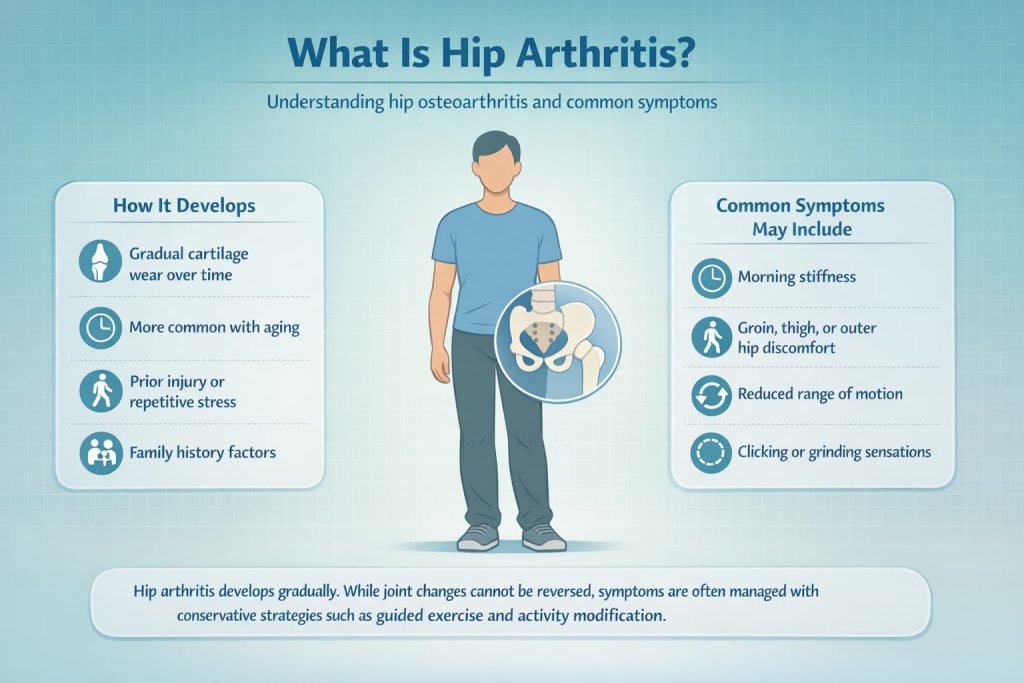
- Morning stiffness
- Groin, thigh, or outer hip discomfort
- Reduced range of motion
- Clicking or grinding sensations
Hip arthritis develops gradually and is more common with aging, prior injury, repetitive joint stress, or family history. While joint changes cannot be reversed, symptoms are often managed with conservative strategies.
Why Exercise Is Recommended for Hip Arthritis
Exercise is widely recommended as a first-line approach for managing hip osteoarthritis. Major clinical guidelines support strengthening, mobility, and low-impact aerobic activity.
Regular exercise may help:
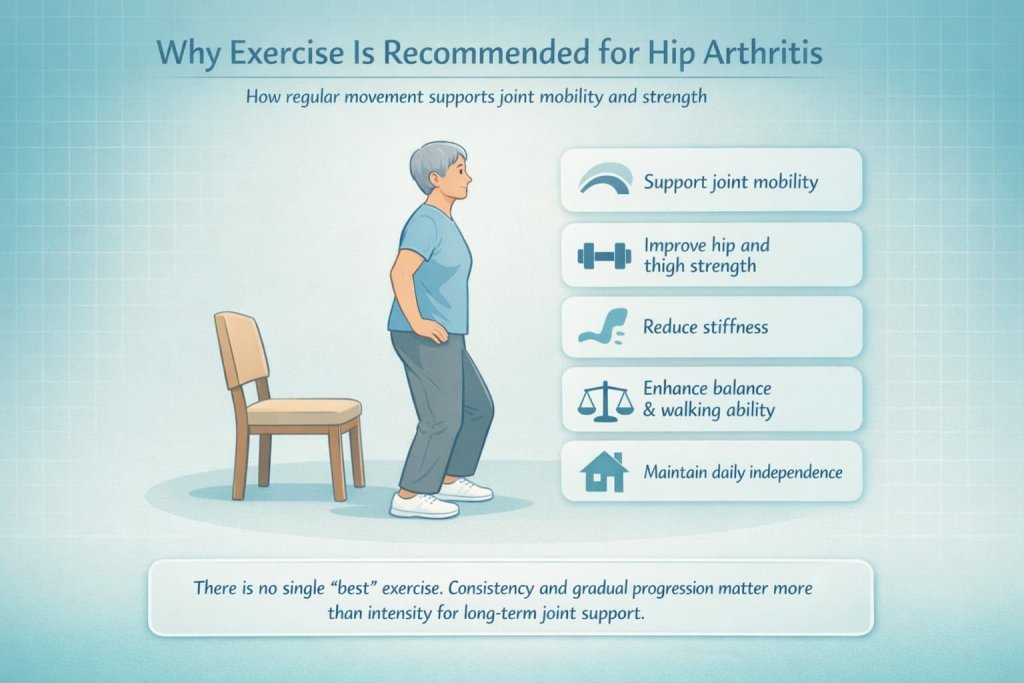
- Support joint mobility
- Improve hip and thigh strength
- Reduce stiffness
- Enhance balance and walking ability
- Maintain daily independence
There is no single “best” exercise. Consistency and gradual progression are more important than intensity.
6 Best Hip Arthritis Exercises to Reduce Pain
Strengthen your hips, reduce stiffness, and support joint mobility with these 6 safe, low-impact exercises designed for hip arthritis. Each movement focuses on improving stability, flexibility, and daily comfort through controlled, joint-friendly motion.
1) Glute Bridge
How to do it:
- Lie on your back with knees bent and feet flat, hip-width apart
- Rest arms by your sides and gently brace your core
- Press through your heels and lift your hips until your body forms a straight line from shoulders to knees
- Pause for 1–2 seconds at the top
- Lower slowly with control
- Perform 2–3 sets of 8–12 reps
Why it works: Strong glutes reduce stress on the hip joint during standing, walking, and climbing stairs. The bridge strengthens hip extension without requiring deep hip bending, which many people with hip arthritis tolerate more comfortably.
Muscles worked: This exercise primarily targets the gluteus maximus and hamstrings while engaging the deep core muscles to stabilize the pelvis.
Trainer Tip: If you feel pressure in your lower back instead of your glutes, reduce the lift height and focus on squeezing your glutes at the top rather than pushing higher.
2) Sit-to-Stand From a Chair
How to do it:
- Sit on a sturdy chair with feet flat and slightly behind your knees
- Keep your chest tall and lean forward slightly from your hips
- Press through your heels and stand up
- Slowly sit back down with control
- Perform 2–3 sets of 6–10 reps
Why it works: Sit-to-stand strengthens the hips and thighs using a real-life movement pattern. This improves daily activities like getting up from a chair, toilet, or car seat while supporting joint stability.
Muscles worked: The glutes and quadriceps do most of the work, with support from the hamstrings and core muscles.
Trainer Tip: Start with a higher chair to reduce strain. As strength improves, gradually use a lower surface to increase difficulty safely.
3) Standing Hip Abduction (Support Hold)
How to do it:
- Stand upright holding a counter or chair for balance
- Shift your weight onto one leg
- Keeping toes facing forward, slowly lift the opposite leg out to the side a few inches
- Pause briefly at the top
- Lower slowly with control
- Perform 2–3 sets of 8–12 reps per side
Why it works: Hip abductors stabilize the pelvis during walking. When these muscles are weak, the hip joint may feel overloaded. Strengthening them helps improve walking mechanics and reduce strain.
Muscles worked: This movement primarily targets the gluteus medius and minimus, along with smaller lateral stabilizing muscles.
Trainer Tip: Keep your torso upright and avoid leaning sideways. If your body shifts, reduce the lift height.
4) Side-Lying Clamshell
How to do it:
- Lie on your side with hips and knees bent, feet stacked together
- Keep your pelvis steady and aligned
- Lift your top knee while keeping your feet touching
- Pause briefly
- Lower slowly with control
- Perform 2–3 sets of 10–15 reps per side
Why it works: Clamshells strengthen the deep hip stabilizers and improve hip alignment during movement. This helps support walking, stair climbing, and balance.
Muscles worked: The gluteus medius and deep external rotators are the primary muscles engaged.
Trainer Tip: If you feel a pinch at the front of the hip, reduce the range of motion and move more slowly.
5) Hip Flexor Stretch (Half-Kneeling or Standing)
How to do it:
- Choose a half-kneeling position (with padding under the knee) or a standing split stance
- Gently tuck your pelvis under (slight posterior tilt)
- Shift your body forward slowly
- Hold when you feel a mild stretch in the front of the hip
- Maintain for 20–30 seconds
- Repeat 2–3 times per side
Why it works: Prolonged sitting can shorten the hip flexors, contributing to stiffness and reduced stride length. Gentle stretching may help improve upright posture and walking comfort.
Muscles worked: This stretch targets the iliopsoas and rectus femoris at the front of the hip.
Trainer Tip: The stretch should feel gentle and controlled. Avoid forcing the position or pushing into joint discomfort.
6) Stationary March (Standing or Seated)
How to do it:
- Stand holding a support, or sit upright in a sturdy chair
- Lift one knee a few inches off the ground
- Lower with control
- Alternate legs in a smooth rhythm
- Continue for 30–60 seconds
- Perform 2–4 rounds
Why it works: Stationary marching promotes circulation and low-impact mobility without excessive joint stress. It also helps maintain coordination and confidence with movement.
Muscles worked: This exercise engages the hip flexors, glutes, calves, and lightly activates the core for posture.
Trainer Tip: Keep movements small and controlled. Focus on steady breathing and upright posture rather than lifting the knees high.
How often should you do hip arthritis exercises?
A simple, sustainable weekly plan:
- Strength (moves 1–4): 2–3 days per week
- Mobility (move 5): most days
- Low-impact cardio (move 6 plus walking/cycling/swimming): aim toward the general adult guideline of 150 minutes per week, as summarized by the CDC (break it into small sessions)
Consistency matters more than intensity, especially when symptoms fluctuate.
Hip arthritis exercises and what they should include
The most helpful plans usually combine:
- Strength training for glutes, hip abductors, and thighs (for joint support)
- Low-impact cardio (for endurance and overall function)
- Gentle mobility (to reduce stiffness)
- Balance and control work (to improve stability)
This mix matches what major guidelines emphasize: individualized exercise that builds strength and fitness without aggravating symptoms. NICE also notes that pain may increase when you first start exercising, which is why gradual progression matters.
Before you start: safety and pain rules that keep progress steady
Use these practical guardrails:
- Work in a “comfortable effort” zone. Mild discomfort is common; sharp pain is a stop signal.
- Start small (fewer reps, smaller range) and build up weekly.
- Move slowly and avoid bouncing into end range.
- If you feel worse for more than 24 hours after a session, reduce volume next time.
- If you have catching/locking, sudden swelling, fever, or severe night pain, get medical guidance before continuing.
Low-impact aerobic activity is often better tolerated for sore joints (walking, cycling, swimming), as noted by Mayo Clinic.
Safety Guidelines Before Starting Hip Arthritis Exercises
Before beginning hip arthritis exercises, follow these basic safety principles:
- Start with low intensity and build gradually
- Mild discomfort can be normal; sharp pain is a stop signal
- Avoid deep bending if it causes joint pinching
- Move slowly and with control
- Reduce volume if soreness lasts more than 24 hours
Seek medical guidance if you experience:
- Sudden swelling
- Night pain that disrupts sleep
- Joint locking or instability
- Rapid worsening of symptoms
Exercise should be individualized. When unsure, consult a qualified healthcare professional.
Common mistakes that make hip arthritis flare-ups more likely
- Doing too much too soon (volume jumps are the #1 issue)
- Forcing deep hip angles that cause pinching
- Moving fast with poor control (especially on single-leg work)
- Skipping rest days when your joint feels “hot” or irritated
When to seek professional guidance
Consider a physical therapist or clinician if:
- Pain is worsening week to week
- You’re limping more or losing range of motion
- You have frequent night pain or unexplained swelling
- You’re unsure which movements are safe for your hip
Guidelines such as NICE also suggest considering supervised exercise, which can help you progress safely.
FAQ
What is the best exercise for hip arthritis?
There isn’t one “best” move for everyone. Most evidence-based plans combine strengthening, low-impact cardio, and mobility work, which aligns with the ACR/Arthritis Foundation guideline.
Should I exercise during a hip arthritis flare-up?
Often you can keep moving, but scale down. Use smaller ranges, fewer reps, and gentle mobility. If pain is sharp, sudden, or escalating, stop and get guidance.
Is walking good for hip arthritis?
Walking is commonly used as low-impact aerobic activity. If walking increases symptoms, shorten duration, slow pace, or switch to cycling or water exercise as suggested in arthritis-friendly activity guidance from Mayo Clinic.
Can strengthening make hip arthritis worse?
Appropriately progressed strengthening is generally recommended in major guidelines. Problems usually come from overload (too much, too soon) rather than the concept of strengthening itself.
Is cycling better than running for hip arthritis?
Cycling is typically lower impact than running. Many people tolerate cycling better because it reduces repetitive pounding.
How long does it take to notice improvement?
Some people feel better within a few weeks, but meaningful strength and function gains often take 6–12 weeks of consistent, progressive work.
Conclusion
Hip arthritis exercises work best when they’re simple, repeatable, and progressed gradually. Start with the six moves above, keep ranges comfortable, and aim for steady weekly consistency. If you want, I can also turn this into a 2–3 day “done-for-you” routine (sets, reps, and progression plan) based on beginner vs intermediate level.
This content is for informational purposes only and not medical advice.