
Landmine exercises are barbell movements done with one end of the bar anchored, creating a guided arc that helps you train pressing, pulling, legs, and core in one setup. This matters because the pivoting bar path makes landmine training versatile across movement patterns and planes of motion, while many people find the angled pressing position more comfortable for the shoulders and wrists.
In this guide, you’ll get the 12 best landmine exercises, step-by-step form cues, what each move targets, smart progressions, and simple programming so you can build strength safely and consistently.
What Are Landmine Exercises?
A landmine setup anchors one end of a barbell so the free end travels in an arc. That pivot lets you train squat and lunge patterns, hinge patterns, diagonal pressing, rowing, and rotation or anti-rotation core work from one station.
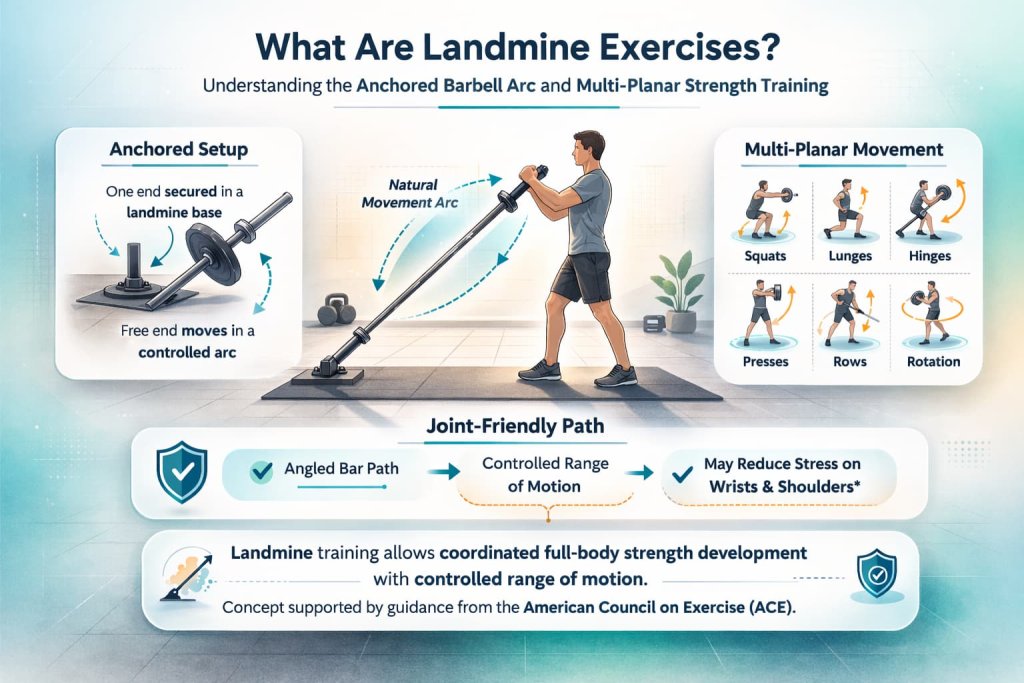
The American Council on Exercise (ACE) explains that landmine training allows multi-planar movement while helping reduce stress on joints compared to some traditional straight-bar positions.
Why Landmine Exercises Build Full-Body Strength and Power
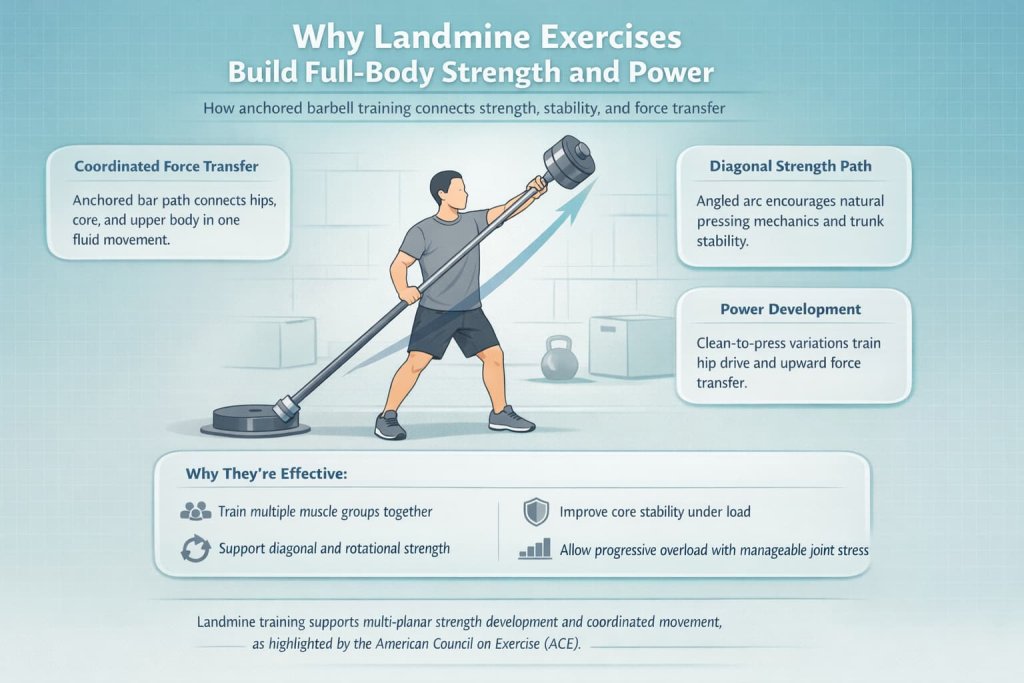
Landmine exercises build full-body strength because the anchored bar path connects the hips, core, and upper body in one coordinated movement. The diagonal arc encourages natural pressing mechanics while demanding trunk stability and force transfer from lower body to upper body.
Power-focused variations like clean-to-press movements teach you to generate force from the hips and transfer it upward efficiently. The American Council on Exercise (ACE) highlights landmine training as a multi-planar option that supports coordinated strength development.
Why they’re effective:
- Train multiple muscle groups together
- Improve core stability under load
- Support diagonal and rotational strength
- Allow progressive overload with manageable joint stress
12 Best Landmine Exercises
These 12 landmine exercises target your legs, core, back, chest, and shoulders using one versatile setup. Together, they help build full-body strength, improve stability, and develop coordinated power through controlled, multi-planar movement.
1) Half-Kneeling Single-Arm Landmine Press
Why it works: This movement sits between horizontal and overhead pressing, allowing strong shoulder engagement while improving core stability and hip control. It’s described by Human Kinetics as a balanced pressing variation that blends strength with joint-friendly mechanics.
Muscles worked: Deltoids, triceps, upper chest, serratus anterior, deep core stabilizers.
How to do it:
- Kneel on one knee (opposite knee to pressing arm down).
- Hold the bar at shoulder height.
- Brace your core and squeeze the glute of the down-knee side.
- Press upward along the natural arc of the bar.
- Lower slowly with control.
Trainer Tip: Exhale gently during the press to prevent rib flare and maintain core tension.
2) Standing Single-Arm Landmine Press
Why it works: Builds unilateral pressing strength while challenging anti-rotation stability through the torso.
Muscles worked: Deltoids, triceps, obliques.
How to do it:
- Stand tall with feet shoulder-width apart.
- Hold the bar at shoulder level.
- Press upward and slightly forward along the arc.
- Avoid twisting your torso as you press.
Trainer Tip: Keep hips level and ribs stacked over pelvis for better balance.
3) Landmine Shoulder Press (Split-Kneeling Option)
Why it works: Targets the shoulders and triceps while allowing stance adjustments for added stability, as noted by Human Kinetics.
Muscles worked: Deltoids, triceps, upper chest.
How to do it:
- Choose either standing or split-kneeling stance.
- Hold the bar at shoulder height.
- Press along the arc smoothly.
- Lower under control.
Trainer Tip: Avoid shrugging the shoulders upward during the press.
4) Landmine Row
Why it works: Provides a stable heavy rowing pattern that effectively develops upper back strength.
Muscles worked: Lats, rhomboids, rear delts, biceps.
How to do it:
- Hinge at the hips with a neutral spine.
- Grip the bar sleeve or handle firmly.
- Row toward your lower ribs.
- Lower slowly with control.
Trainer Tip: Keep your torso angle consistent throughout the movement.
5) Meadows Row
Why it works: Enhances unilateral back engagement and strengthens the posterior chain with improved control.
Muscles worked: Lats, rear delts, obliques.
How to do it:
- Stand perpendicular to the bar.
- Hinge at the hips.
- Row the bar toward your hip pocket.
- Lower under control.
Trainer Tip: Maintain square hips and avoid twisting.
6) Landmine Front Squat
Why it works: Encourages an upright torso and strong quad activation while promoting core engagement.
Muscles worked: Quads, glutes, core.
How to do it:
- Hold the bar at chest height.
- Sit down between your hips.
- Drive through your midfoot to stand.
Trainer Tip: Keep your chest tall and core braced throughout.
7) Landmine Reverse Lunge
Why it works: Builds lower-body strength with less spinal loading compared to traditional back-loaded variations.
Muscles worked: Glutes, quads.
How to do it:
- Step back into a controlled lunge.
- Keep torso upright and stable.
- Push through the front foot to return to standing.
Trainer Tip: Control knee alignment and avoid collapsing inward.
8) Landmine Split Squat
Why it works: Improves unilateral strength and hip stability while enhancing balance.
Muscles worked: Quads, glutes.
How to do it:
- Maintain a split stance.
- Lower straight down with control.
- Drive upward smoothly.
Trainer Tip: Reduce depth if control or balance is limited.
9) Landmine Romanian Deadlift
Why it works: Trains the posterior chain with a guided bar path that supports hinge mechanics.
Muscles worked: Hamstrings, glutes, spinal stabilizers.
How to do it:
- Push hips back.
- Keep shins mostly vertical.
- Stand tall by driving hips forward.
Trainer Tip: Stop before rounding occurs in the lower back.
10) Landmine Clean to Press
Why it works: Combines hip drive and upper-body pressing strength for coordinated full-body power.
Muscles worked: Glutes, shoulders, upper back, core.
How to do it:
- Start in a hinge position.
- Explode hips forward.
- Guide the bar to shoulder height.
- Press upward along the arc.
Trainer Tip: Keep reps crisp and controlled rather than rushed.
11) Landmine Rotation
Why it works: Builds controlled rotational strength and coordinated movement between hips and torso.
Muscles worked: Obliques, hips, shoulders (stabilizers).
How to do it:
- Hold the bar with both hands.
- Rotate torso and hips together.
- Control the return motion.
Trainer Tip: Avoid excessive lower-back twisting by moving from the hips.
12) Landmine Anti-Rotation Press Hold
Why it works: Trains core stability by resisting rotation, a concept emphasized in progressions from ACE.
Muscles worked: Obliques, transverse abdominis, glutes.
How to do it:
- Stand sideways to the bar.
- Press slightly forward.
- Hold while resisting rotation.
Trainer Tip: Breathe steadily during holds to maintain core control.
How to Program Landmine Exercises
- Train 2–3 times per week
- Combine squat, hinge, push, pull, and core patterns
- Strength: 3–5 sets of 4–8 reps
- Hypertrophy: 3–4 sets of 8–12 reps
- Core holds: 10–30 seconds
Progress gradually by increasing load or reps while maintaining control.
Benefits of Landmine Exercises for Strength and Performance
Landmine training blends gym strength with athletic coordination.
Key benefits include:
- Full-body efficiency: Pressing and rowing link hips, core, and upper body.
- Multi-plane strength: You can train forward, diagonal, and rotational patterns.
- Gradual progression: Small plate increases allow controlled overload.
- Performance use: A 2025 study published on PubMed Central (NIH) reported improvements in physical fitness markers when barbell-based landmine exercises were included in structured athletic training.
Landmine Setup and Safety Checklist
Before loading weight:
- Use a stable landmine attachment secured to a rack or platform.
- Always use collars to secure plates. The equipment guide from Eleiko recommends checking plate security and attachment stability before training.
- Inspect knobs, bolts, and fasteners before dynamic lifts.
- Control the arc of the bar rather than forcing the range.
If you have a recent injury, surgery, or persistent pain, consult a qualified professional before starting.
Common Mistakes to Avoid
Landmine exercises are effective, but technique matters.
A common mistake is arching the lower back during presses due to poor bracing or excessive load. Another is using momentum in rows and rotations instead of controlled movement. Over-rotating through the lower back rather than moving from the hips can also increase strain.
Equipment safety is equally important. As noted by Eleiko, plates should be secured with collars and attachments checked before training.
Avoid these errors:
- Leaning back during presses
- Jerking the bar during rows
- Twisting excessively through the lumbar spine
- Skipping equipment safety checks
Who Should Be Cautious With Landmine Exercises?
Landmine exercises are generally well tolerated, but some individuals should use extra care.
People with recent shoulder surgery, lower-back pain, or knee injuries should modify range and load. Beginners unfamiliar with barbell training may benefit from coaching to ensure proper setup and bracing.
Stop exercising and seek professional advice if you experience sharp pain, numbness, tingling, or worsening discomfort.
Use caution if you:
- Have a recent shoulder or back injury
- Are recovering from surgery
- Experience pain during loaded rotation
- Are new to resistance training
FAQs
Are landmine exercises good for beginners?
Yes. They are scalable and beginner-friendly.
Do landmine exercises build muscle?
Yes, when combined with progressive overload and sufficient weekly volume.
Are landmine presses easier on the shoulders?
Many lifters find the angled path more comfortable than strict overhead pressing.
What’s the best landmine core exercise?
Anti-rotation press holds for stability; rotations for controlled power.
Can I train without a landmine attachment?
It’s possible, but a proper attachment is safer and more stable.
How heavy should I go?
Choose a weight that allows clean, controlled reps.
How long before I see results?
Strength and coordination often improve within several weeks of consistent training.
Conclusion
Landmine exercises offer a practical, scalable way to build full-body strength, core stability, and athletic power using one versatile setup. Start with foundational movements, master control, and progressively increase load.
If you’d like, I can build a 3-day landmine-only workout plan based on your equipment.