
Shoulder tendonitis exercises are controlled movements designed to support pain reduction, restore shoulder mobility, and improve strength without overloading irritated tendons.
Understanding how and why to use these exercises matters because shoulder tendon pain often responds better to gradual, well-planned loading than to rest alone. When chosen and progressed carefully, exercise may help improve daily function, movement confidence, and long-term shoulder health.
What Are Shoulder Tendonitis Exercises?
Shoulder tendonitis exercises focus on improving how the shoulder handles load during everyday and athletic activities. In clinical settings, shoulder tendonitis is often discussed as rotator cuff–related shoulder pain or rotator cuff tendinopathy, reflecting changes in tendon structure and load tolerance rather than inflammation alone.
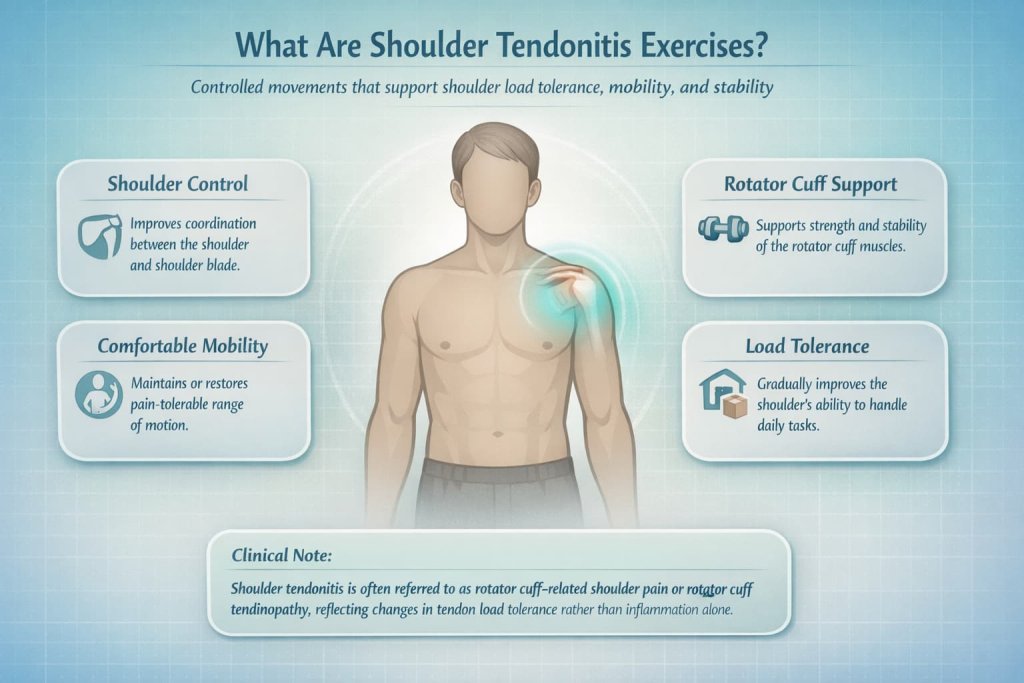
These exercises typically aim to:
- Improve shoulder and scapular control
- Support rotator cuff strength
- Maintain or restore comfortable range of motion
- Gradually increase the shoulder’s tolerance to daily tasks
Why Exercise Matters for Shoulder Tendonitis
Exercise does not “repair” a tendon overnight, but it plays a key role in long-term improvement. According to guidance from American Academy of Orthopaedic Surgeons, appropriately selected exercises may help by:
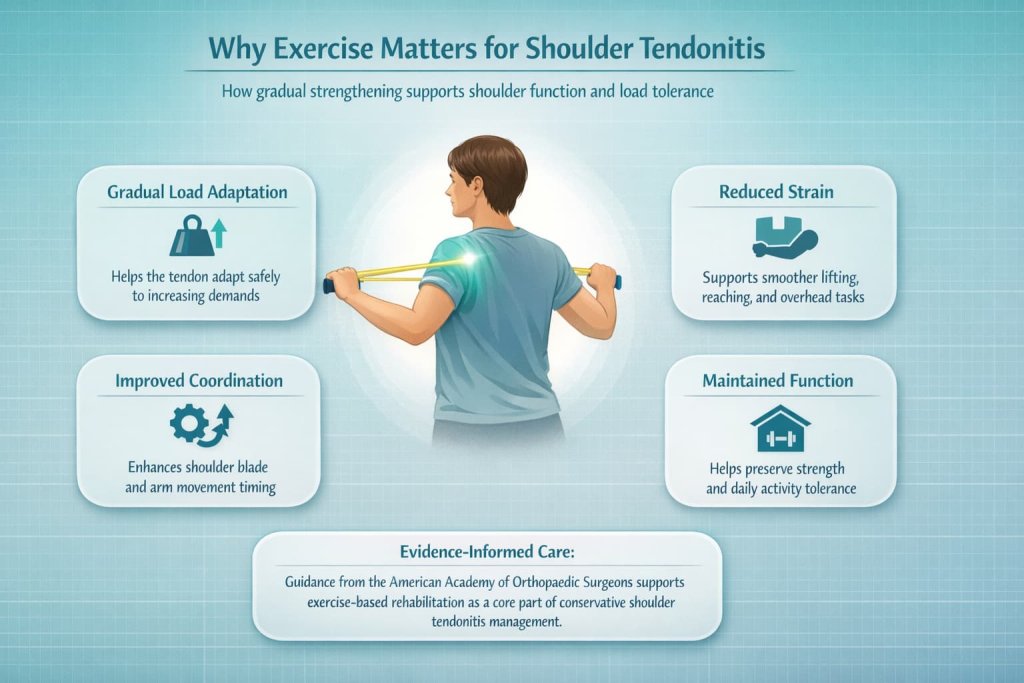
- Supporting gradual tendon adaptation to load
- Reducing excessive strain during lifting, reaching, or overhead use
- Improving coordination between the shoulder blade and arm
- Maintaining strength and function without prolonged rest
10 Best Shoulder Tendonitis Exercises
These exercises focus on gentle mobility, controlled strengthening, and shoulder stability to support pain reduction and daily movement. All movements are designed to be progressed gradually and performed within a pain-tolerable range.
1. Pendulum Exercise
How to do it
- Lean forward from the hips with one hand supported on a chair or table
- Let the affected arm hang completely relaxed
- Gently move the arm in small circles, clockwise and counterclockwise
- Keep the movement slow and controlled
Why it works
This exercise promotes gentle shoulder joint motion without active muscle contraction. It helps reduce stiffness and supports fluid movement while keeping tendon load extremely low.
Muscles worked
Rotator cuff (minimal load), shoulder joint stabilizers.
Trainer Tip
The arm should feel heavy and relaxed. If you feel muscle effort, reduce the circle size or slow down.
2. Isometric Shoulder External Rotation
How to do it
- Stand with your elbow bent to 90 degrees and tucked against your side
- Place the back of your hand against a wall or folded towel
- Gently press outward without allowing the arm to move
- Hold the contraction steadily, then relax
Why it works
Isometric contractions help maintain strength and tendon tolerance without joint movement, making them useful during painful or early stages of shoulder tendon irritation.
Muscles worked
Infraspinatus, teres minor.
Trainer Tip
Use only light to moderate pressure. The goal is control, not maximum force.
3. Isometric Shoulder Internal Rotation
How to do it
- Stand with your elbow bent and resting comfortably at your side
- Place your palm against a wall, doorframe, or towel
- Gently press inward without moving the shoulder
- Hold, then slowly release
Why it works
This exercise supports early strengthening of internal rotators while minimizing tendon strain and joint irritation.
Muscles worked
Subscapularis, anterior shoulder stabilizers.
Trainer Tip
Pain should remain mild and manageable. Stop if symptoms increase during or after the hold.
4. Scapular Retraction
How to do it
- Sit or stand upright with arms relaxed by your sides
- Gently squeeze your shoulder blades together
- Hold for a brief pause
- Slowly relax back to the starting position
Why it works
Improved scapular control helps the shoulder joint move more efficiently, reducing unnecessary stress on the rotator cuff tendons.
Muscles worked
Middle trapezius, rhomboids.
Trainer Tip
Think “back and down,” not “up.” Avoid shrugging or tightening the neck.
5. Shoulder Flexion Assisted Range of Motion
How to do it
- Hold a stick, towel, or your unaffected arm with both hands
- Use the healthy side to assist lifting the affected arm forward
- Move only within a comfortable, pain-tolerable range
- Lower slowly with control
Why it works
Assisted motion maintains shoulder mobility while limiting how much force the irritated tendon must handle.
Muscles worked
Deltoid, rotator cuff (assisted).
Trainer Tip
Smooth motion is more important than height. Stop before pain increases.
6. Wall Slides
How to do it
- Stand facing a wall with forearms lightly resting against it
- Keep elbows bent and shoulders relaxed
- Slowly slide your arms upward along the wall
- Return to the starting position with control
Why it works
Wall slides encourage coordinated movement between the shoulder blade and arm, which is essential for efficient and comfortable shoulder motion.
Muscles worked
Serratus anterior, rotator cuff.
Trainer Tip
Keep your ribs down and core engaged to prevent arching the lower back.
7. Resistance Band External Rotation
How to do it
- Anchor a resistance band at elbow height
- Hold the band with elbow bent and tucked at your side
- Rotate the forearm outward against resistance
- Return slowly to the starting position
Why it works
This exercise builds strength in the external rotators, which play a key role in shoulder stability and control during lifting and reaching.
Muscles worked
Infraspinatus, teres minor.
Trainer Tip
Start with very light resistance and increase gradually as tolerance improves.
8. Resistance Band Internal Rotation
How to do it
- Anchor a resistance band at elbow height
- Hold the band with your elbow bent and close to your body
- Pull the forearm inward toward your abdomen
- Slowly control the return
Why it works
Strengthening the internal rotators helps balance shoulder forces and supports controlled arm movement.
Muscles worked
Subscapularis, pectoralis major.
Trainer Tip
Keep your torso still—movement should come from the shoulder, not body rotation.
9. Shoulder Extension With Band
How to do it
- Hold a resistance band anchored in front of you
- Keep elbows straight but relaxed
- Pull arms backward toward your hips
- Return slowly under control
Why it works
This movement supports posterior shoulder strength and helps improve overall shoulder and scapular coordination.
Muscles worked
Latissimus dorsi, posterior deltoid.
Trainer Tip
Focus on controlled tension rather than pulling as far back as possible.
10. Standing Rows
How to do it
- Hold a resistance band or cable with arms extended forward
- Pull elbows backward while squeezing shoulder blades together
- Pause briefly at the end
- Return slowly with control
Why it works
Rows strengthen the upper back and promote proper shoulder blade positioning, which can reduce stress on irritated shoulder tendons.
Muscles worked
Rhomboids, middle trapezius, rear deltoids.
Trainer Tip
Keep your chest tall and neck relaxed throughout the movement.
Safety Guidelines Before Starting Shoulder Tendonitis Exercises
- Stay within a pain-tolerable range
- Avoid sharp or worsening pain
- Progress load gradually
- Allow rest days between higher-effort sessions
How Often Should You Do Shoulder Tendonitis Exercises?
General guidance from American Academy of Orthopaedic Surgeons suggests:
- Gentle mobility: daily or near-daily
- Strength exercises: 2–4 times per week
- Progress based on comfort and function, not speed
Who Should Be Cautious With Shoulder Tendonitis Exercises
While shoulder tendonitis exercises are commonly used as part of conservative care, they may not be appropriate for everyone without professional guidance. Certain signs and situations require extra caution to reduce the risk of worsening symptoms or missing a more serious condition.
You should be cautious and consider medical or physical therapy evaluation if you experience:
- Sudden or significant loss of shoulder strength, especially difficulty lifting the arm against gravity
- Severe or persistent night pain that does not ease with position changes
- Pain following a fall, direct blow, or accident, which may indicate structural injury
- Rapidly worsening symptoms despite reducing activity and modifying exercise
- Visible swelling, redness, or warmth around the shoulder joint
- Pain accompanied by numbness, tingling, or weakness extending into the arm or hand
People with known rotator cuff tears, recent shoulder surgery, or recent corticosteroid injections should only begin or resume exercises under professional supervision, as load tolerance and timing can vary.
Common Mistakes to Avoid
- Pushing through significant pain
- Using heavy resistance too early
- Ignoring shoulder blade control
- Skipping rest and recovery
When to Seek Medical or Physical Therapy Guidance
Consider professional evaluation if you experience:
- Persistent pain beyond several weeks
- Sudden weakness or loss of movement
- Night pain that disrupts sleep
- Symptoms after trauma or injury
FAQs About Shoulder Tendonitis Exercises
Are shoulder tendonitis exercises safe?
When performed correctly and progressed gradually, they are generally considered safe.
Should I stop exercising if my shoulder hurts?
Mild discomfort may be acceptable, but sharp or worsening pain is a sign to stop.
Can these exercises replace medical treatment?
They are often part of conservative care but do not replace medical evaluation when needed.
How long does it take to see improvement?
Many people notice functional improvement over several weeks with consistency.
Can I do these exercises at home?
Yes, most require minimal equipment and are suitable for home programs.
Is rest better than exercise for tendonitis?
Guidelines generally favor activity modification and exercise over prolonged rest.
Conclusion
Shoulder tendonitis exercises play a central role in supporting pain reduction, restoring mobility, and improving shoulder control when performed thoughtfully and consistently. By focusing on gradual progression and proper technique, you give your shoulder the best chance to adapt and function more comfortably. If symptoms persist or worsen, seek guidance from a qualified healthcare professional.
References
- Rotator Cuff Tendinopathy Clinical Practice Guideline (JOSPT, 2025)
- PubMed: Rotator Cuff Tendinopathy Clinical Practice Guideline (2025)
- APTA Evidence-Based CPG Resource: Rotator Cuff Tendinopathy (2025)
- Mayo Clinic: Rotator Cuff Injury (Symptoms, Causes, and First-Line Care) — Updated 2025
- Mayo Clinic: Rotator Cuff Exercises (Isometric Wall Press Examples)
- NHS Inform: Exercises for Shoulder Problems
- The Lancet: GRASP Trial (Progressive Exercise vs Best-Practice Advice for Shoulder Pain, 2021)