
The heel taps exercise is a beginner-friendly core stability move where you lower one heel to the floor from a tabletop position while keeping your spine steady and your abs braced. Because it trains controlled movement without heavy loading, it’s a practical option for building stronger abs and improving core control at home with no equipment.
What Is the Heel Taps Exercise
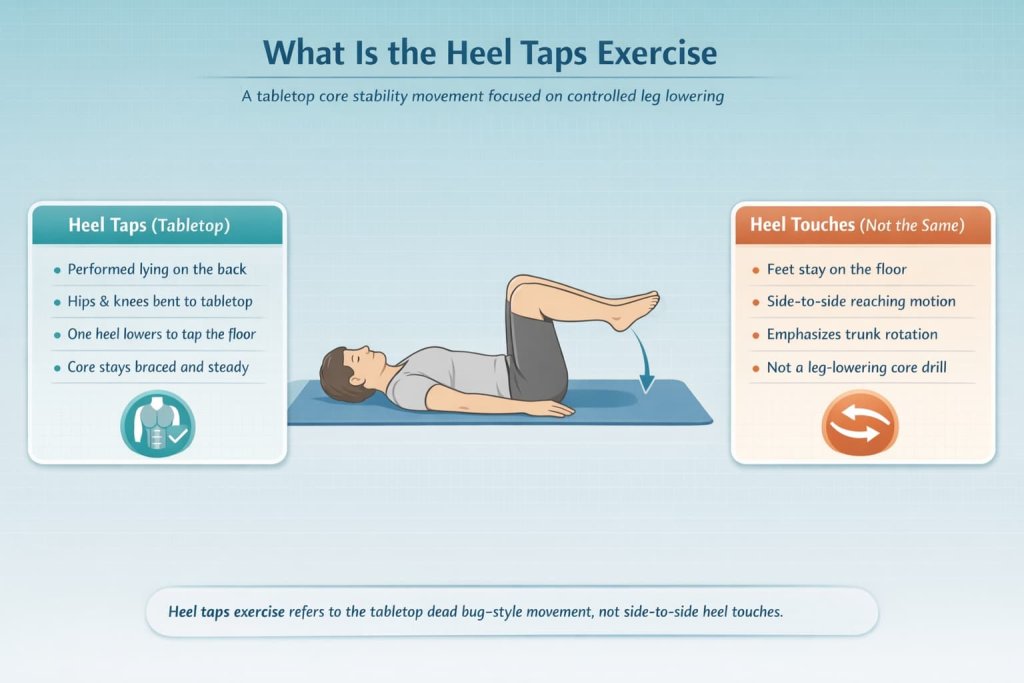
Most coaches use the term “heel taps” to describe the tabletop version:
- You lie on your back
- Hips and knees are bent around 90 degrees
- You alternate lowering one heel to tap the floor, then return to tabletop
This definition aligns with how heel taps are described in instructional fitness content from Peloton.
Heel Taps vs Heel Touches
The term “heel taps” is sometimes confused with “heel touches,” which is a different exercise. Heel touches are performed with feet on the floor while you reach side-to-side toward your heels, emphasizing trunk rotation rather than leg-lowering control. Peloton separates these two movements clearly in its exercise library.
For this article, heel taps exercise refers to the tabletop dead bug–style movement.
How to Do Heel Taps Exercise With Proper Form
How to do it
- Lie on your back with hips and knees bent to tabletop
- Keep your ribs down so your lower back stays stable
- Slowly lower one heel toward the floor
- Lightly tap the heel or stop just before the floor
- Return to tabletop with control
- Alternate sides while maintaining a steady torso
If your lower back arches or lifts, shorten the range of motion. This form cue is emphasized in most dead bug technique guides.
Trainer Tip
Think “quiet torso, moving hips.” If your spine moves, the set is too hard.
How the Heel Taps Exercise Builds Stronger Abs
The heel taps exercise strengthens the abs by teaching them to control and resist movement while the legs move, rather than by bending the spine.
Key reasons it builds stronger abs:
- Trains abdominal bracing to keep ribs and pelvis stable
- Challenges the core through anti-extension control as the heel lowers
- Increases time under tension with slow, controlled reps
- Improves coordination between the abs and hips during leg movement
Instead of relying on crunching motions, heel taps develop the abs’ ability to hold the torso steady under load, which is essential for real-world strength and core stability.
Heel Taps Exercise Benefits
Heel taps are widely used because they train core control while the spine remains supported on the floor.
They may help support:
- Core stability and coordination while the legs move independently
- Controlled abdominal bracing that transfers to lifting, running, and daily tasks
- Progression toward more advanced dead bug and core stability exercises
Muscles Worked in the Heel Taps Exercise
Heel taps are not an isolation exercise. They train the trunk to resist movement while the hips move.
Primary involvement includes:
- Deep core stabilizers responsible for bracing
- Abdominal muscles controlling trunk position
- Hip flexors assisting with leg lowering and lifting
Common Heel Taps Exercise Mistakes
Heel taps are a control drill, not a speed exercise.
Common mistakes include:
- Letting the lower back arch as the heel lowers
- Rib flare that reduces abdominal engagement
- Moving too fast and losing tension
- Chasing floor contact instead of maintaining control
When any of these appear, regress the movement and rebuild clean reps.
Heel Taps Exercise Modifications and Progressions
Make Heel Taps Easier
How to do it
- Keep one foot on the floor while tapping with the other
- Lower the heel only partway down
- Place hands on the ribs to monitor movement
Trainer Tip
Smaller, slower reps build better core control than forcing full range.
Peloton’s postpartum core education also uses this scaled heel tap approach as an entry-level option.
Make Heel Taps Harder
How to do it
- Use a slow 2–3 second lowering phase
- Add opposite-arm reach (dead bug style)
- Progress to suspension-based variations if appropriate
Trainer Tip
Only progress if your spine stays steady on every rep.
The American Council on Exercise highlights stopping the leg descent just before the lower back lifts when using resisted heel tap variations.
How to Program Heel Taps Exercise
Heel taps work best early in a workout or during warm-ups when focus is high.
Beginner guideline:
- 2–3 sets of 6–10 reps per side
- 30–60 seconds rest
- Stop each set when form degrades
For general core programming structure, the Mayo Clinic outlines balanced core training principles that pair stability, control, and gradual progression.
Heel Taps Exercise Safety and Who Should Be Cautious
Heel taps should feel controlled, not painful.
Use caution if you have:
- Ongoing back pain that worsens with core exercise
- Recent injury or surgery
- Pregnancy-related positioning concerns
General guidance from the Mayo Clinic recommends consulting a qualified professional when introducing new core exercises under these conditions.
People Also Ask About Heel Taps Exercise
Are heel taps good for lower abs
They can help support lower trunk control when performed slowly with proper bracing.
Should my lower back touch the floor
Your spine should stay steady. If it arches or lifts, reduce the range and slow down.
How many heel taps should I do
Most beginners benefit from 6–10 controlled reps per side for 2–3 sets.
FAQ
What is the heel taps exercise best for
Developing core stability and controlled leg movement.
Why do I feel heel taps in my hip flexors
This usually means the range is too large or bracing is insufficient.
Can beginners do heel taps daily
They are low-impact, but quality and recovery matter more than frequency.
Are heel taps and heel touches the same
No. Heel taps involve leg lowering from tabletop; heel touches involve side-to-side reaching.
Do heel taps burn belly fat
They strengthen core muscles, but fat loss depends on overall lifestyle factors.
How can I make heel taps harder at home
Slow the tempo, add pauses, or include opposite-arm movement.
Conclusion
The heel taps exercise is a simple but effective way to train your core to stay stable while your legs move. When done slowly and with control, it builds a strong foundation for more advanced core work and supports better movement quality in everyday training.
References
- Mayo Clinic — Core strength fundamentals, bracing concepts, and safe core training guidance that supports your “core stability” framing.
- Harvard Health Publishing — Explains why dead bug–style drills are useful for controlled core work and spinal-friendly core training principles.
- PubMed Central — Systematic review evidence supporting core stability exercise approaches, relevant to your “why it works” and benefits framing without making medical claims.
- Physical Therapy Journal — Foundational evidence on motor control exercises and trunk control concepts that support your “control-first” explanation of heel taps.