
The pullover exercise is a single movement that can train your chest and lats at the same time when you use a controlled arc and a shoulder-friendly range of motion. It’s popular because it blends upper-body strength with deep control through shoulder extension, which many lifters struggle to load well.

Most people get better results (and fewer cranky shoulders) by focusing on clean setup, a steady ribcage position, and a range of motion they can control from start to finish. A clear technique standard matters because the pullover can feel very different depending on the variation and how deep you go.
What Is the Pullover Exercise?
A pullover is an upper-body lift where you move a weight in an arc from above your chest back behind your head (or toward overhead) and return it to the start. The most common versions are:
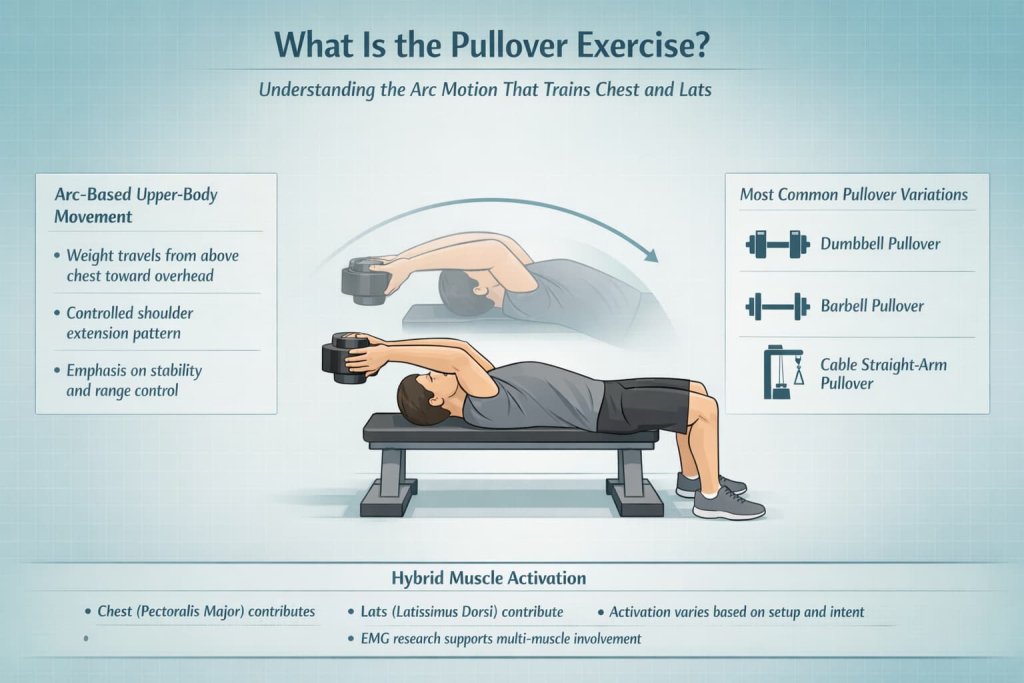
- Dumbbell pullover on a bench
- Barbell pullover
- Cable (straight-arm) pullover or straight-arm pulldown style variations
It’s often described as a hybrid lift because both the pectoralis major (chest) and latissimus dorsi (lats) can contribute meaningfully, depending on your setup and intent. Electromyography research indexed on PubMed supports that both muscles are active during the pullover pattern.
Pullover Exercise Benefits
Builds Chest and Lats With One Movement
Pullovers can help you load shoulder extension patterns that don’t always get trained directly in typical push/pull splits.
Improves Control in Overhead Positions
When done with a manageable range of motion, pullovers can build stability and coordination through positions that also appear in other strength exercises.
Bridges Pressing and Pulling
Pullovers often pair well after pressing (for chest emphasis) or after vertical pulling (for lat emphasis), depending on the variation you choose.
Pullover Exercise Variations for Different Goals
Choosing the right pullover variation helps match your goal, training experience, and shoulder comfort level. Below are the most practical options, broken down using a clear coaching format.
1. Dumbbell Pullover (Balanced Chest + Lats)
Why it works:
The dumbbell creates a natural arc and long lever arm, increasing time under tension across both chest and lats. It allows small grip and path adjustments, making it easier to “steer” the movement toward either muscle group.
Muscles worked:
Pectoralis major, latissimus dorsi, teres major, serratus anterior, long head of the triceps, and core stabilizers.
How to do it:
- Lie flat on a bench with feet planted firmly.
- Hold one dumbbell vertically with both hands under the top plate.
- Start with arms extended above your chest and a slight bend in the elbows.
- Lower the dumbbell in a controlled arc behind your head.
- Stop when you reach a comfortable, stable end range.
- Pull the weight back above your chest without swinging.
Trainer Tip:
If you want more lat emphasis, think about pulling from your upper back/armpits. For more chest focus, slightly shorten the range and control the return phase.
2. Barbell Pullover (Heavier Loading Focus)
Why it works:
The barbell allows slightly heavier loading and symmetrical grip placement. The fixed hand position can increase stability for experienced lifters who want progressive overload.
Muscles worked:
Lats and chest primarily, with triceps long head and upper-back stabilizers assisting.
How to do it:
- Lie on a flat bench and grip a barbell with a shoulder-width grip.
- Press the bar above your chest to start.
- Maintain a small elbow bend.
- Lower the bar backward in a smooth arc under control.
- Stop before shoulder discomfort or rib flare.
- Pull the bar back to the starting position steadily.
Trainer Tip:
Avoid going excessively deep just because you can handle more weight. Heavier loading requires stricter range control to protect the shoulders.
3. Cable Pullover (Lat Emphasis)
Why it works:
The cable provides constant tension throughout the range, making it easier to maintain consistent lat engagement. EMG comparisons published in Applied Sciences and available via MDPI indicate that exercise variation can influence muscle activation patterns.
Muscles worked:
Primarily latissimus dorsi, with teres major and serratus anterior assisting; chest involvement is typically lower than in free-weight versions.
How to do it:
- Stand facing a high cable pulley with a straight bar or rope attachment.
- Grip the handle with straight or slightly bent elbows.
- Brace your core and hinge slightly at the hips.
- Pull the cable downward in an arc toward your thighs.
- Control the return upward without letting your shoulders shrug.
Trainer Tip:
Keep elbows nearly fixed. If they bend too much, the movement shifts toward a triceps or pulldown pattern instead of a true pullover.
4. Short-Range Pullover (Shoulder-Friendly Option)
Why it works:
Reducing range of motion limits stress in deeper overhead positions while still training shoulder extension strength. This can help maintain muscle stimulus without excessive joint strain.
Muscles worked:
Chest and lats within a controlled mid-range, supported by core stabilizers.
How to do it:
- Use a lighter dumbbell or cable setup.
- Begin in the standard pullover starting position.
- Lower only halfway to three-quarters of your usual depth.
- Maintain slow tempo (especially on the lowering phase).
- Stop immediately if discomfort increases.
Trainer Tip:
Rehabilitation guidance from the Hospital for Special Surgery (HSS) emphasizes gradual progression and controlled exposure when returning to overhead loading. Start conservative and increase range slowly over time.
How to Program the Pullover Exercise
- For muscle: 2–4 sets of 8–15 reps
- For strength control: 3–5 sets of 6–10 reps
- Tempo: 2–4 seconds lowering, controlled return
- Placement: After pressing (chest focus) or after pulling (lat focus)
Progress gradually while maintaining clean technique.
Dumbbell Pullover vs Barbell Pullover vs Cable Pullover
Here’s how to choose the best option:
| Variation | Best For | What It Feels Like | Common Mistake |
|---|---|---|---|
| Dumbbell pullover | Balanced chest + lats | Smooth arc, easy to learn | Going too deep and losing control |
| Barbell pullover | Heavier loading | More rigid path | Turning it into a press |
| Cable pullover | Lat emphasis | Constant tension | Bending elbows excessively |
A 2022 EMG comparison study published in Applied Sciences and accessible via MDPI found that exercise variation can change muscle activation patterns, meaning your choice influences emphasis.
Pullover Exercise Cues That Improve Activation
To Emphasize Lats
- Think “pull from the armpits.”
- Stop the descent before shoulder strain begins.
- Keep ribs steady and avoid excessive arching.
To Emphasize Chest
- Use a slightly shorter range of motion.
- Keep tension smooth through the return phase.
- Avoid bouncing at the bottom.
Common Pullover Exercise Mistakes
Going Too Deep
If your shoulders roll forward or ribs flare excessively, you’ve likely exceeded your controlled range.
Turning It Into a Triceps Movement
Excessive elbow bending shifts emphasis away from chest and lats.
Using Momentum
Swinging the dumbbell reduces muscle tension and increases joint stress.
Who Should Avoid or Modify the Pullover Exercise?
Modify or avoid if you have:
- Shoulder pain during overhead movements
- A history of impingement-type symptoms
- Shoulder instability
Shoulder-friendly modifications include shorter range of motion, lighter loads, and cable variations. Rehabilitation guidance from the Hospital for Special Surgery (HSS) emphasizes graded exposure and controlled progression when returning to overhead loading.
FAQs About the Pullover Exercise
Does the pullover work chest or lats more?
Both can be active. EMG research indexed in PubMed shows meaningful activation in pectoralis major and latissimus dorsi during the movement.
Is the dumbbell pullover safe?
It can be when performed with controlled range and without pain, particularly in overhead-sensitive shoulders.
What’s the best pullover for lats?
Many lifters find cable pullovers easier for maintaining consistent lat tension.
Should beginners use heavy weight?
No. Start light and prioritize control.
Can pullovers replace rows or presses?
No. They complement them but don’t fully replace traditional push or pull patterns.
Conclusion
The pullover exercise remains a classic because it can effectively train both chest and lats in one controlled arc. Focus on range you can own, maintain steady rib control, and choose the variation that fits your goal. With consistent, controlled execution, the pullover can be a powerful addition to your upper-body program.
References
- Human Kinetics Journals — Journal of Applied Biomechanics (2011) Pullover EMG Abstract
- PubMed Central (PMC) — Teixeira et al. (2022) Pullover vs Pulldown Shoulder Position Differences
- PubMed — American College of Sports Medicine (ACSM) Position Stand: Resistance Training Progression Models
- PubMed Central (PMC) — Schoenfeld et al. (2021) Loading Recommendations for Strength and Hypertrophy