
Hamstring isometric exercises build hamstring strength by creating muscle tension without joint movement, which can feel more joint-friendly while still training control and stability.
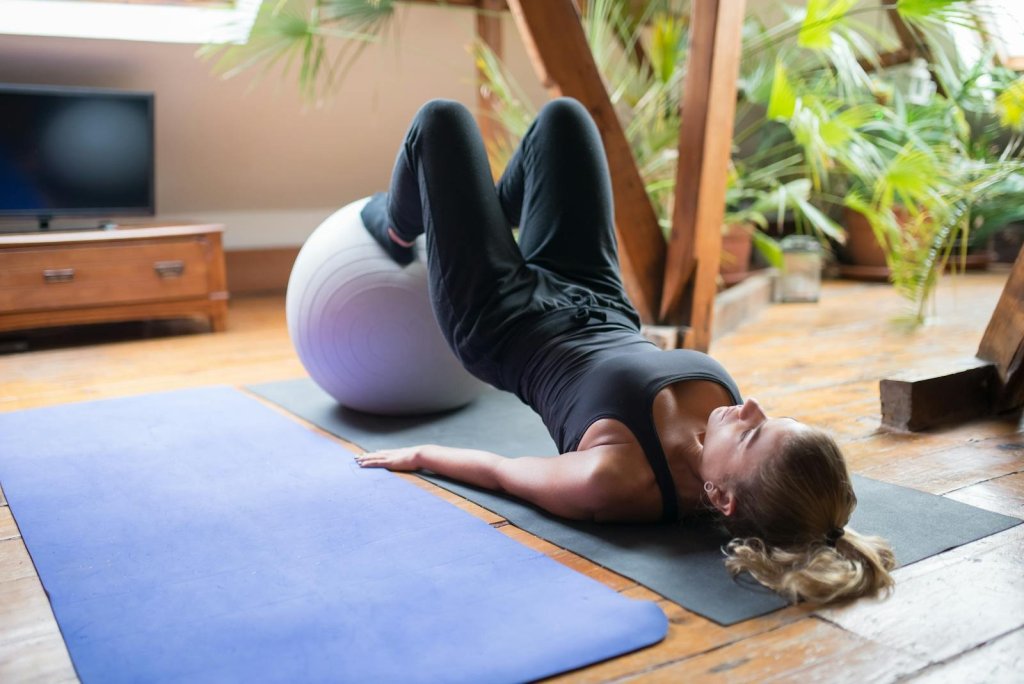
Using isometrics is a common early-to-mid step in evidence-based hamstring rehab progressions because you can load the hamstrings with less movement and clear intensity control. Guidance on hamstring strain rehab often emphasizes criterion-based progression (not rushing timelines) and gradually increasing load as tolerance improves.
What hamstring isometric exercises are
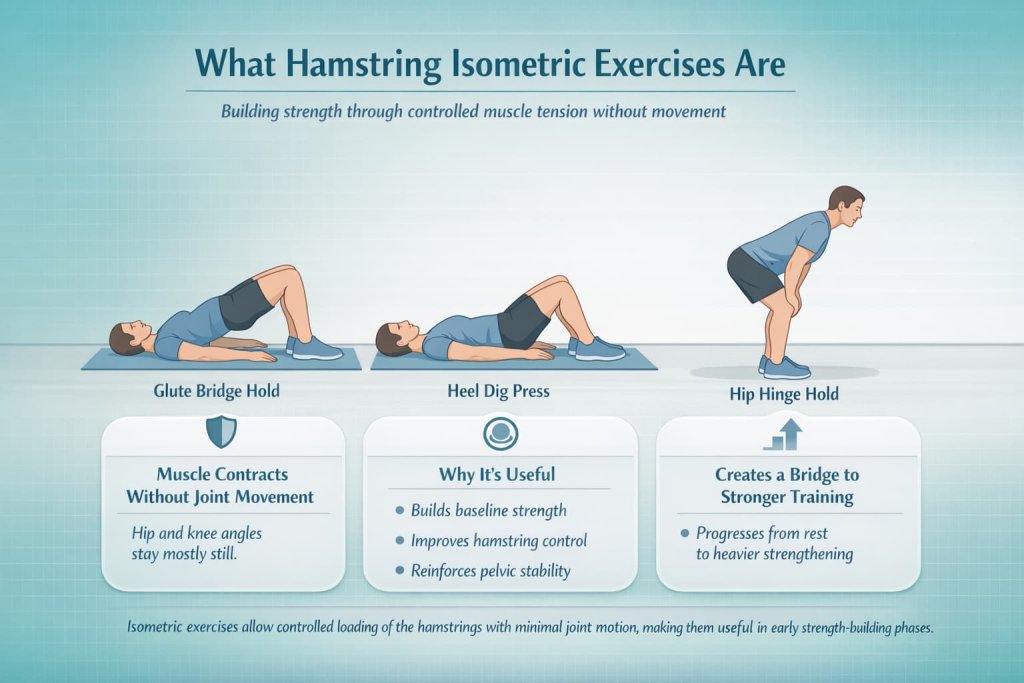
Hamstring isometrics are “holds” where your hamstrings contract while your hip and knee angles stay mostly still. Think: holding a bridge position, pushing your heel into the floor without sliding, or holding a hip-hinge posture while resisting movement.
They’re useful when you want to:
- Build baseline strength and tendon capacity with simpler form demands
- Improve hamstring control (especially near end-range hip hinge positions)
- Create a bridge from rest to heavier strengthening (like eccentrics)
Why hamstring isometrics can feel “lower strain”
Isometrics let you pick:
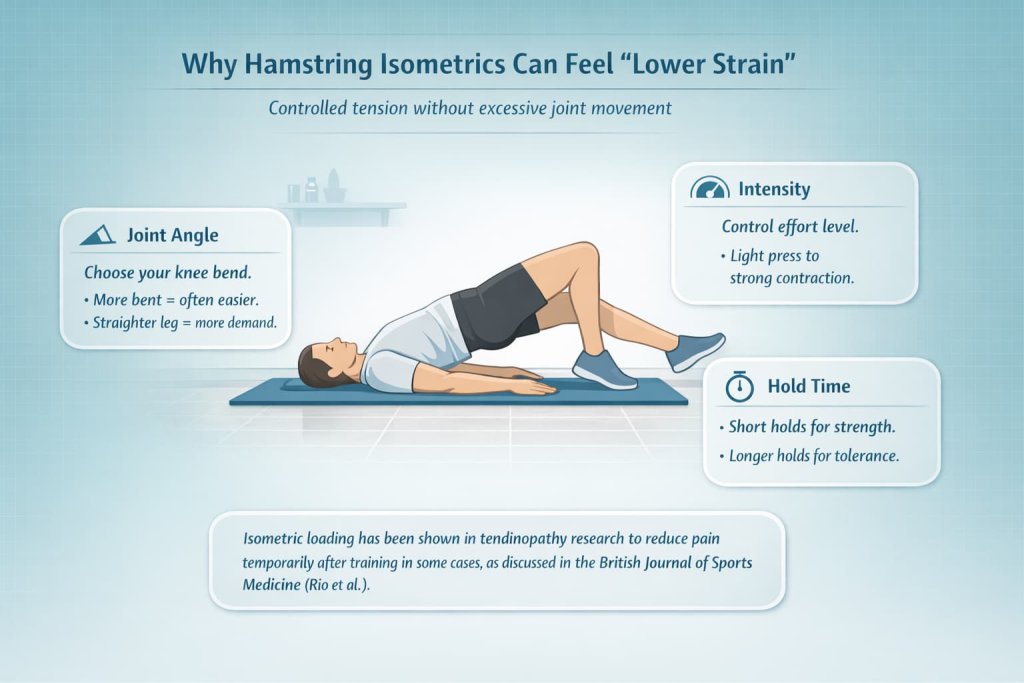
- The joint angle (more bent knee often feels easier; straighter knee is harder)
- The intensity (light to hard push)
- The hold time (short strength holds vs longer tolerance holds)
In tendinopathy research, isometric loading has been shown to reduce pain immediately for a period after training in some cases (this is not hamstring-specific, but it helps explain why isometrics are often used early).
7 Best hamstring isometric exercises
Build stronger, more stable hamstrings with these 7 proven isometric exercises designed to create controlled tension without excessive strain. Each movement focuses on safe strength development, better muscle activation, and steady progression.
1) Glute Bridge Isometric Hold
How to do it:
- Lie on your back, knees bent, feet flat
- Brace your core and squeeze your glutes lightly
- Lift hips until shoulders–hips–knees form a straight line
- Keep ribs down (don’t over-arch your low back)
- Hold 15–45 seconds, then lower with control
Why it works:
This is a simple entry-level hamstring isometric. It builds posterior-chain tension while teaching pelvic control, which helps reduce “compensation” patterns.
Muscles worked:
Hamstrings, glutes, core, spinal stabilizers.
Trainer Tip:
If hamstrings cramp, move your feet slightly farther from your hips or reduce hold intensity and focus on steady breathing.
2) Heels-Elevated Bridge Hold (More Hamstring Bias)
How to do it:
- Set heels on a low step/book/plate (stable surface)
- Perform a bridge and hold at the top
- Keep your pelvis level and knees tracking forward
- Hold 10–30 seconds
Why it works:
Elevating the heels often increases hamstring involvement while staying controlled and low impact.
Muscles worked:
Hamstrings (higher emphasis), glutes, core.
Trainer Tip:
Don’t chase height. A slightly lower bridge with strong tension is better than a high bridge with a big back arch.
3) Single-Leg Bridge Isometric Hold
How to do it:
- Start in a normal bridge position
- Lift one foot a few inches (keep thighs parallel)
- Hold hips level (no dropping or twisting)
- Hold 8–20 seconds per side
Why it works:
Single-leg holds increase demand on the working hamstring and challenge anti-rotation core control—useful for athletic carryover.
Muscles worked:
Hamstrings, glute max/med, core stabilizers.
Trainer Tip:
If your hips rotate, shorten the hold and rebuild control before increasing time.
4) Supine Heel Dig Isometric (Hamstring “Press”)
How to do it:
- Lie on your back, knees bent
- Dig your heels down into the floor as if trying to “pull” the floor toward you (without moving)
- Feel the hamstrings tighten
- Hold 6–15 seconds, relax, repeat
Why it works:
This teaches hamstring activation without needing a full bridge. It’s a great early option when movement tolerance is limited.
Muscles worked:
Hamstrings, calves (light), core (light).
Trainer Tip:
Aim for smooth, steady pressure—not a sudden jerk.
5) Wall Hamstring Isometric Hold (Knee-Bent Version)
How to do it:
- Lie on your back near a wall
- Place one foot on the wall, knee bent around 90 degrees
- Push your heel into the wall as if trying to drag it downward (no movement)
- Hold 10–30 seconds per side
Why it works:
The wall gives you a consistent surface to “push into,” making effort easy to scale and track week to week.
Muscles worked:
Hamstrings, glutes (support), core.
Trainer Tip:
Keep the pelvis heavy and level—don’t let your low back lift into a big arch.
6) Hip Hinge Isometric Hold (Bodyweight RDL Hold)
How to do it:
- Stand tall, soften knees slightly
- Push hips back like closing a car door with your hips
- Keep spine neutral and chest “long,” not rounded
- Stop when you feel hamstrings load (not pain)
- Hold 10–25 seconds
Why it works:
This trains hamstrings in a lengthened position (a key function during running and hinging tasks) while keeping motion minimal.
Muscles worked:
Hamstrings, glutes, spinal erectors, core.
Trainer Tip:
Think “hips back, ribs stacked.” If your back feels it more than your hamstrings, reduce hinge depth.
7) Slider Curl Isometric Hold (Mid-Range Hold)
How to do it:
- Lie on your back with heels on sliders/towels
- Bridge up, then slide heels out a little
- Stop at a challenging point and hold 5–15 seconds
- Slide back in and lower hips
Why it works:
This is a strong hamstring-focused progression that builds high tension while you control the position. It also sets you up to progress into full hamstring curls later.
Muscles worked:
Hamstrings (high), glutes, core.
Trainer Tip:
Start with tiny slides. Quality tension and pelvic control matter more than range.
How to program hamstring isometric exercises
A simple, practical approach:
- Frequency: 3–5 days/week (lighter holds can be more frequent)
- Intensity: start at a “moderate” effort, then build to strong holds
- Volume options:
- Strength focus: 5–8 sets of 10–20 seconds (higher effort)
- Tolerance focus: 3–5 sets of 30–45 seconds (moderate effort)
- Progression: increase hold time or effort first, then move to harder angles (straighter knee, longer lever, single-leg)
If you’re returning to sport, modern hamstring strain resources emphasize structured progressions and objective criteria where possible. JOSPT hamstring strain injury in athletes
Quick safety checklist before you start
Stop and get medical guidance first if you have:
- Sudden sharp pain with a “pop,” major bruising, or trouble walking
- Numbness/tingling down the leg, or pain that keeps worsening
- Unexplained swelling, fever, or pain after a fall/trauma
If you’re rehabbing a hamstring strain, follow a criterion-based progression like those used in clinical rehab guidelines (progress based on symptoms and function, not just days).
Common mistakes to avoid
- Holding your breath (makes you tense in the wrong places)
- Over-arching your low back in bridges
- Letting knees flare out or collapse inward
- Chasing maximum effort too early (build tolerance first)
- Progressing to straight-knee or single-leg versions before you own the basics
Who Should Be Careful With Hamstring Isometrics?
Hamstring isometrics are generally low impact, but caution is needed if you have:
- A recent tear with swelling or bruising
- A sudden “pop” with weakness
- Suspected avulsion near the sit bone
- Radiating pain, numbness, or tingling
- Pain that keeps worsening
If symptoms are severe or unclear, seek professional evaluation before starting exercises.
When to progress to harder hamstring work
Isometrics are a strong foundation, but long-term hamstring resilience usually includes progressively heavier strengthening and, for athletes, faster running exposure when appropriate. Many hamstring strain resources emphasize structured, criteria-driven progressions and return-to-play decision-making.
FAQs
How long should I hold hamstring isometric exercises?
Most people do well with 10–20 seconds for higher-effort strength holds or 30–45 seconds for moderate-effort tolerance holds, depending on comfort and goals.
How often should I do hamstring isometrics?
A common range is 3–5 days per week, starting lighter and building up gradually.
Are hamstring isometrics good for runners?
Yes—especially as a controlled step to restore strength and confidence. Runners often benefit from progressing from isometrics to heavier strength work and gradual speed exposure.
Should hamstring isometrics hurt?
They should feel like strong muscle work, not sharp pain. If pain spikes or lingers and worsens, reduce intensity or stop and get guidance.
What’s the best isometric for beginners?
Start with the glute bridge isometric hold or supine heel dig because they’re easy to scale and teach good pelvic control.
Can I do these at home without equipment?
Yes. Most options here are bodyweight-only. Sliders can be improvised with towels on smooth floors.
When should I see a professional?
If you had a sudden injury with bruising, severe weakness, or symptoms that keep worsening—or if you’re unsure whether it’s a strain vs another issue—get evaluated before progressing.
Conclusion
Hamstring isometric exercises are one of the most practical ways to rebuild hamstring strength with controlled tension and minimal movement. Start with simple bridge and heel-dig holds, progress your effort and hold time, then move to single-leg and hinge-based options as your control improves.
If you want, I can format the 7 exercises into your exact exercise template style (bold labels, “How to do it” in bullet points) and add a short weekly plan.
References
- Goom TSH, Malliaras P, Reiman MP, Purdam CR. (2016). Proximal hamstring tendinopathy: clinical aspects of assessment and management. Journal of Orthopaedic & Sports Physical Therapy, 46(6), 483–493. Journal of Orthopaedic & Sports Physical Therapy
- Schmitt B, Tyler T, McHugh M. (2012). Hamstring injury rehabilitation and prevention of reinjury (full text). International Journal of Sports Physical Therapy, 7(3), 333–341. PubMed Central (NIH)
- Prevention and Rehabilitation of the Athletic Hamstring Injury (full text). (2024). Sports Medicine review article. PubMed Central (NIH)
- Andrews MH, et al. (2025). Hamstring injury mechanisms and eccentric training-induced muscle adaptations: current insights and future directions (full text). Sports Medicine narrative review. PubMed Central (NIH)