
Shoulder isometric exercises are strength-building holds where you contract the shoulder muscles without moving the joint much, which can be a helpful way to train stability when motion is uncomfortable. They’re commonly used in active rehab programs for shoulder issues and can fit into a progressive strengthening plan, as outlined in the Journal of Orthopaedic & Sports Physical Therapy (JOSPT).
Understanding how to do shoulder isometrics correctly matters because the shoulder relies heavily on muscle control (rotator cuff + shoulder blade muscles) to stay stable during daily tasks and lifting. A smart isometric plan focuses on safe positions, steady effort, and gradual progression—without promising “instant fixes,” since short-term pain responses can vary according to research published in BMJ Open Sport & Exercise Medicine.
What Are Shoulder Isometric Exercises?
Shoulder isometric exercises are strength holds where you contract the shoulder muscles without moving the joint. Instead of lifting through a range of motion, you press into a wall or fixed object and maintain steady tension.
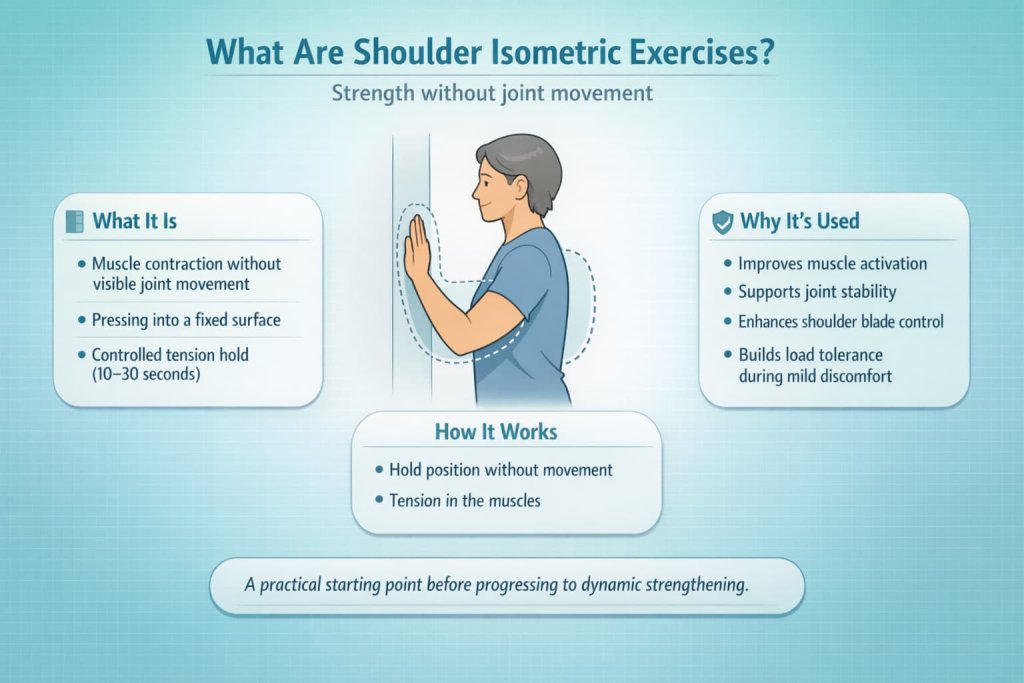
They are commonly used to improve:
- Muscle activation
- Joint stability
- Shoulder blade control
- Load tolerance during mild discomfort
Because movement is limited, they can be a practical starting point before progressing to dynamic strengthening.
Benefits of Shoulder Isometric Exercises
Shoulder isometrics may help support strength and stability when done consistently and with controlled effort.
Key benefits include:
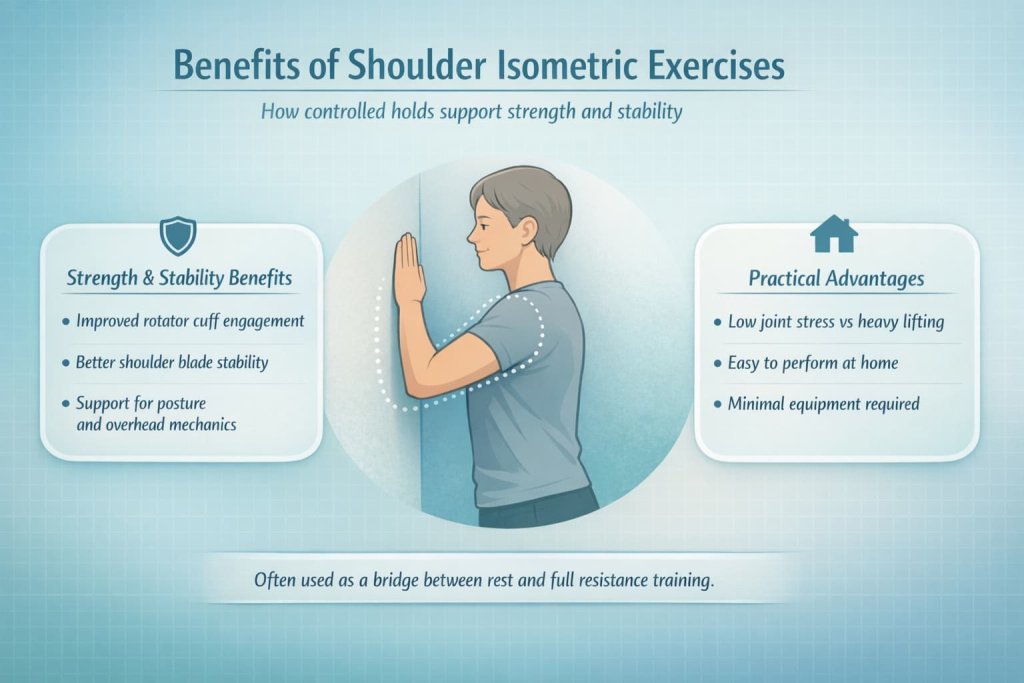
- Improved rotator cuff engagement
- Better shoulder blade stability
- Support for posture and overhead mechanics
- Low joint stress compared to heavy lifting
- Easy to perform at home without equipment
They are often used as a bridge between rest and full resistance training.
7 Best Shoulder Isometric Exercises
These 7 shoulder isometric exercises are designed to improve joint stability, rotator cuff activation, and shoulder blade control without heavy equipment. Each hold focuses on building strength safely while supporting better posture and movement mechanics.
1) Isometric Shoulder External Rotation (Wall Press)
How to do it:
- Stand sideways next to a wall with your elbow bent 90° and tucked to your side
- Place the back of your hand against the wall
- Gently press your hand into the wall as if rotating outward (but don’t let your arm move)
- Keep your shoulder down (don’t shrug)
- Hold 10–20 seconds, relax, repeat
Why it works: External rotation strengthens the rotator cuff’s stabilizing role, helping keep the shoulder joint centered during lifting, reaching, and overhead movements.
Muscles worked: Infraspinatus, teres minor, posterior deltoid (support), scapular stabilizers (support).
Trainer Tip: Place a small towel between your elbow and ribs to prevent the elbow from drifting outward and to improve rotator cuff activation.
2) Isometric Shoulder Internal Rotation (Towel Squeeze)
How to do it:
- Stand tall with elbow bent 90° and tucked to your side
- Place a folded towel between your palm/forearm and your belly (or use a doorframe/pillow at your side)
- Press inward gently as if rotating your forearm toward your stomach (no visible movement)
- Keep your posture tall and steady
- Hold 10–20 seconds, relax, repeat
Why it works: Internal rotation strength supports shoulder stability during pushing, carrying, and pressing tasks while reinforcing front-shoulder control.
Muscles worked: Subscapularis, pectoralis major (assist), latissimus dorsi (assist).
Trainer Tip: If you feel pinching at the front of the shoulder, reduce the effort and avoid arching your lower back.
3) Isometric Shoulder Abduction (Wall Press at Side)
How to do it:
- Stand with your arm by your side and elbow slightly bent
- Place the outside of your upper arm against a wall
- Press your upper arm gently outward into the wall (as if lifting the arm to the side) without moving
- Keep your torso upright
- Hold 10–20 seconds, relax, repeat
Why it works: Abduction control improves shoulder stability when lifting objects away from your body and helps reinforce proper joint alignment.
Muscles worked: Supraspinatus, middle deltoid, upper trapezius (support), rotator cuff.
Trainer Tip: Keep your neck relaxed and avoid shrugging—think about gently setting your shoulder blade down and back.
4) Isometric Shoulder Flexion (Front Wall Press)
How to do it:
- Face a wall and bend your elbow to about 90°
- Place your fist or forearm on the wall in front of you
- Press forward into the wall as if lifting your arm forward (no motion)
- Keep your ribs down and posture neutral
- Hold 10–20 seconds, relax, repeat
Why it works: Flexion strength supports forward reaching and prepares the shoulder for overhead movements with better control.
Muscles worked: Anterior deltoid, upper pectorals (assist), rotator cuff (stability).
Trainer Tip: Avoid leaning into the wall—keep the effort in your shoulder, not your body weight.
5) Isometric Shoulder Extension (Back Press Into Wall)
How to do it:
- Stand with your back near a wall
- Keep your elbow straight and place the back of your arm or hand against the wall behind you
- Press backward gently into the wall without moving your arm
- Maintain a neutral spine
- Hold 10–20 seconds, relax, repeat
Why it works: Extension strengthens the back of the shoulder and helps balance anterior shoulder loading from frequent pushing movements.
Muscles worked: Posterior deltoid, latissimus dorsi (assist), teres major (assist), scapular stabilizers.
Trainer Tip: Lightly brace your core so you don’t arch your lower back during the hold.
6) Isometric Scapular Retraction (Shoulder Blade Squeeze Hold)
How to do it:
- Sit or stand tall with arms relaxed by your sides
- Gently squeeze your shoulder blades back and slightly down
- Keep your chest relaxed and avoid over-arching
- Breathe normally during the hold
- Hold 10–30 seconds, relax, repeat
Why it works: Scapular control is essential for shoulder stability, supporting efficient arm movement and reducing unnecessary strain on the joint.
Muscles worked: Middle trapezius, lower trapezius, rhomboids, posterior shoulder stabilizers.
Trainer Tip: Aim for controlled engagement rather than a forceful squeeze to prevent neck tension.
7) Isometric Serratus Press (Wall “Plus” Hold)
How to do it:
- Stand facing a wall with forearms placed on the wall at shoulder height
- Gently push your forearms into the wall
- “Reach” your chest slightly away so your shoulder blades glide forward
- Keep shoulders relaxed (no shrugging)
- Hold 10–20 seconds, relax, repeat
Why it works: Serratus anterior activation helps stabilize the shoulder blade against the ribcage, supporting safer reaching and overhead activity.
Muscles worked: Serratus anterior, lower trapezius (support), rotator cuff (support).
Trainer Tip: If you feel strain in your neck, lower your arm position slightly and focus on reaching forward rather than lifting upward.
Before You Start
If you have a recent injury, post-surgery restrictions, or a diagnosed condition, follow your clinician’s advice first. The American Academy of Orthopaedic Surgeons (AAOS) also notes that shoulder conditioning programs should be selected with medical guidance to match your needs.
Use this simple rule for effort:
- Start light to moderate (steady, controlled contraction)
- Stop if symptoms worsen or new pain appears, as advised by NHS Inform
How to Use Shoulder Isometric Exercises in a Program
Clinical guidance for rotator cuff–related problems emphasizes active rehabilitation exercise (often including motor control and resistance training). Isometrics can be one of the “entry points” before heavier or more dynamic strengthening, according to the Journal of Orthopaedic & Sports Physical Therapy.
A practical programming starting point:
- Frequency: 3–5 days/week
- Sets: 2–4 per exercise
- Hold time: 10–30 seconds per rep
- Reps: 3–6 holds per set
- Rest: 20–60 seconds between holds
- Progression: increase hold time first, then effort, then add longer-lever positions (only if well tolerated)
For broader shoulder conditioning principles (strength + stability), refer to the American Academy of Orthopaedic Surgeons.
Quick Safety Checklist
Stop and get medical guidance if you have:
- Sudden major weakness after an injury
- A visibly deformed shoulder after a fall
- Fever, unexplained swelling, or severe night pain
- Pain that rapidly worsens or doesn’t improve over time
For everyday shoulder pain, NHS resources advise stopping exercises if they worsen symptoms and checking in if pain hasn’t improved after about 6 weeks of self-management advice.
Common Mistakes to Avoid
- Holding your breath (use steady breathing)
- Shrugging the shoulders toward your ears
- Pushing into pain or forcing higher effort too soon
- Using body lean instead of shoulder contraction
- Skipping scapular control (the shoulder blade matters for stability), as emphasized by the American Academy of Orthopaedic Surgeons
What Results to Expect and How Fast
Many shoulder issues improve gradually with consistent self-management and exercise, but timelines vary. NHS Inform suggests checking in if pain hasn’t improved after about 6 weeks of following guidance and also advises stopping exercises that worsen symptoms.
Also, be careful with “instant pain relief” claims. Research in BMJ Open Sport & Exercise Medicine shows immediate pain responses to isometrics can vary, so they’re best viewed as a tolerable loading method within a longer-term strengthening plan.
Who Should Be Careful or Avoid Them?
Although generally low impact, some individuals should seek medical advice before starting:
- Recent shoulder injury, dislocation, or fracture
- Post-surgery restrictions
- Severe or worsening pain
- Sudden weakness after trauma
- Numbness or tingling in the arm
If symptoms do not improve over several weeks or continue to worsen, consult a healthcare professional.
When to Seek Professional Guidance
Consider seeing a clinician (physio/doctor) if:
- Pain is not improving over several weeks
- You can’t raise your arm normally or daily tasks are getting harder
- Symptoms repeatedly flare even with light exercise
- You had a fall or sudden injury and now have marked weakness
NHS self-care guidance also recommends talking to a healthcare professional if exercises worsen symptoms or if pain hasn’t improved within about 6 weeks.
FAQs
Are shoulder isometric exercises good for rotator cuff pain?
They can be a useful option because they load the shoulder with minimal motion, and current clinical guidance supports active rehab exercise programs for rotator cuff tendinopathy.
How long should I hold an isometric for shoulders?
A common starting range is 10–20 seconds per hold, repeated for multiple reps. Progress by increasing hold time first, then effort, as long as symptoms don’t worsen.
Should isometrics hurt?
They shouldn’t create sharp or escalating pain. Stop if exercises worsen your symptoms or cause new pain.
Can isometrics replace regular shoulder strengthening?
They’re usually a starting step, not the end goal. Many people progress from isometrics to controlled movement and then to heavier resistance training as tolerated.
How often should I do shoulder isometrics?
Many people do them 3–5 days per week. Consistency matters more than intensity early on.
Do isometrics give instant pain relief?
Not always. Evidence suggests immediate pain responses can vary.
Can I do shoulder isometrics if I lift weights?
Yes. They can work well as a warm-up (low effort) or as a deload tool when the shoulder is irritated—while still respecting pain and fatigue.
Conclusion
Shoulder isometric exercises are a simple, equipment-light way to train shoulder strength and stability with minimal movement. Start with controlled effort, prioritize good shoulder blade position, and progress gradually. If symptoms worsen or don’t improve over time, seek professional guidance.
References
- Rotator Cuff and Shoulder Conditioning Program (PDF). American Academy of Orthopaedic Surgeons (AAOS) OrthoInfo.
- Shoulder Problems (Self-management guidance). NHS Inform Shoulder Problems
- Shoulder Pain (Symptoms, advice, and when to seek help). NHS
- Shoulder Pain Exercise Pamphlet. Versus Arthritis