
Subscapularis exercises strengthen your shoulder’s main internal-rotation rotator cuff muscle, which can improve shoulder stability and control. In practical terms, they train you to rotate your arm inward and keep the “ball” of your upper arm steady in the socket during daily lifting, reaching, and sports movements, as explained by the Cleveland Clinic.
Understanding subscapularis training matters because shoulder discomfort and weakness are often linked to rotator cuff overload, poor control, or doing too much too soon, which is why many evidence-based programs start with simple, controlled drills before heavier work, as described by the Mayo Clinic.
What Is the Subscapularis and Why It Matters
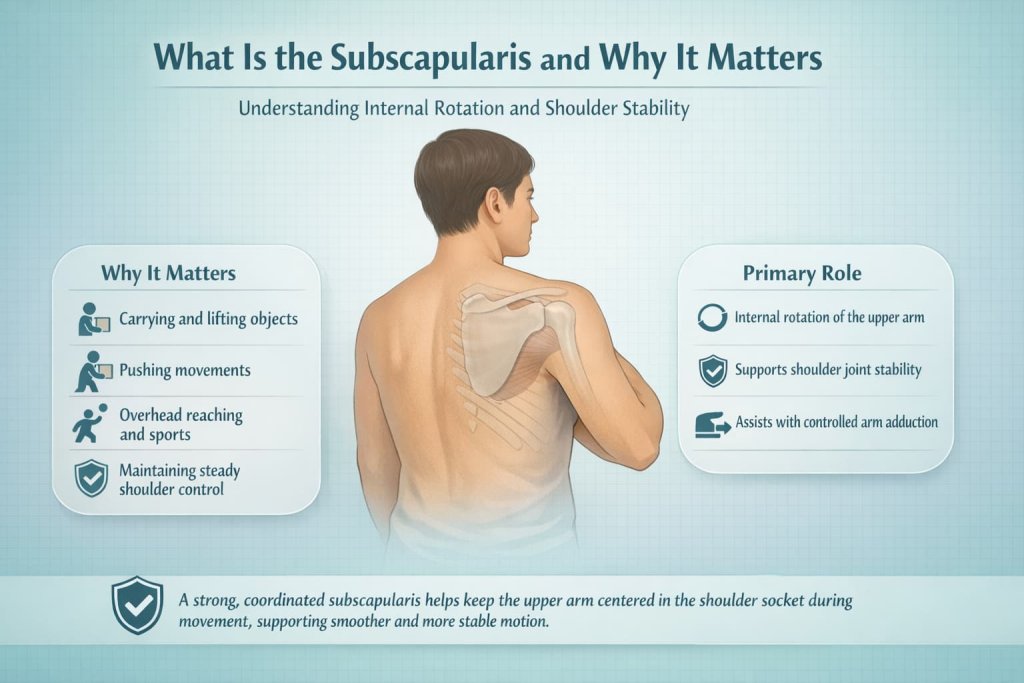
The subscapularis is the rotator cuff muscle on the front side of your shoulder blade. Its primary job is internal rotation (turning your upper arm inward), and it also contributes to shoulder stability and adduction depending on position, according to the NCBI Bookshelf.
When it’s strong and well-coordinated, it can help your shoulder feel steadier during:
- Carrying and lifting (groceries, backpacks)
- Pushing tasks (getting up from the floor, pushing doors)
- Overhead activity (sports, reaching shelves)
Who Should Do Subscapularis Exercises?
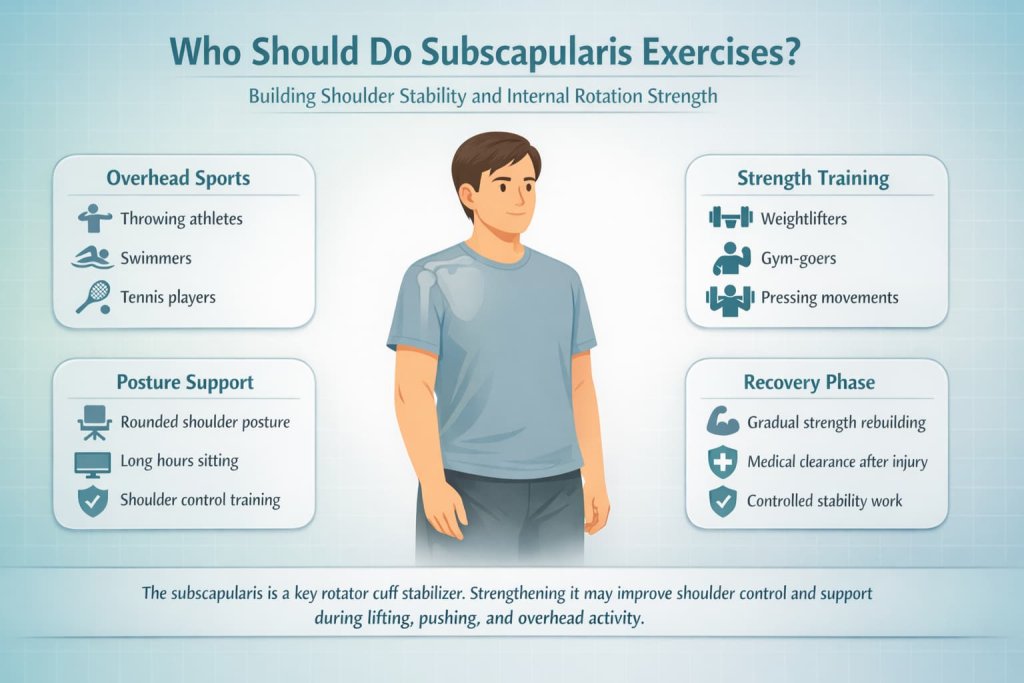
Subscapularis exercises are useful for building shoulder stability and internal rotation strength. They’re especially helpful for:
- Overhead athletes (throwing, swimming, tennis)
- Weightlifters and gym-goers
- Desk workers with rounded shoulders
- Anyone rebuilding shoulder strength (with medical clearance if injured)
Because the subscapularis is a key rotator cuff stabilizer, strengthening it may improve shoulder control and support, as explained by the Cleveland Clinic.
5 Best Subscapularis Exercises
These 5 best subscapularis exercises are designed to strengthen internal rotation and improve shoulder stability with controlled, joint-friendly movements. Start with isometrics, progress to band resistance, and focus on slow, clean reps for stronger, more stable shoulders.
1) Isometric Internal Rotation Wall Press
How to do it:
- Stand next to a wall or door frame with your elbow bent to 90 degrees and tucked at your side.
- Place the inside of your wrist or forearm against the wall.
- Gently press inward as if rotating your arm toward your belly (the wall prevents movement).
- Hold 10–20 seconds while breathing normally, then relax.
- Repeat for 2–3 sets.
Why it works:
Isometrics allow you to activate and strengthen the subscapularis without moving through a large range of motion. This makes it a smart starting point when the shoulder feels sensitive or when you’re rebuilding control after a break from training.
Trainer Tip:
Keep your ribs stacked over your pelvis and avoid leaning your body into the wall to create extra pressure. The effort should come from the shoulder, not your torso.
2) Band Internal Rotation at the Side
How to do it:
- Anchor a light resistance band at elbow height.
- Stand sideways to the anchor, holding the band with the hand farthest from the anchor.
- Pin your elbow to your side at 90 degrees (you can hold a towel roll between elbow and ribs).
- Rotate your forearm inward across your body slowly.
- Return with control and repeat for 8–12 reps.
Why it works:
This is a foundational subscapularis strengthening drill used in many shoulder programs because it directly trains internal rotation with adjustable resistance. The band allows smooth tension throughout the movement.
Trainer Tip:
If your shoulder rolls forward during the movement, reduce the band tension and slow down the return phase to improve control.
3) Side-Lying Internal Rotation
How to do it:
- Lie on your side with the working shoulder on top.
- Bend your elbow to 90 degrees and keep it close to your ribs.
- Start with your forearm pointing upward, holding a very light dumbbell (or no weight).
- Rotate your forearm down toward your stomach slowly.
- Reverse the motion under control for 8–12 reps.
Why it works:
The side-lying position limits body momentum, making it easier to isolate internal rotation and feel the subscapularis working without compensations from the trunk.
Trainer Tip:
If you feel pinching in the front of the shoulder, shorten the range slightly and keep your elbow gently anchored to your side.
4) Band Internal Rotation at 45 Degrees Abduction
How to do it:
- Raise your working arm slightly away from your body (about 30–45 degrees) with the elbow bent at 90 degrees.
- Anchor the band so tension is smooth in this position.
- Keep your shoulder blade stable without shrugging.
- Rotate the forearm inward against the band.
- Return slowly for 8–12 reps.
Why it works:
This variation challenges the subscapularis in a slightly more functional position compared to elbow-at-side work, helping build control as your arm moves farther from the body.
Trainer Tip:
Think “quiet shoulder blade.” If your upper trap starts to dominate, lower the arm angle and decrease resistance.
5) Bear-Hug Band Press
How to do it:
- Loop a light band around your upper back and hold one end in each hand.
- Bring your hands in front of your chest as if hugging a large barrel.
- Press your hands forward and slightly inward to complete the “hug.”
- Pause briefly, then return with control for 8–12 reps.
Why it works:
The bear-hug pattern encourages internal rotation and anterior shoulder stability, both of which involve the subscapularis working in coordination with other front-of-shoulder muscles.
Trainer Tip:
Avoid aggressively rounding your shoulders. Keep your chest relaxed and your neck long throughout the movement.
How to Program Subscapularis Exercises for Results
A simple, safe starting structure is:
- 2–3 days per week
- 2–3 sets per exercise
- 8–12 reps (or 10–30 second holds for isometrics)
- Rest 30–60 seconds between sets
Many general shoulder conditioning plans use modest volume like 3 sets of 8, three days per week for band internal rotation, which can be a helpful baseline if you’re unsure where to start, as shown in the AAOS Rotator Cuff and Shoulder Conditioning Program.
Quick Safety Checklist Before You Start
Use these rules to keep shoulder training joint-friendly:
- Work in a pain-free to mild-effort range (sharp pain is a stop sign).
- Keep your shoulder down and back lightly (avoid shrugging).
- Move slowly on the return phase (control matters more than load).
- Start with isometrics or light bands if you’re sensitive or new.
If you have a known rotator cuff tear, significant weakness after injury, or night pain, follow medical guidance first. For general rotator cuff tear context and red flags, see AAOS OrthoInfo.
Common Mistakes That Reduce Subscapularis Activation
- Going too heavy and turning it into a chest or lat exercise
- Letting the elbow drift away from the body on basic internal rotation
- Shrugging the shoulder up (upper trap dominance)
- Moving too fast and losing the slow, controlled return
When to See a Professional
Stop and seek medical guidance if you experience:
- Persistent night pain
- Sudden weakness after injury
- Limited range of motion
- A catching or instability sensation
Rotator cuff injuries can vary in severity and may require evaluation, according to AAOS OrthoInfo.
People Also Ask About Subscapularis Exercises
How do I know if I’m feeling the subscapularis?
You’ll usually feel gentle work in the front or inner shoulder area, plus a sense of tightening that keeps the shoulder steady. If you only feel biceps, neck, or chest taking over, reduce load and slow the reps.
Are bands or dumbbells better for the subscapularis?
Bands are often easier to scale and keep joint stress low. Dumbbells can work well for side-lying internal rotation, but they require very light loads and strict control.
How fast should I see results?
Many people feel improved control within a few weeks when they train 2–3 times weekly, but strength changes depend on consistency, sleep, and load progression.
FAQ
What are the best subscapularis exercises?
For most people, the best choices are isometric internal rotation holds, band internal rotation (elbow at side), side-lying internal rotation, and a bear-hug band press.
Can subscapularis exercises help shoulder pain?
They may help support better shoulder control and tolerance to activity, but pain has many causes. If pain is sharp, worsening, or affects sleep, get evaluated.
How many reps should I do for subscapularis strengthening?
A common starting range is 2–3 sets of 8–12 reps for movement exercises, or 10–30 second holds for isometrics.
Should I train internal rotation if I also do external rotation?
Yes. Balanced rotator cuff work usually includes both internal and external rotation, plus scapular control, especially if you do overhead lifting or sports.
What should I avoid with a sore shoulder?
Avoid painful ranges, fast jerky reps, and heavy loading early. Start with isometrics and light resistance, and progress gradually.
Do I need to do these exercises forever?
Not necessarily. Many people use them as a focused phase (4–8 weeks), then keep 1–2 drills as maintenance once shoulders feel stable.
Conclusion
Subscapularis exercises don’t need to be complicated. Start with controlled isometrics, build into band internal rotation, and progress your angles only when your shoulder feels steady and pain-free. If you want a simple plan, pick two exercises, do them 2–3 days per week, and focus on slow, clean reps.
This content is for informational purposes only and not medical advice.