
Brandt-Daroff exercises are a home routine used to reduce symptoms of BPPV (benign paroxysmal positional vertigo) by repeating specific sit-to-side-lying positions. If your dizziness is triggered by rolling in bed, looking up, or bending over, understanding how to do brandt daroff exercises safely can help you follow a structured plan and know when to get medical guidance.
What Are Brandt-Daroff Exercises?
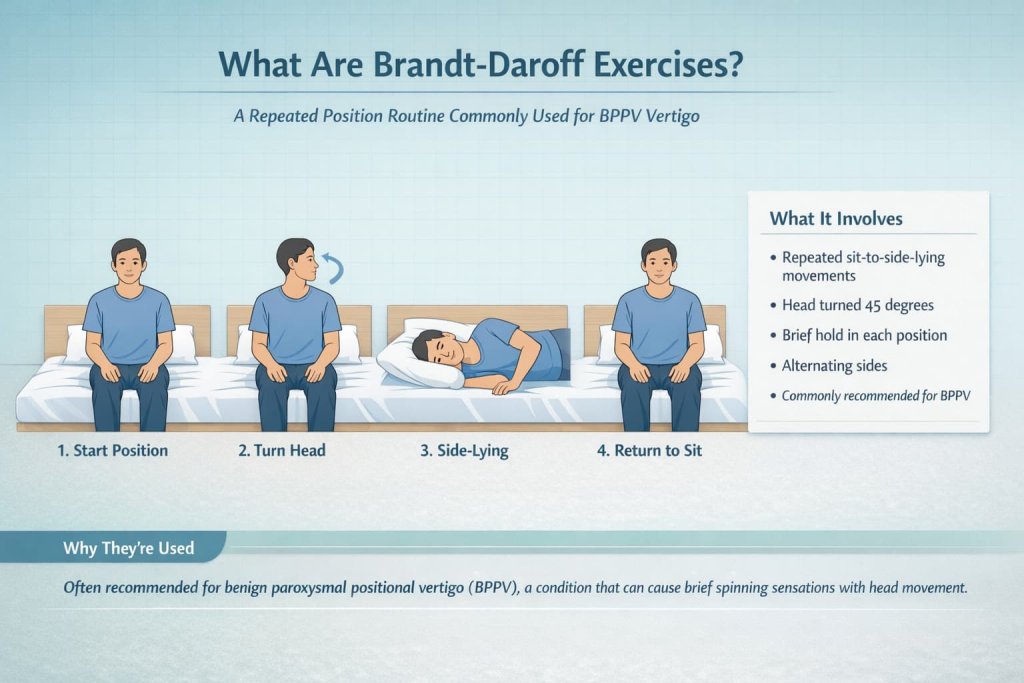
Brandt-Daroff exercises are a set of repeated movements that take you from sitting upright to lying on one side with your head turned, then back to sitting, and then to the other side. They’re commonly recommended for BPPV, a frequent cause of brief, position-triggered spinning sensations.
How to Do Brandt-Daroff Exercises Correctly
Many hospital leaflets describe the same basic movement pattern for brandt daroff exercises.
How to Do It
- Sit upright on the middle or edge of your bed.
- Turn your head about 45 degrees to the left.
- Quickly lie down onto your right side (so your nose points slightly upward).
- Stay there for about 30 seconds, or until the spinning stops.
- Return to sitting and wait about 30 seconds.
- Turn your head about 45 degrees to the right.
- Quickly lie down onto your left side.
- Stay there for about 30 seconds, or until the spinning stops.
- Return to sitting and wait about 30 seconds.
That completes one repetition (both sides).
What Is BPPV and Why Does It Happen?
BPPV is an inner-ear condition where tiny calcium carbonate crystals (often called “ear crystals” or otoconia) shift into a semicircular canal where they don’t belong. When you change head position, those particles can trigger abnormal signals that feel like spinning or rolling dizziness. The Mayo Clinic explains that repositioning maneuvers are commonly used to guide these particles back to their correct location.
Quick Safety Checklist Before You Start
To reduce fall risk and improve safety:
- Perform the routine on a bed rather than the floor
- Clear nearby obstacles
- Have someone nearby the first few times if possible
- Remain seated after each set until dizziness fully settles
- Avoid driving immediately after a session if you still feel unsteady
These precautions are commonly highlighted in hospital-based patient guidance.
Brandt-Daroff Exercises: Benefits and Limitations
Potential Benefits
Brandt-Daroff exercises may help:
- Reduce positional dizziness over time through repeated exposure to provoking positions
- Support recovery when a consistent home program is followed
- Provide a structured option when clinic-based maneuvers aren’t immediately available
According to patient education materials from United Lincolnshire Hospitals NHS Trust, these exercises are sometimes recommended as a practical home-based plan.
Limitations
- They can temporarily increase dizziness during each session
- They require consistency for days to weeks
- They are only appropriate for certain types of vertigo, such as BPPV
Brandt-Daroff Exercise Schedule
Hospitals commonly prescribe a short daily routine for 2–3 weeks. A widely used schedule is:
- 5 repetitions per session
- 3 sessions per day
- For 2 weeks
This schedule is outlined in materials from University Hospitals Dorset NHS Foundation Trust.
Example Plan
| Plan | Repetitions per Session | Sessions per Day | Duration |
|---|---|---|---|
| Standard Plan | 5 | 3 | 2 Weeks |
| Alternative Plan | 5 | 2 | 3 Weeks |
If you miss a session, simply continue with the next scheduled one rather than doubling up quickly.
What You Should Feel During the Exercises
It is common for the movements to bring on dizziness, especially early on. Clinical handouts emphasize doing the routine in a safe environment where you can steady yourself and sit quietly until symptoms pass.
Common Mistakes That Reduce Results
Avoid these common errors:
- Standing up too quickly after each position
- Skipping the 30-second hold period
- Turning the head in the wrong direction
- Performing the routine on an unstable surface
- Stopping the program after only a few days
Consistency is key with brandt daroff exercises.
Who Should Avoid or Modify Brandt-Daroff Exercises?
Because these exercises involve quick positional changes, you should seek professional advice first if you have:
- Recent neck or spine injury
- Severe neck pain
- Stroke-like symptoms (weakness, numbness, speech difficulty)
- Frequent unexplained falls
- New hearing loss or severe ear pain
The American Academy of Otolaryngology–Head and Neck Surgery Foundation emphasizes accurate diagnosis and appropriate management for BPPV to ensure the correct maneuver is used.
Brandt-Daroff Exercises vs. Epley Maneuver
Brandt-Daroff exercises differ from the Epley maneuver. The Epley maneuver is a canalith repositioning procedure often performed in a clinic setting. Resources from the Cleveland Clinic explain that repositioning procedures may provide faster relief for certain types of BPPV.
If you are unsure which approach is appropriate, consult a healthcare professional before starting.
When to See a Doctor
Seek medical care if you experience:
- Severe headache or neurological symptoms
- Fainting or chest pain
- Persistent vomiting
- Vertigo that is constant and not position-triggered
- Worsening symptoms instead of gradual improvement
Proper diagnosis ensures that dizziness is treated appropriately.
Frequently Asked Questions
How long do Brandt-Daroff exercises take to work?
Many programs are designed for 2 weeks, and improvement often occurs gradually with consistent practice.
Is it normal to feel dizzy during the exercises?
Yes. Temporary dizziness during the movements is expected.
Should I do Brandt-Daroff exercises if I’m not sure I have BPPV?
It’s best to confirm the diagnosis first. Not all dizziness is caused by BPPV.
Can I perform more repetitions than recommended?
Stick to the prescribed schedule unless advised otherwise by a healthcare provider.
Are Brandt-Daroff exercises safe for older adults?
They can be appropriate, but safety setup and supervision are important to reduce fall risk.
Are Brandt-Daroff exercises the same as the Epley maneuver?
No. They are different techniques used for BPPV management.
Conclusion
Brandt-Daroff exercises provide a structured at-home routine that may help reduce BPPV-related vertigo when performed correctly and consistently. Always ensure your symptoms match position-triggered vertigo and seek medical evaluation if warning signs appear.
This content is for informational purposes only and not medical advice.