
The best hamstring exercises at home are simple hip-hinge and hamstring-curl patterns you can progressively overload with bodyweight, a towel, a chair, or a backpack. Building stronger hamstrings matters because these muscles support your hips, knees, posture, and sprinting or jumping mechanics, and smart strength work can also lower strain risk when done consistently.
If you’ve had a recent pull or sharp pain, follow guidance from a clinician first. A helpful starting point is the home-care and recovery overview from the Cleveland Clinic.
What Your Hamstrings Do and Why Training Them at Home Works
Your hamstrings run along the back of your thigh and primarily:
- Extend the hip (helping you stand up, climb stairs, hinge, and sprint)
- Flex the knee (helping you bend your knee and control your leg during walking/running)
- Stabilize the knee and pelvis during daily movement and sports
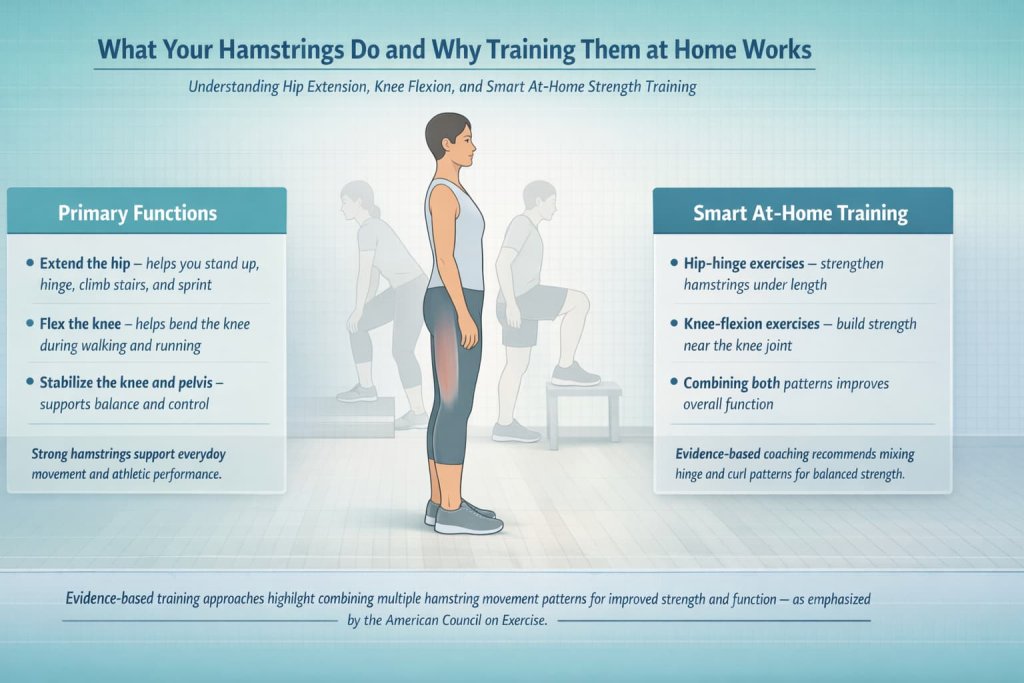
At-home hamstring training works best when you include both:
- Hip-hinge strength (hamstrings lengthen under load)
- Knee-flexion strength (hamstrings work closer to the knee)
Evidence-based coaching resources also emphasize mixing movement patterns rather than relying on only one type of exercise. For example, the American Council on Exercise highlights multiple hamstring-focused patterns to improve strength and function.
10 Best Hamstring Exercises at Home
Build stronger, leaner legs with these 10 best hamstring exercises at home. These simple bodyweight and low-equipment moves target strength, stability, and muscle definition without needing a gym.
1) Slider or Towel Hamstring Curl
How to do it:
- Lie on your back with knees bent and heels on a towel (or sliders).
- Lift hips into a bridge so your body forms a straight line from shoulders to knees.
- Slowly slide heels away until your legs are more extended.
- Pull heels back toward your hips while keeping hips lifted.
- Move with control; stop if your hips drop or your low back arches.
Why it works: This directly trains knee flexion while forcing the hamstrings to control the “out and back” motion. It closely mimics a machine hamstring curl while also challenging hip stability and core control.
Muscles worked: Hamstrings (all heads), glutes (support), calves (support), core (stability).
Trainer Tip: Start with a shorter range of motion. As strength improves, extend farther and slow down the sliding phase to increase difficulty.
2) Hamstring Walkout (Bridge Walkout)
How to do it:
- Start in a glute bridge (hips lifted).
- Take small steps forward with your heels.
- Go only as far as you can without dropping your hips.
- Walk your heels back in and reset.
Why it works: This bridge progression increases hamstring demand as your heels move away from your body, especially in the lengthened position where control matters most.
Muscles worked: Hamstrings, glutes, core.
Trainer Tip: Keep ribs down and pelvis level throughout the movement. Avoid letting one hip drift higher than the other.
3) Single-Leg Glute Bridge
How to do it:
- Lie on your back with one knee bent and foot flat on the floor.
- Extend the other leg straight (or keep it slightly bent for balance).
- Push through the planted heel and lift your hips.
- Pause briefly at the top, then lower slowly with control.
Why it works: This unilateral variation increases load on one hamstring at a time and helps identify side-to-side strength imbalances.
Muscles worked: Hamstrings and glutes (working side), core stabilizers.
Trainer Tip: If you feel tension mostly in your lower back, reduce the range slightly and re-engage your core before lifting.
4) Long-Lever Bridge (Heels Farther Away)
How to do it:
- Lie on your back with knees slightly bent and heels positioned farther from your hips than usual.
- Brace your core and lift your hips upward.
- Hold for 2–3 seconds, then lower slowly.
Why it works: Increasing the distance between your feet and hips shifts more load to the hamstrings compared to a traditional bridge.
Muscles worked: Hamstrings (higher demand), glutes, core.
Trainer Tip: Think “hips up without rib flare.” If cramping occurs, shorten the lever slightly and build gradually.
5) Bodyweight Romanian Deadlift (Hip Hinge)
How to do it:
- Stand tall with soft knees and feet hip-width apart.
- Push your hips back as your torso leans forward.
- Keep a neutral spine and feel the stretch in your hamstrings.
- Drive your hips forward to return to standing.
Why it works: This movement strengthens the hamstrings in the hip-hinge pattern and reinforces proper posterior-chain mechanics with minimal equipment.
Muscles worked: Hamstrings, glutes, lower back (support), upper back (posture).
Trainer Tip: You should feel tension along the back of your thighs, not compression in your lower back. Focus on hinging backward rather than bending downward.
6) Backpack Romanian Deadlift
How to do it:
- Load a backpack with books and hold it securely against your chest.
- Perform the same hip hinge as the bodyweight version.
- Lower until you feel strong hamstring tension.
- Return to standing with control.
Why it works: Adding load increases muscle stimulus, making it easier to build strength and lean muscle at home without gym equipment.
Muscles worked: Hamstrings, glutes, core.
Trainer Tip: Progress weight gradually. Maintain clean hinge mechanics before increasing load.
7) Kickstand RDL (Staggered-Stance Hinge)
How to do it:
- Shift most of your weight onto one leg.
- Place the other foot slightly behind like a kickstand.
- Hinge back with most of the load on the front leg.
- Stand tall and reset before the next rep.
Why it works: This variation increases demand on one leg while maintaining better balance than a full single-leg hinge.
Muscles worked: Hamstrings and glutes of the front leg, core stabilizers.
Trainer Tip: Keep hips square and avoid rotating your torso as you hinge.
8) Standing Hamstring Curl (Counter Support)
How to do it:
- Hold a counter or sturdy chair for balance.
- Bend one knee and bring your heel toward your glutes.
- Pause briefly at the top.
- Lower slowly with control.
Why it works: This simple knee-flexion movement strengthens the hamstrings without floor work and is easy to scale with tempo or higher reps.
Muscles worked: Hamstrings, calves (support).
Trainer Tip: Slow the lowering phase to increase time under tension.
A similar curl progression is demonstrated in clinician-built exercise libraries such as the University of Melbourne Physiotherapy.
9) Assisted Nordic Hamstring (Beginner Regression)
How to do it:
- Kneel on a padded surface with ankles anchored securely.
- Keep hips tall and core braced.
- Slowly lean forward as far as you can control.
- Catch yourself with your hands, then lightly push to return.
Why it works: This eccentric-focused movement challenges the hamstrings as they lengthen under load, a quality linked to stronger and more resilient muscle tissue.
Muscles worked: Hamstrings (eccentric emphasis), glutes (support), core (bracing).
Trainer Tip: Only move through a range you can control. Small, high-quality reps are effective.
Programs that include the Nordic hamstring exercise have been shown to reduce hamstring injuries by about 51%, according to research published in the British Journal of Sports Medicine.
10) Hamstring Isometric Hold (Bridge Hold Variation)
How to do it:
- Get into a bridge position.
- Lift your hips and hold steady tension without arching your lower back.
- Hold for 20–40 seconds, then rest and repeat.
Why it works: Isometric holds build tissue tolerance and muscular control, especially useful when returning from a mild strain or building foundational strength.
Muscles worked: Hamstrings, glutes, core.
Trainer Tip: If cramping occurs, lower your hips slightly and bring your feet a bit closer to reduce lever length.
How Often Should You Do Hamstring Exercises at Home?
A simple, effective plan:
- 2 to 3 days per week
- 2 to 4 sets per exercise
- 6 to 12 reps for strength moves (or 20 to 40 seconds for holds)
- Leave 1 to 3 reps in reserve (challenging but controlled)
Progress one thing at a time:
- More reps
- More sets
- Slower tempo
- More load (backpack)
- Harder variation
Benefits of Hamstring Exercises at Home
Training your hamstrings at home helps build stronger, more balanced legs while supporting knee and hip stability. Consistent strengthening can improve movement efficiency and overall lower-body performance without needing gym equipment.
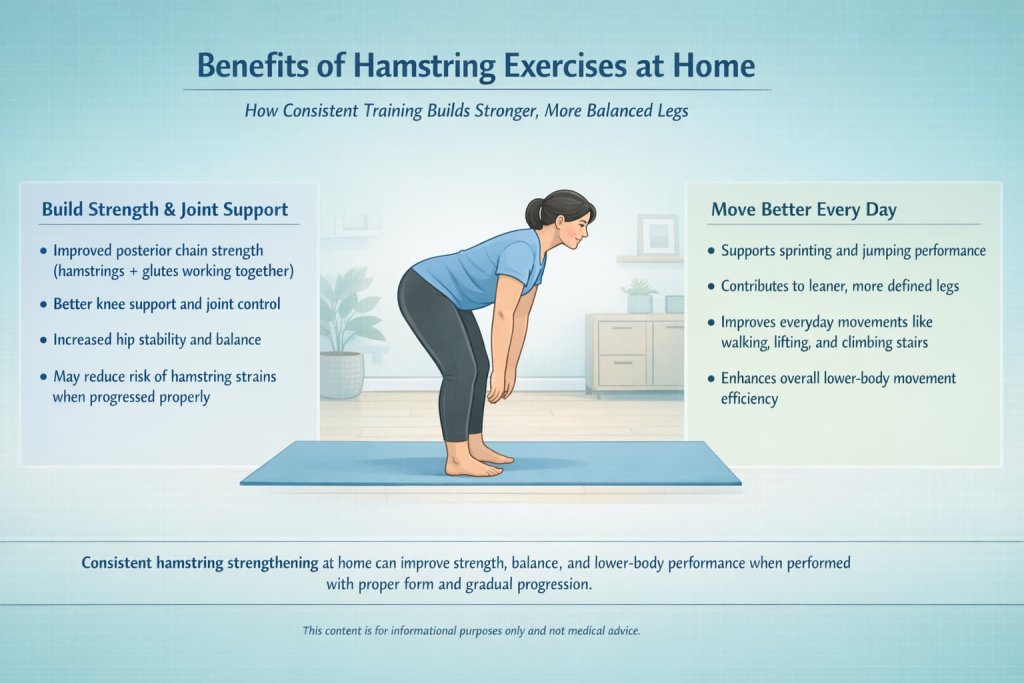
Key benefits include:
- Improved posterior chain strength (hamstrings + glutes work together)
- Better knee support and joint control
- Increased hip stability and balance
- May reduce risk of hamstring strains when progressed properly
- Supports athletic performance like sprinting and jumping
- Contributes to leaner, more defined legs
- Improves everyday movements like walking and lifting
When done consistently and with proper form, hamstring exercises at home can be both effective and practical for building stronger, leaner legs.
Quick Home Equipment Checklist
You can do everything below with:
- A sturdy chair or couch
- A towel (or sliders/socks on tile)
- A light resistance band (optional)
- A backpack you can load with books (optional)
- A wall or countertop for balance support
Common Mistakes to Avoid
- Letting hips drop during curls or walkouts
- Rushing the lowering phase
- Over-arching your lower back at the top of bridges
- Progressing Nordics too fast
- Training through sharp or sudden pain
Simple At-Home Hamstring Workout Plan
Option A: No Equipment (20 Minutes)
- Slider/Towel Hamstring Curl: 3 sets of 6–10
- Hamstring Walkouts: 2–3 sets
- Single-Leg Bridge: 2–3 sets per side
- Standing Hamstring Curl: 2 sets per side
Option B: Strength Focus (With Backpack)
- Backpack RDL: 4 sets of 6–10
- Kickstand RDL: 3 sets per side
- Long-Lever Bridge Hold: 3 holds of 20–40 seconds
FAQs
Are hamstring exercises at home enough to build muscle?
Yes, if you progressively increase difficulty and train consistently.
What’s the best at-home hamstring exercise with no equipment?
A towel hamstring curl paired with a single-leg bridge is a strong combination.
How many days a week should I train hamstrings at home?
Most people do well with 2–3 days per week.
Are Nordic hamstring exercises safe at home?
They can be when progressed gradually and performed with control, as supported by research from the British Journal of Sports Medicine.
Why do my hamstrings cramp during bridges?
Cramping often happens when muscles fatigue quickly. Reduce range and progress gradually.
Should I stretch or strengthen first for tight hamstrings?
Controlled strengthening is often helpful before adding gentle mobility work.
Conclusion
Hamstring exercises at home can be highly effective when you train both hinge patterns and curl patterns, then progress steadily. Stay consistent, focus on controlled reps, and increase difficulty gradually.
If you’d like, tell me your experience level and available equipment, and I’ll build a personalized weekly plan for you.
This content is for informational purposes only and not medical advice.
References
- PubMed. Nordic Hamstring Exercise systematic review record and indexing details. Available at: PubMed
- Cleveland Clinic. Hamstring muscles: anatomy, location, and function. Available at: Cleveland Clinic
- Mayo Clinic. Hamstring injury: symptoms and causes (medical overview). Available at: Mayo Clinic
- American Academy of Orthopaedic Surgeons OrthoInfo. Hamstring muscle injuries overview and care guidance. Available at: American Academy of Orthopaedic Surgeons OrthoInfo