
Shoulder impingement exercises are simple mobility and strengthening moves that can reduce “pinching” symptoms by improving rotator cuff support and shoulder-blade control. Many cases respond well to a structured rehab-style plan that restores motion first, then builds strength and control, as explained by the Cleveland Clinic.
What Is Shoulder Impingement?
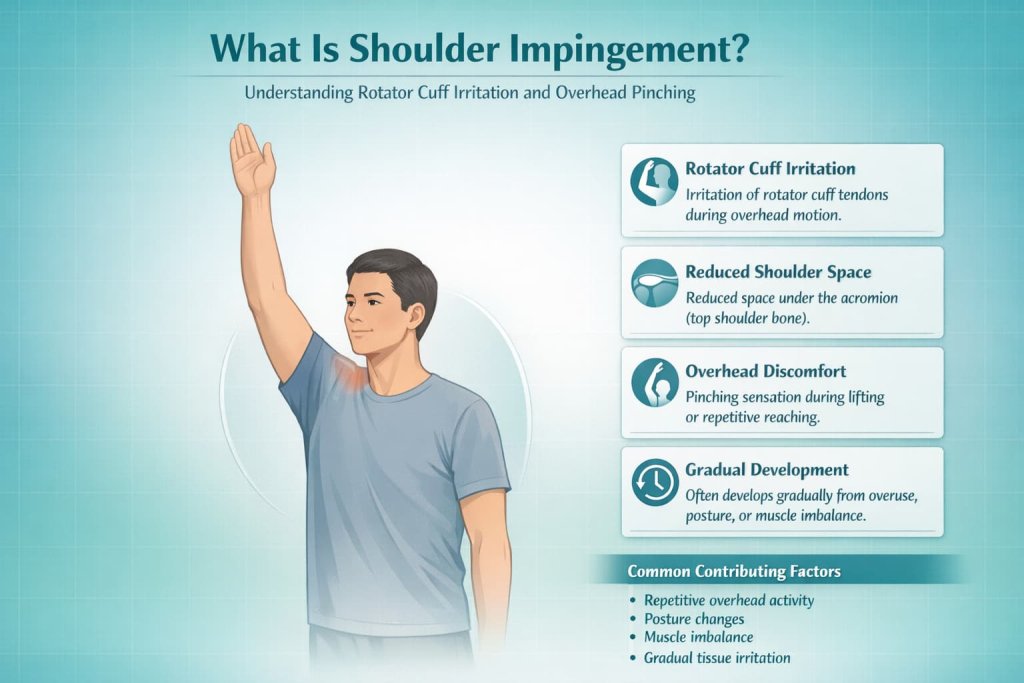
Shoulder impingement happens when the rotator cuff tendons and nearby tissues become irritated as they move through the space at the top of the shoulder. This can create a “pinching” feeling during lifting or reaching, especially overhead.
According to the Cleveland Clinic, it often develops gradually due to repetitive overhead use, posture issues, or muscle imbalance.
In simple terms, shoulder impingement involves:
- Irritation of rotator cuff tendons
- Reduced space under the acromion (top shoulder bone)
- Pain during overhead or repetitive movements
- Gradual onset rather than sudden injury
Symptoms of Shoulder Impingement
Symptoms usually build over time and become more noticeable during certain movements.
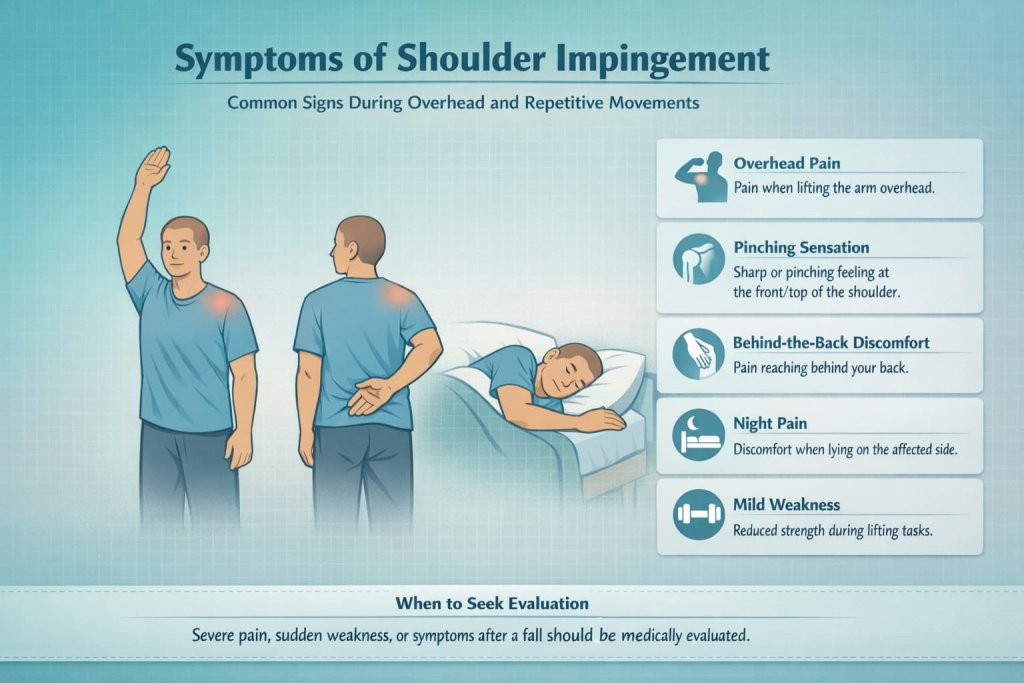
Common signs include:
- Pain when lifting the arm overhead
- A sharp or pinching sensation at the front/top of the shoulder
- Discomfort reaching behind your back
- Night pain, especially when lying on the affected side
- Mild weakness during lifting
As noted by AAOS OrthoInfo, symptoms often worsen with repetitive overhead activities. If pain is severe, follows a fall, or causes major weakness, a medical evaluation is recommended.
8 Best Shoulder Impingement Exercises
These 8 shoulder impingement exercises focus on restoring comfortable range of motion, improving rotator cuff strength, and enhancing shoulder blade control. Performed consistently and pain-limited, they may help reduce irritation and support stronger, more stable shoulders over time.
1) Pendulum Swings
How to do it:
- Lean forward and support yourself with one hand on a table or chair
- Let the painful arm hang relaxed
- Make small circles (clockwise and counterclockwise)
- Keep the circles smooth and pain-limited
- Do 30–60 seconds total
Why it works:
This is a gentle way to keep the shoulder moving without forcing overhead range. It can calm stiffness and help you move more comfortably while minimizing joint compression.
Muscles worked:
There is minimal active loading. You may feel light activation around the shoulder and upper back as your body supports the motion.
Trainer Tip:
Smaller is usually better early on. If you feel pinching, reduce the circle size and slow down.
2) Wall Slide
How to do it:
- Stand facing a wall with forearms on the wall
- Keep ribs down and neck relaxed
- Slide arms up only as high as comfortable
- Pause 1–2 seconds
- Slide down slowly and repeat
Why it works:
Wall slides let you practice raising the arm while keeping the shoulder blade coordinated. This can reduce excessive shrugging and improve how the shoulder moves overhead.
Muscles worked:
Serratus anterior, lower trapezius, light rotator cuff activation, and postural stabilizers.
Trainer Tip:
Think “reach up and away” instead of “shrug up.” If your shoulders hike toward your ears, lower the range.
3) Doorway Pec Stretch (Gentle)
How to do it:
- Place your forearm on a doorframe with elbow about shoulder height
- Step forward slightly until you feel a mild stretch
- Keep your ribs stacked (avoid arching your lower back)
- Hold 20–30 seconds
- Repeat 2–3 times
Why it works:
Tight chest muscles can pull the shoulders forward. A mild stretch may help you maintain better shoulder blade positioning during strengthening work.
Muscles worked:
Pectoralis major and minor (stretch), plus front-of-shoulder tissues.
Trainer Tip:
If this triggers pinching, lower your elbow slightly and reduce the forward step to make the stretch gentler.
4) Scapular Retraction (Shoulder Blade Squeeze)
How to do it:
- Sit or stand tall
- Gently pull shoulder blades back and slightly down
- Keep shoulders away from ears
- Hold 3–5 seconds
- Relax fully and repeat
Why it works:
Better shoulder blade control helps the shoulder joint move with less irritation. It also gives the rotator cuff a more stable base during arm movement.
Muscles worked:
Mid trapezius, rhomboids, and lower trapezius.
Trainer Tip:
Avoid flaring your ribs or arching your back. Keep the movement smooth and controlled, not forceful.
5) Isometric Shoulder External Rotation (Pain-Friendly Starter)
How to do it:
- Stand with elbow at your side, bent 90 degrees
- Place the back of your hand into a wall (or press into your other hand)
- Gently push as if rotating outward, but don’t let the arm move
- Hold 10 seconds
- Repeat 5–10 times
Why it works:
Isometrics build strength without joint movement, which many people tolerate better when symptoms are sensitive. It targets the external rotators that stabilize the shoulder.
Muscles worked:
Infraspinatus, teres minor, and posterior rotator cuff muscles.
Trainer Tip:
Use about 25–50% effort at first. The goal is steady activation without increasing pain afterward.
6) Band External Rotation (Towel at Elbow)
How to do it:
- Place a rolled towel between your elbow and ribs
- Hold a light resistance band with elbow bent 90 degrees at your side
- Rotate your forearm outward slowly
- Pause briefly, then return with control
- Keep ribs down and shoulder relaxed
Why it works:
This classic rotator cuff exercise strengthens the muscles that help center and stabilize the shoulder joint. The towel supports better positioning.
Muscles worked:
Rotator cuff external rotators, rear deltoid (light), and scapular stabilizers.
Trainer Tip:
If you feel pinching in the front or top of the shoulder, reduce your range and slow the lowering phase.
7) Band Internal Rotation (Balanced Cuff Strength)
How to do it:
- Keep your elbow tucked at your side, bent 90 degrees
- Hold a light band anchored to your side
- Pull the band across your body (forearm rotates inward)
- Pause briefly
- Return slowly with control
- Keep your shoulder blade steady
Why it works:
Balanced strength between internal and external rotators supports smoother, more stable shoulder movement during daily tasks.
Muscles worked:
Subscapularis, pectoralis major (light contribution), and latissimus dorsi (light contribution).
Trainer Tip:
If your shoulder rolls forward, use a lighter band and focus on staying tall with steady shoulder blade positioning.
8) Serratus Wall Punch (Scapular Control)
How to do it:
- Stand facing a wall with hands on the wall at shoulder height
- Keep elbows mostly straight
- Gently push the wall away by reaching your shoulder blades forward
- Pause 1–2 seconds
- Return to neutral without shrugging and repeat
Why it works:
Serratus anterior helps the shoulder blade rotate and stay flush against the ribcage. Improved control here often supports smoother overhead movement.
Muscles worked:
Serratus anterior and upper back stabilizers.
Trainer Tip:
This should feel like controlled reaching, not a chest press. Keep your neck relaxed and avoid lifting your shoulders toward your ears.
How to use these 8 shoulder impingement exercises
A simple structure most people tolerate well:
- Do mobility first (Exercises 1–3)
- Then do strength and control (Exercises 4–8)
- Start 3–4 days per week
- Aim for 2–3 sets per exercise
- Use light resistance and clean form, then progress gradually
Quick safety checklist before you start
Use these guardrails to keep your routine safer and more comfortable:
- Keep pain in a “mild and manageable” range; avoid sharp pain
- Reduce range of motion if you feel pinching at the top/front of the shoulder
- Move slowly and control the lowering phase
- Avoid heavy overhead pressing while symptoms are irritable
- Stop and get medical advice if you have sudden major weakness, a new deformity, numbness/tingling into the hand, fever, or pain after a significant fall/impact
If rest and exercises are not enough, care options may include guided physiotherapy, injections, or (less commonly) surgery, depending on severity and exam findings, as summarized by the NHS.
A simple weekly plan you can follow
Use this as a starting point (adjust based on symptoms):
Day A (Mobility + light strength)
- Pendulum swings: 1–2 rounds
- Wall slides: 2 sets of 8–12
- Scapular retraction: 2 sets of 10–15
- Isometric external rotation: 5–10 holds
Day B (Strength + control)
- Band external rotation: 2–3 sets of 8–12
- Band internal rotation: 2–3 sets of 8–12
- Serratus wall punch: 2–3 sets of 10–15
- Gentle pec stretch: 2–3 holds
Common mistakes that keep shoulder impingement from improving
- Pushing through sharp pain “to loosen it up”
- Going too heavy on bands too soon
- Letting shoulders shrug toward ears during every rep
- Rushing overhead motion before control improves
- Only stretching and skipping strength work
When to see a clinician or physical therapist
Consider getting checked if:
- Pain lasts more than 2–4 weeks without improvement
- Night pain is getting worse
- You can’t lift your arm like you normally can
- You feel true weakness (not just pain-limited effort)
- Symptoms started after a fall, pop, or sudden force
A clinician can rule out issues like a significant rotator cuff tear and guide a safer progression, and the AAOS Rotator Cuff and Shoulder Conditioning Program outlines structured conditioning commonly used to restore function after shoulder problems.
FAQs about shoulder impingement exercises
What is the best exercise for shoulder impingement?
Most people do best with a combination: gentle mobility (like wall slides) plus rotator cuff strengthening (especially external rotation) and scapular control (serratus and retraction work).
Should I avoid overhead lifting with shoulder impingement?
If overhead lifting triggers pinching or sharp pain, modify it temporarily and rebuild tolerance gradually with pain-limited range and better scapular control.
How often should I do shoulder impingement exercises?
A common starting point is 3–4 days per week. If symptoms are mild, you may do gentle mobility daily and strength work every other day.
How long does it take for shoulder impingement exercises to work?
Some people feel movement improves within 1–2 weeks, but strength and lasting symptom change often take several weeks of consistent practice. If you’re not improving after 2–4 weeks, get assessed.
Are bands necessary for shoulder impingement exercises?
Bands are helpful but not required at first. You can begin with isometrics, wall-based drills, and scapular control, then add bands as symptoms calm down.
Should I stretch a painful shoulder?
Gentle, pain-limited stretching can help, but aggressive stretching into pinching often backfires. Keep stretches mild and prioritize controlled strength work too.
Conclusion
Shoulder impingement exercises work best when you restore comfortable motion first, then build rotator cuff and shoulder-blade strength with clean, pain-limited reps. Start light, stay consistent, and progress slowly—your shoulder usually responds better to steady practice than to “pushing through.”
This content is for informational purposes only and not medical advice.