
Rear delt dumbbell exercises are strength moves that train the back (posterior) head of your shoulder muscle to help build wider-looking shoulders and better shoulder balance. Because the posterior deltoid helps move your arm backward and supports shoulder control, training it directly can make your upper body look more “complete” and may support better posture habits over time when paired with good technique and a balanced program.

For a quick anatomy refresher, Cleveland Clinic explains that your posterior deltoids (“rear delts”) help move your arm backward.
This guide covers the best dumbbell-only rear delt exercises, exactly how to do each one, common form mistakes, and a simple weekly plan you can follow.
Rear delt dumbbell exercises that tend to work best
A practical way to pick effective rear delt moves is to prioritize:
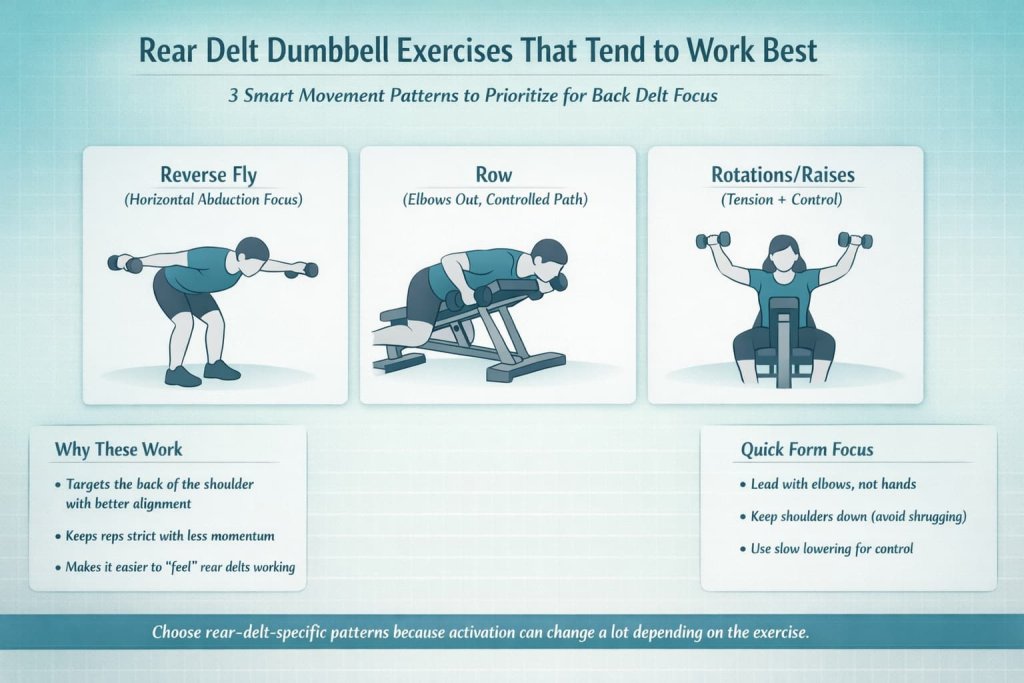
- Reverse-fly patterns (horizontal abduction emphasis)
- Rear-delt–biased rows (elbows out, controlled upper-arm path)
- Controlled rotations and “raise” variations that keep tension on the back of the shoulder
Muscle activation patterns vary a lot by movement choice, which is why using rear-delt-specific patterns matters.
10 Best Rear Delt Dumbbell Exercises
Build bigger, wider-looking shoulders with these 10 rear delt dumbbell exercises that directly target your back delts.
Each move includes clear form cues, muscles worked, and trainer tips so you feel the rear delts working without swinging or shrugging.
1. Bent-Over Dumbbell Reverse Fly
How to do it:
- Hinge at your hips until your torso is close to parallel with the floor.
- Let dumbbells hang under your shoulders, elbows slightly bent.
- Raise the weights out to the sides until your upper arms are in line with your body.
- Pause briefly, then lower slowly with control.
Why it works: This is a direct rear-delt builder because it trains shoulder horizontal abduction with very little help from pressing muscles. When you keep the reps strict and avoid swinging, the rear delts stay under steady tension through the lift and the controlled lowering phase.
Muscles worked: Rear delts, mid traps, rhomboids.
Trainer Tip: If you feel your upper traps taking over, reduce the weight and slightly shorten the range so you can keep shoulders down and the movement smooth.
2. Chest-Supported Dumbbell Reverse Fly (Incline Bench)
How to do it:
- Set an incline bench around 30–45 degrees and lie chest-down.
- Start with dumbbells hanging, palms facing each other.
- Lift out and slightly back while keeping your neck neutral.
- Lower slowly and repeat.
Why it works: Chest support removes most of the momentum and reduces lower-back fatigue, which makes it easier to isolate the rear delts. Because your torso is stable, you can focus on clean reps and consistent tension where you want it.
Muscles worked: Rear delts, mid traps, rhomboids.
Trainer Tip: Think “wide elbows” and “quiet lower back,” and stop the set if you feel shrugging or swinging creep in.
3. Seated Lean-Forward Rear Delt Fly
How to do it:
- Sit on a bench, feet planted, and lean your torso forward.
- Let dumbbells hang under your shoulders.
- Raise out to the sides with a slight elbow bend.
- Lower under control.
Why it works: The seated position reduces full-body movement, which helps you keep the fly strict and rear-delt focused. It’s also a great option if hinging for long sets bothers your lower back.
Muscles worked: Rear delts, upper back stabilizers.
Trainer Tip: Use a controlled tempo—rear delts usually respond better to clean tension than fast, choppy reps.
4. One-Arm Chest-Supported Rear Delt Fly
How to do it:
- Lie chest-down on an incline bench.
- Hold one dumbbell; brace the other hand lightly on the bench.
- Lift the dumbbell out to the side and slightly back.
- Lower slowly and repeat, then switch sides.
Why it works: Single-arm work often improves control and mind-muscle connection, making it easier to “feel” the rear delt doing the job. It also helps you reduce side-to-side strength or coordination differences over time.
Muscles worked: Rear delts, mid traps.
Trainer Tip: Keep your shoulder set “down and back” so you don’t turn the rep into a shrug.
5. Dumbbell Rear Delt Row (Elbows Out)
How to do it:
- Hinge forward (or set up chest-supported on an incline bench).
- Row the dumbbells by pulling your elbows out wide (about 60–90 degrees from your torso).
- Stop when your upper arms are in line with your body.
- Lower slowly.
Why it works: A wide-elbow row shifts emphasis away from the lats and toward the rear delts and upper back. When you keep the movement controlled and stop at the right end range, you get a strong rear-delt stimulus without turning it into a biceps-heavy pull.
Muscles worked: Rear delts, rhomboids, traps.
Trainer Tip: If biceps dominate, lighten the load and focus on driving elbows back and out instead of “curling” the dumbbells up.
6. Dumbbell “W” Raise (Prone or Incline)
How to do it:
- Lie chest-down on an incline bench with light dumbbells.
- Start with arms hanging, palms facing each other.
- Pull elbows up and out while rotating slightly so your arms form a “W” at the top.
- Lower slowly.
Why it works: This variation combines rear-delt work with controlled shoulder rotation, which can improve how your shoulders move and feel during pulling and pressing. The lighter load and stricter control make it especially useful for building quality reps and long-term shoulder balance.
Muscles worked: Rear delts, rotator cuff helpers, mid traps.
Trainer Tip: Go lighter than you think—this is a precision movement, and form matters more than weight.
7. Prone “Y” Raise (Incline Bench)
How to do it:
- Lie chest-down on an incline bench.
- With thumbs slightly up, raise arms forward and out in a “Y” shape.
- Pause, then lower slowly.
Why it works: The “Y” angle encourages upper-back control and helps train the shoulder complex in a way that supports cleaner posture and better scapular mechanics. Done with light dumbbells and patience, it’s a strong complement to heavier rows and flies.
Muscles worked: Rear delts, lower traps, upper-back stabilizers.
Trainer Tip: Keep ribs down and neck relaxed, and think “reach long” rather than “heave up.”
8. Incline Rear Delt Fly With Pause Reps
How to do it:
- Use a chest-supported incline setup.
- Lift into a reverse fly.
- Hold the top position for 1–2 seconds each rep.
- Lower slowly.
Why it works: Pauses remove momentum and make you “own” the top position, which improves recruitment and control. This is a reliable way to make lighter weights feel challenging without compromising shoulder mechanics.
Muscles worked: Rear delts, upper back.
Trainer Tip: Keep the pause clean—no shrugging, no bouncing, and no drifting your shoulders forward.
9. Dumbbell Lateral Raise With a Slight Forward Lean
How to do it:
- Stand tall with dumbbells by your sides.
- Lean forward slightly from the ankles (small tilt).
- Raise arms out to the sides under control.
- Lower slowly.
Why it works: A small forward lean can shift your shoulder position so the rear delts assist more as you lift and stabilize. It’s not a pure rear-delt isolation move, but it can help build more complete shoulder development when performed with strict control.
Muscles worked: Side delts with rear-delt assistance, upper traps (if you shrug).
Trainer Tip: If traps dominate, lower the weight and think “shoulders down” as you lift.
10. Dumbbell High Row to External Rotation (Light and Controlled)
How to do it:
- Hinge forward or chest-support on a bench.
- High-row the dumbbells with elbows out.
- At the top, rotate slightly so your knuckles turn more upward (small external rotation).
- Reverse the motion slowly.
Why it works: This blends a rear-delt–biased pull with controlled rotation, which can support more balanced shoulder function when done conservatively. It’s a great “quality builder” exercise that complements heavier rear-delt rows and fly variations.
Muscles worked: Rear delts, upper back, rotator cuff helpers.
Trainer Tip: Keep this light and smooth—the goal is clean shoulder motion and tension, not max weight.
How to feel rear delts more during dumbbell exercises
Key cues that usually help
- Lead with your elbows, not your hands.
- Keep a soft bend in the elbow (don’t lock out).
- Stop reps when your shoulders start to roll forward or you lose control.
- Use a slower lowering phase (about 2–3 seconds) to keep tension on the rear delts.
- Think “arms move, torso stays” (avoid swinging).
Best rep ranges and weekly volume for rear delts
For most people training for muscle and shoulder balance:
- Reps: 10–20 per set (rear delts often respond well to moderate-to-higher reps)
- Sets: 8–14 total rear-delt sets per week (start lower, build up)
- Frequency: 2–3 days per week
Choose loads you can control without momentum.
Common mistakes that stop rear delt growth
- Using weights that are too heavy and turning flies into swings
- Shrugging up (upper traps take over)
- Letting shoulders roll forward at the bottom
- Turning rows into biceps curls
- Rushing reps and skipping the controlled lowering phase
A simple rear delt dumbbell workout plan
Option A: Add-on finisher (2 days/week)
- Chest-supported reverse fly: 3 sets x 12–15
- Rear delt row (elbows out): 3 sets x 10–14
- “W” raise or prone “Y” raise: 2 sets x 12–20
Option B: Shoulder balance day (3 days/week, low fatigue)
- Seated lean-forward rear delt fly: 2 sets x 15–20
- Incline pause reverse fly: 2 sets x 10–15
- High row to external rotation: 2 sets x 12–16
Keep 1–3 reps “in the tank” for most sets so your form stays clean.
Safety notes for rear delt dumbbell exercises
If you feel sharp pain, numbness, tingling, joint catching, or symptoms that worsen from session to session, stop and get guidance from a qualified clinician or coach. Also keep loads conservative if you’re returning from a shoulder injury.
FAQs
Are rear delts back or shoulders?
Rear delts are part of the shoulder (the posterior head of the deltoid), but they work closely with upper-back muscles during pulling movements.
How often should I train rear delts?
Most people do well with 2–3 sessions per week, using moderate loads and clean technique.
Why don’t I feel rear delts during reverse flys?
Common reasons are too much weight, shrugging, and swinging. Reduce the load, slow down, and lead with elbows.
Do rows hit rear delts enough?
Some row variations can help, but many people need fly patterns to truly emphasize rear delts.
What’s the best rear delt dumbbell exercise for beginners?
A chest-supported reverse fly is usually easiest to learn because it reduces momentum and lower-back fatigue.
Should I go heavy or high reps for rear delts?
Rear delts often respond best to controlled moderate-to-higher reps (10–20), plus slow lowering and pauses.
Conclusion
Rear delts can be the difference between “front-heavy” shoulders and a more balanced, wider look. Pick 2–4 of the exercises above, train them 2–3 times per week, keep reps controlled, and progress slowly as your form improves.
References
- NCBI Bookshelf — Anatomy, Shoulder and Upper Limb (Shoulder Region)
- PubMed Central — Different Shoulder Exercises Affect the Activation of Deltoid Portions (EMG Study)
- ACE Fitness — Incline Reverse Fly (Exercise Technique Reference)
- PubMed — ACSM Position Stand: Progression Models in Resistance Training for Healthy Adults
- Mayo Clinic — Weight Training: Do’s and Don’ts of Proper Technique
- American Heart Association — Strength and Resistance Training Exercise Guidance
- AAOS OrthoInfo — Shoulder Pain and Common Shoulder Problems (When to Seek Care)