
Side delt exercises are the most effective way to build wider, more defined shoulders and improve overall upper-body balance. The side delts—also called the lateral deltoids—are primarily responsible for shoulder width and that capped, rounded look many people want.

Understanding how to train your side delts properly matters because these muscles are often under-stimulated during chest or back workouts. With the right exercises, correct form, and smart programming, side delt training can help support better posture, balanced shoulder strength, and long-term joint health.
In this guide, you’ll learn what side delt exercises are, why they matter, and the 12 best side delt exercises you can use at home or in the gym—based on biomechanics, training guidelines, and widely accepted strength-training principles.
What Are Side Delt Exercises?
Side delt exercises are movements that primarily target the lateral (middle) head of the deltoid muscle. This portion of the shoulder is most active during arm abduction, meaning lifting the arm away from the body to the side.
Most effective side delt exercises involve:
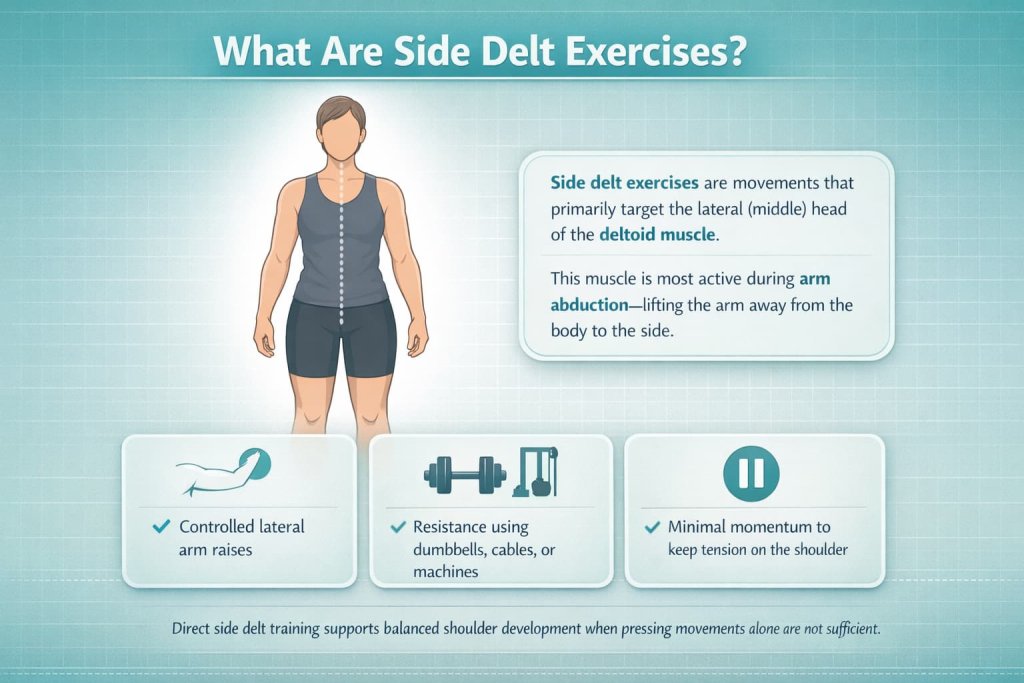
- Controlled lateral arm raises
- Resistance through cables, dumbbells, or machines
- Minimal momentum to keep tension on the shoulder
Because side delts don’t get fully worked during pressing movements alone, direct training is essential for balanced shoulder development.
12 Best Side Delt Exercises for Shoulder Width
Build broader, more defined shoulders by targeting the lateral deltoids with focused, controlled movements.
These 12 side delt exercises are selected to support shoulder width, balance, and long-term joint safety when performed correctly.
1. Dumbbell Lateral Raise
A foundational movement for isolating the side delts.
How to do it
- Stand tall holding dumbbells at your sides with palms facing in
- Brace your core and keep shoulders relaxed
- Raise arms out to shoulder height with a slight bend in the elbows
- Pause briefly, then lower slowly with control
Why it works
This movement directly targets shoulder abduction, the primary function of the lateral deltoids. The simple motion path allows consistent tension on the side delts when momentum is controlled.
Trainer Tip
Lift slightly in front of your body (about 20–30 degrees) to reduce joint strain and improve delt engagement.
2. Cable Lateral Raise
Provides constant tension through the full range of motion.
How to do it
- Stand sideways to a low cable pulley
- Hold the handle with the outside hand
- Raise the arm outward to shoulder height
- Control the lowering phase back to the start
Why it works
Unlike dumbbells, cables maintain resistance throughout the entire lift, especially at the bottom where dumbbells are easiest. This leads to more continuous side-delt activation.
Trainer Tip
Use lighter weight than dumbbells and focus on a slow, controlled tempo.
3. Seated Dumbbell Lateral Raise
Limits lower-body assistance and momentum.
How to do it
- Sit upright on a bench with feet flat on the floor
- Hold dumbbells at your sides
- Raise arms to shoulder height
- Pause briefly, then lower under control
Why it works
Seated positioning removes leg drive and body sway, increasing isolation and forcing the side delts to do more of the work.
Trainer Tip
Keep your torso tall and ribs down—avoid leaning backward to lift heavier weight.
4. Leaning Cable Lateral Raise
Increases resistance at the bottom of the lift.
How to do it
- Hold a low cable with the far hand
- Lean slightly away from the machine for tension
- Raise the arm out to the side
- Lower slowly to the start
Why it works
This variation challenges the side delts in their weakest range of motion, improving strength where most lifters struggle.
Trainer Tip
Focus on smooth, controlled reps rather than lifting the arm as high as possible.
5. One-Arm Dumbbell Lateral Raise
Allows unilateral focus and correction of imbalances.
How to do it
- Hold one dumbbell at your side
- Lift the arm to shoulder height
- Lower slowly
- Switch sides after each set
Why it works
Training one arm at a time improves mind-muscle connection and helps address strength or size imbalances between shoulders.
Trainer Tip
Brace your core and avoid leaning to the opposite side during the lift.
6. Machine Lateral Raise
Offers guided movement and consistent resistance.
How to do it
- Adjust the seat so your arms align with shoulder level
- Place arms against the pads
- Raise pads outward in a controlled motion
- Lower slowly
Why it works
Machines reduce stabilizer demands, allowing you to focus purely on loading the side delts with consistent resistance.
Trainer Tip
Avoid locking out or slamming the weight at the top.
7. Incline Dumbbell Lateral Raise
Performed lying sideways on an incline bench.
How to do it
- Lie on your side against an incline bench
- Hold a dumbbell in the top hand
- Lift the arm upward toward shoulder height
- Lower slowly
Why it works
The incline position keeps constant tension on the side delts and minimizes momentum throughout the movement.
Trainer Tip
Use very light weight—this exercise is about control, not load.
8. Upright Cable Row (Wide Grip)
A delt-biased row variation when performed correctly.
How to do it
- Use a wide grip on a cable bar
- Pull the bar upward until elbows reach shoulder height
- Keep wrists neutral
- Lower smoothly
Why it works
A wide grip reduces upper-trap dominance and places more emphasis on the lateral delts compared to narrow-grip rows.
Trainer Tip
Stop the movement if you feel shoulder pinching or discomfort.
9. Dumbbell Lateral Raise Holds
Time-under-tension focused variation.
How to do it
- Raise dumbbells to shoulder height
- Hold the position for 10–30 seconds
- Lower slowly
Why it works
Isometric holds increase muscular endurance and stability while maximizing time under tension without heavy loads.
Trainer Tip
Use much lighter weight than normal and maintain steady breathing.
10. Partial Range Lateral Raises
Focuses on the strongest range of motion.
How to do it
- Lift dumbbells halfway up
- Pulse in the mid-range
- Keep constant tension on the shoulders
Why it works
Partial reps allow higher training volume with less fatigue, helping stimulate hypertrophy without overloading joints.
Trainer Tip
Combine partials with full-range reps for balanced development.
11. Resistance Band Lateral Raise
Great option for home workouts.
How to do it
- Stand on the center of a resistance band
- Hold the ends at your sides
- Raise arms outward
- Control the return
Why it works
Bands increase resistance as your arms lift higher, matching the strength curve of the side delts.
Trainer Tip
Slow down the lowering phase to increase effectiveness.
12. Lateral Raise Mechanical Drop Set
Combines strict, partial, and assisted reps.
How to do it
- Perform strict lateral raises to near failure
- Switch immediately to partial reps
- Finish with assisted or controlled swings
Why it works
This technique maximizes metabolic stress and muscle fatigue without requiring heavy weights.
Trainer Tip
Use sparingly—this method is very demanding and best saved for final sets.
How Often Should You Train Side Delts?
Most people benefit from training side delts 2–3 times per week, using:
- 2–4 exercises per session
- 2–4 sets per exercise
- 8–15 controlled reps per set
ACSM guidelines emphasize progressive overload and adequate recovery when training for hypertrophy.
How to Train Side Delts Safely and Effectively
Safe and effective side delt training focuses on control, range of motion, and gradual progression, not heavy weights or explosive movement.
Key safety and effectiveness principles include:
- Using light to moderate resistance that allows strict form
- Raising the arms with control rather than momentum
- Avoiding sharp or pinching shoulder pain
- Maintaining relaxed shoulders without excessive shrugging
- Prioritizing smooth lowering phases (eccentric control)
If discomfort persists or worsens during side delt exercises, the movement should be stopped or modified. Individuals with existing shoulder conditions should seek professional guidance before beginning a new program.
Common Mistakes That Limit Side Delt Growth
Several common errors can reduce the effectiveness of side delt exercises or increase strain on the shoulders.
Common mistakes include:
- Using excessive weight and swinging the arms
- Shrugging the shoulders upward during lifts
- Rushing through repetitions
- Neglecting the lowering phase
- Training side delts only occasionally
Correcting these issues often leads to better muscle engagement without needing heavier loads.
Why Side Delt Exercises Matter
Regular side delt training may help support:
- A wider, more athletic shoulder appearance
- Balanced shoulder development alongside front and rear delts
- Improved shoulder mechanics during lifting
- Better upper-body symmetry and posture
According to ACSM resistance-training guidelines, targeting all major muscle groups—including shoulder subdivisions—at least twice per week supports muscular strength and hypertrophy when volume and intensity are appropriate.
Beginner vs Advanced Side Delt Progression
Side delt training should be adjusted based on experience level to ensure safety and continued progress.
Beginner focus
- Light dumbbells or resistance bands
- Seated or supported variations
- Emphasis on technique and control
Advanced focus
- Cable and incline-supported variations
- Tempo manipulation and pauses
- Mechanical drop sets used sparingly
Progression should prioritize form quality and gradual volume increases rather than rapid load jumps.
Frequently Asked Questions
Are side delt exercises enough for shoulder growth?
They are essential, but best combined with front and rear delt training.
Can beginners do side delt exercises?
Yes, starting with light weights and controlled form.
Are lateral raises bad for shoulders?
When done correctly and pain-free, they are generally well tolerated.
Should I train side delts with chest or back?
They fit well after chest, back, or as a standalone accessory.
How long before I see shoulder width gains?
Visible changes may appear after 6–10 weeks with consistent training.
Are cables better than dumbbells?
Both are effective; cables offer constant tension, dumbbells allow versatility.
Conclusion
Side delt exercises play a critical role in building wider, stronger, and more balanced shoulders. By using a variety of movements, controlling your form, and following evidence-based training principles, you can progressively develop shoulder width without excessive strain.
If your goal is broader shoulders and better upper-body symmetry, start adding 2–3 of these side delt exercises into your weekly routine and track your progress over time.
References
- StatPearls (NCBI Bookshelf): Deltoid Muscle Anatomy and Function
- ACSM Position Stand: Progression Models in Resistance Training for Healthy Adults (2009) – PubMed
- CDC: Adult Physical Activity Guidelines (Muscle-Strengthening 2+ Days/Week)
- Campos et al. (2020): Different Shoulder Exercises Affect Deltoid Activation (PMC)
- Coratella et al. (2020): EMG Analysis of Lateral Raise Variations (PMC)
- Schoenfeld (2010): Mechanisms of Muscle Hypertrophy and Resistance Training Application – PubMed
- Schoenfeld et al. (2017): Weekly Training Volume and Hypertrophy Dose–Response – PubMed
- Schoenfeld (2011): Upright Row and Subacromial Impingement Considerations (Nova Southeastern University)