
Shoulder range of motion exercises are gentle, controlled movements that help you move your shoulder more comfortably through key directions like reaching overhead, reaching behind your back, and rotating your arm. Understanding these basics matters because daily tasks like dressing, lifting, reaching shelves, and sports depend on smooth shoulder motion and good control.

If you’ve had recent shoulder surgery or have been diagnosed with a specific shoulder condition, follow your clinician’s plan first. A good general routine stays pain-free or only mildly uncomfortable, uses slow control, and builds consistency over intensity, as explained in guidance from NHS inform.
What Are Shoulder Range of Motion Exercises?
Shoulder range of motion exercises are gentle, controlled movements that help your shoulder move through its natural directions—such as reaching overhead, out to the side, across your body, and rotating inward or outward.
They can be:
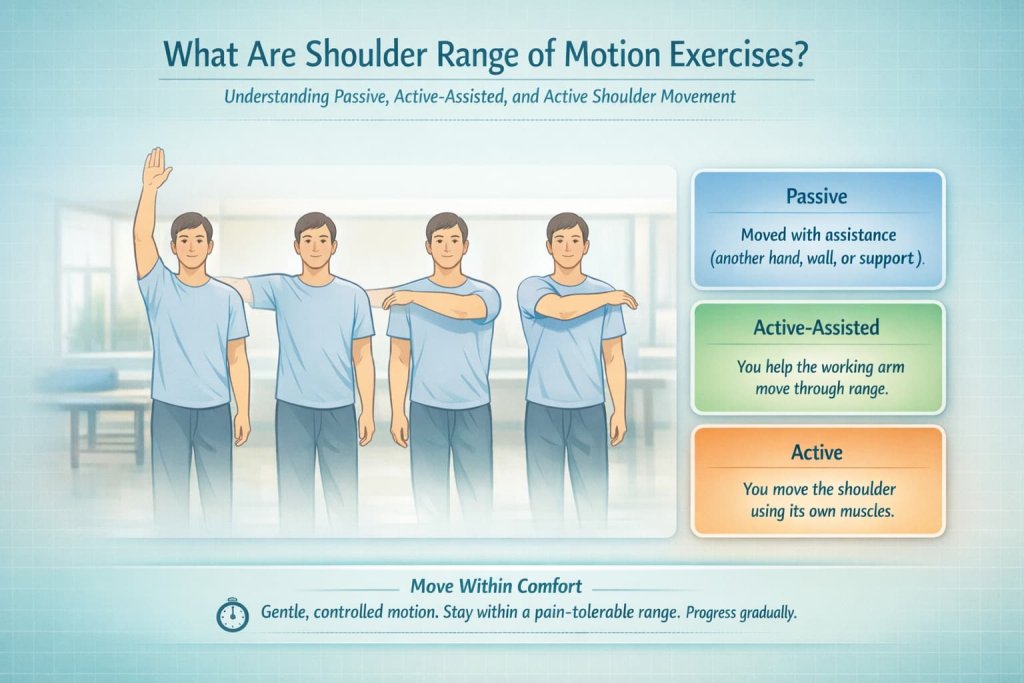
- Passive – moved with assistance
- Active-assisted – you help the arm move
- Active – you move it using your own muscles
The goal is to maintain or gradually improve comfortable movement without forcing the joint. Guidance from the NHS emphasizes staying within a pain-tolerable range and progressing gradually.
Benefits of Shoulder Range of Motion Exercises
When done consistently, shoulder range of motion exercises may:
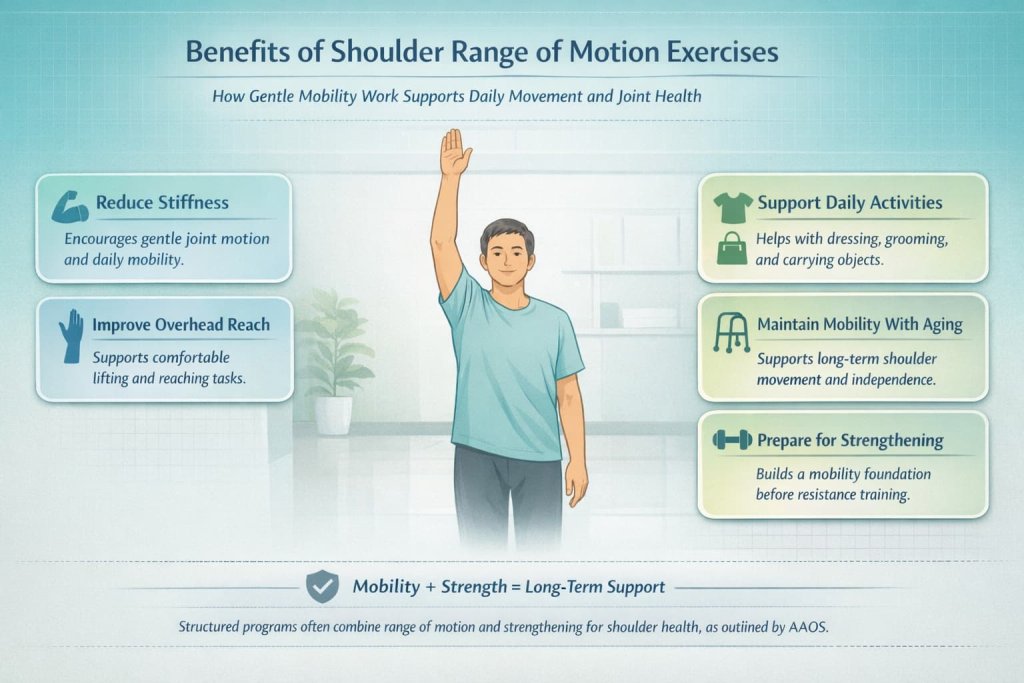
- Help reduce stiffness
- Improve overhead reach
- Support daily activities like dressing and lifting
- Maintain mobility as you age
- Prepare the shoulder for strengthening work
Many structured programs combine mobility and strengthening for long-term joint support, as outlined by the American Academy of Orthopaedic Surgeons (AAOS).
9 Best Shoulder Range of Motion Exercises
These 9 shoulder range of motion exercises are designed to gently improve mobility, reduce stiffness, and support smoother overhead movement. Each move focuses on controlled, pain-tolerable motion to help restore comfortable shoulder function.
1. Pendulum Swings
How to do it:
- Lean forward and support yourself with your non-working hand on a table or chair
- Let the working arm hang relaxed
- Gently swing the arm forward/back, side-to-side, then small circles
- Keep the motion smooth and easy
Why it works:
Pendulums use gravity and relaxed movement to create gentle joint motion without forcing the shoulder. This makes them especially useful early on when stiffness or sensitivity limits more active movement.
Muscles worked:
Minimal activation around the shoulder; the goal is relaxation, circulation, and joint nourishment rather than strength.
Trainer Tip:
Start with small circles and gradually increase range only if comfortable. Your shoulder should feel looser, not irritated. Pendulums are commonly included in shoulder ROM guidance from the NHS.
2. Arm Swings Forward and Back
How to do it:
- Stand tall with relaxed shoulders
- Swing one or two arm forward and back in a comfortable range
- Keep your ribs and torso steady
- Use slow, controlled reps
Why it works:
This movement reintroduces shoulder flexion and extension in a simple, natural pattern, helping restore comfortable front-to-back motion.
Muscles worked:
Deltoids (light activation), upper back stabilizers, and rotator cuff support muscles assist with control.
Trainer Tip:
If you feel pinching at the front of the shoulder, shorten the swing and slow down. Focus on control over height.
3. Arm Circles
How to do it:
- Raise your arm slightly out to the side
- Make small circles for 10–20 seconds
- Reverse direction
- Increase circle size only if comfortable
Why it works:
Blends multiple shoulder motions—flexion, abduction, and rotation—into one controlled pattern, improving coordination and awareness.
Muscles worked:
Deltoids, rotator cuff, and upper back stabilizers with light activation.
Trainer Tip:
Small circles are better early on. Controlled motion matters more than large range.
4. Wall Slide (Finger Walk)
How to do it:
- Face a wall with fingertips at chest height
- Walk fingers upward until you feel a gentle stretch
- Pause briefly
- Slowly walk back down
Why it works:
Safely practices overhead motion with built-in support, helping retrain upward reach without forcing the joint.
Muscles worked:
Serratus anterior, mid/lower trapezius, deltoids, and rotator cuff stabilizers (light engagement).
Trainer Tip:
Stop before shrugging. Keep your shoulder relaxed and neck long.
5. Towel Wall Slide
How to do it:
- Hold a towel against a wall
- Slide upward and back down slowly
- Add diagonal slides if tolerated
- Keep motion controlled and comfortable
Why it works:
The towel reduces friction, allowing smoother multi-directional movement and improved control.
Muscles worked:
Scapular stabilizers and deltoids with gentle shoulder motion.
Trainer Tip:
This is a great option if finger walking feels too sticky or jerky.
6. Supine Assisted Shoulder Flexion
How to do it:
- Lie on your back with knees bent
- Support the working arm with your other hand
- Slowly raise toward overhead within comfort
- Lower with control
Why it works:
Lying down limits compensation through the spine and ribs, helping isolate shoulder motion.
Muscles worked:
Deltoids and upper back stabilizers (light), with assistance from the supporting arm.
Trainer Tip:
Keep your ribs down and avoid arching your lower back to “fake” more range.
7. External Rotation Isometric
How to do it:
- Stand sideways near a wall
- Keep elbow bent 90 degrees and tucked at your side
- Press the back of your hand gently into the wall
- Hold briefly, then relax
Why it works:
Gentle activation of the external rotators supports shoulder stability and can improve movement quality over time.
Muscles worked:
Rotator cuff external rotators and posterior shoulder stabilizers.
Trainer Tip:
Keep effort light and controlled. The American Academy of Orthopaedic Surgeons (AAOS) outlines a common dosage example of holding about 5 seconds and repeating 10 times.
8. Internal Rotation Isometric
How to do it:
- Stand near a wall or door frame
- Bend elbow to 90 degrees
- Press your palm gently into the surface
- Hold briefly, then relax
Why it works:
Supports functional movements like reaching inward and lifting, while improving shoulder control.
Muscles worked:
Rotator cuff internal rotators and anterior shoulder stabilizers.
Trainer Tip:
Avoid rolling the shoulder forward. Keep posture upright and movements controlled.
9. Arm Swings Side to Side
How to do it:
- Stand tall with your arm relaxed
- Swing the arm gently across your body and back out
- Keep the shoulder down and away from your ear
- Stay within an easy range
Why it works:
Encourages horizontal shoulder motion and helps restore smoother joint mechanics without loading the joint heavily.
Muscles worked:
Anterior deltoid, scapular stabilizers, and light rotator cuff activation.
Trainer Tip:
Think “loose arm, steady torso.” If your neck tightens or you shrug, reduce the range.
How to Use This Shoulder Range of Motion Routine
Use these as a simple mobility circuit:
- Pick 5–9 exercises from the list
- Do 1–2 rounds
- Move slowly and stop before sharp pain
- Aim for a gentle stretch, not a forced end-range
For scheduling:
- Most days: light ROM work (5–10 minutes)
- A few days per week: add light strengthening once motion improves, similar to the structured progression recommended by the American Academy of Orthopaedic Surgeons (AAOS)
Quick Safety Checklist for Shoulder Range of Motion Exercises
Use these guardrails to keep ROM work safe and effective:
- Keep pain mild and manageable
- Avoid shrugging your shoulder toward your ear
- Move slower than you think you need to
- If symptoms spike and don’t settle shortly after, scale back and seek guidance, as patient resources from Cambridge University Hospitals suggest
Simple 5-Minute Shoulder ROM Routine
- Pendulum swings – 30–60 seconds
- Wall slide – 8–12 reps
- Arm circles – 10–20 seconds each direction
- Supine assisted flexion – 8–10 reps
- External rotation isometric – 10 gentle holds
Repeat once if comfortable.
Common Mistakes That Slow Shoulder Mobility
- Pushing into sharp pain
- Moving too quickly
- Shrugging during overhead motion
- Arching your low back to fake range
- Being inconsistent
When to See a Healthcare Professional
Stop exercising and seek medical advice if you experience:
- Severe or worsening pain
- Swelling or visible deformity
- Sudden weakness
- Numbness or tingling
- Limited movement after a fall or injury
If you’ve had recent shoulder surgery or a diagnosed condition, follow your provider’s plan rather than a general routine. Patient resources from Cambridge University Hospitals recommend getting guidance if pain significantly increases.
FAQs About Shoulder Range of Motion Exercises
How often should I do shoulder range of motion exercises?
Light ROM can be done most days. If following rehab, frequency depends on your provider’s plan.
Should these exercises hurt?
Mild discomfort may be normal. Sharp or worsening pain is not. Seek medical advice if symptoms persist.
What’s the best exercise for stiff shoulders?
Pendulum swings and wall slides are common beginner-friendly options.
How long does it take to improve mobility?
Improvements vary by cause and consistency. Gradual progress over weeks is common.
Can I do these after shoulder surgery?
Only if cleared by your surgeon or physical therapist.
Do I need equipment?
No. A wall and possibly a towel are enough.
When should I see a professional?
If you experience severe pain, weakness, swelling, deformity, numbness, or worsening symptoms.
Conclusion
Shoulder range of motion exercises work best when they are gentle, consistent, and controlled. Start with pendulums and wall slides, add assisted overhead reach, and gradually include light rotational support work. If pain increases or you’re recovering from surgery, follow clinician guidance.
References
- Leicestershire Partnership NHS Trust: Shoulder exercises (PDF)
- Sherwood Forest Hospitals NHS Foundation Trust: Shoulder range of movement exercises (PDF)
- Bridgewater NHS Trust: Shoulder range of motion exercises patient advice sheet (PDF)
- PubMed Central: Exercise therapy for rotator cuff-related shoulder pain (review)