
Vertical pull exercises train your back by pulling your arms down from an overhead position, and they are some of the best moves for building lat strength, upper-body pulling power, and better shoulder control. If you want a stronger back, better pull-up performance, and a more balanced upper-body program, vertical pulls deserve a regular place in your routine. Guidance from ACE and NASM supports vertical pulling patterns like pull-ups and lat pulldowns as major back-strengthening exercises.
These exercises matter because they help train the lats, upper back, biceps, forearms, and the muscles that stabilize the shoulder blades. They also give you options at every level, from beginner-friendly machine work to advanced bodyweight strength. Research on pull-up and lat pulldown variations from PubMed Central shows that grip, setup, and exercise choice can meaningfully change muscle activation and performance outcomes.
What Are Vertical Pull Exercises?
Vertical pull exercises are upper-body pulling movements in which you pull resistance down toward your chest or torso from above.
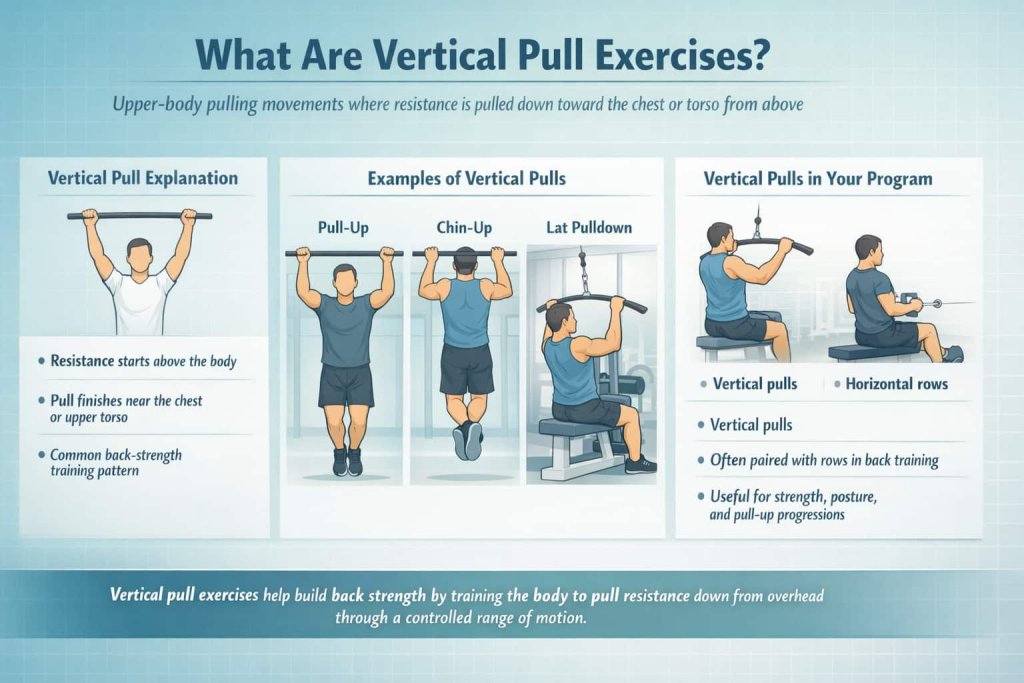
The classic examples are pull-ups, chin-ups, and lat pulldowns. In a practical training program, vertical pulling is often paired with horizontal pulling, such as rows, to build a more complete back routine. NSCA specifically includes lat pulldowns and assisted pull-ups in its vertical-pull progression model.
Why Vertical Pull Exercises Matter
Vertical pull exercises can help you build the kind of strength that carries over to pull-ups, climbing, grappling, swimming, and many everyday tasks that involve pulling or stabilizing the shoulders. They also add an important movement pattern that many lifters undertrain if they only focus on rows or pressing.
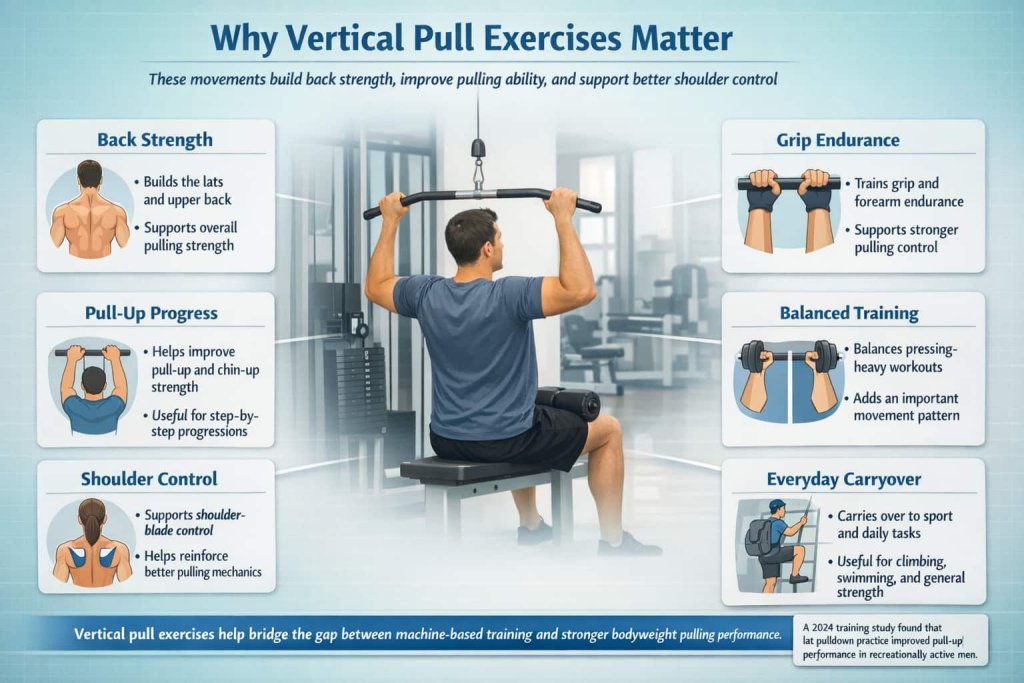
Main benefits include:
- Building the latissimus dorsi and upper back
- Improving pull-up and chin-up strength
- Training grip and forearm endurance
- Supporting shoulder-blade control
- Balancing pressing-heavy workouts
- Giving beginners a progression path from pulldowns to pull-ups
For example, an eight-week 2024 study from PubMed Central found that lat pulldown training improved pull-up performance in recreationally active men, which supports using machine-based vertical pulls as a stepping stone toward bodyweight pulling strength.
8 Best Vertical Pull Exercises
Vertical pull exercises help build back strength, improve pulling power, and support better shoulder control. This list covers eight effective options for different levels, from beginner-friendly pulldowns to advanced bodyweight pulls.
1. Pull-Up
How to do it:
- Hang from a pull-up bar with an overhand grip.
- Brace your core and keep your ribs under control.
- Pull your chest upward by driving your elbows down.
- Stop when your chin clears the bar or you reach your strongest top position.
- Lower with control to a full hang.
Why it works:
The pull-up is one of the best pure vertical pull exercises because it trains your back and arms while forcing you to control your whole body through space. ACE highlights the importance of setting the shoulders down and back and keeping the trunk braced, which is one reason pull-ups are such a strong total upper-body pulling option.
Muscles worked:
Pull-ups mainly train the lats, teres major, biceps, brachialis, forearms, and scapular stabilizers. A 2017 EMG study in PubMed Central comparing common pull-up variations found meaningful differences in muscle activity based on setup, supporting the idea that pull-ups are not just a back exercise but also a shoulder and arm challenge.
Trainer Tip:
Do not turn the rep into a full-body swing. Controlled reps with a full range of motion are usually more useful than chasing extra reps with poor form.
2. Chin-Up
How to do it:
- Grab the bar with your palms facing you.
- Start from a controlled dead hang.
- Pull your body upward while keeping your chest tall.
- Bring your chin over the bar if possible.
- Lower slowly and reset before the next rep.
Why it works:
The chin-up uses a supinated grip, which often feels more approachable for many lifters because it usually brings the biceps more into the movement. NASM notes that close-grip chin-up variations can increase the contribution of the elbow flexors, which makes them a helpful progression for people building toward stronger vertical pulling.
Muscles worked:
Chin-ups train the lats, biceps, brachialis, forearms, and upper back. Compared with a pronated pull-up, many lifters notice more arm involvement and slightly different shoulder comfort, which is one reason both variations can earn a place in a program.
Trainer Tip:
If your elbows feel irritated, adjust grip width slightly rather than forcing a very narrow position.
3. Assisted Pull-Up
How to do it:
- Use an assisted pull-up machine or resistance band.
- Set up with a stable grip and braced torso.
- Pull upward by driving your elbows down.
- Pause briefly near the top.
- Lower under control without dropping into the bottom.
Why it works:
The assisted pull-up lets beginners train the same general movement pattern as a full pull-up without needing full bodyweight strength on day one. NSCA includes assisted pull-ups in its vertical-pull teaching progression, and NASM also recommends assistance options such as machines or bands for newer trainees.
Muscles worked:
This variation still trains the lats, upper back, biceps, forearms, and trunk, but with reduced loading so technique is easier to control.
Trainer Tip:
Use only enough assistance to keep your form clean. Too much help can turn the exercise into a very different movement.
4. Neutral-Grip Pull-Up
How to do it:
- Use parallel handles on a neutral-grip pull-up station.
- Hang with your palms facing each other.
- Keep your torso steady and shoulders away from your ears.
- Pull until your upper chest approaches your hands.
- Lower slowly to the start.
Why it works:
A neutral-grip pull-up places the hands facing each other, which many people find more shoulder-friendly than a straight pronated or supinated grip. It can be a smart option if you want hard vertical pulling work with slightly more comfortable joint positioning. Research from PubMed Central on grip and forearm position during pulling patterns supports the idea that setup changes can influence muscle demand and comfort.
Muscles worked:
Neutral-grip pull-ups train the lats, brachialis, biceps, forearms, and upper back, with strong contribution from the muscles that stabilize the shoulder girdle.
Trainer Tip:
This is often a strong middle-ground option for lifters who want a challenging pull without the wrist position of a standard chin-up.
5. Lat Pulldown
How to do it:
- Sit with your thighs secured under the pad.
- Grab the bar with an overhand grip.
- Brace your midsection and keep your chest lifted.
- Pull the bar toward your upper chest.
- Return the bar overhead with control.
Why it works:
The lat pulldown is one of the most practical vertical pull exercises because it lets you train the same general pattern as a pull-up while adjusting the load precisely. Both ACE and NASM provide detailed technique guidance for keeping the trunk stable, anchoring the lower body, and pulling the bar toward the upper chest.
Muscles worked:
The lat pulldown mainly trains the lats, teres major, biceps, brachialis, forearms, and upper back. A 2025 EMG analysis in PubMed Central found that grip type, grip width, and trunk inclination can change dorsal muscle activation during the lat pulldown, which is one reason small setup details matter.
Trainer Tip:
Do not yank the bar behind your neck. NASM explains why front pulldowns are the more practical mainstream choice for most lifters and are generally easier to coach safely.
6. Neutral-Grip Lat Pulldown
How to do it:
- Attach a neutral-grip handle if your machine allows it.
- Sit tall with your legs secured.
- Pull the handles down toward the upper chest.
- Keep your shoulders down and elbows driving toward your sides.
- Return slowly to the overhead start.
Why it works:
This variation changes the hand position and can make the movement feel smoother for some shoulders and wrists. Research in PubMed on lat pulldown grip width and hand position shows that technique changes affect strength output and muscle activity, even when the movement pattern stays broadly the same.
Muscles worked:
It targets the lats, upper back, brachialis, biceps, and forearms, with some lifters finding it easier to keep the elbows tracking naturally in this version.
Trainer Tip:
If standard pulldowns bother your shoulders, try this variation before giving up on vertical pulling altogether.
7. Straight-Arm Pulldown
How to do it:
- Stand facing a cable machine with a straight bar or rope attached high.
- Start with your arms straight but not locked.
- Pull the handle down in an arc toward your thighs.
- Keep your torso stable and avoid bending the elbows too much.
- Return with control until your arms are overhead again.
Why it works:
The straight-arm pulldown is an accessory vertical pull that emphasizes shoulder extension with very little elbow flexion. That makes it useful when you want more direct lat work without as much help from the biceps. A 2022 study in Applied Sciences found especially high latissimus dorsi and triceps brachii activation in the straight-arm pulldown compared with the tested pullover setup.
Muscles worked:
This move mainly trains the lats, teres major, long head of the triceps, and the muscles that help stabilize the trunk and shoulder blades.
Trainer Tip:
Think about driving your upper arms down rather than pushing with your hands. That cue often helps lifters feel the lats more clearly.
8. Scapular Pull-Up
How to do it:
- Hang from a bar with straight elbows.
- Without bending your arms, pull your shoulders down and slightly back.
- Lift your body a small amount.
- Pause briefly.
- Relax back to the starting hang.
Why it works:
The scapular pull-up is a short-range drill that teaches you how to control the shoulder blades in a hanging position. NASM highlights dead hangs and scapular pull-up style work as foundational drills for improving pull-up skill. It is not a full vertical pull by itself, but it is a highly useful support exercise for better pull-up mechanics.
Muscles worked:
This drill emphasizes the lower trapezius, lats, serratus anterior, and other scapular stabilizers while also training grip endurance.
Trainer Tip:
Keep the motion small and deliberate. This is a control drill, not a momentum exercise.
How to Add Vertical Pull Exercises to Your Routine
For most people, one to three vertical pull exercises per week is enough, depending on total training volume and recovery. You do not need every variation in one workout.
A simple approach:
- Choose one main strength exercise: pull-up, chin-up, or lat pulldown
- Add one secondary variation: assisted pull-up or neutral-grip pulldown
- Finish with one accessory: straight-arm pulldown or scapular pull-up
A practical example:
- Pull-ups: 3 to 4 sets
- Lat pulldowns: 3 sets
- Straight-arm pulldowns: 2 to 3 sets
Weekly set volume matters for hypertrophy and strength planning, and research reviews in PubMed Central support managing total set count rather than relying on random exercise selection alone.
Common Mistakes to Avoid With Vertical Pull Exercises
Using too much momentum
Swinging, kipping, and jerking can turn a strength exercise into a less controlled skill drill. For general strength and muscle goals, controlled reps are usually more productive.
Pulling with the hands instead of the elbows
A better cue is to drive the elbows down toward the ribs. That often improves lat engagement.
Letting the shoulders shrug up
Keeping the shoulders organized helps maintain better shoulder mechanics, especially during pull-ups and pulldowns. ACE emphasizes scapular control from the start in its pull-up setup guidance.
Leaning too far back on pulldowns
A slight lean is fine, but turning the movement into a row changes the exercise.
Ignoring progression
Many people jump straight to full pull-ups before they are ready. Assisted work, pulldowns, and scapular drills can build the base you need first, which aligns with the vertical-pull teaching progression outlined by NSCA.
Beginner Progression Tips for Vertical Pull Exercises
If you cannot yet do a full pull-up, start with the pattern you can control well. A smart beginner progression often looks like this:
- Scapular pull-ups
- Assisted pull-ups
- Lat pulldowns
- Slow eccentric pull-ups
- Full pull-ups
This kind of progression is supported by coaching guidance from NASM, ACE, and NSCA.
Who Should Use Vertical Pull Exercises?
Vertical pull exercises are a strong fit for:
- Lifters trying to build a wider, stronger back
- Beginners working toward their first pull-up
- Athletes who need pulling strength and grip endurance
- People trying to balance a press-heavy routine
- Trainees who want more upper-body strength without only relying on rows
If you have shoulder pain, elbow irritation, or a recent upper-body injury, exercise selection and setup may need to be adjusted. In that case, it is wise to get individual advice from a qualified clinician or coach.
FAQ About Vertical Pull Exercises
Are pull-ups and chin-ups both vertical pull exercises?
Yes. Both are vertical pull exercises because the resistance starts overhead and you pull your body upward by driving the elbows down. The grip changes the feel and muscle emphasis, but the pattern remains a vertical pull, as shown in ACE exercise guidance.
What is the best vertical pull exercise for beginners?
For many beginners, the lat pulldown or assisted pull-up is the best starting point because load can be adjusted while you learn the pattern. NSCA also supports starting with more accessible versions before moving to full pull-ups.
Do vertical pull exercises build lats?
Yes. Vertical pull exercises are one of the main ways to train the lats. Research in PubMed Central shows strong lat involvement across multiple pulldown and pull-up variations.
Are lat pulldowns as good as pull-ups?
They are not identical, but lat pulldowns are a very useful alternative and progression tool. They let you train the same general movement pattern with adjustable resistance, and PubMed Central suggests they can improve later pull-up performance.
How often should I train vertical pull exercises?
Two to three times per week works well for many people, depending on your full training program, recovery, and total back volume. Research reviews in PubMed Central support matching the amount to your experience level and goals.
Should I do vertical pulls and rows in the same program?
Yes. Vertical pulls and rows train different pulling angles, so using both usually creates a more balanced back program than relying on only one category.
Conclusion
Vertical pull exercises are one of the most effective ways to build a stronger back, improve pulling power, and work toward better pull-up performance. The best plan is usually simple: choose one main vertical pull, add one variation that matches your level, and progress it with clean form over time. If you are building your routine now, start with the version you can control best and improve from there.