
Pilates board exercises can be a beginner-friendly way to build core strength, balance, and full-body control at home. Most “Pilates boards” sold for home use are compact sliding or reformer-style boards, so the best beginner approach is to focus on slow, low-impact movements that improve stability before adding speed or difficulty. Balanced Body describes reformer-style Pilates as a low-impact, full-body workout that emphasizes core strength, flexibility, balance, and coordination, while the NHS supports Pilates as an accessible home exercise option.
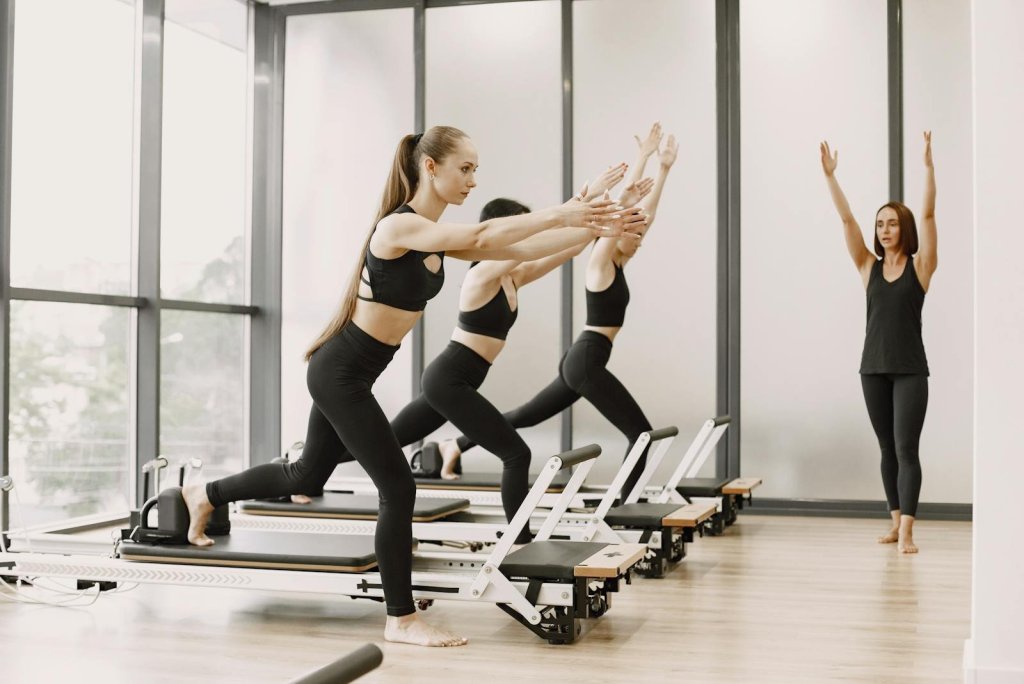
Understanding how to use a Pilates board matters because the equipment can make simple exercises feel more unstable than they look. When beginners start with controlled reps, proper setup, and realistic expectations, Pilates board exercises may help support posture, coordination, and everyday movement without the joint impact of jumping or running. Core-focused training also matters because strong core muscles help improve balance and steadiness in daily life, as explained by Mayo Clinic.
What Is a Pilates Board?
A Pilates board is usually a compact home fitness device designed to mimic some reformer-style movement patterns in a simpler and cheaper format. It often uses a sliding platform, a track, and sometimes resistance bands or handles. It is not identical to a studio reformer, but it can still support low-impact core and full-body training when used carefully.
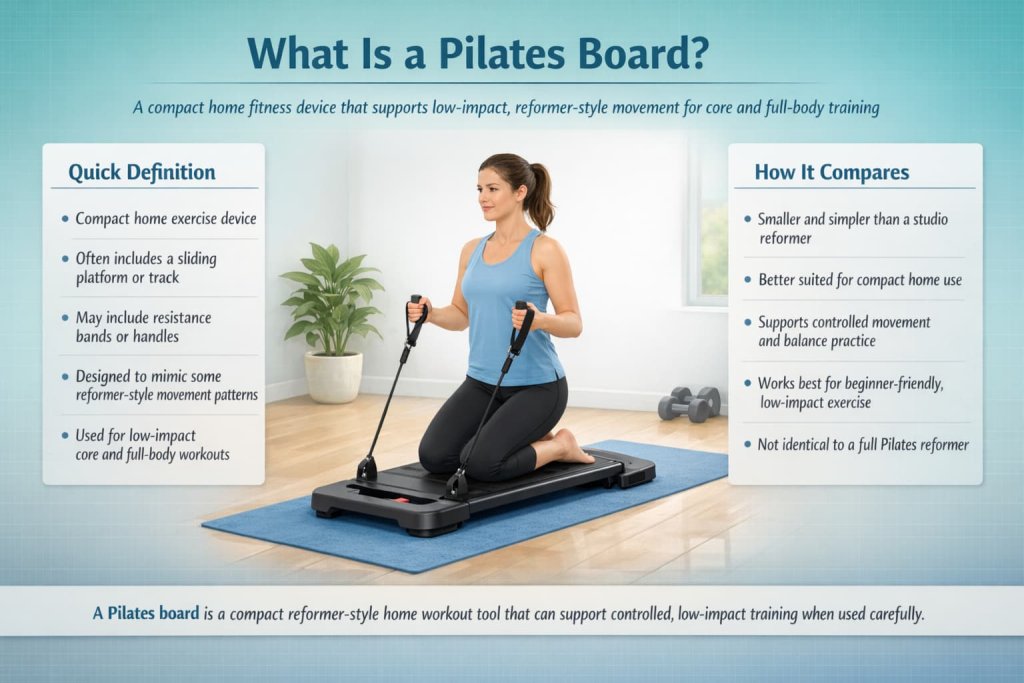
Reformer Pilates itself is commonly described by Balanced Body as a full-body method centered on controlled movement, breathing, posture, and core-focused strength.
Why Pilates Board Exercises Are Good for Beginners
Many beginners do well with Pilates board exercises because they combine strength, control, and stability work in one session. Pilates is commonly associated with improving flexibility, posture, muscle tone, balance, and joint mobility, while core exercises help the body stay steadier during both workouts and daily tasks, which is reflected in beginner guidance from the NHS.
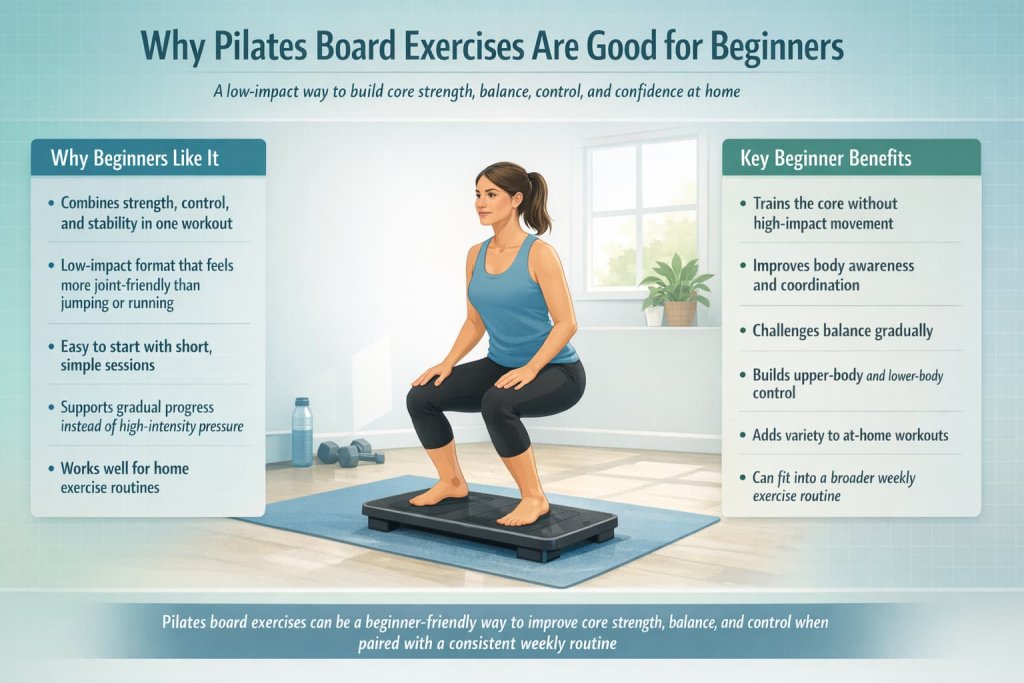
A beginner-friendly Pilates board routine can help you:
- train your core without high-impact movement
- improve body awareness and coordination
- challenge balance in a gradual way
- build lower-body and upper-body control
- add variety to home workouts
That does not mean a Pilates board is magic. It works best as part of a consistent routine that also includes walking, other strength training, or general physical activity. The CDC says adults should aim for at least 150 minutes of moderate-intensity physical activity each week plus muscle-strengthening activity on at least 2 days per week.
Who Should Be Careful Before Starting Pilates Board Exercises
Most healthy adults can try beginner Pilates board exercises, but some people should be more cautious. Get medical guidance first if you have:
- a recent surgery
- a recent fall or major balance problem
- ongoing back, hip, knee, wrist, or shoulder pain
- numbness, tingling, or pain that travels down an arm or leg
- trouble getting on and off the floor safely
This matters because even low-impact exercise can feel unstable on a sliding surface. The NHS offers chair-based and modified Pilates options for people who need more support, and Mayo Clinic notes that balance training becomes especially important with age.
8 Best Pilates Board Exercises for Beginners
These Pilates board exercises focus on simple movement patterns that fit the beginner goal of building core strength and full-body balance. Start with control first. Range of motion and speed can come later.
1. Standing Squat Slide
How to do it
- Stand tall with both feet placed securely on the board or in the board’s intended foot positions.
- Hold the handles if your board has them.
- Bend your knees and hips into a shallow squat.
- Keep your chest lifted and your weight centered.
- Press back to standing slowly.
- Repeat with smooth, controlled reps.
Why it works: This is one of the simplest ways to learn board control. It builds confidence, teaches alignment, and introduces lower-body loading without a high skill demand.
Muscles worked: Quads, glutes, hamstrings, calves, core.
Trainer Tip: Start with a shallow squat. Depth matters less than staying steady and keeping your knees tracking in line with your toes.
2. Glute Bridge on the Board
How to do it
- Lie on your back with knees bent and feet placed securely on the board.
- Keep your arms relaxed by your sides.
- Brace your core gently.
- Press through your feet and lift your hips.
- Pause briefly at the top.
- Lower down with control.
Why it works: Bridges are a practical beginner exercise for posterior-chain strength and core bracing. Mayo Clinic includes bridges among core exercises that train the trunk to support better movement.
Muscles worked: Glutes, hamstrings, core, lower back support muscles.
Trainer Tip: Do not overarch your low back at the top. Think about lifting your hips as one unit.
3. Hamstring Curl Slide
How to do it
- Start in a bridge position with your heels on the board.
- Lift your hips gently.
- Slide your feet away from your body slowly.
- Pull them back in while keeping your hips as steady as possible.
- Lower and reset if you lose control.
Why it works: This adds a sliding challenge to the bridge pattern, making the hamstrings and core work harder to control movement.
Muscles worked: Hamstrings, glutes, core.
Trainer Tip: Keep the motion short at first. A small, smooth range is better than a big shaky one.
4. Forearm Plank Hold
How to do it
- Place your forearms on the floor and your feet on the board, or follow your board’s intended plank setup.
- Step back into a straight-body position.
- Brace your core and glutes.
- Keep your neck neutral.
- Hold for a short, controlled time.
- Rest and repeat.
Why it works: Planks are a straightforward way to train trunk stiffness and whole-body control. Mayo Clinic explains that core training helps improve balance and steadiness, which is a major reason plank-style work fits beginner Pilates board routines.
Muscles worked: Deep core, abs, shoulders, glutes, quads.
Trainer Tip: A 10- to 20-second quality hold is better than a longer hold with sagging hips.
5. Knee Tuck Slide
How to do it
- Begin in a plank position with your feet on the board.
- Keep your shoulders stacked over your hands or forearms.
- Pull your knees in toward your chest slowly.
- Pause briefly.
- Slide back to the start with control.
- Repeat without rushing.
Why it works: Knee tucks challenge the core through motion, not just holding. They also teach you to resist wobbling while moving your lower body.
Muscles worked: Abs, hip flexors, shoulders, chest, core stabilizers.
Trainer Tip: Shorten the range if your hips lift too high or your low back starts to sag.
6. Mountain Climber Slide
How to do it
- Start in a high plank with your feet on the board.
- Bring one knee in slowly.
- Slide it back.
- Repeat on the other side.
- Alternate sides at a controlled pace.
- Keep your shoulders and hips as level as possible.
Why it works: This adds coordination and light cardio demand while still reinforcing core control.
Muscles worked: Core, shoulders, hip flexors, chest, legs.
Trainer Tip: For beginners, do this slowly. Fast mountain climbers often turn into sloppy reps.
7. Reverse Lunge Slide
How to do it
- Stand with one foot stable and the other foot on the moving part of the board.
- Slide the moving leg back as you bend both knees slightly.
- Keep your torso upright.
- Press through the front foot to return to standing.
- Complete all reps, then switch sides.
Why it works: Reverse lunges are often easier for beginners to control than forward lunges. On a board, they train balance, hip control, and lower-body strength at the same time.
Muscles worked: Glutes, quads, hamstrings, calves, core.
Trainer Tip: Hold a wall or chair lightly if balance is your limiting factor.
8. Side Leg Slide
How to do it
- Stand tall with one foot stable and the other on the board.
- Slide the moving leg out to the side slowly.
- Keep your hips level and torso tall.
- Pull the leg back in with control.
- Repeat, then switch sides.
Why it works: Side slides add frontal-plane work, which many beginners miss in basic home routines. That makes them useful for hip control and balance.
Muscles worked: Glute medius, inner thighs, quads, core.
Trainer Tip: Keep the range small until you can stay steady without leaning.
Before You Start Pilates Board Exercises
Set your board on a flat, non-slip surface. Wear shoes or socks only if the manufacturer says that is safe for your specific board. Start with the easiest resistance setting if bands are attached. Keep the movement slow enough that you can stop at any point without losing control.
Use these simple rules before each session:
- read the board setup instructions first
- make sure the board does not slide on the floor
- keep a wall or sturdy chair nearby for balance if needed
- stop if you feel sharp, worsening, or radiating pain
- begin with short sessions and build up gradually
That gradual approach matches broader public-health exercise guidance. The NHS beginner Pilates materials are designed for accessible home use, and the CDC also recommends building activity up over time rather than trying to do too much at once.
Common Pilates Board Mistakes Beginners Should Avoid
A few mistakes show up again and again with Pilates board exercises:
- moving too fast
- using too much band resistance
- letting the low back arch during core work
- choosing advanced plank or pike drills too early
- treating the board like a cardio toy instead of a control tool
Pilates works best when movement stays precise. That fits both reformer-style Pilates teaching from Balanced Body and general beginner Pilates guidance.
How Often Should You Do Pilates Board Exercises?
For most beginners, 2 to 3 sessions per week is a practical starting point. That is often enough to practice the movements, recover well, and build consistency. On other days, walking or other light activity can help keep your weekly routine balanced. This fits the broader CDC recommendation that adults include both regular aerobic activity and muscle-strengthening work each week.
A simple beginner plan could look like this:
- Day 1: 4 to 5 Pilates board exercises
- Day 2: walking or other light activity
- Day 3: another short Pilates board session
- Day 4: rest or mobility work
- Day 5: optional third short session
Are Pilates Board Exercises Actually Effective?
They can be effective for the goals they are best suited for: core control, low-impact strength work, movement awareness, and balance-focused training. Balanced Body describes reformer-style Pilates as a full-body, low-impact method that supports core strength, posture, balance, and coordination. Pilates is not usually the fastest route to maximal strength or high-calorie cardio, but it can be a useful and realistic part of a broader fitness plan.
That balanced view matters. Some marketing for home boards can overpromise dramatic body transformations. A better and more evidence-aligned expectation is that regular Pilates board exercises may help improve control, strength, posture, and stability over time when paired with consistent overall activity, which aligns with the practical, beginner-focused perspective from ACE.
Pilates Board Exercises FAQ
Are Pilates board exercises good for weight loss?
They can support a weight-loss plan by adding movement and muscle work, but they are not a guaranteed or standalone solution. Weight loss usually depends on the overall mix of nutrition, physical activity, sleep, and consistency. The CDC supports regular weekly activity as part of long-term health and weight management.
Can beginners use a Pilates board every day?
Some beginners can do short, easy sessions often, but daily hard sessions are not necessary. Most people do well with 2 to 3 focused sessions each week, especially while learning control and setup.
Is a Pilates board the same as a reformer?
No. A home Pilates board is usually a simplified reformer-style device, not a full studio reformer. It may copy some movement patterns, but the setup, resistance, and range of options are usually much more limited, as explained by Balanced Body.
Which Pilates board exercise is best for the core?
Forearm plank holds and knee tuck slides are two of the best beginner core options because they train bracing and control without needing advanced skill. Bridges also support core function by teaching the trunk and hips to work together, which fits the core training principles outlined by Mayo Clinic.
Are Pilates board exercises safe for older adults?
They can be, but safety depends on balance, mobility, and the exercise choice. Older adults or anyone worried about falls may need more support, a chair nearby, or a simpler non-board option first. Mayo Clinic notes that balance training is especially important with age.
Can Pilates board exercises help posture?
They may help support better posture by improving core control, movement awareness, and strength in the muscles that help stabilize the body. Balanced Body commonly describes posture improvement as one of the method’s practical benefits.
What should I do if a Pilates board exercise hurts?
Stop the exercise and check your setup, range of motion, and speed. If pain is sharp, worsening, or keeps returning, get guidance from a qualified healthcare professional before continuing.
Conclusion
Pilates board exercises can be a smart beginner option when your goal is to build core strength, body control, and full-body balance at home. The key is to treat the board as a tool for slow, precise movement, not as something to rush through. Start with the easiest patterns, keep sessions short, and build up only when your control feels solid.
For the best results, combine Pilates board exercises with regular walking or other weekly physical activity, and keep your expectations realistic. Done consistently, these beginner movements may help you feel stronger, steadier, and more confident over time.