
Pilates reformer exercises are controlled, low-impact movements performed on a spring-based reformer machine to build full-body strength, improve flexibility, and enhance posture and core control. Understanding how these exercises work—and how to perform them correctly—helps you train more efficiently, progress safely, and get the most benefit from every session.
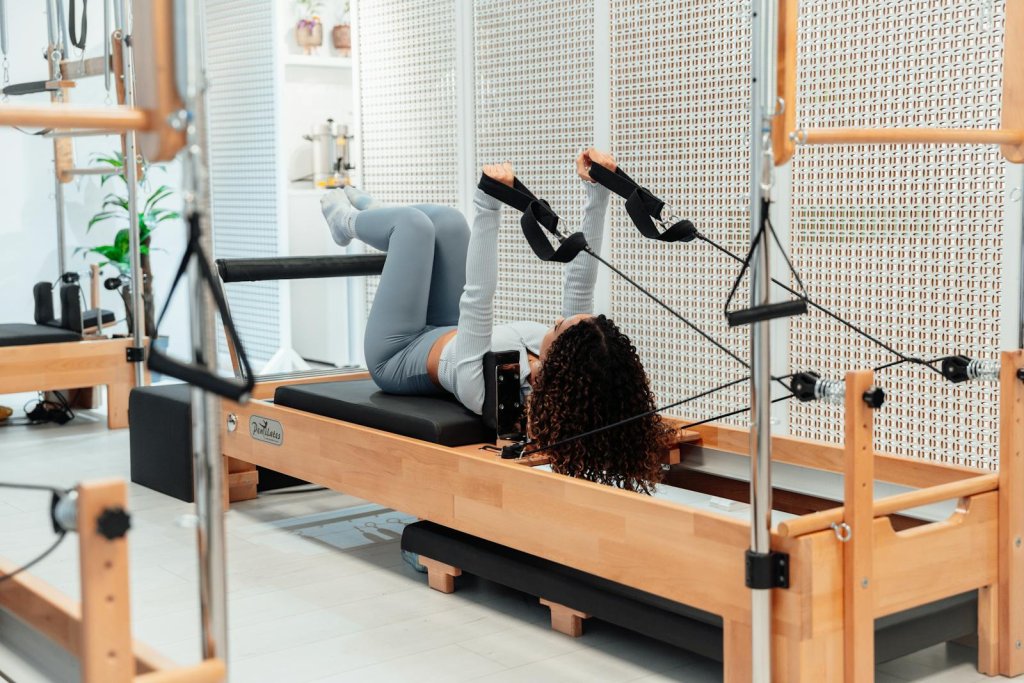
Pilates reformer training is widely used in fitness studios and rehabilitation settings because it can be adapted for beginners, advanced athletes, and people seeking low-impact strength work. With adjustable resistance, guided movement patterns, and multiple body positions, reformer exercises offer a structured way to support balanced muscle development and movement quality.
What Are Pilates Reformer Exercises?
Pilates reformer exercises are performed on a Pilates reformer—a machine made up of a sliding carriage, adjustable springs for resistance, straps, and a footbar. Unlike mat Pilates, the reformer provides external resistance and assistance, allowing for greater exercise variety and progression.
Key characteristics include:
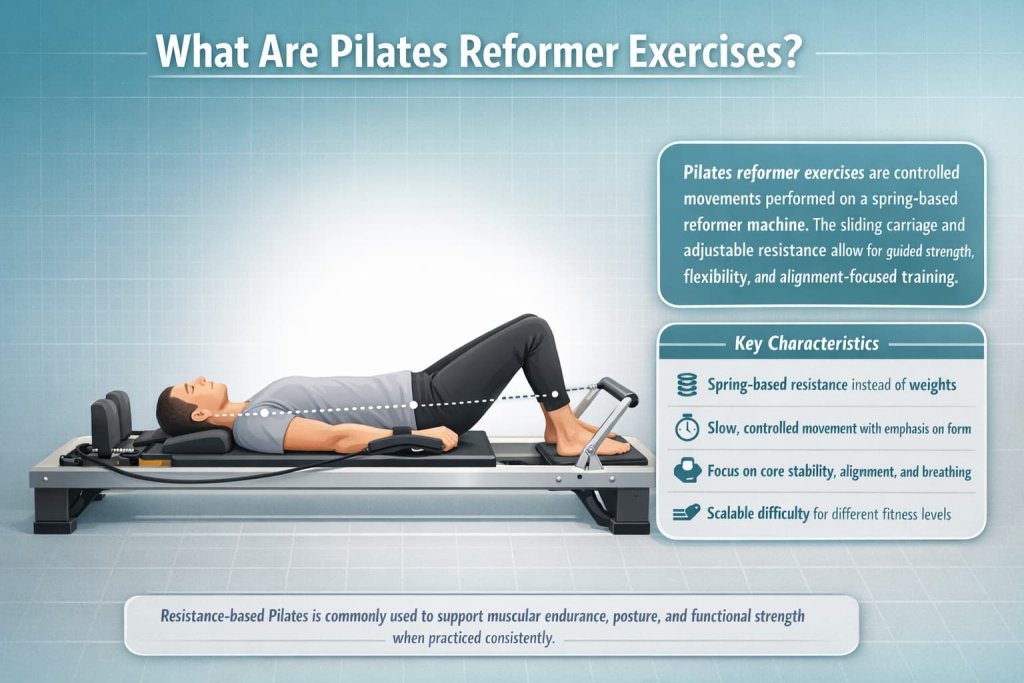
- Spring-based resistance instead of weights
- Slow, controlled movement with emphasis on form
- Focus on core stability, alignment, and breathing
- Scalable difficulty for different fitness levels
According to guidance referenced by organizations such as the American Council on Exercise, resistance-based Pilates can contribute to muscular endurance, postural control, and overall functional strength when practiced consistently.
12 Best Pilates Reformer Exercises
Below are some of the most commonly taught and widely recommended Pilates reformer exercises used in studio programming.
1. Reformer Footwork
How to do it:
- Lie on your back on the carriage with your head on the headrest
- Place feet on the footbar (heels, toes, or Pilates V position)
- Keep pelvis neutral and ribs gently connected
- Press the carriage out by extending the legs
- Control the return without locking the knees
Why it works:
Reformer footwork establishes foundational alignment and teaches proper leg mechanics against spring resistance. It reinforces lower-body strength while training the core to stabilize the pelvis, making it ideal as a warm-up or movement primer.
Muscles worked:
Quadriceps, glutes, hamstrings, calves, deep core stabilizers
Trainer Tip:
Focus on even pressure through both feet and avoid arching the lower back as the carriage moves.
2. Leg Circles
How to do it:
- Lie on your back with feet in straps
- Extend legs toward the ceiling with light spring tension
- Circle the legs slowly in one direction
- Keep hips stable as the legs move
- Reverse direction after completing reps
Why it works:
Leg circles challenge hip mobility while demanding strong core control. The straps provide resistance that encourages precision, coordination, and pelvic stability throughout the movement.
Muscles worked:
Hip flexors, glutes, inner thighs, deep abdominal muscles
Trainer Tip:
Make the circles small and controlled—stability matters more than range.
3. The Hundred (Reformer Version)
How to do it:
- Lie on your back with legs in tabletop or extended
- Hold straps or place arms by your sides
- Lift head, neck, and shoulders slightly
- Pump arms up and down while breathing rhythmically
- Maintain a stable pelvis throughout
Why it works:
The reformer adds resistance to the classic Hundred, increasing abdominal engagement while supporting spinal alignment. It builds endurance in the core while reinforcing breath control.
Muscles worked:
Rectus abdominis, transverse abdominis, hip flexors, shoulders
Trainer Tip:
If neck tension builds, lower the head while maintaining abdominal engagement.
4. Short Spine Massage
How to do it:
- Lie on your back with feet in straps
- Press legs out and lift hips into a supported rollover
- Bend knees and articulate spine down slowly
- Return to starting position with control
Why it works:
This exercise promotes spinal mobility and posterior-chain flexibility while encouraging deep abdominal support. The springs assist movement, allowing smooth articulation of the spine.
Muscles worked:
Hamstrings, glutes, spinal stabilizers, deep core muscles
Trainer Tip:
Move slowly and evenly through the spine—avoid dropping the hips quickly.
5. Long Stretch Series
How to do it:
- Start in a plank position with hands on the footbar
- Keep shoulders stacked over wrists
- Push the carriage back using the legs and core
- Maintain a straight line from head to heels
- Control the return forward
Why it works:
The long stretch series builds total-body strength by combining upper-body load with core stabilization. It improves shoulder control while challenging balance and endurance.
Muscles worked:
Shoulders, chest, triceps, abdominals, glutes
Trainer Tip:
Keep the neck long and avoid sagging through the lower back.
6. Elephant
How to do it:
- Stand on the carriage facing the footbar
- Place hands on the bar and heels flat on the carriage
- Hinge hips back with spine long
- Push carriage back using the legs
- Return with control without shifting shoulders
Why it works:
Elephant strengthens the posterior chain while reinforcing spinal length and shoulder stability. It teaches weight distribution and controlled hip movement.
Muscles worked:
Hamstrings, glutes, calves, shoulders, core stabilizers
Trainer Tip:
Think of lifting the sit bones upward to maintain length in the spine.
7. Knee Stretches
How to do it:
- Kneel on the carriage with hands on the footbar
- Round or neutral the spine depending on variation
- Press carriage back using hips and legs
- Draw carriage in using abdominal control
- Keep shoulders stable
Why it works:
Knee stretches build abdominal strength and coordination while reinforcing control of the moving carriage. They also improve hip flexor and core integration.
Muscles worked:
Abdominals, hip flexors, glutes, shoulders
Trainer Tip:
Initiate the movement from the core, not momentum.
8. Rowing Series
How to do it:
- Sit facing front or back holding straps
- Maintain tall posture through the spine
- Pull straps through designated rowing patterns
- Control both pull and return phases
- Coordinate breath with movement
Why it works:
The rowing series strengthens the upper body while encouraging upright posture and controlled breathing. It enhances shoulder mobility and postural endurance.
Muscles worked:
Upper back, shoulders, arms, core stabilizers
Trainer Tip:
Avoid shrugging—keep shoulders relaxed and wide.
9. Swan on the Reformer
How to do it:
- Lie prone on the carriage with hands on the footbar
- Engage core before lifting the chest
- Extend spine gradually against spring resistance
- Lower with control
- Keep legs long and active
Why it works:
Swan promotes thoracic extension while strengthening the back body. The reformer provides support that allows safe spinal extension with control.
Muscles worked:
Spinal extensors, glutes, hamstrings, upper back
Trainer Tip:
Lift through the chest, not the lower back.
10. Side Splits
How to do it:
- Stand with one foot on the carriage and one on the platform
- Maintain upright posture
- Press carriage out by abducting the legs
- Draw legs back together with control
- Keep hips level
Why it works:
Side splits challenge lateral hip strength, balance, and control. The springs add resistance that improves coordination and stability.
Muscles worked:
Inner thighs, outer hips, glutes, core stabilizers
Trainer Tip:
Use lighter springs until balance improves.
11. Long Spine Stretch
How to do it:
- Lie on your back with feet in straps
- Press legs out and lift hips into rollover
- Open and close legs while elevated
- Articulate spine down slowly
- Maintain control throughout
Why it works:
This advanced movement integrates core strength with spinal mobility and coordination. It encourages control through a large range of motion.
Muscles worked:
Abdominals, hamstrings, glutes, spinal stabilizers
Trainer Tip:
Only attempt if you already have good spinal control and instructor guidance.
12. Mermaid Stretch
How to do it:
- Sit sideways on the carriage with one foot against the shoulder block
- Hold the footbar with one hand
- Side-bend the spine smoothly
- Return to upright with control
- Repeat on both sides
Why it works:
Mermaid enhances lateral spinal flexibility while promoting controlled breathing and pelvic stability. It counterbalances strength-focused exercises.
Muscles worked:
Obliques, spinal stabilizers, shoulders, hips
Trainer Tip:
Keep both sit bones grounded to avoid collapsing into the stretch.
Who Should Try Pilates Reformer Exercises?
Pilates reformer exercises may be suitable for:
- Beginners seeking guided, low-impact strength work
- Adults looking to improve posture and core control
- Athletes using Pilates as cross-training
- Individuals returning to structured movement under professional guidance
Because the reformer uses moving parts and spring tension, beginners are generally encouraged to learn under the supervision of a qualified instructor.
Benefits of Pilates Reformer Exercises
Well-designed Pilates reformer exercises may help support:
- Core strength and trunk stability
- Joint-friendly strength training with minimal impact
- Improved flexibility and controlled mobility
- Better posture and body awareness
- Balanced muscle engagement across the whole body
Public-health recommendations from the Centers for Disease Control and Prevention and the World Health Organization encourage muscle-strengthening activities at least two days per week. Reformer Pilates can contribute to these guidelines when sessions challenge major muscle groups appropriately.
Safety Guidelines for Reformer Pilates
To reduce risk and improve training quality:
- Start with light spring resistance and progress gradually
- Maintain slow, controlled movements at all times
- Focus on neutral spine and proper alignment
- Avoid rushing transitions between exercises
- Stop if you experience sharp or worsening discomfort
If you have a medical condition, recent surgery, or ongoing pain, professional guidance is recommended before starting reformer training.
Beginner vs Advanced Progression in Pilates Reformer Exercises
Pilates reformer exercises progress by adjusting resistance, range of motion, and complexity—not speed.
Beginner progression focuses on:
- Light spring resistance
- Small, controlled movements
- Slower tempo with emphasis on alignment and breathing
- Foundational exercises such as footwork and leg circles
Advanced progression may include:
- Heavier or varied spring settings
- Larger ranges of motion
- Standing or balance-based exercises
- Complex sequences combining strength, control, and mobility
Progress gradually to maintain proper form and reduce injury risk.
How Often Should You Do Pilates Reformer Exercises?
Most studios and fitness professionals recommend:
- 2–3 reformer sessions per week for general fitness
- Allowing rest days between sessions for recovery
- Combining reformer work with walking, mobility work, or light cardio
Consistency matters more than intensity when building strength and control through Pilates.
Frequently Asked Questions
Are Pilates reformer exercises good for beginners?
Yes. With proper instruction and appropriate spring settings, reformer exercises can be adapted for beginners.
Do Pilates reformer exercises build muscle?
They may help improve muscular strength and endurance, especially in the core, legs, and postural muscles.
Is reformer Pilates better than mat Pilates?
Neither is universally “better.” Reformer Pilates offers adjustable resistance, while mat Pilates relies more on body weight and gravity.
Can Pilates reformer exercises help with posture?
Many reformer exercises emphasize spinal alignment and upper-back engagement, which may help support better posture when practiced consistently.
How long is a typical reformer Pilates class?
Most studio classes last 45–60 minutes, depending on the format and level.
Is reformer Pilates low impact?
Yes. Movements are generally smooth and controlled, placing minimal stress on the joints.
Conclusion
Pilates reformer exercises offer a structured, adaptable way to build strength, flexibility, and body control without high impact. Whether you are new to Pilates or looking to progress beyond mat work, reformer training can support balanced movement and long-term fitness when practiced consistently and with proper technique.
If you’re ready to start, consider booking a beginner reformer session with a certified instructor or adding one or two reformer workouts to your weekly routine.
References
- Pilates Overview (Mayo Clinic – Dan Abraham Healthy Living Center)
- A Systematic Review of the Effects of Pilates Method of Exercise in Healthy People (PubMed)
- Is Pilates Better Than Other Exercises for Muscle Strength? (Systematic Review, PubMed Central)
- Adult Physical Activity Guidelines Overview (CDC)
- WHO Guidelines on Physical Activity and Sedentary Behaviour (Official publication page)