
The best lower body exercises for seniors are simple, stable moves like chair sit-to-stands, heel raises, mini squats, step-ups, and standing hip work because they help build leg strength, balance, and mobility without requiring complicated equipment. This matters because older adults are encouraged to include muscle-strengthening and balance activities each week, and falls remain a major health concern, with the CDC noting that more than 1 in 4 adults age 65 and older falls each year.
For most readers, the safest approach is simple: start with controlled bodyweight exercises, use a chair or wall for support when needed, and build gradually. The National Institute on Aging and the Physical Activity Guidelines for Americans both support combining strength, balance, and regular movement as part of healthy aging.
Why Lower Body Exercises for Seniors Matter
Lower body strength supports daily tasks that many people want to keep doing independently, such as standing up from a chair, climbing stairs, walking with confidence, and getting in and out of a car. For older adults, multicomponent physical activity that includes balance and strength work improves physical function and lowers fall risk, according to the CDC.
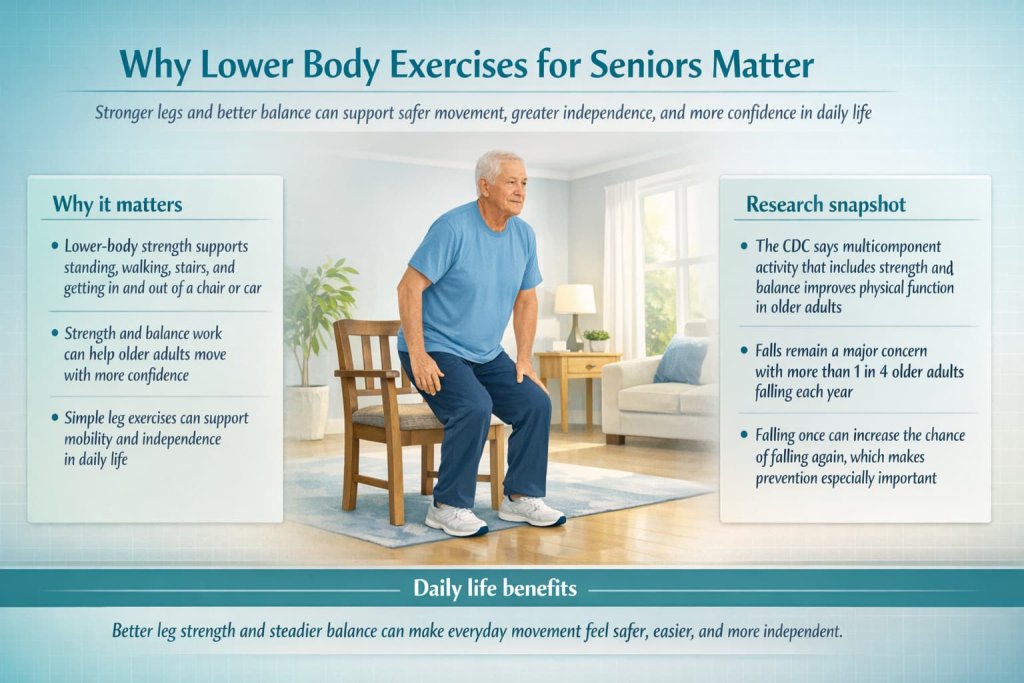
This is especially important because the CDC says more than one out of four older adults falls each year, less than half tell their doctor, and falling once doubles the chance of falling again.
Before You Start Lower Body Exercises for Seniors
Start with 5 to 10 minutes of easy movement such as walking, marching in place, or gentle ankle and knee motion. Use a sturdy chair, countertop, or wall if balance feels uncertain. If you have recent surgery, a recent fall, new dizziness, major joint swelling, or pain that feels sharp or worsening, get individualized guidance before starting. The AAOS also notes that chair or wall support can be useful for balance during lower-body exercise progressions.
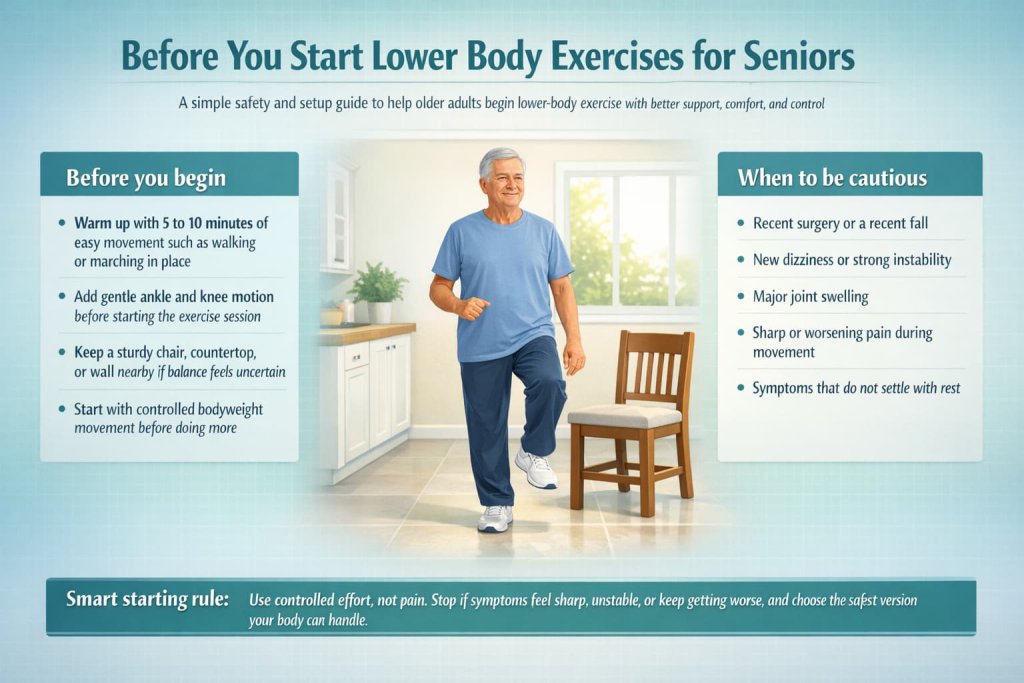
A good beginner rule is to stop if an exercise causes sharp pain, strong instability, chest symptoms, or symptoms that keep getting worse. The goal is controlled effort, not pushing through pain. This fits the advice in the Physical Activity Guidelines for Americans that older adults should be as active as their abilities and conditions allow.
10 Best Lower Body Exercises for Seniors
Build stronger legs, better balance, and easier everyday movement with these simple lower body exercises for seniors.
Each move is beginner-friendly, practical, and designed to support strength, mobility, and confidence at home.
1. Chair Sit-to-Stand
How to do it:
- Sit near the front of a sturdy chair with feet about hip-width apart.
- Lean slightly forward from the hips while keeping your chest lifted.
- Push through your feet and stand up.
- Slowly lower back down with control.
- Use your hands on the chair only if needed at first.
Why it works: Sit-to-stands train one of the most practical strength patterns for older adults: getting up from a seated position. They build leg strength and reinforce a daily movement that supports independence. The National Institute on Aging includes practicing standing from a sitting position among useful balance-related activities for older adults.
Muscles worked: Quadriceps, glutes, hamstrings, and core stabilizers.
Trainer Tip: Start with a higher chair if a low chair feels too difficult.
2. Supported Mini Squat
How to do it:
- Stand tall with feet about shoulder-width apart.
- Lightly hold the back of a chair or a wall for balance.
- Bend at the hips and knees a small amount, as if sitting back into a chair.
- Keep your chest up and your heels down.
- Return to standing slowly.
Why it works: Mini squats strengthen the thighs and hips without needing deep knee bend. AAOS knee-conditioning guidance uses half squats to strengthen the quadriceps, glutes, and hamstrings and notes that a chair or wall can be used for balance.
Muscles worked: Quadriceps, glutes, hamstrings.
Trainer Tip: Think “sit back a little,” not “drop straight down fast.”
3. Heel Raises
How to do it:
- Stand behind a chair or near a wall.
- Hold on lightly for support.
- Raise your heels as high as comfortable.
- Pause briefly at the top.
- Lower with control.
Why it works: Heel raises strengthen the calf muscles and help with walking, push-off, and ankle stability. AAOS conditioning materials include calf raises as a practical lower-leg strengthening exercise and recommend support when needed.
Muscles worked: Calves and foot-ankle stabilizers.
Trainer Tip: Move slowly both up and down. The lowering phase matters too.
4. Toe Raises
How to do it:
- Stand tall near a chair or wall.
- Keep your heels on the floor.
- Lift your toes and the front of your feet upward.
- Pause briefly.
- Lower slowly.
Why it works: Toe raises help strengthen the muscles at the front of the lower leg, which can support foot clearance when walking and may help reduce shuffling. They pair well with heel raises for balanced lower-leg training. Guidance for older adults from the CDC consistently emphasizes balance and function-focused movement patterns.
Muscles worked: Tibialis anterior and lower-leg stabilizers.
Trainer Tip: Keep your body upright instead of rocking backward.
5. Step-Ups
How to do it:
- Stand facing a low step.
- Place one foot fully on the step.
- Push through that foot to step up.
- Bring the other foot up if comfortable.
- Step down slowly and repeat.
Why it works: Step-ups build the kind of leg strength used for stairs, curbs, and everyday mobility. They also challenge balance in a controlled way when the step height is appropriate. The Physical Activity Guidelines for Americans and the National Institute on Aging both support functional, multicomponent activity for older adults.
Muscles worked: Quadriceps, glutes, calves, hamstrings.
Trainer Tip: Start with a very low step and hold a rail or countertop if needed.
6. Standing Hamstring Curl
How to do it:
- Stand behind a chair and hold it lightly.
- Keep one leg planted.
- Bend the other knee and bring your heel toward your buttocks.
- Lower slowly.
- Repeat, then switch sides.
Why it works: Hamstring curls target the back of the thigh and can help support walking and knee control. AAOS knee-conditioning materials include hamstring-focused work as part of lower-body support for the knee.
Muscles worked: Hamstrings and calf support muscles.
Trainer Tip: Keep your knees close together and avoid arching your lower back.
7. Standing Hip Abduction
How to do it:
- Stand tall behind a chair.
- Shift weight onto one leg.
- Move the other leg out to the side without leaning your trunk.
- Bring it back in slowly.
- Repeat and switch sides.
Why it works: Hip abduction helps strengthen the outer hip muscles that support side-to-side stability. That can be useful for walking, standing, and balance control. Guidance from the National Institute on Aging and the CDC supports exercises that improve stability and physical function.
Muscles worked: Gluteus medius, gluteus minimus, and hip stabilizers.
Trainer Tip: Keep the movement small and controlled instead of swinging the leg.
8. Standing Hip Extension
How to do it:
- Stand behind a chair with both hands on it.
- Keep your torso upright.
- Move one leg straight back a short distance.
- Pause briefly.
- Return slowly and switch sides.
Why it works: Hip extension strengthens the muscles that help with posture, walking, and pushing through the ground. It is a simple way to train the glutes without getting on the floor. The National Institute on Aging supports simple, accessible movement options for older adults.
Muscles worked: Glutes and hamstrings.
Trainer Tip: Do not lean forward to make the leg go farther back.
9. Side Steps
How to do it:
- Stand tall with knees slightly soft.
- Step a small distance to one side.
- Bring the other foot in under control.
- Continue for several steps, then go the other way.
- Use a counter or wall nearby if needed.
Why it works: Side steps add lateral movement, which many people do not practice enough in daily life. They can help challenge balance and improve side-to-side control, which matters for stability. The National Institute on Aging specifically lists walking sideways among balance exercise examples for older adults.
Muscles worked: Outer hips, glutes, quadriceps, and lower-leg stabilizers.
Trainer Tip: Stay tall and avoid dragging your feet.
10. Marching in Place
How to do it:
- Stand near a chair or wall.
- Lift one knee, then the other, in a slow marching rhythm.
- Keep your posture upright.
- Swing your arms lightly if comfortable.
- Continue for time or repetitions.
Why it works: Marching in place builds hip strength, coordination, and balance while also adding a light endurance challenge. It is easy to scale by making the knee lift smaller or larger. This matches the broader older-adult recommendation from the CDC to combine strength, balance, and movement throughout the week.
Muscles worked: Hip flexors, quadriceps, calves, and core stabilizers.
Trainer Tip: Start slow. Control matters more than height.
How Often Should Seniors Do Lower Body Exercises?
For most older adults, a practical target is muscle-strengthening activity on at least 2 days per week, plus regular balance work. CDC guidance for adults 65 and older also recommends at least 150 minutes of moderate-intensity aerobic activity per week, when possible, along with balance-improving activity. The National Institute on Aging notes that balance exercises can be done about 3 times per week.
A simple weekly plan could look like this:
- 2 to 3 lower-body strength sessions per week
- 2 to 3 balance-focused sessions per week
- walking or other aerobic activity on most days, based on ability
Sample Lower Body Routine for Seniors
This beginner-friendly routine works well at home:
- Chair sit-to-stand: 2 sets of 6 to 10 reps
- Supported mini squat: 2 sets of 8 to 10 reps
- Heel raises: 2 sets of 10 to 15 reps
- Standing hamstring curl: 2 sets of 8 to 12 reps per side
- Standing hip abduction: 2 sets of 8 to 12 reps per side
- Marching in place: 30 to 60 seconds
This type of structure is consistent with the official emphasis in CDC guidance on multicomponent activity for older adults. Start at the low end and add repetitions only when form stays solid.
Common Mistakes to Avoid
Many seniors do better when they avoid rushing, gripping too hard with the hands, or trying to make every movement too deep right away. It is usually better to use a small, controlled range and progress over time than to force depth or speed. That gradual approach is consistent with advice from the National Institute on Aging.
Other common mistakes include skipping support when balance is uncertain, holding the breath during effort, and doing too much after a long break from exercise, which the National Institute on Aging also addresses.
Who Should Be More Careful With Lower Body Exercises for Seniors?
Extra caution makes sense if you have had a recent fall, recent surgery, major arthritis flare, new numbness, strong dizziness, or significant balance problems. The National Institute on Aging notes that some balance issues may require patient-specific exercises from a qualified professional, and AAOS also emphasizes fall-prevention awareness as people age.
That does not always mean avoiding exercise. It usually means choosing a more supported version, reducing range of motion, or getting individualized advice first, which is in line with the Physical Activity Guidelines for Americans.
FAQs About Lower Body Exercises for Seniors
Are Lower Body Exercises Safe for Seniors?
Yes, in many cases they are safe when the exercises match the person’s current ability and are performed with control. Guidance from the CDC, National Institute on Aging, and AAOS supports regular strength and balance activity, with modifications when needed.
What Is the Best Leg Exercise for Seniors at Home?
Chair sit-to-stands are one of the best starting points because they train a daily-life movement and are easy to scale with chair height and hand support. The National Institute on Aging also highlights standing from a sitting position as a useful balance-related activity.
How Many Times a Week Should Seniors Train Their Legs?
A good general target is 2 or more days per week of muscle-strengthening activity, with balance practice added regularly. That is consistent with recommendations from the CDC and the Physical Activity Guidelines for Americans.
Can Seniors Build Leg Strength After 60 or 70?
Yes. Official older-adult exercise guidance consistently states that it is beneficial to become more active even later in life. The National Institute on Aging specifically says it is never too late to start being physically active and gain benefits from an active lifestyle.
Which Lower Body Exercises Help With Balance?
Exercises such as marching in place, side steps, sit-to-stands, step-ups, and standing hip work can all support balance when used appropriately. The National Institute on Aging lists balance activities such as walking sideways and practicing standing from sitting, while the CDC emphasizes balance as part of older-adult activity.
Should Seniors Exercise Every Day?
Many older adults can benefit from moving every day, but hard strength sessions do not need to happen daily. A balanced week usually works better than doing intense lower-body training every day. The CDC recommends spreading activity across the week and combining aerobic, strength, and balance work.
Conclusion
Lower body exercises for seniors do not need to be complicated to be effective. A simple program built around sit-to-stands, mini squats, heel raises, step-ups, and standing hip work can support stronger legs, steadier balance, and better everyday mobility. Start with the easiest version you can control, stay consistent, and build gradually over time.