
The windshield wipers exercise is a core movement that trains rotational control, oblique strength, and trunk stability by moving your legs side to side while keeping your upper body grounded. It matters because strong core control helps you manage force better during training, improve movement quality, and stay more stable through your hips and trunk. When done well, this exercise teaches you to brace, control range of motion, and move your lower body without letting your torso collapse.
Guidance from the American Council on Exercise and broader core-training research supports this general approach to trunk endurance and stability work.
What Is the Windshield Wipers Exercise?
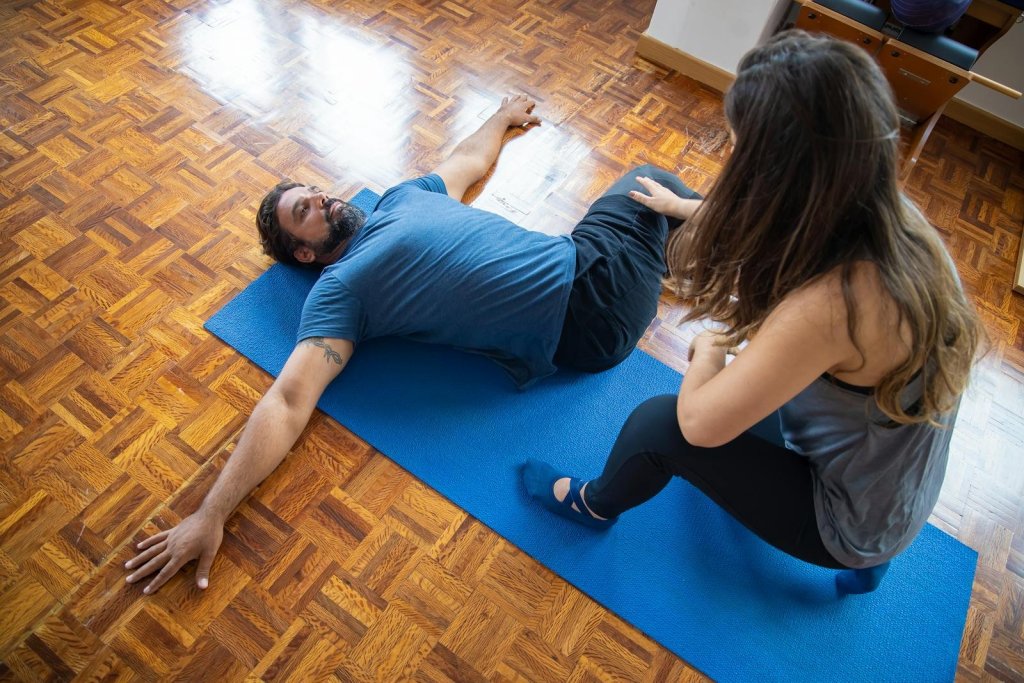
The windshield wipers exercise is usually performed lying on your back with your arms out in a T-shape while your legs move from side to side in a controlled arc. In the American Council on Exercise version, you begin with your hips and knees bent to 90 degrees, brace your abdominals, lower your legs slowly to one side, and keep the opposite shoulder blade pressed into the floor. ACE also shows an advanced “three-kick” version that adds extra movement at the end range to increase the challenge on the obliques.
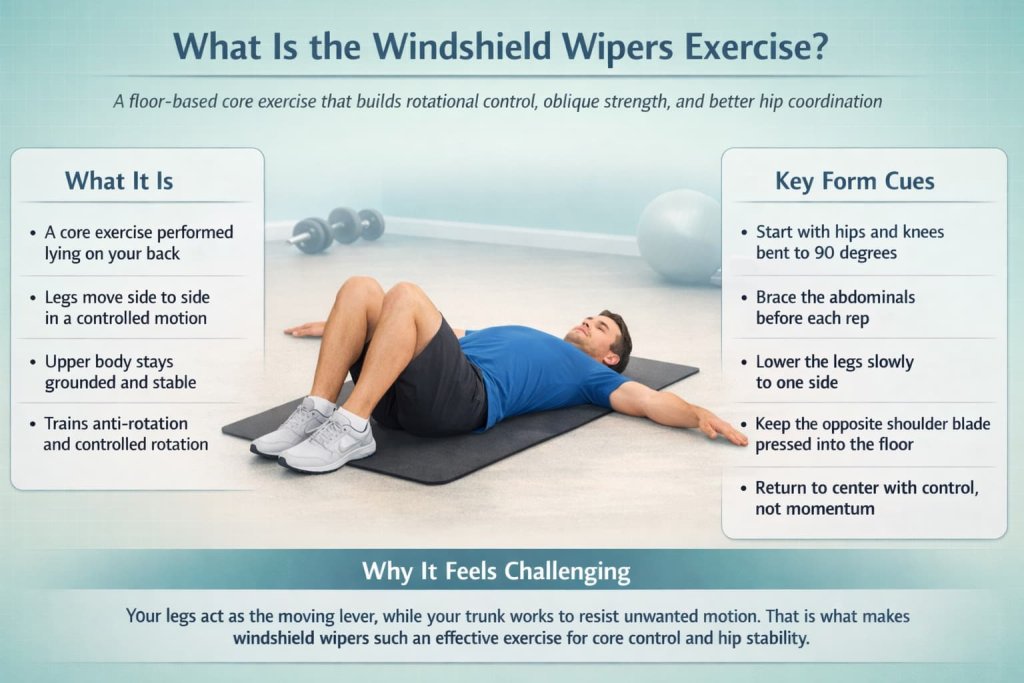
In simple terms, it is an anti-rotation and controlled-rotation core exercise. Your legs create the lever. Your trunk has to manage that lever without losing position. That is why the move feels harder than it looks.
How to Do the Windshield Wipers Exercise
How to do it:
- Lie on your back with your arms straight out to the sides in a T-shape.
- Lift your legs so your hips and knees are bent to about 90 degrees.
- Brace your abs and keep your ribcage down.
- Slowly lower both knees to one side.
- Stop at the range where you can still keep the opposite shoulder blade on the floor.
- Return to center with control.
- Repeat to the other side.
- Continue alternating sides for the planned reps.
Trainer Tip:
Do not chase floor contact. Only lower as far as you can while keeping your brace and shoulder position.
This setup closely follows the coaching cues the American Council on Exercise uses for its three-kick windshield wiper: arms in a T, hips and knees at 90 degrees, braced abdominals, slow lowering, and the opposite shoulder blade staying down.
Muscles Worked in the Windshield Wipers Exercise
The main muscles involved are:
- Obliques
- Rectus abdominis
- Transverse abdominis
- Other trunk stabilizers
- Hip flexors as assistants
The American Council on Exercise specifically says the abdominal exercises in that workout target the rectus abdominis, obliques, and transverse abdominis. In the windshield wiper itself, the obliques do much of the noticeable work because they help control rotation and keep the movement from becoming a sloppy drop to the floor.
Best Windshield Wipers Exercise Variations
These windshield wipers exercise variations help you match the movement to your current strength, control, and mobility level. Start with the easiest option you can perform well, then progress as your core stability and hip control improve.
1. Heel-Tap Windshield Wipers
How to do it:
- Set up in the same bent-knee position.
- Lower your knees only partway to one side.
- Tap lightly or stop just above your limit.
- Return to center.
- Repeat on the other side.
Why it works:
This is a beginner-friendly variation because the range is smaller and easier to control.
Muscles worked:
Obliques, transverse abdominis, rectus abdominis.
Trainer Tip:
Start with small, smooth arcs. Bigger is not better unless you can control it.
2. Straight-Leg Windshield Wipers
How to do it:
- Lie on your back with your arms out wide.
- Extend both legs straight up.
- Brace your trunk and squeeze your legs together.
- Slowly lower both legs to one side.
- Return to center without swinging.
- Repeat to the other side.
Why it works:
Straight legs create a longer lever, which raises the demand on your trunk and obliques.
Muscles worked:
Obliques, rectus abdominis, transverse abdominis, hip flexors.
Trainer Tip:
Only try this progression after you fully own the bent-knee version.
Why the Windshield Wipers Exercise Works
This movement works because it forces your trunk to resist momentum while your legs move away from center. The farther the legs travel, the more control your abdominals and obliques need to keep your ribcage, pelvis, and shoulders organized. The National Strength and Conditioning Association notes that proper bracing and spinal stabilization matter for safe and effective resistance training, and windshield wipers are a good example of that principle in action.
Research on core training more broadly shows that it can improve trunk strength, core endurance, and dynamic balance. A 2025 systematic review indexed in PubMed found that core training improved trunk extensor strength, core endurance, dynamic balance, and sprint speed in athletes, while a 2023 systematic review in PMC found benefits for balance and some performance measures. Windshield wipers are just one exercise, but they fit that larger evidence-based pattern of controlled trunk training.
Windshield Wipers Exercise Benefits
Builds stronger obliques
The American Council on Exercise specifically describes the windshield wiper variation as intensifying the work of the obliques. That makes it useful when you want more side-to-side trunk control instead of only straight-ahead ab work.
Improves core endurance and control
This is not a fast, explosive movement. It is a control exercise. That means it can help build the kind of trunk endurance you need to maintain position during longer sets, sport movement, or strength training. Core-training reviews have found improvements in endurance-related trunk measures after structured programs.
Supports better hip and trunk coordination
Your hips move, but your upper body should stay stable. That teaches the lower body and trunk to work together instead of moving as one loose unit. Core-training evidence also suggests improvements in dynamic balance, which fits the same idea of better control through the body. A review available through PubMed supports that broader link between core training and balance-related outcomes.
Gives you a scalable core progression
You can make windshield wipers easier by bending the knees more and shortening the range of motion. You can make them harder by straightening the legs, slowing the tempo, pausing near the floor, or progressing to more advanced versions later. That makes the exercise useful for a wide range of training levels. This progression model also lines up with Mayo Clinic guidance that core work should strengthen the abdominal, back, and pelvic muscles in a manageable way.
Common Mistakes to Avoid
Dropping the legs too far
The biggest mistake is going lower than you can control. Once your ribs flare, your low back shifts too much, or your shoulder lifts, the exercise stops being a clean core drill and becomes a compensation drill. The American Council on Exercise specifically tells you to find the range of motion that engages your obliques.
Moving too fast
Windshield wipers are not meant to be rushed. Momentum can hide weak control. Slower reps usually make the exercise better, not easier.
Letting the shoulders peel off the floor
A grounded upper back gives you a more stable base. The American Council on Exercise cue to keep the opposite shoulder blade down is one of the clearest markers of good form here.
Forgetting to brace
The National Strength and Conditioning Association emphasizes proper bracing because trunk stability matters when force is generated and transmitted through the body. If you do not brace before the legs move, the exercise usually feels messy right away.
Who Should Modify or Avoid Windshield Wipers?
Windshield wipers are not the best starting point for everyone. You may want to modify or skip them for now if you have:
- Current low back pain that gets worse with rotation
- Poor control in basic dead bug or bent-knee core drills
- Trouble keeping your shoulders or ribcage stable on the floor
- Recent trunk, hip, or spinal injury unless cleared by a qualified clinician
The safer rule is simple: stop if the exercise clearly increases pain rather than just creating normal muscular effort. NHS guidance on back pain says there are exercises and stretches that can help, but you should stop if pain gets worse and seek advice. Mayo Clinic also notes that physical therapy can teach you how to strengthen back and abdominal muscles while modifying movements to avoid flaring symptoms.
How Many Reps and Sets Should You Do?
For most people, windshield wipers work best as a controlled accessory exercise rather than an all-out burnout move.
A practical starting point is:
- 2 to 4 sets
- 6 to 10 reps per side
- Slow tempo
- 30 to 60 seconds of rest between sets
If you are new to rotational core training, start with fewer reps and a smaller range. Good reps count more than total reps. This fits the general logic of progressive core training: manage difficulty, own position, then build volume over time. That approach is consistent with the stability and progression principles discussed by the National Strength and Conditioning Association.
Windshield Wipers Exercise vs. Dead Bug
The dead bug is usually easier because it challenges trunk control with smaller limb movements and less rotation. Windshield wipers are more rotational and often place a bigger demand on the obliques. If you cannot keep your back and ribs organized during dead bugs, windshield wipers will usually feel too advanced.
A smart progression often looks like this:
- Dead bug
- Bent-knee windshield wipers
- Straight-leg windshield wipers
- Advanced paused or hanging variations
That progression is based on exercise difficulty and leverage rather than a formal clinical protocol, but it aligns with the broader bracing and progression principles described by the American Council on Exercise, the National Strength and Conditioning Association, and Mayo Clinic.
Frequently Asked Questions
Is the windshield wipers exercise good for abs?
Yes. It is especially useful for the obliques and for overall trunk control. The American Council on Exercise places its windshield wiper variation in a routine targeting the rectus abdominis, obliques, and transverse abdominis.
Are windshield wipers bad for your lower back?
Not necessarily, but they can be too aggressive if you use too much range of motion or lack core control. If the movement worsens your pain, back off and choose an easier variation. Both NHS and Mayo Clinic support modifying or stopping exercises that aggravate symptoms.
What is the easiest windshield wipers variation?
A bent-knee version with a short range of motion is usually the easiest place to start. It reduces the lever length and makes it easier to keep your trunk stable. The American Council on Exercise demonstrates a similar beginner-friendly setup.
How often should I do windshield wipers?
For general fitness, 2 to 3 times per week is reasonable as part of a balanced core routine. That frequency is a practical programming suggestion based on common strength-training structure, not a specific formal guideline for this exact exercise.
Do windshield wipers train the obliques?
Yes. Oblique involvement is one of the main reasons people use this exercise. The American Council on Exercise directly notes that its three-kick windshield wiper intensifies the work of the obliques.
Should beginners do straight-leg windshield wipers?
Usually no. Most beginners do better with bent-knee versions first. Straight legs increase the lever and the challenge.
Can windshield wipers help with athletic performance?
They can support the kind of trunk strength and control that matter in sport, but they are only one part of a full program. Broader core-training reviews available through PMC have found benefits for dynamic balance and some performance outcomes.
Conclusion
The windshield wipers exercise is a strong choice when you want more than a basic ab move. It challenges your obliques, teaches controlled rotation, and helps build the kind of trunk stability that carries over to better movement quality. Start with the bent-knee version, keep your range honest, and focus on smooth control instead of speed. That is what makes the exercise effective.