
The best lower body exercises at home are simple squat, hinge, lunge, bridge, calf, and hip-stability movements that help build stronger legs and glutes without needing a gym. Understanding which moves to choose matters because a good home routine can improve strength, balance, and everyday function while still being beginner-friendly and easy to scale. Current CDC guidance says adults should do muscle-strengthening activity at least 2 days per week, and it should cover the major muscle groups.
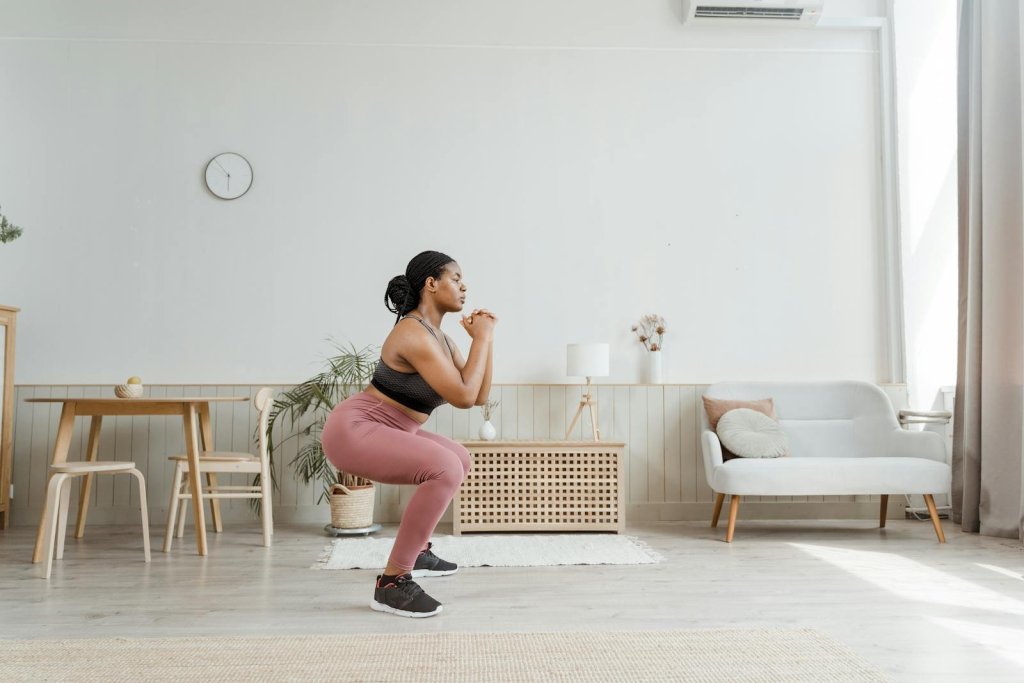
A smart lower-body plan at home does not need to be complicated. Focus on a few proven patterns, use controlled reps, and progress gradually. For older adults, the National Institute on Aging also highlights the value of combining muscle-strengthening work with balance activity, which makes lower-body training especially useful for long-term function.
Why lower body exercises at home are worth doing
Home-based leg training can help you build or maintain muscle strength, support daily movement, and improve balance. The CDC notes that muscle-strengthening activity can help people increase or maintain muscle mass and strength, perform daily activities, and help prevent falls. Mayo Clinic also notes that regular strength training can increase lean muscle mass, strengthen bone, and support body composition goals.
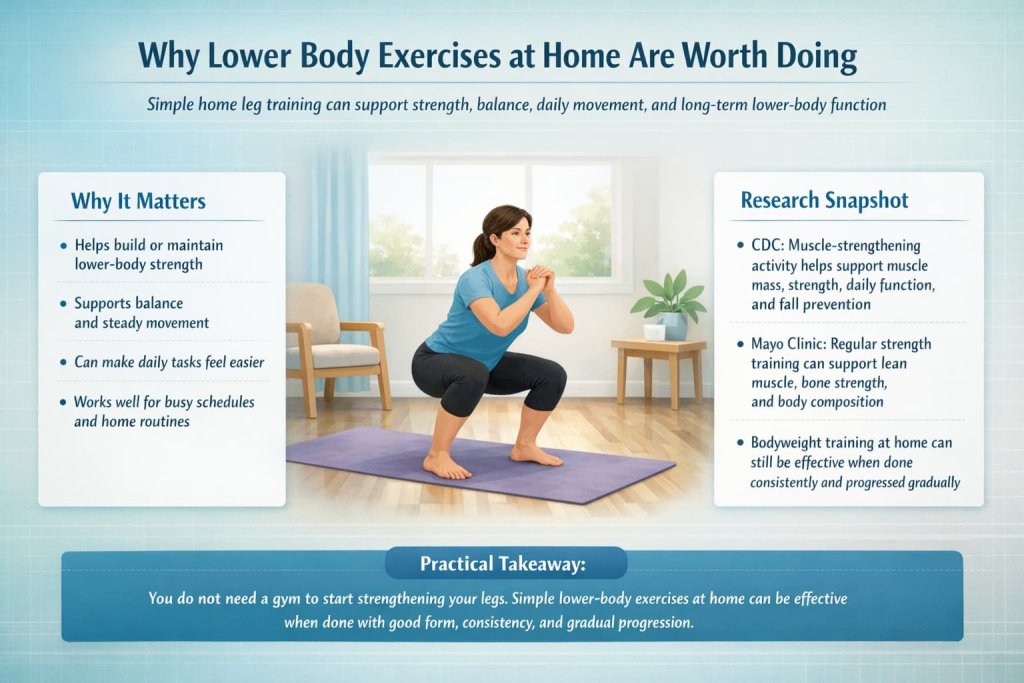
This also makes home workouts practical for people who are busy, new to exercise, or not ready for a gym membership. You can get meaningful results from bodyweight training alone when you stay consistent and make the exercises harder over time.
Before you start lower body exercises at home
Warm up first. The American Academy of Orthopaedic Surgeons recommends warming up with 5 to 10 minutes of low-impact activity before exercise, and it also notes that you should not feel pain during an exercise.
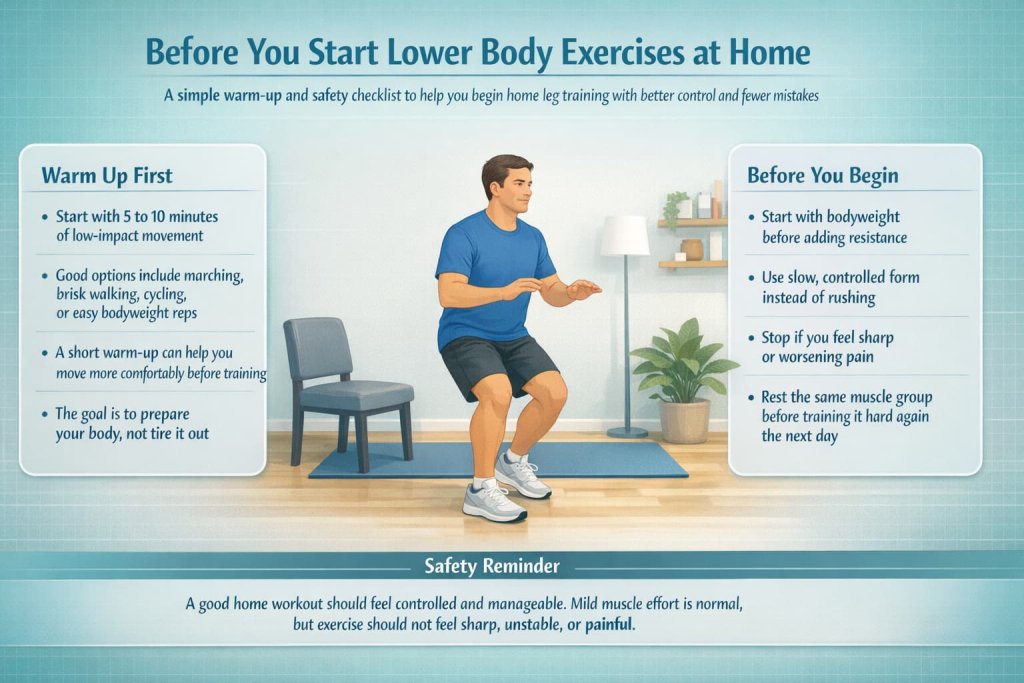
Use these quick rules before you begin:
- Warm up with marching, brisk walking, cycling, or easy bodyweight reps
- Start with bodyweight before adding resistance
- Use slow, controlled form instead of rushing
- Stop if you feel sharp or worsening pain
- Rest the same muscle group before training it hard again the next day
12 best lower body exercises at home
Build stronger legs and glutes with these simple lower body exercises at home, designed to improve strength, balance, and everyday movement. This list includes beginner-friendly moves that help tone your lower body without needing a gym or complicated equipment.
1. Bodyweight Squat
How to do it:
- Stand with feet about shoulder-width apart
- Brace your midsection and keep your chest tall
- Sit back and down as if lowering into a chair
- Lower as far as you can with control
- Press through your feet to stand back up
Why it works: The squat is one of the most practical lower body exercises at home because it trains the quads, glutes, and overall leg strength in one move. It also has strong carryover to sitting, standing, and stair use.
Muscles worked: Quadriceps, glutes, hamstrings, adductors, core.
Trainer Tip: Keep the movement smooth and controlled. If depth is limited, use a chair target behind you.
2. Reverse Lunge
How to do it:
- Stand tall with feet hip-width apart
- Step one leg back
- Lower until both knees bend comfortably
- Keep the front foot planted
- Push through the front foot to return to standing
- Switch sides
Why it works: Reverse lunges build single-leg strength and are often easier to control than forward lunges. They help train balance, hip stability, and leg strength with minimal space.
Muscles worked: Quadriceps, glutes, hamstrings, calves, core stabilizers.
Trainer Tip: Think “drop straight down” rather than leaning forward.
3. Glute Bridge
How to do it:
- Lie on your back with knees bent and feet flat
- Keep your feet about hip-width apart
- Brace your core gently
- Press through your heels and lift your hips
- Pause at the top
- Lower with control
Why it works: The glute bridge is a simple way to train hip extension at home. It is useful for glute strength and can be easier on the knees than some standing moves. ACE includes glute bridge variations in its hip and glute exercise library.
Muscles worked: Glutes, hamstrings, core.
Trainer Tip: Do not overarch your lower back at the top. Stop when your body forms a straight line from shoulders to knees.
4. Split Squat
How to do it:
- Stand in a staggered stance
- Keep most of your weight on the front leg
- Lower straight down with control
- Pause briefly near the bottom
- Push through the front foot to rise
- Complete reps, then switch sides
Why it works: The split squat lets you train the same pattern as a lunge without having to step in and out of each rep. That makes it a good option for beginners who need more balance support.
Muscles worked: Quadriceps, glutes, hamstrings, calves.
Trainer Tip: Use a wall or chair lightly for balance if needed.
5. Step-Up
How to do it:
- Stand in front of a sturdy step, stair, or low platform
- Place one foot fully on the step
- Press through that foot to stand up
- Step back down slowly
- Repeat all reps, then switch sides
Why it works: Step-ups build leg strength and control in a very practical pattern. Mayo Clinic includes step-up exercise demonstrations in its fitness basics resources.
Muscles worked: Quadriceps, glutes, hamstrings, calves.
Trainer Tip: Use a low step first. Avoid pushing hard off the trailing foot.
6. Wall Sit
How to do it:
- Stand with your back against a wall
- Slide down until your knees are comfortably bent
- Keep your feet flat and slightly in front of you
- Hold the position while breathing steadily
- Stand back up when the hold ends
Why it works: Wall sits create steady tension in the quads and help build lower-body endurance. They are simple to set up and easy to scale by changing the hold time.
Muscles worked: Quadriceps, glutes, calves.
Trainer Tip: Start with short holds, such as 15 to 30 seconds.
7. Romanian Deadlift With Household Weight
How to do it:
- Hold a backpack, water jug, or dumbbells in front of your thighs
- Stand tall with a soft bend in your knees
- Hinge at the hips and send them back
- Keep your back neutral as the weight lowers
- Stop when you feel tension in the hamstrings
- Drive your hips forward to stand tall
Why it works: This teaches the hip-hinge pattern and trains the back of the legs. It balances out squat-heavy routines by giving the hamstrings and glutes more direct work.
Muscles worked: Hamstrings, glutes, lower back, core.
Trainer Tip: Think “hips back” instead of “bend forward.”
8. Side Lunge
How to do it:
- Stand tall with feet together
- Step out to one side
- Sit into that hip while keeping the other leg straighter
- Push through the bent leg to return to start
- Repeat on the other side
Why it works: Side lunges train the frontal plane, which many basic home workouts miss. They can help improve lateral strength, hip control, and movement variety.
Muscles worked: Glutes, quadriceps, adductors, hamstrings.
Trainer Tip: Start with a small step until your mobility improves.
9. Single-Leg Glute Bridge
How to do it:
- Lie on your back with knees bent
- Lift one foot off the floor
- Press through the grounded heel
- Raise your hips with control
- Lower slowly
- Complete reps, then switch sides
Why it works: This variation increases the demand on one side at a time, which can expose side-to-side differences and build stronger glutes without needing heavy weights.
Muscles worked: Glutes, hamstrings, core stabilizers.
Trainer Tip: Keep your hips level instead of letting one side rotate.
10. Standing Hip Abduction
How to do it:
- Stand tall beside a wall or chair
- Shift your weight onto one leg
- Lift the other leg out to the side
- Pause briefly
- Return with control
- Complete reps, then switch sides
Why it works: Standing hip abduction helps target the side glutes, which support balance and pelvic stability. Mayo Clinic includes standing hip abduction with resistance tubing in its exercise library, and the NHS also includes a sideways leg lift in its strength exercise guidance.
Muscles worked: Gluteus medius, gluteus minimus, hip stabilizers.
Trainer Tip: Keep your torso still and avoid leaning to the side.
11. Calf Raise
How to do it:
- Stand near a wall or counter
- Rise onto the balls of your feet
- Pause briefly at the top
- Lower slowly back down
- Repeat for smooth reps
Why it works: Calf raises strengthen the lower legs and support walking, running, and stair climbing. They are also simple to progress by adding pauses or doing one leg at a time. The NHS includes calf raises among its basic strength exercises.
Muscles worked: Calves.
Trainer Tip: Lower slowly. The lowering phase matters just as much as the lift.
12. Hamstring Curl With Towel or Bands
How to do it:
- Lie on your back with heels on towels or sliders, or use a resistance band
- Lift your hips slightly
- Pull your heels toward you
- Pause briefly
- Extend the legs back out with control
- Repeat
Why it works: Hamstring curls give the back of the thighs direct work that many bodyweight-only routines miss. Mayo Clinic includes hamstring curl variations with resistance tubing in its exercise resources.
Muscles worked: Hamstrings, glutes, core.
Trainer Tip: Start with a small range of motion if the full version feels too difficult.
How often should you do lower body exercises at home?
For most people, 2 to 3 lower-body sessions per week is a practical starting point. That fits well with CDC guidance for at least 2 days of muscle-strengthening activity each week, and Mayo Clinic similarly recommends strength training for all major muscle groups at least two times per week.
A simple starting structure looks like this:
- 5 to 10 minute warm-up
- 4 to 6 exercises per workout
- 2 to 3 sets per exercise
- 8 to 15 reps for most movements
- 30 to 90 seconds of rest depending on difficulty
Mayo Clinic notes that one set can provide health and fitness benefits, and that the resistance should be challenging enough that muscles feel tired around 12 to 15 repetitions.
A simple lower body workout at home
Here is a practical beginner-friendly session:
- Bodyweight squat — 2 to 3 sets of 10 to 15
- Glute bridge — 2 to 3 sets of 10 to 15
- Reverse lunge — 2 sets of 8 to 10 per side
- Step-up — 2 sets of 8 to 10 per side
- Calf raise — 2 to 3 sets of 12 to 20
- Standing hip abduction — 2 sets of 10 to 15 per side
Do this routine 2 times per week to start. As it becomes easier, add a third round, increase reps, slow the lowering phase, or use household resistance like a backpack.
How to make lower body exercises at home harder
Progress gradually so your joints and technique can keep up.
Good options include:
- Add reps
- Add sets
- Slow the lowering phase
- Pause at the hardest point
- Use a backpack, dumbbells, or resistance bands
- Switch from two-leg to one-leg variations when appropriate
The CDC notes that slowly increasing the amount of weight and number of repetitions can provide even more benefits.
Common mistakes to avoid
Rushing through reps
Fast, sloppy reps usually reduce muscle tension and make technique worse. Controlled movement is usually the better choice for strength and joint comfort.
Picking only squat-style exercises
A good lower-body routine should not be all squats. Include glute bridges or hinges for the back of the legs, plus calf and side-hip work for a more balanced plan.
Ignoring pain signals
Muscle effort is normal. Sharp pain is not. The American Academy of Orthopaedic Surgeons advises that exercise should not cause pain and that painful movements should be discussed with a doctor or physical therapist.
Making every session too hard
Consistency matters more than crushing one workout. Start with a level you can recover from and repeat.
Who should be careful with lower body exercises at home?
Most healthy adults can do these movements with appropriate modifications. Still, it is smart to get individualized guidance first if you have:
- A recent surgery
- A recent fall or major balance problem
- Significant hip, knee, ankle, or back pain
- Numbness, tingling, or pain that travels down a leg
- Trouble standing, stepping, or getting on and off the floor safely
Older adults may especially benefit from pairing strength work with balance training, according to the National Institute on Aging and CDC guidance.
FAQ about lower body exercises at home
Can lower body exercises at home really build strength?
Yes. Home exercises can build strength when they challenge the muscles enough and get harder over time. Bodyweight moves, slower tempo, one-leg variations, and household resistance can all increase difficulty.
What is the best lower body exercise at home for beginners?
The bodyweight squat and glute bridge are usually among the best starting points because they are simple, effective, and easy to modify.
How many lower body exercises should I do in one workout?
Most people do well with 4 to 6 exercises in a session. That is enough to cover squats, lunges, hip hinges, glutes, calves, and hip stability without making the workout overly long.
Do I need weights for lower body exercises at home?
No. Weights can help later, but they are not required to start. Bodyweight, tempo changes, pauses, and single-leg variations can still make a workout effective.
How long does it take to notice results?
That varies by training history, effort, recovery, and nutrition. Many people notice improved control and endurance within a few weeks, while visible muscle changes usually take longer and depend on consistency.
Are lower body exercises at home good for older adults?
They can be, especially when chosen carefully and matched to the person’s balance, mobility, and strength level. CDC and the National Institute on Aging both support strength and balance activity for older adults.
Can I do lower body exercises at home every day?
You can move every day, but hard lower-body strength sessions usually need recovery time. Many people do better with 2 to 3 focused lower-body sessions per week rather than intense daily leg workouts.
Conclusion
Lower body exercises at home can be simple, effective, and realistic for almost any schedule. Start with proven basics like squats, lunges, glute bridges, step-ups, calf raises, and hip-stability work. Build gradually, keep your form clean, and stay consistent. That is usually what leads to stronger legs, better function, and a more toned lower body over time.