
Cable face pulls are a simple upper-body exercise that may help you build stronger rear delts, a more resilient upper back, and better shoulder control. They are especially useful because they train pulling, scapular retraction, and shoulder external rotation in one movement pattern. Learning cable face pulls matters because many workout plans overemphasize pressing and front-side muscles, while the upper back and rear shoulder often need more attention for balanced training.

Done well, this exercise can support shoulder function, posture-focused training, and better movement quality as part of a broader program, not as a standalone fix. Guidance from NASM and ACE reflects that role in upper-back programming.
What Are Cable Face Pulls?
Cable face pulls are a pulling exercise usually done with a rope attachment on a cable machine set around face height. You pull the rope toward your face while allowing the elbows to move out and back. At the same time, your shoulder blades retract and your shoulders move into external rotation. NASM describes the finish position with the hands near the ears, while ACE includes the cable face-pull in its mid-back exercise list.
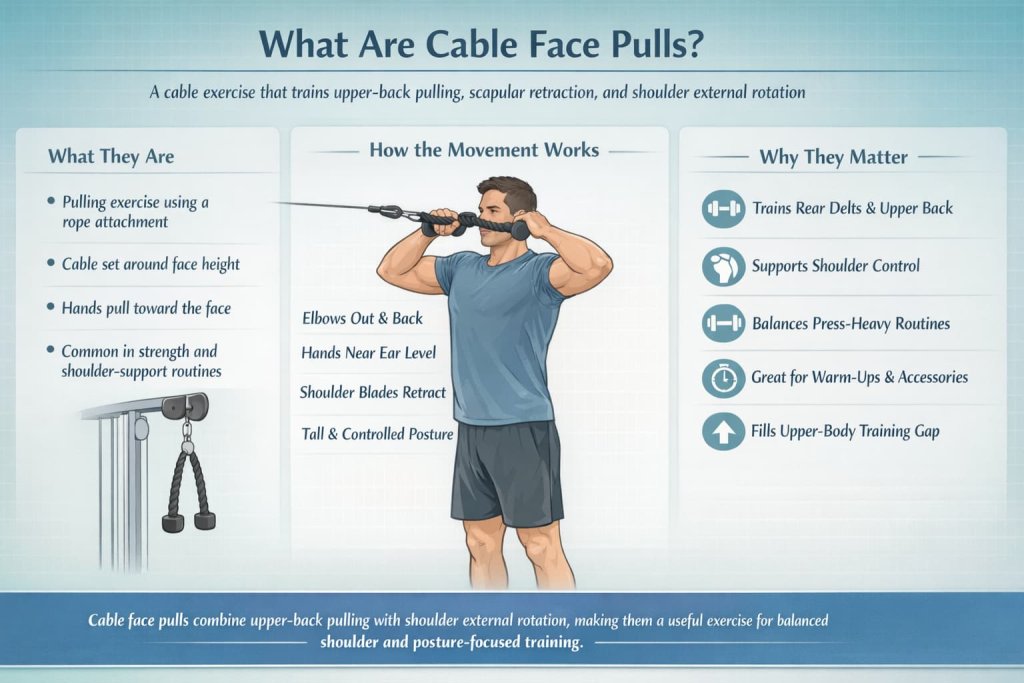
That movement combination is a big reason cable face pulls are popular in strength programs, warm-ups, and shoulder-support routines. They do not replace all rowing or rotator cuff work, but they can fill an important gap that many lifters miss. A classic EMG study published in the Journal of Orthopaedic & Sports Physical Therapy found that common shoulder external-rotation exercise patterns meaningfully recruit muscles involved in shoulder control, including the infraspinatus and posterior deltoid.
How to Do Cable Face Pulls Correctly
Set the cable pulley about face height and attach a rope handle. Then use a controlled, repeatable setup.
- Stand facing the cable machine
- Grab the rope with a neutral grip
- Step back until there is light tension on the cable
- Set your feet about hip- to shoulder-width apart, or use a light staggered stance
- Brace your core and keep your head neutral
- Pull the rope toward your face
- Let your elbows travel out to the sides
- Finish with your hands near your ears and your shoulder blades pulled back
- Pause briefly without shrugging
- Return slowly to the starting position
NASM’s coaching notes for face pulls include a staggered stance, neutral head position, and a controlled rep tempo, typically for 10 to 20 repetitions over 1 to 3 sets in general corrective-style programming.
Cable Face Pulls Muscles Worked
Cable face pulls mainly train the muscles that help control the upper back, shoulder blades, and rear shoulder. In practice, the exercise commonly emphasizes:
- Rear deltoids
- Rhomboids
- Middle trapezius
- Lower trapezius
- External rotators of the shoulder, especially the infraspinatus and teres minor
- Supporting upper-back and scapular stabilizing muscles
This is why cable face pulls are often described as both a rear-delt exercise and an upper-back exercise. ACE classifies the cable face-pull as a mid-back movement, while the shoulder external-rotation research helps explain why it also fits well in shoulder-stability training.
Why Cable Face Pulls Work So Well
Cable face pulls work well because the cable gives you consistent tension through the rep, and the rope allows a more natural finish than many fixed-handle options. The exercise also trains a movement pattern that is often undertrained in people who do a lot of pressing, typing, or forward-shoulder activities.
The bigger benefit is not just “pulling.” It is the combination of upper-back engagement and shoulder external rotation. That makes cable face pulls especially useful for people who want more balanced shoulder training. The JOSPT EMG paper supports the value of external-rotation-based exercise patterns for recruiting the muscles that help stabilize the shoulder complex.
Do Cable Face Pulls Help With Posture?
Cable face pulls may help support better posture, but they should not be sold as a posture cure by themselves. A 2024 meta-analysis in BMC Musculoskeletal Disorders found that therapeutic exercise was effective overall for improving forward head posture, rounded shoulders, and thoracic kyphosis measures. That supports exercise-based posture improvement in general, but it does not prove that cable face pulls alone fix posture.
The more accurate takeaway is this: cable face pulls can be a useful part of a posture-focused strength plan because they strengthen muscles that oppose constant forward-rounded positioning. Still, lasting posture change usually depends on a broader mix of training, movement habits, workstation setup, and total weekly activity. NASM also notes that upper-back weakness and rounded positioning are usually part of a bigger movement picture, not one isolated problem.
Benefits of Cable Face Pulls
Stronger rear delts and upper back
This exercise gives direct work to muscles that many people neglect. That can improve upper-body balance if your routine already includes bench pressing, push-ups, or shoulder pressing. ACE’s classification of the cable face-pull as a mid-back exercise supports its role here.
Better shoulder control
Because the exercise includes external rotation and scapular retraction, it can support better shoulder mechanics during training. That does not make it medical treatment, but it does make it a smart option in many general fitness programs. The JOSPT external-rotation study supports this training logic.
Useful for balanced programming
Many lifters do far more pressing than pulling. Cable face pulls are an easy way to add volume for the upper back and rear shoulder without needing heavy loads. NASM specifically includes face pulls among upper-back corrective exercises.
Joint-friendly for many people
Compared with some heavier pulling options, cable face pulls are usually easier to scale. You can lighten the load, adjust the pulley height, and focus on clean reps. That makes them accessible for beginners, general gym-goers, and many people doing shoulder-friendly accessory work. This is a practical training inference based on how NASM presents the exercise setup and rep range.
Common Cable Face Pull Mistakes
Pulling too low
If you turn the movement into a row toward the chest, you lose part of the intended shoulder external-rotation pattern. The line of pull should stay around face level for a true cable face pull.
Going too heavy
Heavy weight often causes shrugging, momentum, or a rushed finish. Cable face pulls usually work better with moderate or light loading and strong control.
Letting the low back take over
Do not lean back hard or flare the ribs to finish the rep. Keep the torso steady and the movement focused on the shoulders and upper back.
Losing the finish position
A good rep ends with the elbows out, the rope split, and the hands near ear level. If the elbows drop too much, the exercise becomes a different pattern.
Turning it into a neck exercise
Your neck should stay neutral. Do not crane your head forward to meet the rope.
Best Rep Range for Cable Face Pulls
For most people, cable face pulls fit best as an accessory exercise rather than a max-strength lift. A practical range is:
- 2 to 4 sets
- 10 to 20 reps
- Controlled tempo
- Light to moderate load
- 1 to 3 times per week depending on the rest of your program
That lines up well with NASM’s example programming of 10 to 20 repetitions for 1 to 3 sets. In real-world training, many lifters use them near the end of an upper-body session, during a warm-up, or between heavier compound sets.
Cable Face Pulls vs Rear Delt Flys
Both exercises can train the rear shoulder, but they are not identical.
- Cable face pulls usually give you more emphasis on scapular retraction plus shoulder external rotation.
- Rear delt flys usually isolate horizontal abduction more directly and often involve less external-rotation focus.
If your goal is shoulder-friendly upper-back work and better movement balance, cable face pulls are often the better all-around choice. If your goal is specifically to bias the rear delts, rear delt flys can still be useful. Many strong programs use both.
Who Should Do Cable Face Pulls?
Cable face pulls can be a smart option for:
- Lifters who do a lot of bench pressing or shoulder pressing
- People who want more rear-delt and upper-back work
- Gym-goers trying to build a more balanced upper body
- Beginners learning controlled pulling mechanics
- Anyone who wants a joint-friendly accessory exercise for shoulders and posture support
Because the exercise is easy to lighten and adjust, it fits many experience levels when technique is kept clean.
Who Should Be Careful With Cable Face Pulls?
Use extra caution if you have:
- A current shoulder injury
- Sharp pain with pulling or external rotation
- Recent surgery involving the shoulder, neck, or upper back
- Symptoms like numbness, tingling, or instability
In those cases, it is better to get individualized guidance from a qualified clinician or rehab professional. Cable face pulls may be useful in some settings, but they are not a one-size-fits-all solution.
Simple Form Cues That Make Cable Face Pulls Better
These cues usually help immediately:
- Pull the rope to your face, not your chest
- Keep your elbows high but not shrugged
- Split the rope as you finish
- Keep your ribs down
- Move slowly on the way back
- Think “upper back and rear shoulders,” not “lower back lean”
These cues match the technique pattern described by NASM and the intended external-rotation emphasis supported by the shoulder exercise literature.
Sample Ways to Add Cable Face Pulls to Your Workout
Upper-body day
Do cable face pulls after your main pressing and rowing work for 2 to 4 sets of 12 to 15 reps.
Shoulder-focused day
Use them as a lighter accessory for 3 sets of 15 to 20 reps with strict form.
Warm-up option
Use 1 to 2 light sets before upper-body training to help groove upper-back engagement and shoulder control.
Posture-support accessory
Pair cable face pulls with rows, thoracic mobility work, and overall pulling volume rather than depending on them alone for posture change.
Are Cable Face Pulls Enough for Shoulder Health?
Not by themselves. They can be valuable, but shoulder health usually depends on a full training picture that includes sensible load management, balanced push-pull volume, range of motion, exercise variety, and technique quality. Posture and shoulder comfort also depend on non-gym factors such as work setup and daily movement habits.
The research on exercise and posture supports the idea that exercise can help, but it points toward broader therapeutic exercise approaches rather than one magic drill. That is why cable face pulls are best viewed as one strong tool inside a balanced plan.
FAQs About Cable Face Pulls
Are cable face pulls good for shoulders?
Yes, they can be very useful for general shoulder training because they strengthen the rear shoulder and upper back while reinforcing external rotation and scapular control. They are best used as part of a balanced program, not as a standalone fix.
Do cable face pulls work rear delts?
Yes. Rear delts are one of the main muscles involved, especially when you keep the cable at face height and finish with the elbows out and the rope split.
Are cable face pulls a back exercise or a shoulder exercise?
They are both, but many coaches treat them as a hybrid accessory. ACE lists the cable face-pull as a mid-back movement, while the exercise also trains the rear delts and shoulder external rotators.
How heavy should cable face pulls be?
Usually lighter than you think. Most people get better results with strict control, a full finish position, and moderate to higher reps rather than trying to go heavy.
Can cable face pulls fix rounded shoulders?
Not on their own. They may help support stronger upper-back muscles and better movement habits, but posture changes usually come from a broader exercise and lifestyle approach. The 2024 posture meta-analysis supports exercise overall, not one single exercise as a cure.
Should I do cable face pulls before or after workouts?
Either can work. Light sets can fit into a warm-up, while most people use them after heavier exercises as accessory work.
Are cable face pulls better than rows?
Not better across the board. Rows are generally better for broader back strength and loading potential, while cable face pulls are more specific for rear-delt, upper-back, and shoulder-control work. They complement each other well.
Conclusion
Cable face pulls deserve a place in many workout routines because they are simple, scalable, and effective for building the rear delts, upper back, and shoulder control that many people need more of. They may also support better posture when included in a broader training plan, but they should not be oversold as a cure-all. Focus on clean setup, controlled reps, and moderate loading, and cable face pulls can become one of the most useful accessory movements in your upper-body program.
References
- Yuksel E, Yesilyaprak SS, Celik D. Scapular Stabilization Exercise Training Improves Treatment Effectiveness on Shoulder Pain, Scapular Dyskinesis, Muscle Strength, and Function in Patients With Subacromial Pain Syndrome: A Meta-Analysis of Randomized Controlled Trials
- Saito H, Harrold ME, Cavalheri V, McKenna L. Scapular Focused Interventions to Improve Shoulder Pain and Function in Adults With Subacromial Pain: A Systematic Review and Meta-Analysis
- Ravichandran H, Janakiraman B, Sundaram S, et al. Effect of Scapular Stabilization Exercise Program in Patients With Subacromial Impingement Syndrome: A Systematic Review
- Başkurt Z, Başkurt F, Gelecek N, Özkan MH. The Effectiveness of Scapular Stabilization Exercise in the Patients With Subacromial Impingement Syndrome
- Sheikhhoseini R, Shahrbanian S, Sayyadi P, O’Sullivan K. Effectiveness of Therapeutic Exercise on Forward Head Posture: A Systematic Review and Meta-Analysis
- Gu Q, Li Y, Wang C, et al. Effect of Scapular Posterior Tilting Exercise on Rounded Shoulder Posture