
Lateral pelvic tilt exercises may help improve hip stability, pelvic control, and side-to-side movement balance, especially when the routine focuses on the glutes, hip abductors, and core. For most readers, the goal is not to “perfectly straighten” the pelvis overnight. It is to build better strength and control so everyday movement feels steadier and more comfortable.
Understanding this matters because lateral pelvic tilt is usually discussed in rehab and research as pelvic obliquity or frontal-plane pelvic asymmetry. It can show up for different reasons, including hip muscle weakness, movement habits, spinal asymmetry, hip contracture, or actual or apparent leg-length difference. That is why the best exercise plan is a supportive, strength-based program, not a one-size-fits-all “quick fix.” Research and rehab sources, including a review published by Symmetry, consistently point to hip abductor strength, gluteal control, trunk stability, and gradual loading as the most useful exercise themes.
What is lateral pelvic tilt?
Lateral pelvic tilt means one side of the pelvis sits higher than the other in the frontal plane.
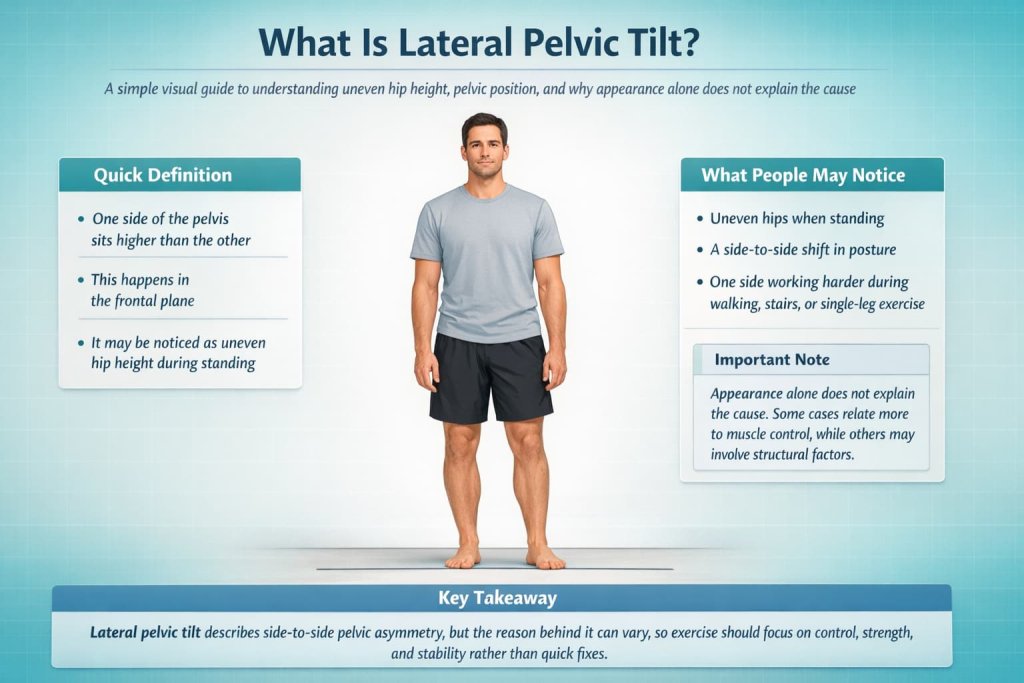
In practice, people may notice uneven hips, a shift during standing, or a feeling that one side works harder during walking, stairs, or single-leg exercise. But appearance alone does not tell you the cause. Some cases relate more to muscle control, while others may involve structural issues that exercise alone will not fully change, as discussed in that same Symmetry review.
Why these lateral pelvic tilt exercises can help
The strongest exercise logic for lateral pelvic tilt exercises is simple: the hip abductors, especially the gluteus medius, help stabilize the pelvis during weight-bearing. ACE Fitness notes that the gluteus medius helps with hip abduction and stabilization of the hip and pelvis during standing and other weight-bearing activity. A 2025 rehab review also notes that exercise programs often progress from low-load activation work such as side-lying raises and clamshells to more functional weight-bearing drills such as band walks and single-leg work.
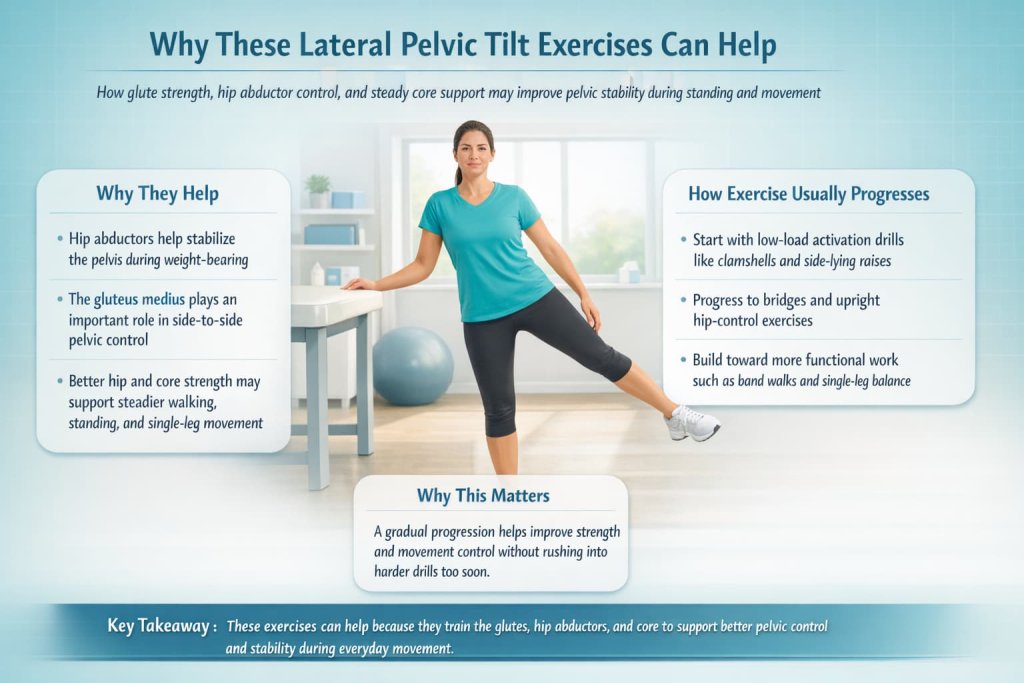
That broader rehab approach also matches the AAOS Hip Conditioning Program, which emphasizes strengthening the muscles that support the hip to help keep the joint stable, and it fits the Mayo Clinic core-strength guide, which uses the bridge to train multiple core muscles while keeping the hips controlled.
Before you start lateral pelvic tilt exercises
Start with control, not fatigue. These exercises should feel deliberate and steady. General hip-exercise guidance from NHS inform says movement and strengthening work should be added gradually, pain should stay in a manageable range, and exercise should not make your symptoms worse overall the next day.
Use these rules before your first set:
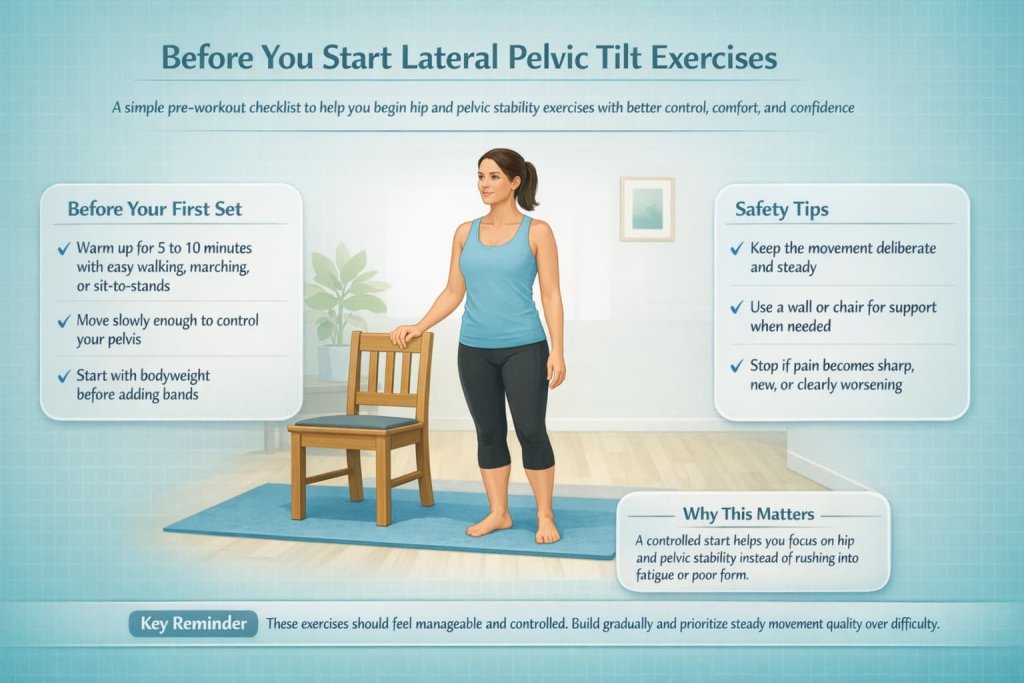
- Warm up for 5 to 10 minutes with easy walking, marching, or sit-to-stands
- Move slowly enough to control your pelvis
- Stop if pain becomes sharp, new, or clearly worsening
- Use a wall or chair for support when needed
- Start with bodyweight before adding bands
6 Best Lateral Pelvic Tilt Exercises
Improve hip alignment, glute strength, and pelvic stability with these simple lateral pelvic tilt exercises. These beginner-friendly moves may help support better balance, posture, and everyday movement control.
1. Clamshell
Why it works: The clamshell is one of the most common early-stage lateral pelvic tilt exercises because it targets the gluteus medius with a low-load setup. ACE Fitness specifically includes the clamshell as a glute medius exercise, and newer rehab review literature still places clamshells among useful early activation options before harder weight-bearing drills.
Muscles worked: Gluteus medius, gluteus minimus, deep hip stabilizers.
How to do it:
- Lie on your side with knees bent and feet stacked
- Keep your hips stacked directly on top of each other
- Brace your midsection gently so your trunk does not roll backward
- Lift the top knee while keeping your feet together
- Pause briefly at the top
- Lower slowly with control
- Repeat, then switch sides
Trainer Tip: Keep the movement small. If your pelvis rolls backward, the exercise becomes less about hip control and more about compensation.
2. Side-Lying Hip Abduction
Why it works: This is one of the best direct strengthening drills for the hip abductors. ACE Fitness notes that side-lying hip abduction works best when the hips stay stacked and the lift stays controlled rather than exaggerated. It also fits the graded rehab model described in the 2025 review, which highlights side-lying raises as an effective low-load starting point.
Muscles worked: Gluteus medius, gluteus minimus, lateral hip stabilizers.
How to do it:
- Lie on your side with the bottom knee bent for support
- Straighten the top leg
- Stack your hips and shoulders
- Point the top toes mostly forward rather than up
- Lift the top leg only as high as you can without rolling the pelvis
- Pause briefly
- Lower slowly and repeat
- Switch sides
Trainer Tip: Higher is not better. A smaller lift with stacked hips usually trains the target muscles better than a big swing.
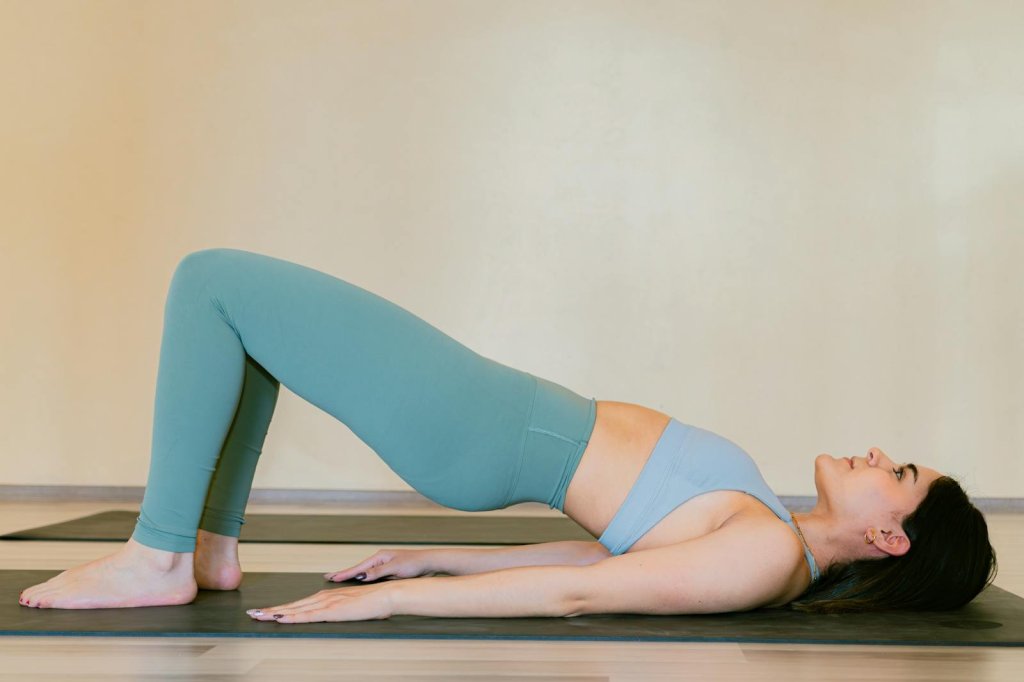
3. Glute Bridge
Why it works: The bridge helps train the hips and trunk together. Mayo Clinic recommends the bridge as a core-strengthening move and cues people to keep the back neutral and avoid tilting the hips during the rep. That makes it useful when you want pelvic control, not just glute effort. NHS inform also includes a basic hip-lift variation in its hip-problem exercise guidance.
Muscles worked: Gluteus maximus, hamstrings, deep core, posterior chain stabilizers.
How to do it:
- Lie on your back with knees bent and feet flat
- Keep your feet about hip-width apart
- Tighten your abdominal muscles gently
- Press through your feet and raise your hips until they line up with your knees and shoulders
- Pause briefly without over-arching your back
- Lower slowly to the floor
- Repeat with smooth control
Trainer Tip: Think about keeping both sides of the pelvis level as you lift. Do not twist toward your stronger side.
4. Standing Hip Abduction
Why it works: Standing hip abduction begins to bridge the gap between floor-based activation and functional standing control. NHS inform includes a standing sideways leg raise with chair or wall support, and this type of drill is practical because it trains the side hip while you manage posture in an upright position.
Muscles worked: Gluteus medius, gluteus minimus, stance-leg hip stabilizers, core.
How to do it:
- Stand tall next to a wall or chair for support
- Shift your weight onto one leg
- Keep the working leg straight
- Lift that leg out to the side without leaning your torso
- Pause briefly
- Lower with control
- Complete all reps, then switch sides
Trainer Tip: Try not to “hike” your hip. The leg should move out from the hip joint while your torso stays quiet.
5. Lateral Band Walk
Why it works: Lateral band walks are a strong next step once you can control easier drills. ACE Fitness includes lateral band walks for glute medius strength and pelvic stability, and the 2025 review specifically identifies band walks as useful functional hip abductor training after early activation work.
Muscles worked: Gluteus medius, gluteus maximus, hip external rotators, core stabilizers.
How to do it:
- Place a mini band above your knees or around your ankles
- Stand with feet hip-width apart
- Bend slightly into a quarter squat
- Keep tension on the band
- Step sideways slowly without letting your knees collapse inward
- Bring the trailing foot in without losing band tension
- Take several steps one way, then return
Trainer Tip: Keep the steps short and controlled. If the band pulls you into wobbling, use a lighter band.
6. Single-Leg Balance With Pelvic Control
Why it works: Lateral pelvic tilt often becomes more noticeable during single-leg stance, so a balance drill makes sense once basic strength is improving. ACE Fitness includes standing pelvic-stability drills such as the isometric single-leg wall lean and triplanar toe-tap patterns, which train the standing leg to stabilize the pelvis.
Muscles worked: Gluteus medius, gluteus maximus, foot and ankle stabilizers, trunk stabilizers.
How to do it:
- Stand near a wall or chair
- Shift onto one leg
- Keep your pelvis as level as you can
- Hold the position for 10 to 20 seconds
- Breathe normally and avoid gripping with the shoulders
- Return to both feet
- Repeat on the other side
- Progress later by adding light toe taps in front, to the side, and behind
Trainer Tip: This is about steadiness, not showing off balance. Use fingertip support if your hips start drifting.
Sample beginner routine for lateral pelvic tilt exercises
A simple starting plan is 2 to 3 sessions per week:
Day plan
- Clamshell: 2 sets of 8 to 12 per side
- Side-lying hip abduction: 2 sets of 8 to 12 per side
- Glute bridge: 2 sets of 8 to 12
- Standing hip abduction: 2 sets of 8 to 10 per side
- Lateral band walk: 1 to 2 rounds of 6 to 10 steps each way
- Single-leg balance: 2 holds of 10 to 20 seconds per side
This gradual approach fits NHS inform guidance, which suggests building volume slowly, starting with small amounts, and progressing as tolerated toward sets of higher reps.
How long does it take to notice improvement?
Most people should think in terms of weeks of consistent practice, not days. Early improvements are often better balance, cleaner single-leg control, and less side-to-side shifting during walking or exercise. Visible alignment changes can be slower and may be limited if the reason for the tilt is structural rather than mainly muscular. Research on pelvic asymmetry and pelvic obliquity, including the review in Symmetry, supports that this is a complex topic, so realistic expectations matter.
Common mistakes to avoid
Going too hard too soon
Jumping straight to heavy bands or advanced single-leg work often leads to leaning, hip hiking, or trunk compensation instead of cleaner pelvic control. Rehab literature supports moving from lower-load activation to harder functional exercises over time.
Chasing range instead of control
With side-lying and standing abduction, the goal is not the highest leg lift. ACE Fitness specifically notes that overdoing the lift can shift the work away from the gluteus medius.
Ignoring symptoms that keep getting worse
NHS inform advises stopping if exercise causes worsening symptoms or new pain, and recommends speaking with a healthcare professional if symptoms are not improving.
When to get medical or rehab guidance
Get professional guidance before relying on lateral pelvic tilt exercises alone if you have any of these:
- A noticeable leg-length difference or you suspect one
- Significant scoliosis or a history of hip surgery
- Ongoing hip, groin, or back pain
- Numbness, weakness, or walking difficulty
- Symptoms that keep getting worse despite a few weeks of careful exercise
This is important because pelvic obliquity can sometimes be linked with structural or compensatory issues, not only deconditioning, as discussed in research available through PubMed Central.
FAQs About Lateral Pelvic Tilt Exercises
Can exercises really fix lateral pelvic tilt?
Exercises may help improve muscle balance, pelvic control, and movement quality. They do not guarantee a full correction in every case, especially when the tilt is driven by structural factors rather than mainly strength or control deficits.
What muscles should I focus on most?
The main priorities are usually the gluteus medius, gluteus minimus, gluteus maximus, and core stabilizers. These muscles help control the pelvis during standing and walking, which is why ACE Fitness emphasizes glute medius strength and stability work.
Are stretches enough for lateral pelvic tilt?
Usually not on their own. Stretching may feel helpful in some cases, but most exercise-based guidance for pelvic control emphasizes strength, stability, and progressive loading rather than stretching alone.
How often should I do these exercises?
A good starting point is 2 to 3 times per week, with easier balance or activation work sometimes practiced more often if it does not aggravate symptoms. NHS inform recommends building gradually and adjusting volume based on how you respond.
Which exercise is best for beginners?
Clamshells, side-lying hip abduction, and glute bridges are usually the easiest places to start because they let you learn pelvic control before moving into harder standing patterns, which also aligns with the progressions described by ACE Fitness.
Should I do both sides equally?
Usually yes, but the weaker or less stable side may need extra attention. In practice, many rehab programs start with symmetrical training and then make small adjustments based on control and tolerance.
Conclusion
The best lateral pelvic tilt exercises are usually the ones that build glute strength, hip abductor control, and steady single-leg stability without forcing the body into awkward positions. Start with clamshells, side-lying hip abduction, and bridges, then progress to standing hip abduction, band walks, and single-leg balance as your control improves.
A consistent, gradual plan is usually more useful than chasing a dramatic “pelvis correction” promise. If the issue seems persistent, painful, or clearly uneven in a way that affects walking or standing, get an assessment from a qualified clinician.
This content is for informational purposes only and not medical advice.
References
- Macadam P, Cronin J, Contreras B. An Examination of the Gluteal Muscle Activity Associated With Dynamic Hip Abduction and Hip External Rotation Exercise: A Systematic Review. International Journal of Sports Physical Therapy. 2015.
- Moore D, Reiman MP, Mather RC 3rd, et al. A Systematic Review and Meta-Analysis of Common Therapeutic Exercises That Generate Highest Muscle Activity in the Gluteus Medius and Gluteus Minimus Segments. International Journal of Sports Physical Therapy. 2020.
- Jung KS, In TS, Cho HY. Effects of Pelvic Stabilization Training with Lateral and Posterior Tilt Taping on Pelvic Inclination, Muscle Strength, and Gait Function in Patients with Stroke: A Randomized Controlled Study. Evidence-Based Complementary and Alternative Medicine. 2022.
- González-de-la-Flor Á, et al. Optimizing Hip Abductor Strengthening for Lower Extremity Rehabilitation: A Narrative Review. Journal of Clinical Medicine. 2025.
- Ludwig O, Kelm J, Hammes A, Schmitt E. Muscular Strategies for Correcting the Pelvic Position to Improve Posture and Comfort in Sitting. Life. 2024.