
A body temperature chart by age is not one fixed number for everyone. Babies and young children usually run a little warmer, adults average slightly cooler, and seniors often have a slightly lower baseline temperature. Most fevers are still judged around 100.4°F (38°C), but the meaning of a reading also depends on age and how the temperature was taken. According to Mayo Clinic, average temperatures vary slightly by age, while the Centers for Disease Control and Prevention uses 100.4°F (38°C) as a standard measured fever threshold in public-health guidance.
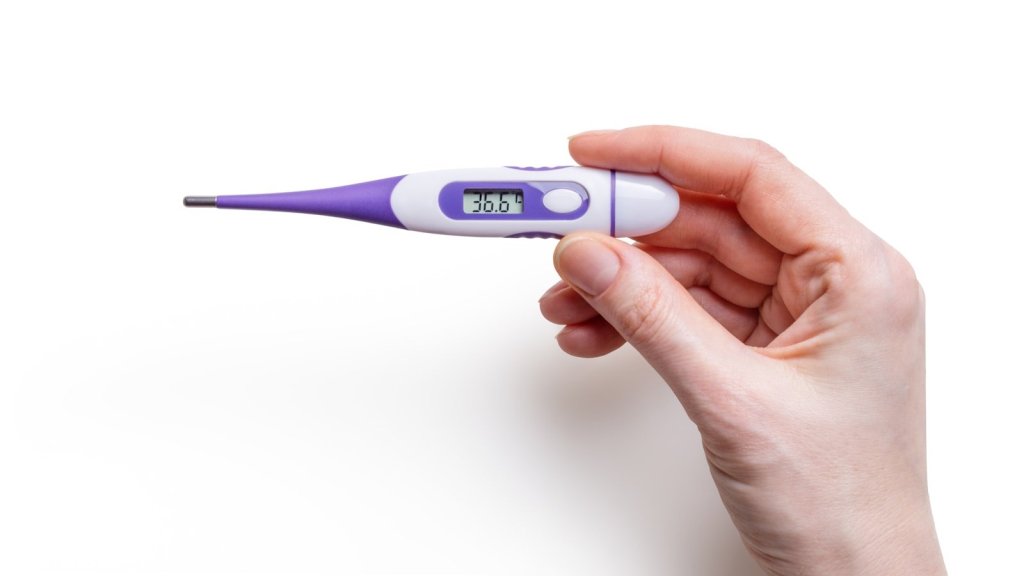
Understanding this matters because a “normal” reading for one person may look unusual in another, and because fever cutoffs are more urgent in babies under 3 months and can be easier to miss in older adults. The most useful way to read a body temperature chart by age is to combine age, thermometer method, and symptoms, not just one number alone.
Body Temperature Chart by Age
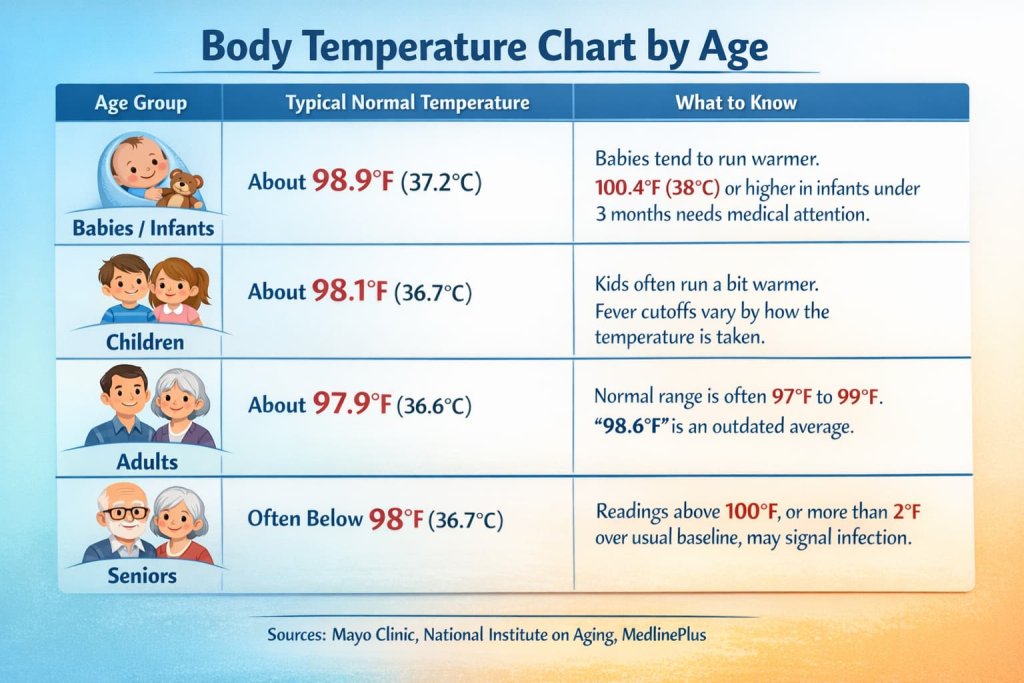
| Age group | Typical normal body temperature | What to know |
|---|---|---|
| Babies / infants | About 98.9°F (37.2°C) on average | Babies tend to run warmer than older groups. A rectal temperature of 100.4°F (38°C) or higher in a baby under 3 months needs prompt medical attention. |
| Children | About 98.1°F (36.7°C) on average | Children often run a bit warmer than adults. Fever cutoffs depend on how the temperature was taken. |
| Adults | About 97.9°F (36.6°C) on average | The old “98.6°F” rule is too simple. A typical normal range is often around 97°F to 99°F. |
| Seniors | Often slightly lower than younger adults | A single reading above 100°F, repeated readings above 99°F, or a rise of more than 2°F above usual baseline may signal infection. |
These age averages come from Mayo Clinic, while senior guidance comes from the National Institute on Aging. MedlinePlus also notes that a broad normal range of about 97°F to 99°F is common.
Why Normal Body Temperature Changes by Age
The body does not stay at one exact temperature all day. MedlinePlus explains that temperature varies by person, age, activity, and time of day, and is usually lowest in the early morning. Mayo Clinic also notes that temperatures tend to run higher later in the afternoon and that people assigned female at birth may run slightly warmer on average.
That is why a body temperature chart by age should be used as a guide, not as a diagnosis. A child with 99.5°F by one method may be fine, while an older adult whose temperature rises only slightly above their usual baseline may still be getting sick.
Fever Chart by Thermometer Method
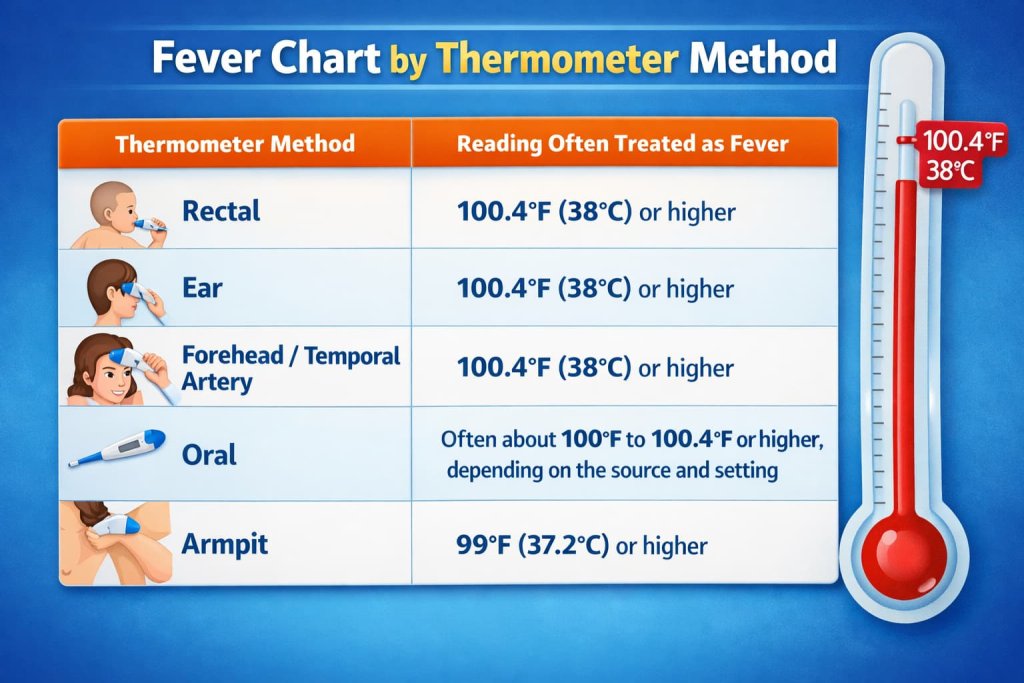
A temperature reading makes more sense when you know where it was taken. Different methods do not give identical numbers. Mayo Clinic and MedlinePlus both note that the method affects the result, and MedlinePlus explains that the exact relationship is not perfectly precise.
| Thermometer method | Reading often treated as fever |
|---|---|
| Rectal | 100.4°F (38°C) or higher |
| Ear | 100.4°F (38°C) or higher |
| Forehead / temporal artery | 100.4°F (38°C) or higher |
| Oral | Often about 100°F to 100.4°F or higher, depending on the source and setting |
| Armpit | 99°F (37.2°C) or higher |
For children, Mayo Clinic flags fever at 100.4°F for rectal, ear, and temporal readings, 100°F for oral readings, and 99°F for armpit readings. CDC guidance uses 100.4°F as a standard measured fever threshold more broadly. MedlinePlus adds that rectal and ear readings are usually a bit higher than oral, while armpit and forehead readings are usually a bit lower.
How to Get the Most Accurate Reading
Before comparing numbers, make sure the reading was taken correctly. Wait at least 15 minutes after eating or drinking before taking an oral temperature. Ear thermometers can also read less accurately right after coming in from very hot or very cold weather, and armpit readings are usually the least accurate. For the clearest comparison, take the temperature the same way each time and tell your clinician both the number and the method used.
Best Way to Take Temperature by Age
Using the right thermometer method helps make the chart more accurate. According to HealthyChildren, which reflects American Academy of Pediatrics guidance, rectal temperature gives the best reading for infants under 3 months.
| Age | Best or common choices |
|---|---|
| Under 3 months | Rectal is the best reading for fever concerns; forehead devices may be used depending on the device and clinician guidance |
| 3 to 6 months | Rectal, armpit, or forehead |
| 6 or 7 months to 3 years | Rectal, ear, or forehead; armpit can be used as a quick screening method |
| 4 years and older | Oral, ear, or forehead |
| 65 years and older | Mouth or ear is preferred; Mayo Clinic advises against relying on forehead thermometers in this age group |
It also helps to avoid methods that look convenient but are less dependable. Temperature-sensitive forehead strips are not reliable, and mercury glass thermometers are no longer recommended because mercury is poisonous if the thermometer breaks. A digital thermometer is the safest everyday choice for home use.
HealthyChildren says ear thermometers are for children 6 months and older, oral readings are usually practical around age 4 and up, and rectal readings remain the most accurate for young infants. Mayo Clinic also recommends comparing readings taken the same way each time instead of trying to convert one method exactly into another.
What Is a Normal Temperature for Babies and Children?
Babies and children often run a little warmer than adults, which is why a number that looks “high normal” for an adult may still be normal for a child. Even so, the most important pediatric rule is simple: a baby younger than 3 months with a rectal temperature of 100.4°F (38°C) or higher needs medical attention right away.
One more point matters for newborns and young infants: a low temperature can also be a warning sign. Serious infections in this age group do not always cause a classic fever, and some newborns may instead have a temperature that is lower than usual along with poor feeding, unusual sleepiness, breathing changes, or color changes. That is why caregivers should not ignore a baby who seems sick just because the thermometer is not high.
For older babies and children, the number is only part of the story. MedlinePlus says caregivers should also watch for poor drinking, fewer wet diapers, unusual sleepiness, trouble breathing, seizure, stiff neck, or a new rash or bruising. Those symptoms matter as much as the thermometer reading.
What Is a Normal Temperature for Adults?
For most adults, normal body temperature is not locked at 98.6°F. Mayo Clinic now puts the average adult temperature closer to 97.9°F (36.6°C), and MedlinePlus uses a broad normal range of about 97°F to 99°F. So an adult temperature of 97.5°F can be completely normal, especially in the morning or at rest.
In adults, a fever often becomes more concerning when it is 103°F (39.4°C) or higher, lasts more than three days, or comes with symptoms such as shortness of breath, a stiff neck, or a severe headache.
What Is a Normal Temperature for Seniors?
Seniors often have a lower baseline temperature than younger adults, which means infection can be easier to miss if you wait for a classic high fever. According to the National Institute on Aging, possible signs of infection in older adults include one reading above 100°F, several readings above 99°F, or an increase of more than 2°F above that person’s usual temperature.
This is one reason a body temperature chart by age is especially useful for caregivers. In seniors, watching for a change from personal baseline can be more helpful than looking for a single dramatic number.
When to Call a Doctor About a Fever
You should seek medical advice sooner when age or symptoms raise the risk level. The most important situations are these: a baby under 3 months with a rectal temperature of 100.4°F or higher; a child 3 to 12 months with fever around 102.2°F (39°C) or higher; a child under 2 years with fever lasting longer than 48 hours; or any child with a seizure, breathing trouble, bluish lips, unusual confusion, stiff neck, or a new rash.
Adults should contact a clinician if the fever stays at 103°F or higher, lasts longer than three days, or comes with serious symptoms such as trouble breathing, severe headache, confusion, or stiff neck. Older adults may need earlier evaluation even at lower temperatures because fever can be blunted.
Safety Box: Low Temperature and Very High Temperature
A temperature that is too low or very high can be an emergency. The National Institute on Aging says hypothermia begins when core body temperature falls below 95°F (35°C). Symptoms can include shivering, pale skin, slurred speech, confusion, and sleepiness.
Very high temperature can also be dangerous. The National Institute on Aging and Mayo Clinic say heat stroke is a medical emergency that happens when body temperature rises above 104°F (40°C). Warning signs include confusion, fainting, hot dry skin or heavy sweating, fast pulse, seizure, or collapse.
FAQ
Is 99°F a fever?
Usually, 99°F is not considered a fever for most adults when taken orally or rectally. But it can matter more in an older adult if it is higher than their usual baseline or if there are repeated readings above 99°F.
Is 97.5°F a normal adult temperature?
Yes. A reading of 97.5°F can be normal for many adults. Mayo Clinic lists the average adult temperature at 97.9°F, and MedlinePlus says the normal range can run from 97°F to 99°F.
Should you add a degree to an armpit temperature?
It is better not to rely on a fixed correction. MedlinePlus says armpit readings are usually lower than oral readings, but Mayo Clinic notes there is no exact conversion that works every time. If an armpit reading seems high or does not fit the symptoms, confirm it with a better method.
Why do seniors often have lower body temperatures?
The National Institute on Aging says older adults tend to have slightly lower normal body temperatures, so the fever response may also be lower. That is why smaller changes can still matter in this age group.
Bottom Line
The best body temperature chart by age is the one that combines age, thermometer method, and symptoms. Babies and children usually run warmer, adults often average a bit below 98.6°F, and seniors may show infection with a smaller temperature rise. Track temperature the same way each time, know your or your child’s usual baseline, and get medical help quickly for young infants, severe symptoms, very high fever, or low body temperature.
Sources/References
- Mayo Clinic — Thermometers: Understand the options
- Mayo Clinic — Thermometer basics: Taking your child’s temperature
- Mayo Clinic — Fever treatment: Quick guide to treating a fever
- MedlinePlus — Body temperature norms
- MedlinePlus — Temperature measurement
- MedlinePlus — When your baby or infant has a fever
- HealthyChildren — How to Take Your Child’s Temperature
- HealthyChildren — Sepsis in Infants and Children
- HealthyChildren — Fever and Your Baby
- Centers for Disease Control and Prevention — Definitions of Signs, Symptoms, and Conditions of Ill Travelers
- National Institute on Aging — Flu and Older Adults
- National Institute on Aging — Cold Weather Safety for Older Adults
- National Institute on Aging — Hot Weather Safety for Older Adults
This content is for informational purposes only and not medical advice.