
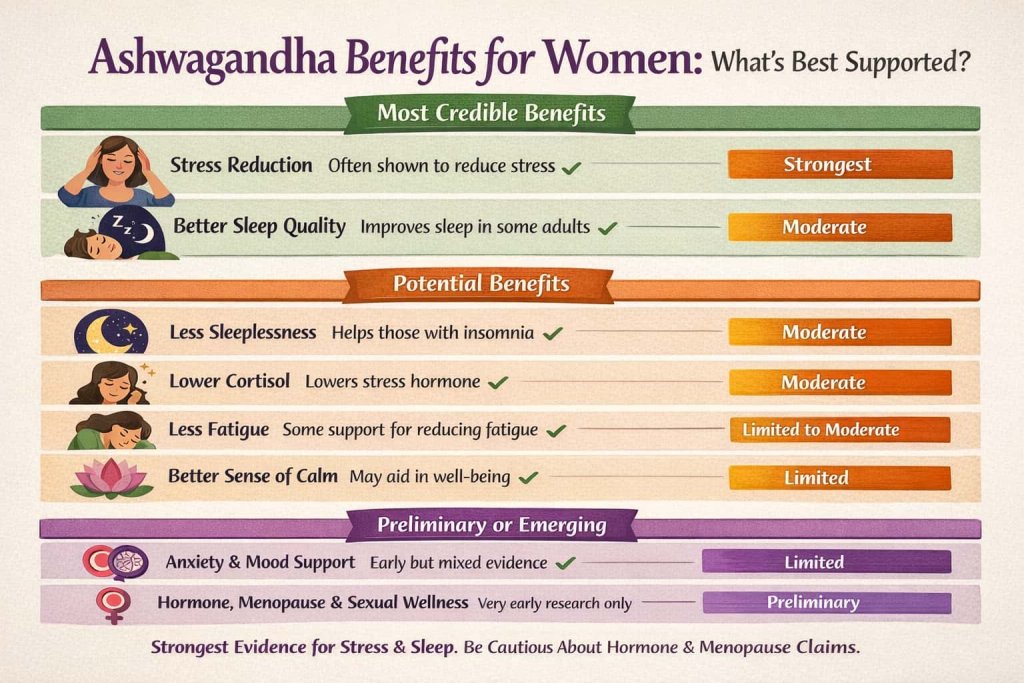
Ashwagandha may help some women with stress and sleep, and it may also support fatigue and overall well-being in some short-term studies. The strongest evidence is for stress-related symptoms and sleep quality, while many hormone-related claims you may see online are still less certain or only lightly studied. According to the NIH Office of Dietary Supplements’ ashwagandha fact sheet, ashwagandha has shown the most consistent short-term benefits for stress, sleeplessness, fatigue, and cortisol, and the National Center for Complementary and Integrative Health notes that evidence is still limited for many other uses.
That is why it helps to understand what ashwagandha may actually do, what is still uncertain, and when safety matters more than hype. If you are considering it, the most practical questions are whether your goal is stress relief, better sleep, or improved day-to-day resilience, and whether you have any reasons to avoid it, such as pregnancy, breastfeeding, thyroid disease, autoimmune disease, or medication interactions.
Quick Answer: Which Ashwagandha Benefits for Women Are Backed Best?
Here is the short version:
| Potential benefit | What the evidence suggests | Strength of evidence |
|---|---|---|
| Stress reduction | Often improves perceived stress in short-term trials | Strongest |
| Better sleep quality | Small but meaningful improvements in some adults | Moderate |
| Less sleeplessness | More noticeable in people who already have insomnia | Moderate |
| Lower cortisol | Seen in several stress studies | Moderate |
| Less fatigue | Reported in some trials, especially when stress is involved | Limited to moderate |
| Better sense of calm | Reported in some studies as part of improved well-being | Limited |
| Anxiety symptom support | Promising, but overall evidence is still unclear | Limited |
| Mood support | Early evidence is promising, but not enough for treatment claims | Emerging |
| Perimenopause or sexual wellness support | Small studies exist, but evidence is still preliminary | Preliminary |
This is the most accurate way to think about ashwagandha for women right now: the stress-and-sleep benefits are the most credible, while more specific claims about hormones, menopause, or fertility should be treated much more cautiously.
1. Ashwagandha May Help Reduce Stress
Stress support is the clearest reason many women try ashwagandha. The NIH fact sheet summarizes a 2021 systematic review of seven studies involving 491 adults and found that ashwagandha significantly reduced stress, anxiety-related symptoms, sleeplessness, fatigue, and serum cortisol compared with placebo. In several studies, benefits looked greater around 500 to 600 mg per day than at lower doses.
If your daily stress shows up as feeling wired, mentally overloaded, or emotionally worn down, this is the area where ashwagandha is most likely to help. That does not mean it works for everyone, and it does not replace therapy, sleep habits, or medical care, but stress is the use with the best support so far.
2. Ashwagandha May Improve Sleep Quality
Sleep is the second major area where the evidence looks reasonably encouraging. The NIH Office of Dietary Supplements reports that a meta-analysis of five studies involving 372 adults found a small but significant improvement in sleep with ashwagandha compared with placebo.
That matters for women because poor sleep often overlaps with stress, caregiving demands, shift work, perimenopause, or general burnout. In practical terms, the benefit looks more like modest support for sleep quality than a strong sedative effect.
3. It May Help You Fall Asleep Faster and Sleep More Efficiently
Some of the sleep studies did not just measure whether people felt better. They also found improvements in sleep efficiency, total sleep time, sleep latency, and waking after sleep onset. These improvements were more noticeable in people who already had insomnia.
So when women ask whether ashwagandha helps with sleep, the more accurate answer is that it may support several parts of sleep, especially if stress and insomnia are part of the picture.
4. Ashwagandha May Lower Cortisol in Some Short-Term Studies
Cortisol is often called the body’s main stress hormone. Several studies summarized by NIH found that people taking ashwagandha had lower serum cortisol levels than those taking placebo.
That does not mean you need cortisol testing before taking it, and it does not mean ashwagandha broadly “balances hormones” in a proven way. It simply suggests that one reason some people feel calmer on ashwagandha may be related to a lower stress response.
5. It May Reduce Fatigue and Support Steadier Energy
Ashwagandha is not a stimulant like caffeine, but some studies suggest it may reduce fatigue. NIH notes that participants in some trials reported less fatigue, and one 12-week trial in adults with low energy and fatigue found that ashwagandha reduced fatigue even when it did not clearly reduce perceived stress.
For women, that makes energy one of the more realistic reasons to consider it, but the effect is likely indirect. If it helps, it is probably by supporting stress resilience or sleep rather than by creating a fast, jittery boost.
6. It May Improve Calm, Well-Being, and Day-to-Day Resilience
Some short-term trials have reported improvements in calm, psychological well-being, and quality of life. In one NIH-cited trial, participants taking ashwagandha reported better stress levels, lower cortisol, and better sleep quality, along with improvements in psychological well-being.
This benefit is harder to measure than sleep time or a lab value, but it matches why many women reach for ashwagandha in real life. They are often not looking for a dramatic transformation. They want to feel more steady, less frazzled, and less depleted.
7. It May Help Some Anxiety Symptoms, but the Evidence Is Still Mixed
This is where nuance matters. The NIH fact sheet summarizes studies showing that ashwagandha may reduce anxiety scores, and a 2026 systematic review and dose-response meta-analysis in Current Therapeutic Research found improvements in stress, anxiety, and depression outcomes across 22 randomized trials involving 1,391 adults. But the same review also noted heterogeneity and low certainty in the evidence, and NCCIH says the overall evidence for anxiety is still unclear.
So it is fair to say that ashwagandha looks promising for anxiety-related symptoms, but it is not accurate to present it as a proven treatment for anxiety disorders.
8. It May Offer Some Mood Support, but It Is Not a Treatment for Depression
The same 2026 meta-analysis also found improvements in depression outcomes, which suggests that ashwagandha may support mood in some adults. Still, the review called for better-quality trials before firm clinical recommendations can be made.
For women dealing with low mood alongside stress or poor sleep, that makes ashwagandha a possible supportive option to discuss with a clinician, not a replacement for evidence-based mental health care.
9. It May Help Some Women With Perimenopause or Sexual Wellness, but the Evidence Is Still Preliminary
This is one of the most over-marketed parts of the ashwagandha conversation. Small clinical studies have looked at issues such as perimenopausal symptoms and female sexual function, but the overall evidence is not strong enough to make confident claims. NCCIH says there is not enough evidence to determine whether ashwagandha is helpful for menopause or female infertility.
That means women should be careful with articles or supplement labels that promise hormone balance, fertility benefits, or menopause relief as if those effects are settled science. They are not.
What Ashwagandha Does Not Clearly Do for Women
Ashwagandha is often marketed as if it has been proven to fix hormones, improve fertility, relieve menopause symptoms, and raise energy in almost everyone. That is not what the strongest evidence shows. Right now, the best-supported uses are stress and sleep, with possible secondary benefits for fatigue and general well-being.
If your main goal is help with thyroid disease, infertility, severe anxiety, depression, or menopause symptoms, you should not assume ashwagandha is a reliable first-line solution. Those situations deserve more targeted guidance.
How Much Ashwagandha Should Women Take?
There is no single best dose for every woman because products vary a lot. In the studies summarized by NIH, doses ranged from about 240 to 1,250 mg per day of extract, while many of the better-known stress and sleep trials used about 250 to 600 mg per day for 6 to 12 weeks. Sleep benefits looked more noticeable at 600 mg per day and after at least 8 weeks in some studies. The 2026 meta-analysis suggested that lower doses up to 500 mg per day and longer interventions over 8 weeks may still be effective for stress outcomes.
A practical approach is to follow the product label and talk with a clinician if you take medications or have a chronic condition. Because ashwagandha products differ by plant part, extract type, and standardization, “600 mg” on one label is not always equivalent to “600 mg” on another. NIH also notes that most commercial products use root extract, while some use both root and leaf.
A practical way to think about ashwagandha is as a short-term trial, not an indefinite daily habit. Most of the better-known studies lasted about 6 to 12 weeks, and NCCIH notes that short-term use up to about 3 months appears reasonably well tolerated in many adults. If you do not notice a clear benefit after roughly 8 to 12 weeks, or you feel worse, it is reasonable to stop and reassess instead of continuing automatically.
Ashwagandha Side Effects and Safety for Women
NCCIH says ashwagandha may be safe in the short term, generally up to about 3 months, but there is not enough information to know whether it is safe over the long term. Reported side effects include drowsiness, stomach upset, diarrhea, nausea, and vomiting. Rare cases of liver injury have also been linked to ashwagandha supplements.
When to Stop Ashwagandha and Get Medical Advice
Stop taking ashwagandha and contact a clinician promptly if you develop yellowing of the skin or eyes, dark urine, itching, unusual nausea, severe fatigue, or right-upper-abdominal pain. Rare liver injury linked to ashwagandha supplements has most often appeared within about 2 to 12 weeks after starting use. This caution matters even more if you already have cirrhosis or chronic liver disease, because severe cases have been reported in people with underlying liver disease.
Women should be especially careful with ashwagandha in these situations:
- Pregnancy: avoid it
- Breastfeeding: do not use it
- Thyroid disorders: use caution and get medical advice
- Autoimmune disorders: use caution and get medical advice
- Upcoming surgery: avoid it unless your clinician says otherwise
- Medication use: especially sedatives, thyroid hormone, diabetes medicines, blood pressure medicines, immunosuppressants, and anti-seizure medications
Why Thyroid Caution Matters
If you have a thyroid disorder or take thyroid hormone medication, do not assume ashwagandha is a simple “hormone balance” supplement. The NIH Office of Dietary Supplements notes potential thyroid-related effects, and NCCIH specifically advises caution in people with thyroid disorders. That makes medical guidance especially important for women with hypothyroidism, hyperthyroidism, or thyroid medication use.
Safety Box
Who it may suit: some adult women looking for short-term support for stress or sleep, especially after checking for medication interactions.
Who should be careful or avoid it: women who are pregnant or breastfeeding, people with thyroid or autoimmune disorders, people preparing for surgery, and anyone taking medications that could interact with it.
How to Choose an Ashwagandha Supplement
Because dietary supplements are regulated differently from drugs, product quality and marketing claims can vary. The FDA’s dietary supplements guidance explains that manufacturers are responsible for evaluating the safety and labeling of their products before marketing, and the agency can take action after products reach the market if they are adulterated or misbranded. The FDA also notes that supplement claims are not the same as FDA-approved drug claims.
When you compare products, it helps to look for a clearly labeled extract, the plant part used, the amount per serving, and realistic claims. Be cautious with products that promise to diagnose, treat, cure, or prevent disease.
Frequently Asked Questions
Is ashwagandha good for women every day?
It may be reasonable for some women in the short term, especially for stress or sleep, but long-term safety is still unclear. NCCIH says short-term use up to about 3 months appears reasonably well tolerated in many adults.
How long does ashwagandha take to work?
Many studies ran for 6 to 12 weeks. For sleep, benefits were more noticeable in some research when treatment lasted at least 8 weeks.
Can ashwagandha help with hormones?
That depends on what you mean by hormones. Claims about broad hormone balance are often overstated. There is not enough evidence to say ashwagandha clearly helps with menopause or female infertility, and it may affect thyroid-related pathways, which is one reason women with thyroid disorders should be cautious.
Can women take ashwagandha for anxiety?
Maybe, but the evidence is mixed. Some trials and newer meta-analyses look promising, yet NCCIH still says the evidence for anxiety is unclear overall.
Should women take ashwagandha for energy?
Possibly, if low energy is tied to stress, poor sleep, or fatigue. It is not a stimulant, and it should not be marketed as one. The evidence is better for stress and sleep than for energy on its own.
The Bottom Line on Ashwagandha Benefits for Women
Ashwagandha may be worth considering if your main goal is less stress, better sleep, or less fatigue, and those are the areas where the evidence is most encouraging. The bigger the claim gets beyond that, especially around hormones, fertility, or menopause, the more careful you should be.
If you want to try it, keep your expectations realistic, choose a clearly labeled product, and check with a qualified health professional first if you are pregnant, breastfeeding, taking medication, or managing a thyroid, autoimmune, or mental health condition.
This content is for informational purposes only and not medical advice.
References
- NIH Office of Dietary Supplements — Ashwagandha: Health Professional Fact Sheet
- National Center for Complementary and Integrative Health — Ashwagandha
- U.S. Food and Drug Administration — Dietary Supplements
- U.S. Food and Drug Administration — Questions and Answers on Dietary Supplements
- Current Therapeutic Research — Effects of Ashwagandha on Mental Health in Adults: A Systematic Review and Dose-Response Meta-Analysis of Randomized Controlled Trials