
Creatine is not a direct weight-loss supplement. The best current evidence shows it may help body recomposition by supporting harder resistance training and helping you keep or gain lean mass, but it does not reliably lower body weight, and it often raises scale weight at first because it increases water retention. NIH Office of Dietary Supplements and Mayo Clinic’s creatine overview both describe creatine as most useful for short, intense exercise rather than fat loss itself.
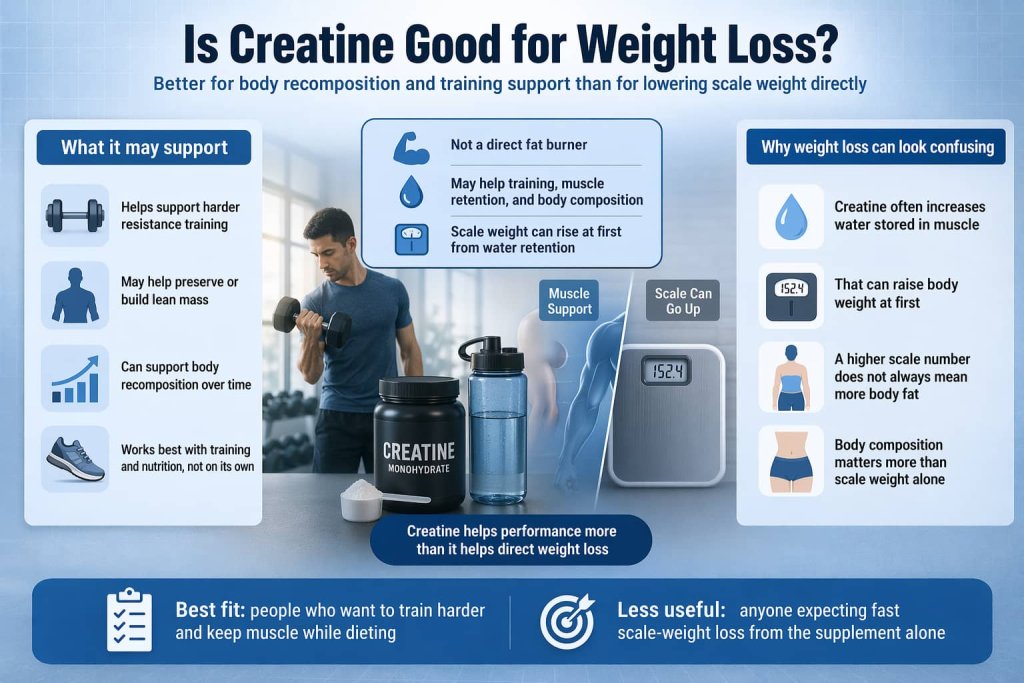
That distinction matters. If your goal is a lower number on the scale next week, creatine can feel frustrating. If your goal is to preserve muscle while dieting, train harder, and improve how your body composition changes over time, creatine can be useful when paired with a solid workout and nutrition plan.
What creatine actually does
Creatine helps your muscles rapidly produce energy during short bursts of high-intensity effort, such as lifting weights, sprinting, or repeated hard intervals. According to the NIH Office of Dietary Supplements, it may increase strength, power, and work from maximal-effort contractions, but it has little value for endurance-focused activities like long-distance running or swimming. NIH ODS consumer guidance says creatine is mainly helpful for repeated short bursts of intense, intermittent activity.
That is why creatine is usually discussed as a performance supplement first. It helps some people do a bit more high-quality training, and that extra training stimulus can support better body composition over time. OPSS also notes benefits such as improved power, speed, strength, and lean body mass when creatine is combined with resistance training.
Can creatine help with weight loss?
Not in the way most people mean “weight loss.” A 2025 meta-analysis of controlled trials found that creatine supplementation increased fat-free mass and body mass, but did not produce a significant overall reduction in fat mass, BMI, or body-fat percentage across all included studies.
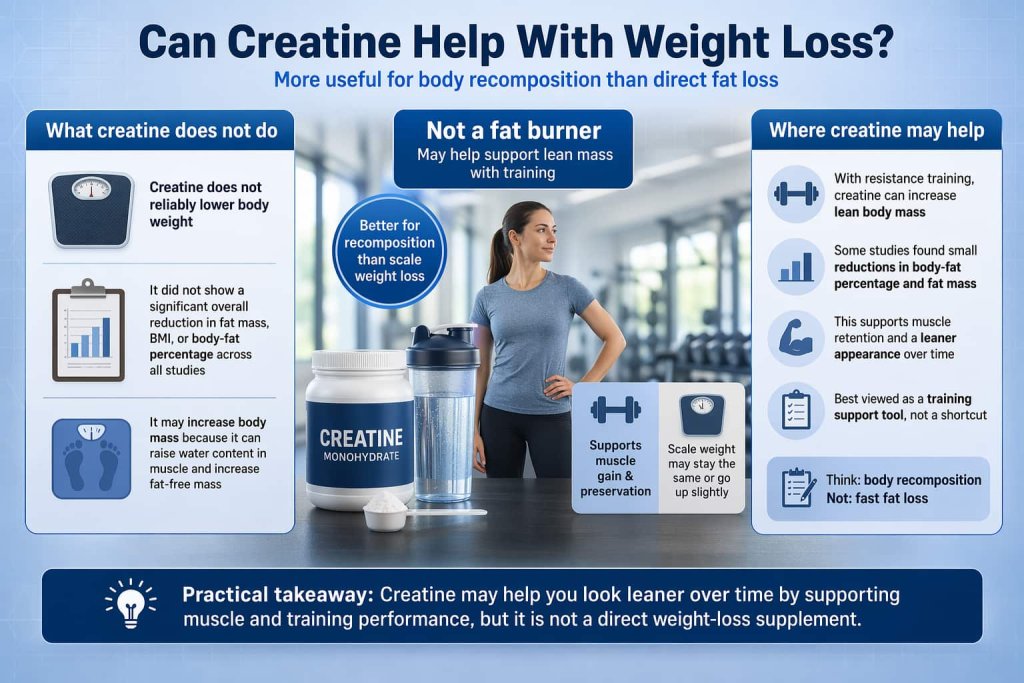
However, the picture changes a bit when creatine is paired with resistance training. A 2024 meta-analysis in adults under 50 found that creatine supplementation during resistance training increased lean body mass by 1.14 kg and produced small reductions in body-fat percentage and fat mass. In older adults, a 2025 review also found a small but significant reduction in body-fat percentage when creatine was combined with exercise. Those findings support creatine as a body recomposition tool, not a fat burner. PubMed 2024 meta-analysis and PubMed 2025 older-adults review point in that direction.
So the practical answer is simple: creatine may help you look leaner over time if it helps you train well and hold onto muscle during a calorie deficit, but it is not a shortcut to lower body weight.
Why the scale may go up after starting creatine
This is the part many people do not expect. NIH says creatine often causes weight gain because it increases water retention, and several strength-training studies found about 1 to 2 kg of total body-weight gain within a month. The NIH consumer sheet also says creatine “usually causes some weight gain” because of water retention.
That does not automatically mean fat gain. Early scale changes after starting creatine are usually a poor way to judge whether your nutrition plan is working. Waist measurements, progress photos, gym performance, and longer-term trends are usually more useful.
What happens if you stop taking creatine?
If you stop taking creatine, muscle creatine stores gradually fall back toward baseline over about 4 to 6 weeks, and some of the extra water weight may fade during that time. That can make the scale drop even if your diet has not changed. This is another reason not to judge creatine by short-term scale shifts alone.
When creatine makes the most sense for fat loss goals
Creatine tends to make the most sense when your goal is one of these:
- You are in a calorie deficit and want to preserve muscle.
- You are doing resistance training three or more times per week.
- You care about performance, strength, or recovery quality while dieting.
- You want body recomposition more than rapid scale loss.
It makes less sense if your only goal is to see the scale drop fast, or if your training is mostly low-intensity endurance work. NIH specifically notes that creatine has little value for endurance sports and that the related weight gain may be a downside in those settings.
Best creatine for weight loss support
Creatine monohydrate is the best-studied form
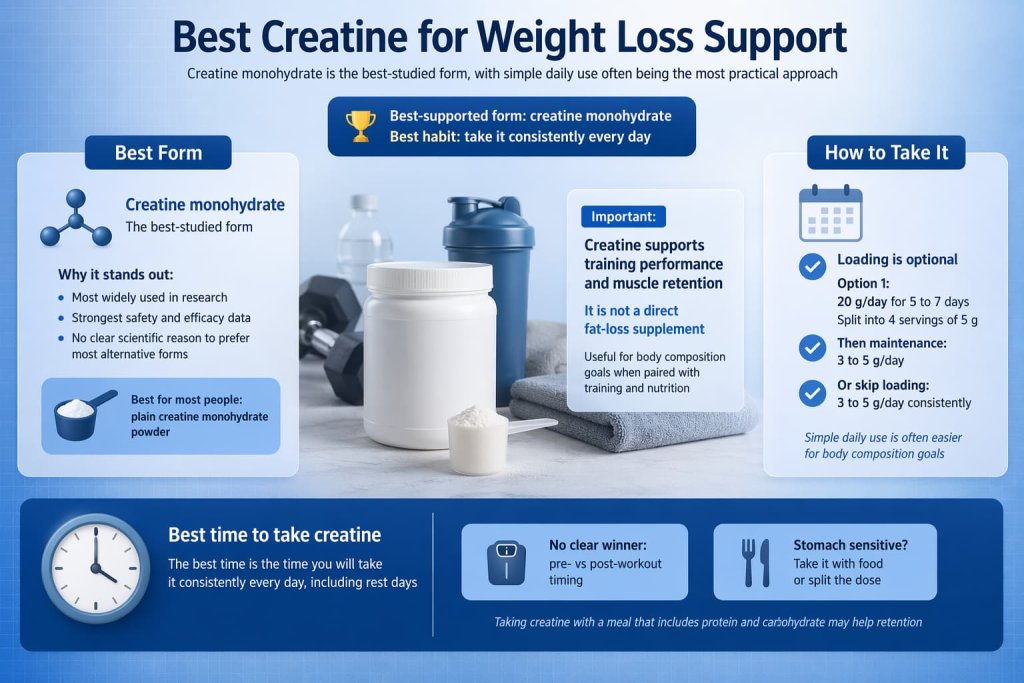
If you decide to use creatine, creatine monohydrate is the form with the strongest evidence. NIH says it is the most widely used and studied form, and the Australian Institute of Sport creatine guidance states that about 99% of the safety and efficacy data are on creatine monohydrate powder, with no scientific reason to prefer most alternative forms.
Loading is optional
A common adult protocol is a loading phase of 20 grams per day for 5 to 7 days, split into four 5-gram servings, followed by 3 to 5 grams per day for maintenance. NIH also notes that another protocol is about 3 to 6 grams per day for 3 to 4 weeks without loading, which can still produce ergogenic effects.
For most readers focused on body composition rather than speed, a simple 3 to 5 grams daily approach is easier and often more comfortable. Loading may saturate muscles faster, but it can also make early water-weight changes more noticeable.
Best time to take creatine
The best time to take creatine is the time you will take it consistently every day, including rest days. Research comparing pre- and post-workout dosing has not shown a clear body-composition or performance advantage to one over the other. If creatine bothers your stomach, taking it with food or splitting the dose can be easier. Taking it with a meal that includes protein and carbohydrate may also help creatine retention.
How to use creatine without sabotaging your weight-loss mindset
Use creatine as part of a complete plan:
- Keep protein intake and resistance training consistent.
- Weigh yourself less reactively in the first few weeks.
- Track waist, photos, strength, and workout quality.
- Stay patient with body-weight fluctuations.
This matters because creatine can improve the quality of training before it changes appearance. Better training quality is often the real benefit that later supports better body composition.
Safety box
Who it may be for: Healthy adults doing resistance training or repeated high-intensity exercise who want support for strength, lean mass, or body recomposition.
Who should be careful: People with kidney disease should discuss creatine with a clinician before use. Mayo Clinic notes that research in people with kidney disease is limited. NCCIH also advises talking with your health care providers about any supplement you are using or considering.
One practical lab note: Creatine supplementation can modestly raise serum creatinine on blood tests because creatine is converted to creatinine. That does not automatically mean kidney damage, but it can complicate lab interpretation. If you take creatine and have kidney blood work scheduled, tell your clinician before the test.
Most common side effects: Water-weight gain is the most consistent one. NCCIH also lists nausea, cramping, and diarrhea among possible side effects. NIH consumer guidance mentions occasional muscle stiffness, cramps, and GI distress.
What about dehydration, cramps, or heat illness? OPSS says individual reports exist, but kidney injury, dehydration, and heat illness have not been confirmed through research. Mayo Clinic also says research does not show a higher risk of muscle cramps or muscle injury in people taking creatine supplements.
How to choose a creatine supplement
Supplement quality matters because dietary supplements are not approved by FDA before they are marketed. FDA’s dietary supplement Q&A explains that manufacturers and distributors are responsible for safety and labeling before sale, and FDA generally acts after products reach the market.
That is why third-party testing is worth looking for. According to OPSS guidance on third-party certification, laboratory testing is the only way to know the actual ingredients and amounts in a supplement product, and certification helps confirm that the label matches the contents.
A practical buying checklist:
- Choose creatine monohydrate.
- Avoid proprietary blends and flashy “advanced” forms.
- Look for reputable third-party testing.
- Follow label directions unless your clinician advises otherwise.
Frequently asked questions about creatine for weight loss
Does creatine burn fat?
No. Current evidence does not show creatine directly burns fat. Its value is more indirect: it may support better resistance training and lean-mass retention, which can improve body composition over time.
Will creatine make me gain weight?
Possibly, especially at the start. NIH says creatine often causes weight gain because it increases water retention, and this can happen even when fat mass does not increase.
Can I take creatine while cutting?
Many people do, especially to help preserve training quality and lean mass during a calorie deficit. That said, the scale may temporarily rise or stall because of water retention, so it helps to track more than body weight alone.
Do I need a loading phase?
No. Loading is optional. NIH lists both a traditional loading protocol and a lower daily-dose approach without loading.
Is creatine better for fat loss than protein or a calorie deficit?
No. A calorie deficit drives weight loss, and adequate protein plus resistance training are more foundational for preserving muscle during fat loss. Creatine can support that plan, but it should not replace it.
Bottom line on creatine for weight loss
Creatine can be helpful during a fat-loss phase, but not because it directly makes you lose weight. Its real value is that it may help you train better and preserve lean mass, which can support better body composition over time. Just be ready for possible water-weight gain, especially early on.
If your goal is to get leaner without losing strength, creatine monohydrate is one of the more evidence-backed options to consider alongside a calorie-controlled diet, sufficient protein, and consistent resistance training.
This content is for informational purposes only and not medical advice.
References
- NIH Office of Dietary Supplements — Dietary Supplements for Exercise and Athletic Performance: Consumer Fact Sheet
- Office of Dietary Supplements, NIH — Dietary Supplements: What You Need to Know
- U.S. Food and Drug Administration — Dietary Supplements
- OPSS — Creatine Monohydrate: Dietary Supplement for Performance
- OPSS — Why is Third-Party Certification Important for Dietary Supplements?
- Mayo Clinic — Creatine
- Australian Institute of Sport — Creatine
- PubMed — The Effect of Creatine Supplementation on Resistance Training-Induced Changes in Body Composition in Adults Under 50 Years of Age
- PubMed — Impact of Creatine Supplementation and Exercise Training in Older Adults: A Systematic Review and Meta-Analysis