
For most adults, 5 hours of sleep is not enough on a regular basis. The main reason is simple: the official sleep recommendations for adults are higher than that. According to CDC sleep guidance, adults ages 18 to 60 should get 7 or more hours per night, adults 61 to 64 should get 7 to 9 hours, and adults 65 and older should get 7 to 8 hours. The American Academy of Sleep Medicine also advises that adults should sleep 7 or more hours per night on a regular basis to support health, productivity, and daytime alertness.
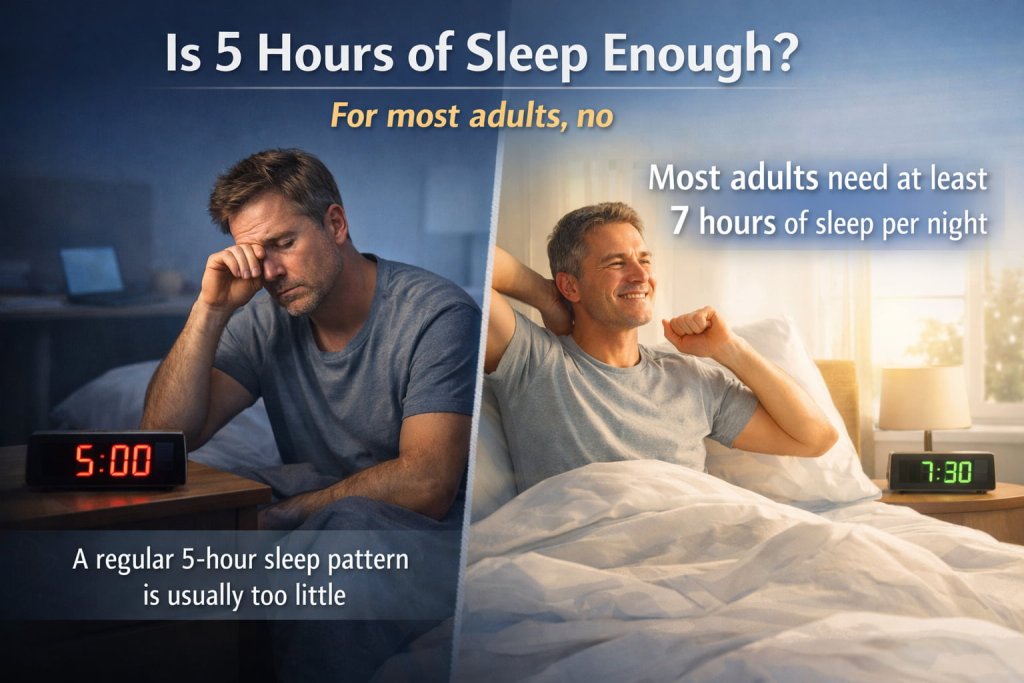
That is why understanding the answer to “is 5 hours of sleep enough” matters. This is not just about feeling tired the next day. Sleep affects attention, memory, mood, driving safety, heart health, metabolism, and long-term well-being. The practical takeaway is clear: one short night can happen, but a steady pattern of 5-hour sleep is usually too little, and there are proven steps that can help you move in the right direction.
Is 5 Hours of Sleep Enough for Most Adults?
No. If you regularly sleep 5 hours a night, you are well below the recommended range for adults. CDC classifies adults who report less than 7 hours as getting insufficient sleep or having short sleep duration. That means 5 hours is not just a little short. It clearly falls into the short-sleep category.
It is also worth clarifying that “7 or more hours” does not mean exactly 7 is ideal for every person. Official CDC guidance gives a minimum target for most adults, but individual sleep need still varies somewhat. In practice, many adults function best somewhere in the 7- to 9-hour range, and needing more than 7 hours does not mean anything is wrong.
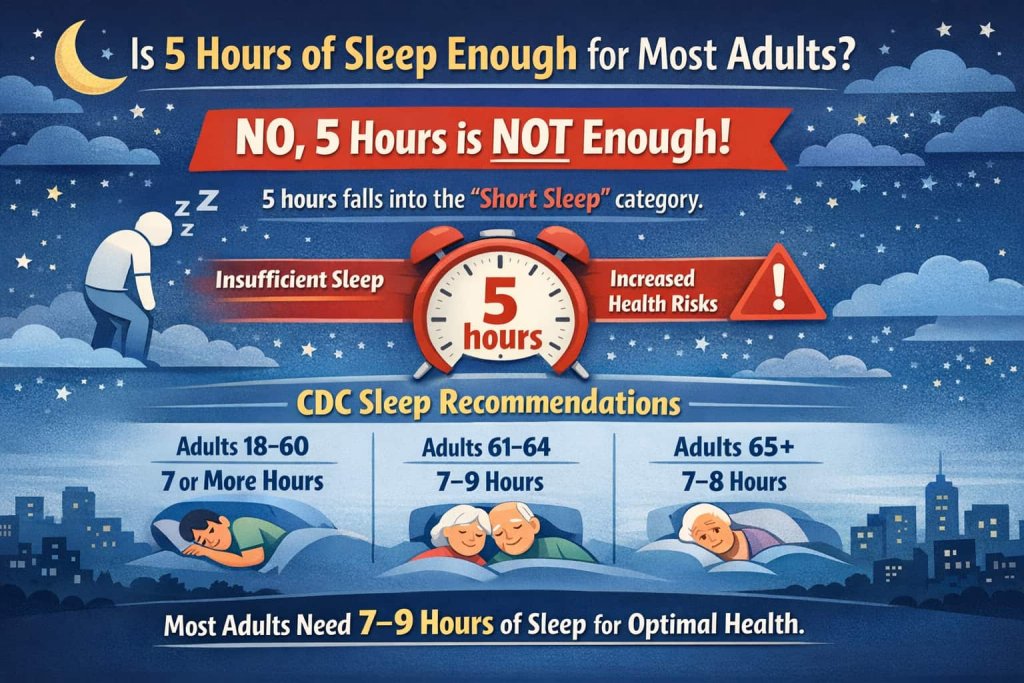
For quick reference, the current CDC recommendations are:
- Adults 18–60: 7 or more hours
- Adults 61–64: 7–9 hours
- Adults 65+: 7–8 hours
So even for older adults, 5 hours is still generally below the healthy target. Individual needs can vary somewhat, but the official guidance is still that adults should usually be at or above 7 hours, not 5.
Why 5 Hours of Sleep Is Usually Too Little
When sleep stays too short, the effects are not limited to low energy. The National Heart, Lung, and Blood Institute overview of sleep deficiency says sleep deficiency can interfere with work, school, driving, and social functioning. It can make learning, focusing, and reacting harder, and it can leave you feeling frustrated, cranky, or worried. CDC also says enough sleep helps lower the risk of type 2 diabetes, heart disease, high blood pressure, stroke, and motor vehicle crashes, while improving attention, memory, mood, and metabolic health.
CDC’s sleep and heart health guidance adds an important point: adults who sleep fewer than 7 hours each night are more likely to report problems such as heart attack, asthma, and depression. Sleep loss is also tied to higher blood pressure, weight gain, and poorer blood sugar control. For readers trying to judge whether 5 hours is “good enough,” that broader health context matters more than whether they can still get through the day.
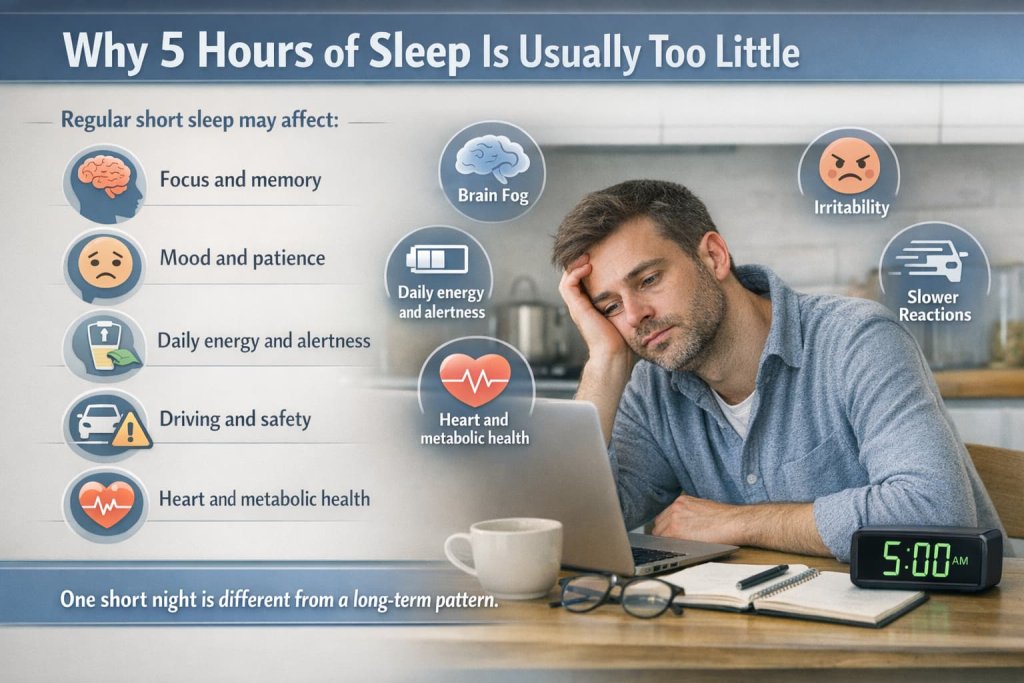
Common signs that 5 hours is not enough can include:
- Trouble focusing or remembering things
- Slower reaction time
- Irritability or lower patience
- Daytime sleepiness
- Worse driving alertness
- Feeling unrefreshed even after sleeping
Does Good Sleep Quality Make 5 Hours Enough?
Usually, no. Sleep quality matters, but it does not replace getting enough total sleep. CDC says healthy sleep includes both enough sleep and good-quality sleep. It defines quality sleep as sleep that is uninterrupted and refreshing.
That means 5 solid hours of sleep is better than 5 broken, restless hours. But for most adults, 5 high-quality hours is still below the recommended amount. The better goal is not to choose between sleep quality and sleep quantity. It is to aim for both.
CDC also notes that signs of poor sleep quality include:
- Trouble falling asleep
- Waking up repeatedly during the night
- Still feeling sleepy or tired even after enough time in bed
One Short Night Is Different From Sleeping 5 Hours Every Night
This distinction is important. According to CDC’s sleep and heart health guidance, not getting enough sleep may be manageable for a day or two, but not getting enough sleep over time can lead to serious health problems and can make existing conditions worse.
So if you sleep 5 hours once because of travel, a deadline, a sick child, or a stressful week, that is different from building your life around 5-hour nights. The more useful question is not “Can I survive on 5 hours?” but “Can I stay healthy and function well over time on 5 hours?” For most adults, the evidence-backed answer is no.
Why “Catching Up on Sleep” Is Not a Full Solution
A common question is whether you can sleep 5 hours on weekdays and make up for it later. The safer answer is not to rely on that plan. When you do not get enough sleep over several days, your body builds up sleep debt. The CDC’s NIOSH guidance on sleep debt explains that this debt can build quickly, and while a recovery night may help you feel better, it may not fully restore normal thinking and performance right away.
That is why regular sleep matters more than occasional catch-up sleep. If your body really needs around 7 to 8 hours and you are only getting 5, the gap adds up fast. The better goal is to get enough sleep consistently rather than running short during the week and hoping weekends will fully fix it.
How Common Is Short Sleep?
Short sleep is very common, which is one reason this topic gets searched so often. In CDC’s adult sleep data, more than 1 in 3 American adults do not get the recommended amount of sleep. In 2022, the share of adults reporting insufficient sleep ranged from 30% in Vermont to 46% in Hawaii. CDC also reports that insufficient sleep in 2022 was highest among men (37%), adults ages 45 to 64 (39%), and Native Hawaiian or Pacific Islander adults (49%).
That does not make 5 hours normal in a healthy sense. It simply means many people are dealing with the same problem.
What to Do if You Are Only Getting 5 Hours of Sleep
If 5-hour nights are becoming a pattern, focus on simple habits with official backing instead of hacks or extreme routines. CDC recommends:
- Keep the same bedtime and wake time every day, including weekends
- Get natural light, especially earlier in the day
- Get regular physical activity, but not too close to bedtime
- Keep your bedroom cool, dark, quiet, and relaxing
- Turn off or put away electronic devices at least 30 minutes before bed
- Avoid large meals, alcohol, and caffeine later in the day or close to bedtime
One practical shift can make a real difference: stop thinking only about your wake-up time and start protecting your bedtime too. If your day starts at 6:00 a.m., a healthy sleep plan usually has to begin the night before, not the next morning. That sounds obvious, but it is often the missing step. The official guidance supports making enough room in your schedule for the sleep your body actually needs.
Keep a Simple Sleep Diary if the Problem Is Ongoing
If 5-hour nights have become a pattern, it can help to keep a simple sleep diary for a week or two. The CDC sleep guidance notes that a healthcare provider may ask you to track when you go to bed, when you wake during the night, when you wake in the morning, whether you nap, your exercise, and your use of caffeine, alcohol, or medications.
This can make your next step much more useful. Instead of only saying “I’m tired,” you can show whether the issue looks more like a late bedtime, repeated awakenings, shift-work timing, caffeine too late in the day, or possible signs of a sleep disorder.
When 5 Hours of Sleep May Point to a Bigger Problem
Sometimes the issue is not just a busy schedule. CDC says to talk to a healthcare provider if you regularly have trouble sleeping. Poor sleep can be related to conditions such as insomnia or sleep apnea.
A particularly important warning sign is sleep apnea. The NHLBI overview of sleep apnea says you should consider talking to a healthcare provider if someone tells you that you snore or gasp for air during sleep, or if you have excessive daytime sleepiness. Those symptoms can mean your sleep is being disrupted even if you think you are spending enough time in bed.
Do Not Ignore Sleepiness Behind the Wheel
One of the most practical dangers of too little sleep is driving while fatigued. CDC and NIOSH advise getting enough sleep each day to reduce fatigue-related driving risk. If you feel sleepy while driving, pull over safely instead of trying to push through it. NIOSH says a short-term emergency step is to pull over, have a cup of coffee, and take a 15- to 30-minute nap before continuing, but it also stresses that this is only temporary. Sleep itself is the real fix.
This matters because many people underestimate how much 5-hour sleep can affect alertness, reaction time, and decision-making during ordinary daily tasks like commuting.
Is 5 Hours of Sleep Enough for Older Adults?
Usually not. This is a common misunderstanding. Older adults do not suddenly become fine on very little sleep. CDC’s current recommendations still put adults ages 65 and older at 7 to 8 hours per night, and adults 61 to 64 at 7 to 9 hours. So while sleep patterns may change with age, 5 hours is still generally below the recommended amount.
FAQ: Is 5 Hours of Sleep Enough?
Is 5 hours of sleep enough for one night?
A single short night is different from a long-term pattern. CDC says a day or two of short sleep may happen, but not getting enough sleep over time can lead to serious health problems.
Is 5 hours of sleep enough if the sleep quality is good?
Usually no. Good sleep quality helps, but CDC says healthy sleep requires both enough hours and good-quality sleep.
Is 5 hours of sleep enough if I feel okay?
Feeling “okay” does not change the official recommendation. Adults are still advised to get at least 7 hours on a regular basis, because sleep supports health, alertness, mood, and performance over time.
Is 5 hours enough for adults over 65?
No, not as a regular target. CDC recommends 7 to 8 hours for adults 65 and older.
The Bottom Line on Whether 5 Hours of Sleep Is Enough
For most adults, 5 hours of sleep is not enough. It falls below current sleep recommendations, and regular short sleep is linked with worse daytime functioning and higher long-term health risks. The healthiest target is not just to “get by,” but to get enough high-quality sleep to support your mood, focus, safety, and overall health.
If 5-hour nights have become your normal, start with the basics: protect your bedtime, improve your sleep environment, and take ongoing sleep problems seriously. If snoring, gasping, repeated awakenings, or daytime sleepiness are part of the picture, talk to a healthcare professional.
This content is for informational purposes only and not medical advice.
References
- Centers for Disease Control and Prevention — About Sleep
- Centers for Disease Control and Prevention — About Sleep and Your Heart Health
- Centers for Disease Control and Prevention — FastStats: Sleep in Adults
- Centers for Disease Control and Prevention, NIOSH — Sleep Debt and Recovery
- Centers for Disease Control and Prevention, NIOSH — Driver Fatigue
- American Academy of Sleep Medicine — Adult Sleep Duration Health Advisory
- National Heart, Lung, and Blood Institute — What Are Sleep Deprivation and Deficiency?
- National Heart, Lung, and Blood Institute — What Is Sleep Apnea?