
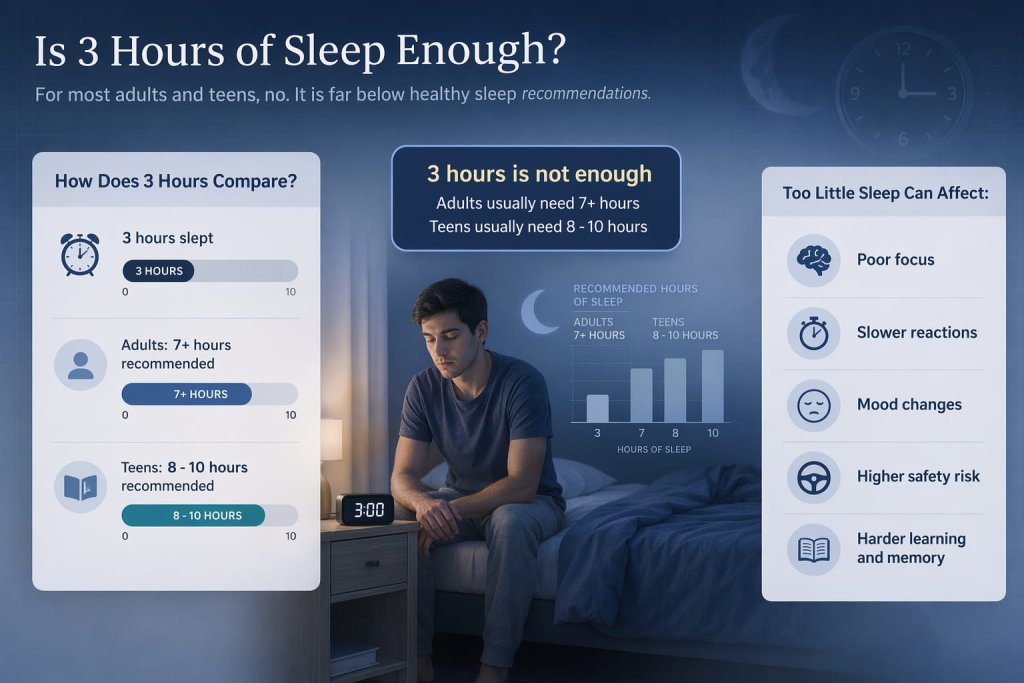
No, 3 hours of sleep is not enough for adults or teens. According to the Centers for Disease Control and Prevention and the American Academy of Sleep Medicine, adults generally need at least 7 hours of sleep a night, while teens need 8 to 10 hours. AASM also notes that 6 hours or less is not enough to support adult health, which means 3 hours is far below the healthy range.
That matters because sleep affects much more than how tired you feel. It plays a major role in alertness, learning, mood, reaction time, safety, and long-term health. If you only got 3 hours of sleep, the smartest next step is to lower your risk for the day, avoid turning it into a pattern, and work on getting back to a normal sleep routine tonight.
How much sleep do you actually need?
For most adults ages 18 to 60, the target is 7 or more hours per night. For teens ages 13 to 17, the recommended range is 8 to 10 hours. Those numbers are linked to better health, daytime alertness, learning, and safer performance.
So when people ask, “Is 3 hours of sleep enough?” the practical answer is simple: it is not enough for normal functioning, and it is definitely not enough as a regular habit.
Is 3 hours of sleep enough for one night?
A single night of 3 hours may happen during travel, exams, deadlines, illness, or family emergencies. That does not make it safe or sufficient. It only means one bad night is different from living that way every night.
The National Heart, Lung, and Blood Institute explains that even short-term sleep loss can affect learning, focus, reaction time, decision-making, memory, mood, and productivity. It also notes that after several nights of losing even 1 to 2 hours of sleep per night, performance can drop sharply. That helps explain why repeated 3-hour nights can catch up with you quickly, even if you feel like you are managing.
What happens after only 3 hours of sleep?
Sleep loss can affect both your brain and your body by the next day. Common problems include:
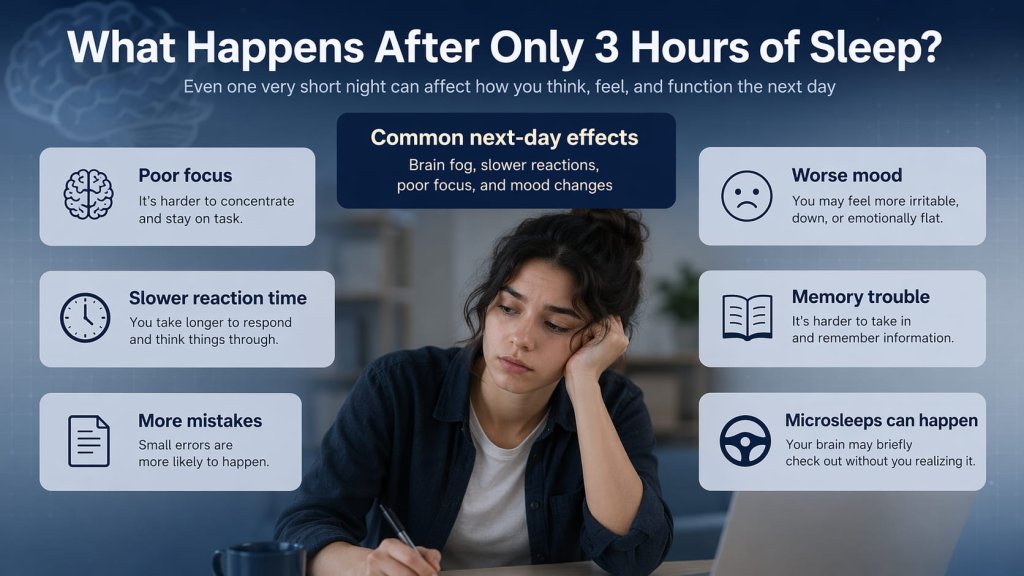
- Slower reaction time
- Poor focus and concentration
- More mistakes
- Worse decision-making
- Memory and learning problems
- Irritability or mood changes
- Feeling mentally foggy or unmotivated
NHLBI also warns about microsleeps, which are brief moments of sleep that happen while you think you are awake. That is one reason severe sleepiness can become dangerous so quickly.
Why 3 hours of sleep can become a safety issue
The risk is not just feeling tired. Very short sleep can affect driving, school, work, sports, and anything else that depends on attention and quick reactions. The National Highway Traffic Safety Administration reports that 684 people were killed in crashes involving a drowsy driver in the United States in 2021.
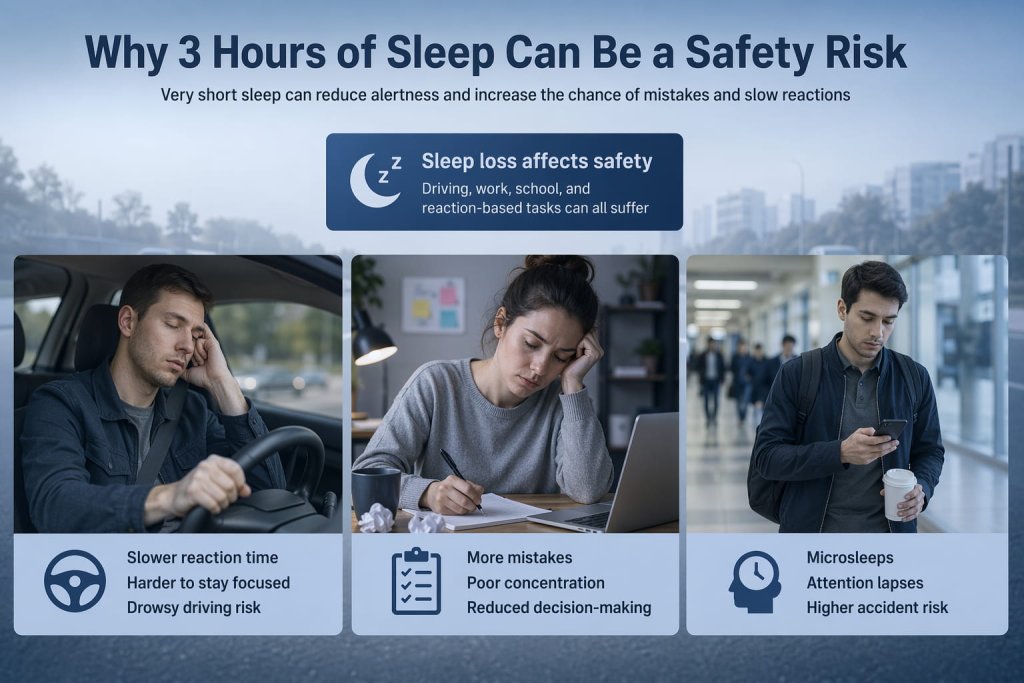
That is why a 3-hour night is especially concerning if you have to drive early, take an exam, use tools or machinery, or do anything where a brief lapse in attention could hurt you or someone else.
What to do if you only got 3 hours of sleep last night
You may not be able to fully fix a 3-hour night in one morning, but you can reduce the downside.
Lower your risk during the day
- Be extra careful with driving and other tasks that need fast reactions.
- Delay nonessential risky activities if you can.
- Do not assume you are fully alert just because you are awake.
- Keep your day as simple as possible if you are feeling very sleepy.
If you become sleepy while driving, the NHTSA’s drowsy driving advice says to pull over in a safe place and take a short nap. It also notes that coffee may help only for a limited time.
Use naps carefully
A short nap may help with alertness, but it is not a replacement for a full night of sleep. According to NHLBI’s healthy sleep habits guidance, adults should keep naps to no more than 20 minutes. Longer naps can leave some people groggy or make it harder to sleep later.
Can you catch up on sleep later?
A longer night of sleep may help you feel better after a very short night, but it does not fully erase a growing sleep debt. According to NHLBI’s sleep debt guidance, when you regularly lose sleep, the deficit adds up over time. Naps may give a short-term boost in alertness, but they do not replace all the benefits of a full night of sleep. That means sleeping in later is not a real fix for repeated 3-hour nights. The better goal is to return to a consistent, adequate sleep schedule as soon as possible.
Protect tonight’s sleep
The goal after a bad night is usually to return to a normal routine, not to start a cycle of late caffeine, irregular sleep, and another poor night. CDC recommends:
- Going to bed and getting up at the same time each day
- Keeping your bedroom quiet, relaxing, and cool
- Turning off devices at least 30 minutes before bed
- Avoiding large meals and alcohol before bedtime
- Avoiding caffeine in the afternoon or evening
- Exercising regularly
These basics matter even more after a night of severe sleep loss.
What happens if 3 hours of sleep becomes a habit?
This is where the real health concern starts. Ongoing short sleep is linked to higher risk of major health problems, not just daytime tiredness. CDC notes that not getting enough sleep over time is associated with serious health issues, and more than 1 in 3 American adults report not getting the recommended amount.
Over time, chronic sleep deficiency is linked with:
- High blood pressure
- Heart disease
- Stroke
- Obesity
- Type 2 diabetes
- Poor mental health
- Lower overall daytime functioning
So while one 3-hour night is rough, repeated 3-hour nights are a real health issue.
Is 3 hours of sleep enough for teens?
No. It is even less appropriate for teens than for adults. The AASM teen sleep duration advisory says teenagers ages 13 to 18 should sleep 8 to 10 hours per 24 hours on a regular basis for optimal health and daytime alertness.
The CDC’s sleep and health page explains that children and adolescents who do not get enough sleep have higher risk of obesity, type 2 diabetes, poor mental health, injuries, and attention and behavior problems that can hurt school performance. Sleep also supports healthy growth and development, which makes a 3-hour night especially concerning for teens.
Is good sleep quality enough if the total is only 3 hours?
No. Good sleep quality helps, but it does not make 3 hours sufficient. Healthy sleep is not only about falling asleep fast or sleeping deeply. It also depends on getting enough total sleep time on a regular schedule. A very short night is still a very short night.
When to get medical help
It is time to talk to a healthcare professional if you are regularly sleeping only 3 hours, often cannot fall asleep, wake up unrefreshed, or feel so sleepy during the day that it affects school, work, driving, or daily life. CDC advises talking to a provider if you regularly have problems sleeping or notice symptoms of a sleep disorder.
Some symptoms deserve extra attention because they can point to a sleep disorder, not just a late night or a busy schedule. Ask about an evaluation if you snore loudly, wake up gasping or choking, someone notices that your breathing stops and starts during sleep, or you keep having trouble falling asleep, staying asleep, or waking too early. The NHLBI sleep apnea symptoms page and NHLBI’s sleep-wake cycle overview show how these problems can leave you sleepy and unrefreshed even when you spend enough time in bed.
It can also help to track the pattern before your appointment. NHLBI’s diagnosis and treatment guidance says keeping a sleep diary for a few weeks can help your doctor understand what is happening and what might be affecting your sleep.
If your main problem is ongoing insomnia, treatment is not always just about medication. The NHLBI insomnia treatment page says cognitive behavioral therapy for insomnia, or CBT-I, is usually the first treatment for long-term insomnia and can be very effective. That is useful to know if your 3-hour nights are becoming a pattern rather than a one-time problem.
Frequently asked questions
Is 3 hours of sleep okay once in a while?
A rare short night can happen, but it is still not enough. You may get through the day, but your alertness, mood, judgment, and reaction time can still be worse than normal.
Can you function on 3 hours of sleep?
You might still be awake and moving, but that is not the same as functioning well. Sleep loss can impair learning, concentration, decision-making, and reaction time, and it can trigger microsleeps.
What should you do if 3-hour nights keep happening?
Do not ignore it. Start with basic sleep habits, but if the pattern keeps happening, talk to a healthcare professional and consider keeping a sleep diary. Repeated 3-hour nights can sometimes point to insomnia, sleep apnea, shift-work problems, stress, or another issue worth evaluating.
The bottom line
3 hours of sleep is not enough for adults, and it is definitely not enough for teens. It can leave you less alert, less safe, and less able to think clearly the next day. If it happens once, focus on getting through the day safely and returning to a healthy sleep routine. If it keeps happening, treat it as a health issue worth addressing.
Good sleep is one of the simplest foundations of health. Protect it like it matters, because it does.
This content is for informational purposes only and not medical advice.
References
- American Academy of Sleep Medicine — Seven or More Hours of Sleep Per Night: A Health Necessity for Adults
- National Heart, Lung, and Blood Institute — How Sleep Affects Your Health
- National Highway Traffic Safety Administration — Drowsy Driving: Avoid Falling Asleep Behind the Wheel
- National Heart, Lung, and Blood Institute — Healthy Sleep Habits
- National Heart, Lung, and Blood Institute — Sleep Deprivation and Deficiency: Diagnosis and Treatment
- National Heart, Lung, and Blood Institute — Insomnia Treatment