
The single leg deadlift exercise is a unilateral strength movement that targets the glutes, hamstrings, and core while actively training balance and movement control. Because you work one side of the body at a time, it challenges stability and coordination in ways that traditional two-leg deadlifts cannot.
Understanding how to perform the single leg deadlift correctly is important for building functional lower-body strength, improving balance, and supporting safer movement patterns in both fitness and everyday activities.
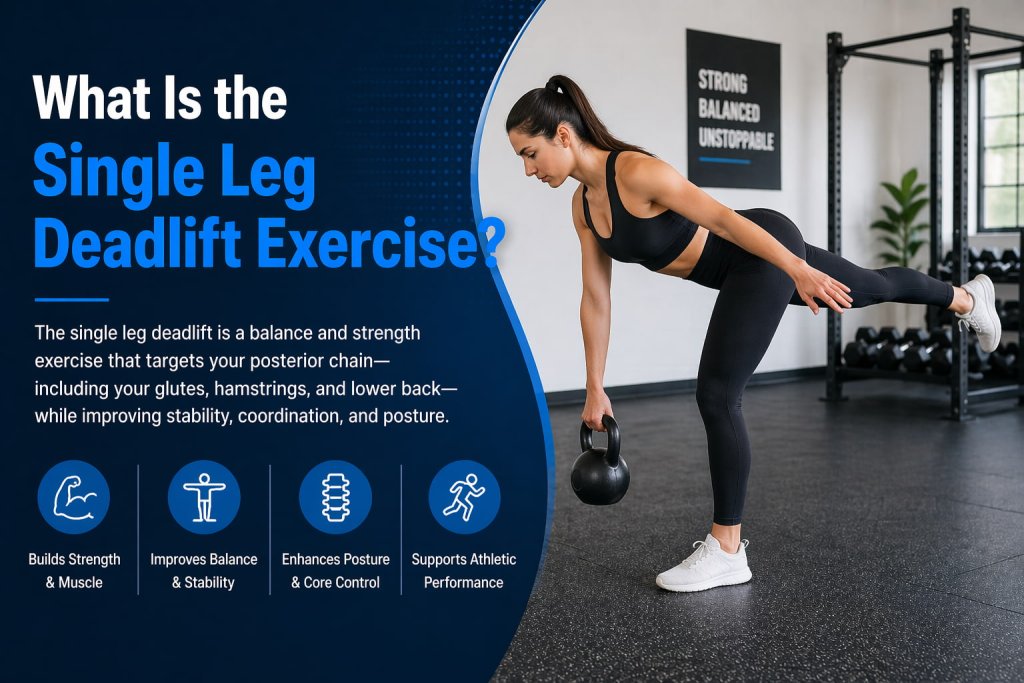
What Is the Single Leg Deadlift Exercise?
The single leg deadlift exercise is a hip-hinge movement performed while balancing on one leg. As you hinge forward at the hips, the non-working leg extends backward to counterbalance the torso, while the spine stays neutral and controlled.
This exercise is often taught as the single-leg Romanian deadlift (SL RDL) and is widely used in strength training, athletic conditioning, and rehabilitation programs.
Key characteristics include:
- One foot remains planted on the ground
- Movement occurs primarily at the hip, not the lower back
- The core and hip stabilizers work continuously to maintain balance
How to Do the Single Leg Deadlift (Proper Form)
How to do it
- Stand tall with weight evenly distributed on one foot
- Slightly bend the standing knee and brace your core
- Hinge at the hips, pushing them backward while your free leg extends behind you
- Keep your spine neutral and shoulders aligned with hips
- Lower until your torso is nearly parallel to the floor (or as mobility allows)
- Drive through the standing foot to return to upright
Trainer Tip: Move slowly and with control. Balance quality matters more than range of motion or load.
Muscles Worked in the Single Leg Deadlift Exercise
The single leg deadlift activates multiple muscle groups:
Primary muscles
- Gluteus maximus
- Hamstrings
Secondary muscles
- Gluteus medius (hip stabilizer)
- Core muscles (deep abdominals and spinal stabilizers)
Support muscles
- Calves and foot stabilizers
- Upper-back muscles for posture control
This full posterior-chain engagement explains why the exercise is often used to support athletic performance and daily movement strength.
Single Leg Deadlift Variations
Bodyweight, dumbbell, kettlebell, and assisted single leg deadlifts allow you to adjust difficulty while training balance and hip hinge mechanics. Choose the variation that matches your current control level, and progress only when technique and stability remain consistent.
1. Dumbbell Single Leg Deadlift
Why it works:
Adding a dumbbell increases posterior-chain loading while maintaining unilateral balance demands. Holding the weight challenges grip strength and trunk stability without excessive spinal compression.
Muscles worked:
Glutes and hamstrings remain the primary movers, while the core, upper back, and forearm muscles assist with posture, balance, and load control.
How to do it:
- Hold a dumbbell in one or both hands
- Stand on one leg with the knee slightly bent
- Hinge at the hips while lowering the dumbbell toward the floor
- Keep the weight close to your body
- Maintain a neutral spine throughout
- Return to standing by driving through the stance heel
Trainer Tip:
If balance feels difficult, start by holding the dumbbell in the opposite hand of the working leg to increase stability demands gradually.
2. Kettlebell Single Leg Deadlift
Why it works:
The kettlebell’s center of mass sits lower than a dumbbell, which can help reinforce proper hip hinge mechanics and improve control during the lowering phase.
Muscles worked:
This variation strongly targets the glutes and hamstrings, while also engaging the core and hip stabilizers to prevent rotation and side-to-side sway.
How to do it:
- Hold a kettlebell with one or both hands
- Balance on one leg with the chest tall
- Push the hips back while lowering the kettlebell vertically
- Keep shoulders square and spine neutral
- Lower under control, then return to standing
Trainer Tip:
Think about “reaching the kettlebell toward the floor” rather than bending forward—this cue improves hip hinge mechanics.
3. Assisted Single Leg Deadlift (Wall or Dowel Support)
Why it works:
Assisted variations reduce balance demands, allowing you to focus on form, range of motion, and muscle engagement. This makes them ideal during rehabilitation phases or when learning the movement pattern.
Muscles worked:
Glutes and hamstrings still do the primary work, while the assistance reduces stress on balance-related stabilizers, making the movement more controlled.
How to do it:
- Stand near a wall, rail, or dowel for light support
- Place one hand on the support for balance
- Perform the hip hinge on one leg
- Keep your spine neutral and hips level
- Use the support only as needed
- Return to standing with control
Trainer Tip:
Gradually reduce how much support you use over time to transition smoothly into unassisted single leg deadlifts.
Why the Single Leg Deadlift Exercise Matters
The single leg deadlift exercise matters because it trains strength and stability simultaneously. Unlike bilateral exercises, unilateral movements require the body to resist rotation and maintain alignment.
Research summarized in strength and conditioning literature shows that unilateral exercises may help support:
- Balance and postural control
- Side-to-side strength symmetry
- Functional movement patterns used in walking, climbing, and sport
Organizations such as the American College of Sports Medicine emphasize incorporating a mix of unilateral and bilateral exercises for well-rounded strength training programs.
Benefits of the Single Leg Deadlift Exercise
Regularly performing the single leg deadlift exercise may help support:
- Lower-body strength without heavy spinal loading
- Improved balance and coordination
- Better hip stability during walking, running, and lifting
- Increased body awareness and movement control
Public-health guidance from the World Health Organization and the Centers for Disease Control and Prevention recommends muscle-strengthening activities at least two days per week, and unilateral exercises can play a valuable role within those programs.
Common Mistakes to Avoid
The most frequent errors reduce effectiveness and increase strain:
- Rounding the lower back instead of hinging at the hips
- Allowing the hips to rotate open excessively
- Rushing the movement and losing balance
- Using weights that compromise form and control
Prioritizing alignment and tempo helps ensure the exercise remains safe and productive.
Who Should Modify or Avoid This Exercise?
The single leg deadlift exercise may need modification for:
- Individuals with current lower-back, hip, or knee pain
- Those with balance limitations or recent lower-limb injury
In these cases, assisted versions or professional guidance may be more appropriate. If pain occurs, stop the exercise and consult a qualified professional.
How to Program the Single Leg Deadlift for Strength and Balance
Programming the single leg deadlift exercise correctly helps you build strength while reinforcing balance, control, and proper movement mechanics. Because this is a unilateral exercise, quality and consistency matter more than heavy loading.
General Programming Guidelines
For most healthy adults, the single leg deadlift works best as an accessory or secondary lift rather than a maximal strength exercise.
- Frequency: 2–3 times per week
- Sets: 2–3 sets per side
- Repetitions: 6–10 controlled reps
- Tempo: Slow and deliberate, especially during the lowering phase
- Rest: 45–75 seconds between sets
This approach aligns with public-health recommendations from organizations such as the World Health Organization and the Centers for Disease Control and Prevention, which advise including muscle-strengthening activities at least two days per week.
Frequently Asked Questions
Is the single leg deadlift good for beginners?
Yes. Starting with bodyweight and limited range of motion makes it accessible for most beginners.
Does the single leg deadlift build muscle?
It may help support muscle development in the glutes and hamstrings when performed consistently and progressively.
Is it better than a regular deadlift?
Neither is “better.” Single-leg and bilateral deadlifts serve different purposes and work best when combined.
Can I do it without weights?
Yes. Bodyweight versions are effective for balance, control, and movement training.
How often should I do single leg deadlifts?
Most people can include them 2–3 times per week as part of a balanced strength program.
Can it help with balance?
Research suggests unilateral exercises may support balance and coordination, especially when performed with control.
Conclusion
The single leg deadlift exercise is a simple yet powerful movement that builds lower-body strength, balance, and control with minimal equipment. When performed with proper form and thoughtful progression, it fits seamlessly into evidence-based strength programs and supports functional movement across all fitness levels.
If you want to improve stability, address strength imbalances, and train smarter—not just heavier—the single leg deadlift deserves a place in your routine.
References
- ACE Exercise Library: Single-Leg Romanian Deadlift
- ACE Exercise Library: Single-Arm Single-Leg Romanian Deadlift
- CDC: Adult Activity Guidelines Overview (includes strength training 2+ days/week)
- Physical Activity Guidelines for Americans (2nd Edition PDF)
- WHO: Physical Activity (includes muscle-strengthening 2+ days/week)
- WHO Guidelines on Physical Activity and Sedentary Behaviour (Official Publication Page)
- Liao et al. (2021): Unilateral vs Bilateral Resistance Training (Systematic Review + Meta-analysis)
- Diamant et al. (2021): EMG Comparison of Single-Leg Deadlift vs Conventional Deadlift