
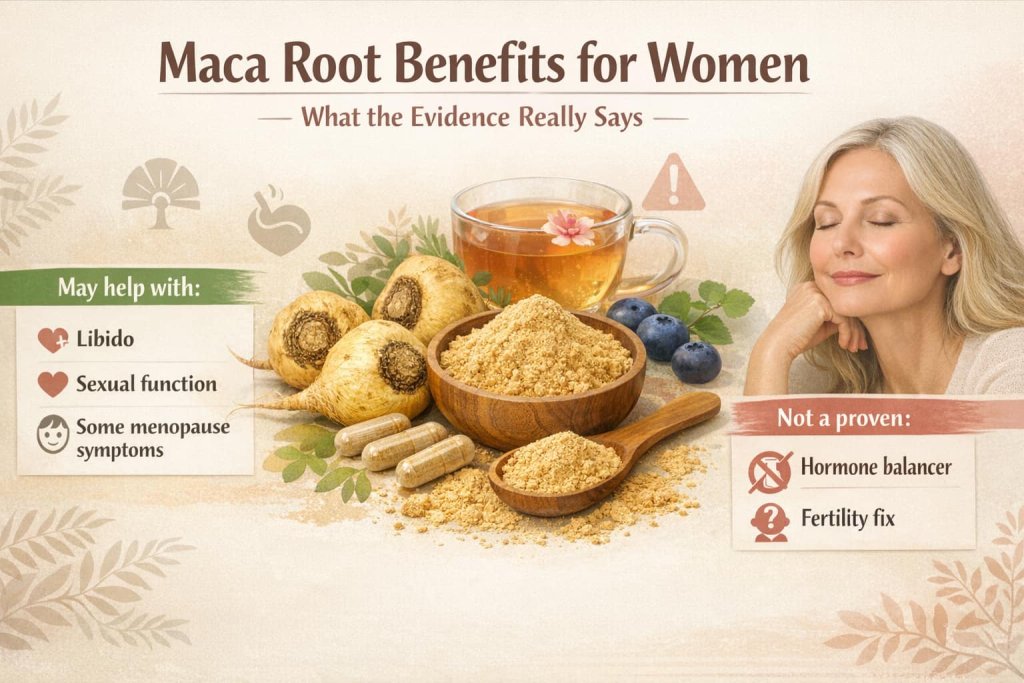
Maca root benefits for women may include modest support for libido, sexual function, and some menopause-related symptoms, but it is not a proven hormone balancer or fertility fix. That matters because maca is heavily marketed for women’s hormones, energy, mood, and reproductive health, while the actual human evidence is much narrower and less certain than many labels suggest. According to Memorial Sloan Kettering Cancer Center’s maca monograph, the 2010 systematic review on sexual function, and the 2011 review on menopausal symptoms, the most promising findings are in sexual well-being and postmenopausal symptom relief, but the studies are small and the overall evidence remains limited.
If you are considering maca, the practical questions are simple: what it may help with, what claims are overstated, how much has been studied, and who should be careful. Because maca is sold as a dietary supplement, the FDA explains that these products are not approved for safety or effectiveness before they are marketed, and the National Center for Complementary and Integrative Health notes that the supplement you buy may differ from the product used in research.
What Is Maca Root?
Maca is a root from the Andes of Peru and belongs to the mustard or cabbage family. It has a long history as a food, and today it is also sold in powders, capsules, and tablets. The LiverTox maca overview and Memorial Sloan Kettering both describe maca as a traditional food and herbal product rather than a medicine with proven clinical effects.
That distinction is important. A food or supplement can still be useful, but it should not be treated like a thoroughly proven therapy. For maca, the research is promising in a few areas, but it is not strong enough to support sweeping claims about women’s hormones, fertility, or long-term health.
Maca Root Benefits for Women With the Best Evidence
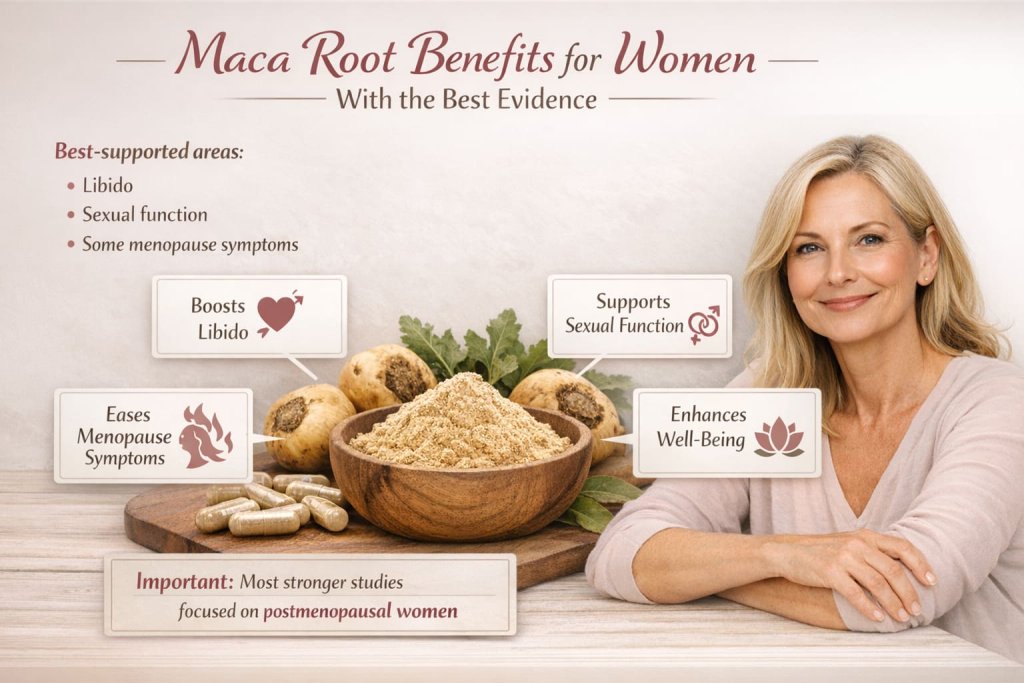
Before looking at the specific benefits, it helps to define who has actually been studied. Most of the better human research in women has focused on postmenopausal women, including women with menopause-related sexual symptoms. So while maca is marketed broadly to women of all ages, the evidence is strongest for postmenopausal sexual and quality-of-life concerns, not for younger women with regular menstrual cycles.
Maca root may help support libido and sexual function
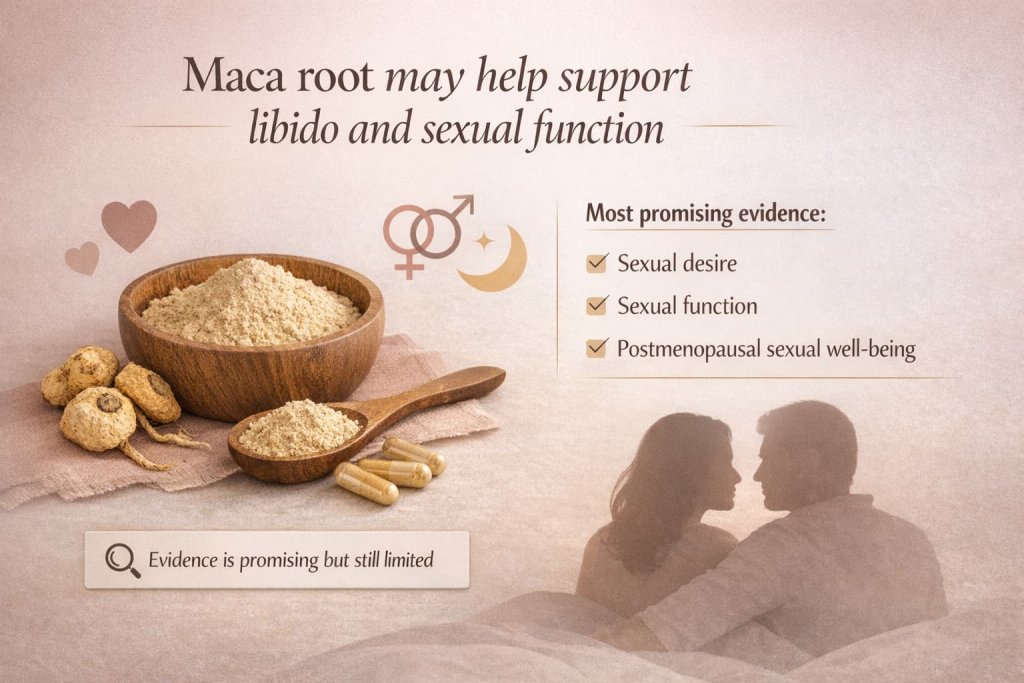
The strongest women-focused evidence for maca is in sexual desire and sexual function. The 2010 systematic review found some positive results, but also concluded that the total evidence was limited because only a small number of randomized trials were available. Memorial Sloan Kettering reaches a similar conclusion and notes that several studies in women suggest maca may improve sexual dysfunction, while broader reviews still judge the evidence as limited.
This is especially relevant for two groups of women studied in the research:
- healthy menopausal or postmenopausal women with lower sexual desire
- postmenopausal women experiencing antidepressant-related sexual dysfunction
In one placebo-controlled trial in postmenopausal women with antidepressant-induced sexual dysfunction, maca was reported to be well tolerated and may have improved some aspects of sexual function. Another trial summary suggested improvement in orgasm in postmenopausal women. These findings are encouraging, but they still come from small studies, so they should be viewed as preliminary rather than definitive.
Maca root may help some menopause symptoms
This is the other area where maca has the most useful evidence for women. The review of maca for menopausal symptoms concluded that there is some evidence of benefit, but not enough to make firm recommendations because the trials were few and generally small.
A frequently cited trial in postmenopausal women found that 3.5 grams per day of maca was associated with lower scores for anxiety, depression, and sexual dysfunction. Another pilot study in Chinese postmenopausal women reported improvements in depressive symptoms. These results make maca worth discussing for some women, especially if low libido or menopause-related quality-of-life issues are the main concern, but the evidence still falls short of proving that it works consistently for hot flashes, mood, or broader menopause symptom relief in all women.
One important limitation is that maca is not a direct treatment for vaginal dryness or painful sex. Around menopause, lower sexual interest is sometimes driven less by desire itself and more by discomfort, dryness, sleep disruption, or mood symptoms. If sex has become painful, if you have bothersome dryness, or if urinary symptoms are part of the problem, talk with a health care provider because over-the-counter moisturizers, lubricants, and prescription treatments may address the root issue more directly. And if you have bleeding or spotting after 12 months without a period, get medical evaluation promptly.
Mood and energy may improve for some women, but this is less certain
Maca is often promoted for energy, stamina, and mood. The human data here are weaker than the data on libido and menopause-related sexual symptoms. Some small studies and later reviews suggest possible improvements in mood or well-being, but this has not been established with large, high-quality trials in women. That makes energy and mood reasonable possible benefits, not reliable promises.
Maca Root Benefits for Women That Are Often Overstated
“Hormone balance” is not a proven maca benefit
This is one of the biggest problems in maca marketing. Some studies suggest maca may influence hormone-related pathways in women, but others found no meaningful changes in major hormone levels. Memorial Sloan Kettering specifically notes that maca appears to modulate some hormone levels in some studies but not in others. In the 2008 postmenopausal trial, symptom improvement did not clearly track with estrogenic or androgenic effects.
So, if you are searching for a natural way to “balance hormones,” maca should be framed carefully. A more accurate statement is that maca may help some symptoms in some women without consistently changing hormone levels in a predictable way.
Fertility claims are still not well proven in women
Maca is traditionally associated with fertility, and that claim is common online. But the better human evidence does not show that maca reliably improves female fertility or chances of conception. The women-focused research is centered far more on sexual function and menopause-related symptoms than on pregnancy outcomes.
That does not mean maca has no fertility-related role at all. It means women should not assume that taking maca will meaningfully improve ovulation, egg quality, or the odds of becoming pregnant. If fertility is the real goal, it is better to get evaluated for the most likely causes rather than relying on a supplement claim.
Weight loss, PCOS, breast growth, and “cure-all” claims are not well supported
These are common marketing angles, but they are not backed by strong, authoritative human evidence. For a trustworthy women’s health article, those claims should be treated as unproven.
Who Maca Root May Be Most Relevant For
Maca may be most relevant for women who fit one of these situations:
- postmenopausal women bothered by lower libido or sexual well-being
- women with menopause-related symptoms where mood or sexual function is part of the problem
- women who want to try a supplement after discussing it with a clinician and understanding that benefits are uncertain
Maca is less compelling if your main goal is dramatic energy improvement, hormone correction, or fertility treatment. The evidence simply is not strong enough there.
How to Take Maca Root
Maca is commonly sold as powder, capsules, tablets, or extracts. There is no established standard dose for women. The LiverTox review notes that recommended daily amounts vary widely, often around 500 to 3,000 mg per day, depending on the product and preparation. In clinical studies relevant to women, doses around 1.5 to 3.5 grams daily have been used, often for 6 to 16 weeks.
That does not mean those doses are right for everyone. Because products vary, it is smarter to use the specific label directions as a starting point and review them with your health care provider if you have any medical condition, take prescription medicine, or want to use maca regularly. NCCIH and the Office of Dietary Supplements both stress that supplements used in studies may differ from what is sold online or in stores.
One more important point is duration. Most clinical studies of maca in women have been short, often lasting only 6 to 16 weeks. That means short-term use is studied much better than long-term daily use. For women considering maca as an ongoing routine, that evidence gap is worth taking seriously rather than assuming indefinite daily use has been proven safe or helpful.
Safety Box: Who Should Be Careful With Maca?
Maca is generally well tolerated in short-term studies, but “generally tolerated” is not the same as risk-free. Short-term side effects reported in reference sources are usually mild and may include digestive upset and headache.
Talk with a health care professional before using maca if any of these apply to you:
- you are pregnant or breastfeeding
- you are trying to conceive and want evidence-based guidance
- you have a hormone-sensitive condition, including breast or uterine cancer
- you take prescription medicines or have surgery coming up
- you are having hormone-related lab work, because maca may interfere with some testosterone tests
Memorial Sloan Kettering advises caution for people with hormone-sensitive cancers and says maca may not be safe during pregnancy or breastfeeding. NCCIH adds that many supplements have not been adequately tested in pregnant women, nursing mothers, or children, and that supplements can interact with medications or pose risks around surgery.
There are also reports of altered menstrual cycles, moodiness, cramps, gastritis, insomnia, and a case of intermenstrual bleeding. These are not common enough to define maca’s overall safety profile, but they are important reminders that “natural” does not automatically mean harmless.
How to Choose a Better Maca Supplement
Because supplements are not preapproved by the FDA for safety or effectiveness, product quality matters. The NIH Office of Dietary Supplements consumer guide explains that independent organizations such as NSF, U.S. Pharmacopeia (USP), and ConsumerLab offer quality testing for some products. These seals do not prove that a supplement works, but they can help you identify products that were manufactured properly and tested for listed ingredients and contaminants.
Also check the label for red flags. A better product will clearly list the amount of maca per serving in the Supplement Facts panel and identify itself as a dietary supplement. Be cautious with proprietary blends that do not tell you how much maca you are actually getting. And be skeptical of products that promise to treat infertility, fix hormone imbalance, or cure symptoms. Under FDA rules, dietary supplements are not allowed to claim that they diagnose, treat, cure, or prevent disease.
When shopping for maca, look for:
- a clear ingredient list
- a dose listed in milligrams or grams
- third-party quality testing when available
- no exaggerated claims about curing hormone problems, infertility, or chronic disease
Frequently Asked Questions About Maca Root Benefits for Women
Does maca root increase estrogen in women?
Not in a consistent, proven way. Some studies suggest hormone-related effects, while others do not show meaningful changes. That is why “raises estrogen” or “balances hormones” is too strong as a general claim.
Can women take maca every day?
Some studies used daily maca for several weeks, often between 6 and 16 weeks, and short-term tolerance looked acceptable. But there is no standard daily dose, and daily use is not automatically appropriate for everyone, especially during pregnancy, breastfeeding, or with hormone-sensitive conditions.
How long does maca take to work?
The studies that found possible benefits generally ran for several weeks, not just a few days. In practical terms, most research looked at roughly 6 to 16 weeks of use.
Is maca root safe during pregnancy?
There is not enough good safety evidence to call it safe during pregnancy or breastfeeding. That is why authoritative guidance recommends caution and a discussion with your clinician before using it.
The Bottom Line on Maca Root Benefits for Women
Maca root may help some women, especially with libido, sexual function, and possibly certain menopause-related symptoms, but the evidence is still limited. The safest, most accurate way to think about it is as a supplement with promising but not definitive research, not as a proven hormone solution.
If you are thinking about trying maca, use the label carefully, choose a quality-tested product when possible, and talk with a qualified health professional if you are pregnant, breastfeeding, managing a hormone-sensitive condition, taking medication, or using maca for a specific women’s health concern.
This content is for informational purposes only and not medical advice.
References
- National Center for Complementary and Integrative Health — Using Dietary Supplements Wisely
- U.S. Food and Drug Administration — Questions and Answers on Dietary Supplements
- NIH Office of Dietary Supplements — Dietary Supplements: What You Need to Know
- PubMed — Maca (Lepidium meyenii) for treatment of menopausal symptoms
- PubMed — Beneficial effects of Lepidium meyenii (Maca) on psychological symptoms and measures of sexual dysfunction in postmenopausal women
- PubMed — A double-blind placebo-controlled trial of maca root as treatment for antidepressant-induced sexual dysfunction in women
- Office on Women’s Health — Menopause symptoms and relief