
The clean and jerk is a full-body Olympic lift that can build explosive power, strength, and coordination when it is taught and progressed correctly. It matters because it combines leg drive, trunk stiffness, upper-body stability, and timing in one movement, but it is also a technical lift that is usually best learned with qualified coaching rather than trial and error with a heavy barbell.
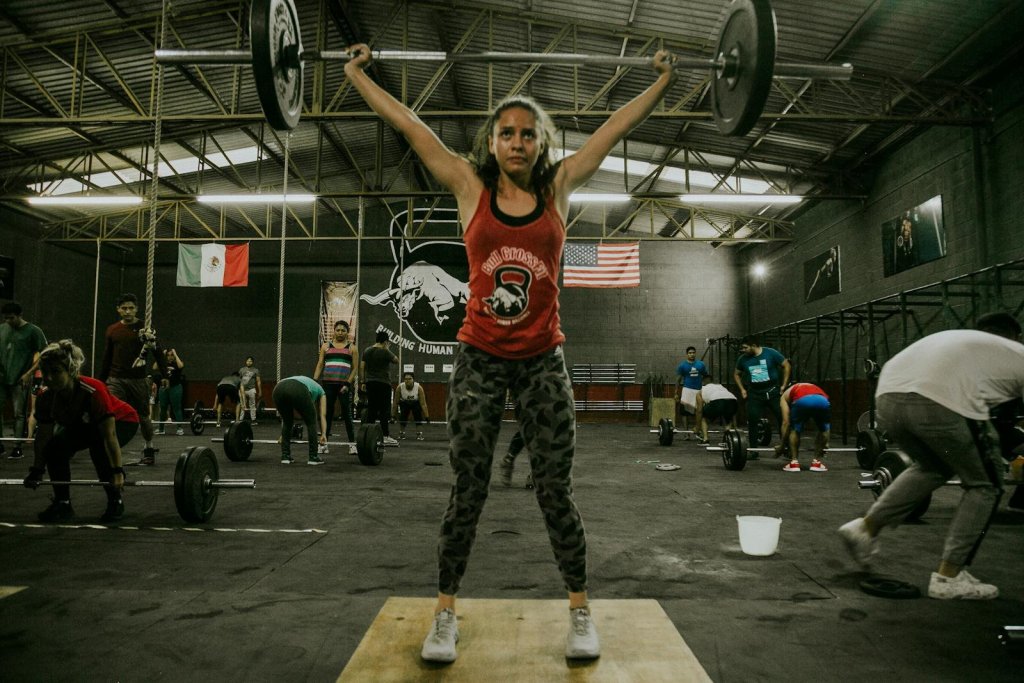
The clean and jerk is popular for a reason. It is one of the two competition lifts in Olympic weightlifting, and according to USA Weightlifting, it is the lift in which the most weight can usually be raised. For readers trying to understand whether it is worth learning, the short answer is yes for the right person, but not as a first power exercise for everyone.
What Is the Clean and Jerk?
The clean and jerk is a two-part lift. In the clean, the bar moves from the floor to the shoulders. In the jerk, the bar is driven from the shoulders to overhead. The International Weightlifting Federation and USA Weightlifting both describe it this way, which makes it the clearest official definition to use.
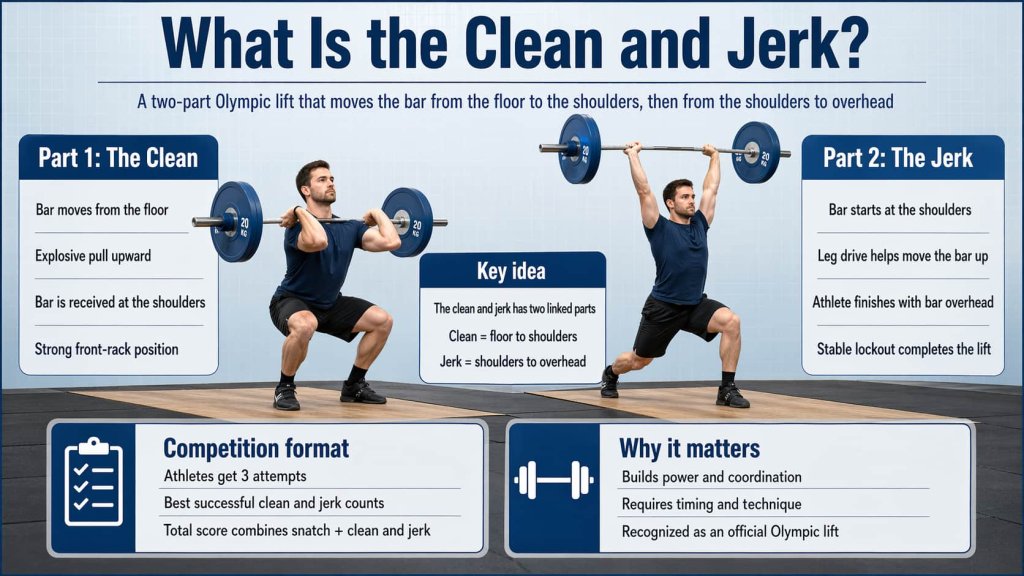
In competition, athletes get three attempts in the clean and jerk, just as they do in the snatch, and the total result comes from the best successful snatch plus the best successful clean and jerk. That sport-specific structure helps explain why the lift is treated as a serious technical skill rather than just another gym exercise, as outlined by the International Weightlifting Federation.
Why the Clean and Jerk Works
The clean and jerk stands out because it asks the body to produce force quickly. The 2023 NSCA position statement explains that weightlifting exercises can improve force-production characteristics and athletic performance when they are programmed appropriately, and it notes that the clean and jerk is especially useful for emphasizing strength-speed.
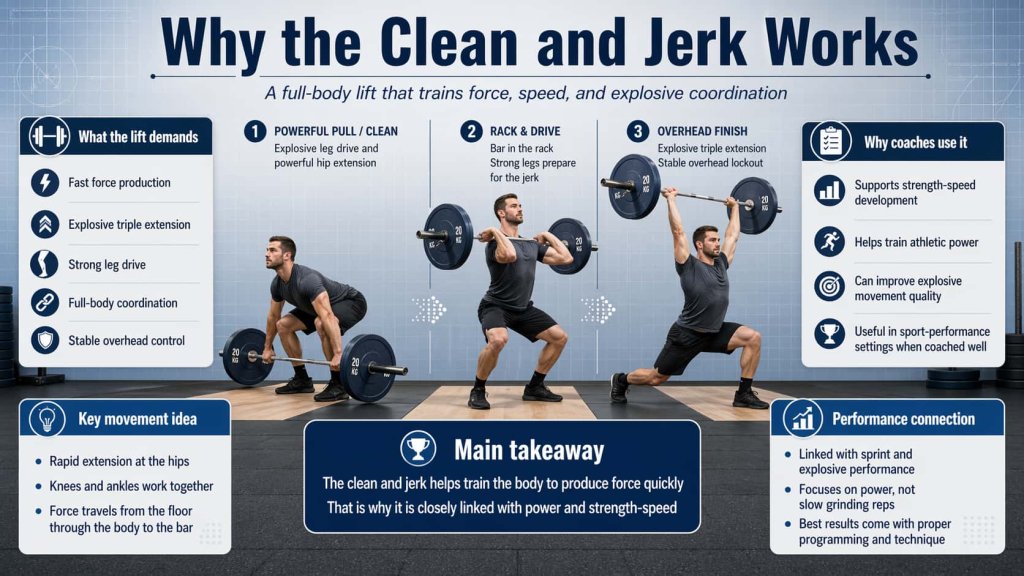
The same NSCA paper highlights why coaches like these lifts for sport performance: rapid extension at the hips, knees, and ankles during the explosive phases can produce high force, high rate of force development, and high power output. In plain English, that means the lift trains you to apply force fast, not just slowly grind through a rep.
There is also growing review-level support for Olympic lifting patterns in performance settings. A 2024 systematic review and meta-analysis available through PubMed reported benefits for sprint performance in athletes, which fits the broader idea that these lifts can support speed and explosiveness when they are coached well.
How the Clean and Jerk Is Usually Taught
Good coaching rarely starts with a heavy floor-to-overhead attempt. The NSCA position statement explains that the clean is commonly broken into five phases, while the jerk is broken into four phases, and it supports a step-by-step teaching method. It also notes that reverse chaining is advocated by both the NSCA and the International Weightlifting Federation.
In real coaching settings, that usually means learning the lift in pieces first, then linking those pieces together only when the positions are stable. A safe learning path often looks something like this:
- Learn basic squat, hinge, and front-rack positions
- Practice pull mechanics and receiving positions with light implements
- Learn the clean and the jerk as separate skills before combining them
- Add speed and load only after the movement stays consistent
- Keep technical practice ahead of ego lifting
That approach is less exciting than copying a max-effort video, but it is far more in line with how reputable coaching organizations describe skill development in weightlifting.
Clean and Jerk Muscles Worked
The clean and jerk is not just a shoulder exercise or just a leg exercise. According to a 2025 technique article from the American Council on Exercise, the lift involves major work from the glutes, quadriceps, hamstrings, trapezius, forearm flexors, deltoids, latissimus dorsi, spinal erectors, calves, and triceps, while the deep core muscles help stabilize the movement.
That full-body demand is one reason the clean and jerk gets so much attention. Research on trunk and core activity during clean-and-jerk variations, indexed in PubMed, also supports the idea that the lift challenges the torso as part of an integrated movement, not as an afterthought.
Clean and Jerk Benefits
The clearest clean and jerk benefits are not just “more strength.” The lift may help develop explosive power, full-body coordination, timing, and the ability to move force from the lower body through the trunk to the upper body. The American Council on Exercise also describes it as a foundational exercise for explosive total-body power in strength and conditioning settings.
Practical benefits may include:
- Better power production for jumping, sprinting, and fast athletic movements
- Stronger leg and hip drive
- Improved ability to brace the trunk under load
- Greater coordination between the lower body, trunk, and shoulders
- A useful skill base for competitive Olympic weightlifting
These benefits are strongest when technique, mobility, and progression are taken seriously. They do not mean the clean and jerk is the best choice for every gym-goer or that it should replace simpler strength work.
Before You Start the Clean and Jerk
This is where many articles get too casual. The clean and jerk is a technical lift, and the American Council on Exercise notes that it is best suited for advanced clients with at least one year of strength-training experience and good joint mobility. The same article stresses the need for sufficient range of motion at the ankles, hips, thoracic spine, shoulders, and wrists before teaching the lift.
That does not mean younger or newer athletes can never learn weightlifting movements. It does mean they should learn them in a structured setting. A review in PMC notes that well-supervised youth strength training does not appear to carry greater inherent risk than many other youth sports, but supervision and proper progression are central to safety.
Before someone starts practicing the clean and jerk, it is smart to check these basics:
- Can they front-rack a light bar comfortably enough to learn the positions?
- Can they squat and hinge with control?
- Can they hold overhead positions without pain or obvious instability?
- Can they follow coaching cues and repeat positions consistently?
If the answer is no, the next step is usually not “try harder.” It is usually to build the missing mobility, strength, and positioning first.
Common Clean and Jerk Mistakes
The biggest clean and jerk mistakes usually come from trying to rush a complex lift. Common problems include poor front-rack mobility, early arm pulling, losing trunk position, unstable overhead receiving, and trying to add load before the movement pattern is consistent. Coaching material from USA Weightlifting and technique guidance from the American Council on Exercise both point back to the same theme: skill first, then speed, then heavier loading.
Another common mistake is treating the clean and jerk like a general muscle-building exercise. Even weightlifting-specific programming sources from USA Weightlifting note that the clean and jerk is not the most efficient lift for hypertrophy, because its training value is more about power, timing, and technical performance than slow muscular tension.
Who Should Be Careful Before Trying the Clean and Jerk?
Anyone with current pain, recent injury, poor overhead control, or major mobility limits should be cautious. That includes people with unresolved wrist, shoulder, back, hip, knee, or ankle problems. A technical lift becomes much less forgiving when someone is already fighting pain or movement restrictions, which is one reason the American Council on Exercise emphasizes prerequisites before teaching it.
The injury data also support taking the lift seriously. A 2024 updated systematic review available through PubMed reported injury incidence around 1.0 to 4.4 injuries per 1,000 training hours, with common injury areas including the lower back or pelvis, shoulder, and elbow or upper arm. That does not prove the clean and jerk is unusually dangerous, but it does support careful coaching, sensible progression, and stopping when technique breaks down.
Clean and Jerk vs. Simpler Power Exercises
For some readers, the better question is not “Is the clean and jerk good?” but “Do I need it?” Often, the honest answer is no. The clean and jerk is valuable, but many people can build power and strength with less technical options first, such as jump training, medicine-ball throws, kettlebell work, or simpler barbell movements. The NSCA makes it clear that Olympic lifting can be effective, but that does not make it mandatory for general fitness.
For general health, the bigger picture still matters most. The Physical Activity Guidelines for Americans recommend that adults get at least 150 to 300 minutes of moderate-intensity aerobic activity each week and do muscle-strengthening activity at least 2 days per week. The clean and jerk can fit inside a training program, but it does not replace the need for a balanced overall routine.
Is the Clean and Jerk Good for Beginners?
For most true beginners, the full clean and jerk is usually not the first barbell skill to learn alone. The American Council on Exercise specifically places it with advanced clients who already have training experience and mobility, which is a useful reality check for readers who see it online and assume it should be part of every beginner workout.
That said, beginners can still build toward it. Learning the positions, using lighter tools, and working with a coach can make the path much safer and more productive than trying to force the full lift too early.
FAQ About the Clean and Jerk
Is the clean and jerk a full-body exercise?
Yes. It uses the legs, hips, trunk, upper back, shoulders, arms, and grip in one coordinated movement. The American Council on Exercise muscle breakdown makes that clear.
Is the clean and jerk harder than the snatch?
Many lifters find the snatch more technically demanding, but the clean and jerk is still highly technical. USA Weightlifting notes that the clean and jerk is usually the lift where the most weight can be lifted.
Does the clean and jerk build muscle?
It can contribute to strength and muscular development, but it is mainly valued for power, coordination, and strength-speed qualities rather than being the most efficient hypertrophy exercise. That distinction is clear in the NSCA position statement and related coaching material.
Can teenagers learn the clean and jerk?
Some teen athletes do learn weightlifting movements, but the safe answer is that they should do so only with proper supervision, age-appropriate progression, and qualified coaching. Supervised youth strength training is supported in the literature, and the PMC review is a useful reference for that point.
Is the clean and jerk safe?
It can be trained safely, but it is not a casual lift. The skill level, mobility demands, and injury data all point to the same lesson: coaching, progression, and self-control matter. The 2024 review indexed in PubMed supports a careful, technique-first approach.
Do I need the clean and jerk for general fitness?
No. You can get strong, powerful, and athletic without it. The clean and jerk is a valuable tool, but not a requirement for meeting general fitness guidelines or building a solid strength base, as the Physical Activity Guidelines for Americans make clear.
Conclusion
The clean and jerk is one of the most impressive lifts in the gym because it combines strength, speed, timing, and stability in one movement. It may help develop explosive full-body power, but it is not a shortcut and it is not a beginner must-have. The smartest path is to respect the skill, build the prerequisites, and learn it with qualified coaching if it matches your goals.
If your goal is better athletic power or Olympic lifting performance, the clean and jerk can be worth the work. If your goal is general strength and health, simpler exercises may get you there faster and more safely.
This content is for informational purposes only and not medical advice.
References
- USA Weightlifting — The Lifts
- International Weightlifting Federation — The Two Lifts
- National Strength and Conditioning Association — Position Statement on Weightlifting for Sports Performance
- American Council on Exercise — The Barbell Clean and Jerk
- PubMed — Olympic Weightlifting Training for Sprint Performance in Athletes
- PubMed — Core Muscle Activity During the Clean and Jerk Lift Using Different External Loads
- PubMed — Injuries in Weightlifting and Powerlifting: An Updated Systematic Review
- PMC — Weightlifting for Children and Adolescents: A Narrative Review