
Hanging leg raises can be an excellent exercise for building stronger abs and better core control, but they do not isolate a separate “lower-ab” muscle. They are best understood as an advanced core move that challenges the rectus abdominis, deep trunk stabilizers, hip flexors, and your ability to control your body while hanging from a bar. That is why they are worth learning carefully instead of rushing into sloppy reps, as explained by Cleveland Clinic.
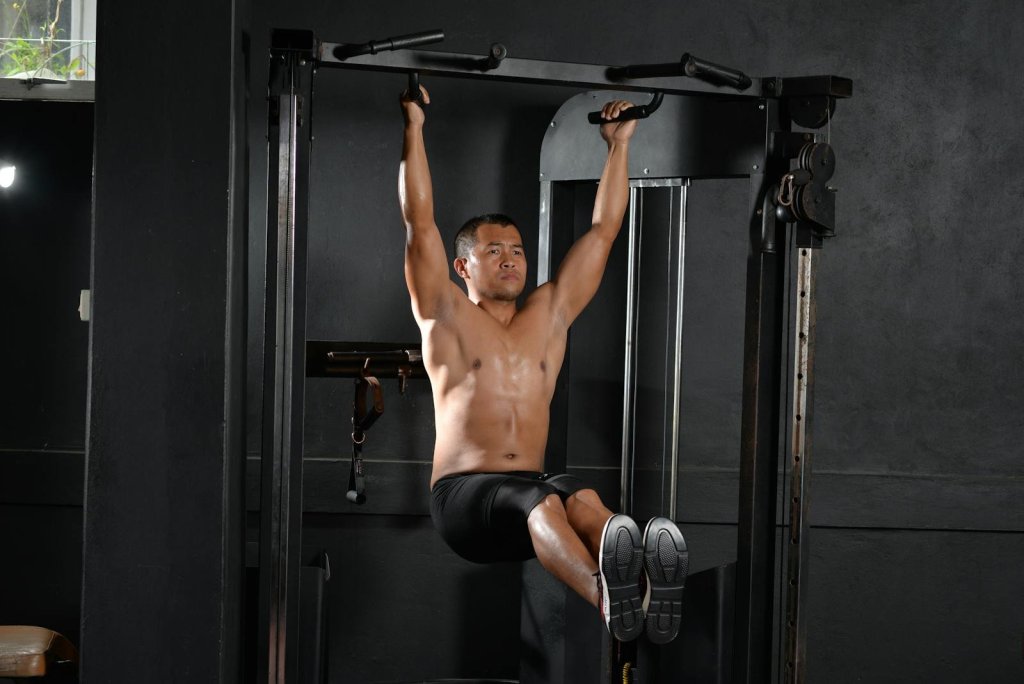
If you want hanging leg raises to actually work, focus on the right progression, slow lowering, and minimal swing. Guidance from ACE and Cleveland Clinic supports starting with easier variations first, then progressing only when you can control the full range of motion.
What Are Hanging Leg Raises
A hanging leg raise is a leg-lift variation done from a pull-up bar. You hang from the bar and raise your legs forward, usually until they reach about parallel to the floor. Cleveland Clinic classifies this version as highly advanced and also notes that it can be done with bent knees first before progressing to straighter-leg versions.
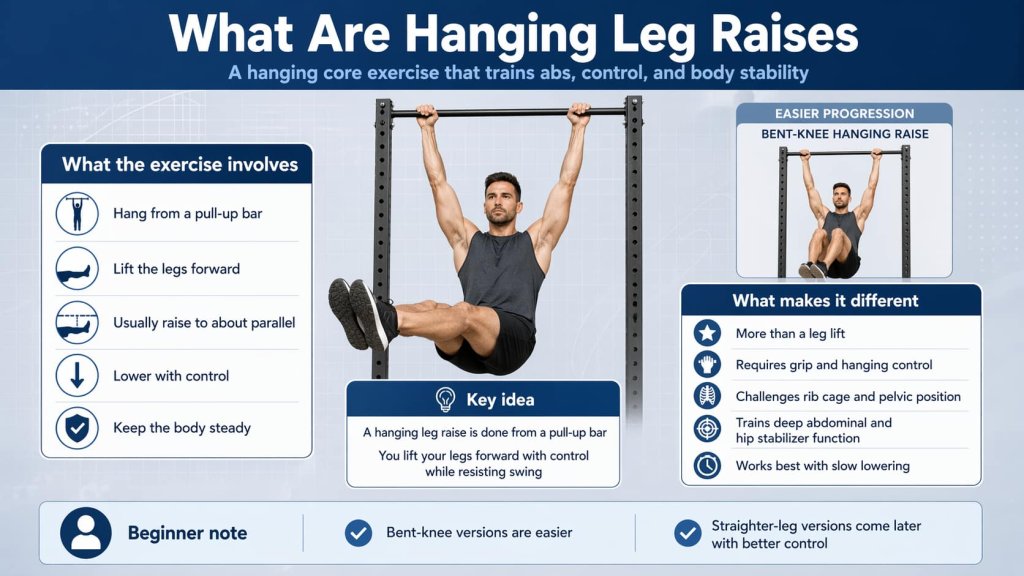
What makes the exercise different from floor leg lifts is the hanging position itself. You are not just lifting your legs. You are also resisting swing, controlling your rib cage and pelvis, and maintaining your position while suspended from the bar. ACE highlights unsupported leg-raise variations as a way to work the deep abdominal muscles and hip stabilizers, especially when the lowering phase is done slowly.
Are Hanging Leg Raises Really for Lower Abs
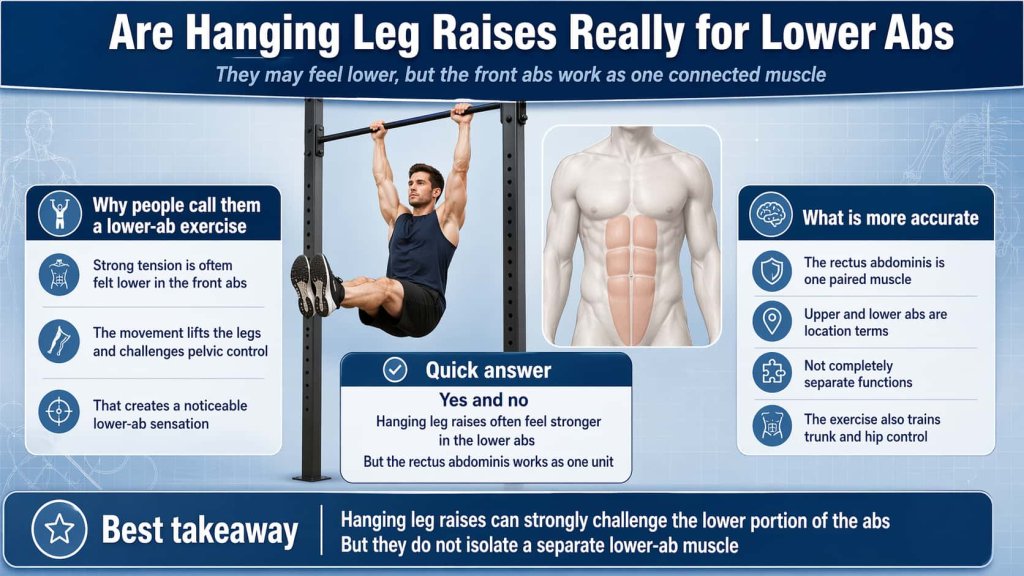
Yes and no. Hanging leg raises often create a strong sensation in the lower part of your abs, which is why people search for them as a lower-ab exercise. But the rectus abdominis works as one unit, not as a completely separate upper-ab and lower-ab system. NASM specifically explains that “upper” and “lower” abs are location terms, not separate functions, and says people often feel leg lifts lower because of what is happening underneath that area. Cleveland Clinic also describes the rectus abdominis as a paired muscle running vertically along the front of the stomach.
That does not mean the exercise is overrated. It means the smarter claim is this: hanging leg raises may help you feel more tension in the lower portion of the front abs while also training the rest of the trunk and hips. That is accurate, useful, and much more trustworthy than pretending this move magically isolates one tiny section of your midsection.
How to Do Hanging Leg Raises With Proper Form
1. Hanging Knee Raise
How to do it:
- Grab a pull-up bar and let your body settle into a controlled hang.
- Brace your midsection before you move.
- Bend your knees and lift them toward your chest as high as you can without swinging.
- Keep the motion smooth instead of jerking your legs upward.
- Lower your legs slowly, ideally over several seconds.
- Reset your body position before the next rep if you start to swing.
Trainer Tip: Own the lowering phase. ACE specifically emphasizes slow eccentrics because they build control and help prevent swinging.
2. Straight Leg Hanging Leg Raise
How to do it:
- Start from a steady hang on the bar.
- Tighten your core before you lift.
- Raise your straight legs forward only as high as you can without using momentum.
- Keep your ribs from flaring and avoid turning the rep into a swing.
- Lower your legs slowly and under full control.
- Stop the set when the rep quality drops.
Trainer Tip: Progress to this variation only after your bent-knee version looks calm and controlled. Harder is not better if the rep turns messy halfway through.
Hanging Leg Raises Muscles Worked
Hanging leg raises involve more than one muscle group at a time. The main muscles and supporting areas include:
- Rectus abdominis, the front abdominal muscle often called the six-pack
- Transversus abdominis and other deep trunk stabilizers
- Obliques, which help control the torso
- Hip flexors, which help lift the legs
- Grip, forearms, and shoulder-supporting muscles that help you stay hanging on the bar
Cleveland Clinic explains that leg lifts can strengthen the abdominal muscles, lower back, glutes, transverse abdominis, and hip flexors as part of overall trunk function. ACE adds that unsupported versions especially challenge the deep abdominal muscles and hip stabilizers.
Hanging Leg Raises Benefits
When done with control, hanging leg raises can offer several practical benefits.
- They may help build stronger abs and trunk stiffness for other exercises
- They train hip and pelvic control instead of just chasing a burn
- They challenge anti-swing control, which makes the movement more athletic
- They can improve your tolerance for hanging, grip work, and body control
- They are easy to scale from bent-knee raises to straight-leg raises
These benefits fit well with how NASM describes core training: the goal is not just visible abs, but better stability, movement efficiency, and performance. Cleveland Clinic also notes that leg lifts can support posture, trunk stability, and workout strength when they are part of a broader routine.
Why Hanging Leg Raises Work Best With Good Progressions
This is not the kind of exercise most people should start with on day one. ACE recommends that beginners begin in a Captain’s Chair, then progress to ab straps or hanging from the hands once they have enough strength and control. NASM also recommends beginning core work at the highest level where you can still maintain stability with proper form, rather than choosing a harder variation just because it looks impressive.
That is the real secret to making hanging leg raises effective. Clean, controlled knee raises usually do more for your progress than wild straight-leg reps with lots of momentum.
Common Hanging Leg Raise Mistakes
The biggest errors usually come from trying to make the move look harder than your current strength allows.
- Swinging the body to create momentum
- Raising the legs quickly and dropping them without control
- Jumping straight to full straight-leg reps too early
- Letting the lower back arch and losing trunk tension
- Treating every set like a max-effort challenge instead of a technical exercise
ACE offers especially useful coaching advice here: think about the slow downward phase, because that is where much of the control and stabilization work happens. NASM also stresses that progression should match the level where you can still maintain stability with good form.
Best Hanging Leg Raise Progressions and Regressions
A smart progression path usually looks like this:
- Captain’s Chair knee raises
- Bent-knee hanging raises
- Higher bent-knee raises with less swing
- Straight-leg hanging raises
- More advanced variations only after you fully own the basics
If you are not ready to hang from a bar yet, floor-based leg lifts with bent knees can still help you train your trunk. Cleveland Clinic recommends modifying leg lifts to your fitness level and even using bent-knee options for beginners. That makes hanging leg raises a goal to work toward, not a starting point you have to force.
To round out your program, it also helps to pair hanging work with other forms of core training such as bracing, anti-rotation, and stability-based exercises. NASM emphasizes that good core training includes more than flexion-based movements alone.
How Many Reps and Sets Should You Do
For beginners working on bent-knee versions, ACE suggests eight to 10 repetitions with a strong emphasis on slow lowering. NASM places many core strength exercises in the range of two to three sets of eight to 12 reps, while stabilization work may start lighter and slower.
A practical way to apply that is:
- Start with 1 to 3 sets of 8 to 10 bent-knee reps
- Move to 2 to 3 sets of 8 to 12 cleaner reps as your control improves
- Rest enough between sets that you can avoid sloppy swinging
- Do not push focused core work hard every single day
NASM notes that the core muscles need recovery after intense focused sessions, just like other muscles do.
Where Hanging Leg Raises Fit in a Workout
Hanging leg raises usually work best after your warm-up and before heavy fatigue ruins your technique. NASM recommends core exercises early in the workout, after the warm-up and before the main resistance-training portion, so you can activate the core without exhausting it first.
They also make the most sense inside a bigger training plan. According to CDC, adults need muscle-strengthening work on two or more days each week, alongside regular aerobic activity. Hanging leg raises can be one useful piece of that strength work, but they should not be your entire program.
Who Should Be Careful Before Doing Hanging Leg Raises
This exercise is not the best choice for everyone.
You should be careful or get guidance first if you have:
- Diagnosed lower-back pain
- A recent shoulder, elbow, wrist, or hand issue that makes hanging uncomfortable
- Trouble controlling swing even in easier variations
- A current injury affecting your trunk, hips, or grip
ACE specifically says unsupported leg-raise variations are not recommended for people with diagnosed lower-back pain. Cleveland Clinic also recommends matching leg-lift variations to your fitness level and discussing exercise choices with a clinician or exercise professional if you have concerns.
Do Hanging Leg Raises Burn Belly Fat
Not by themselves. Hanging leg raises can strengthen your abs, but they are not a shortcut for reducing belly fat in one spot. NASM states that core training can improve function and performance, but visible abs usually depend on lowering body fat levels, not just doing more ab exercises. A commonly cited PubMed study also found that six weeks of abdominal exercise alone was not enough to reduce abdominal fat or improve body-composition measures in that study group. CDC explains that weight loss comes from a calorie deficit, created by using calories through physical activity along with reducing the calories you eat.
That does not make hanging leg raises useless. It just means they belong in a balanced plan that includes resistance training, enough weekly activity, nutrition habits you can sustain, and recovery.
Frequently Asked Questions About Hanging Leg Raises
Are hanging leg raises better than crunches
They are not automatically better for everyone. Hanging leg raises are more advanced and place bigger demands on control, hanging tolerance, and anti-swing stability. Crunches are easier to learn, while hanging variations can add a stronger challenge once you already have a good base, as noted by ACE.
What is the difference between hanging knee raises and hanging leg raises
Hanging knee raises keep the knees bent, which shortens the lever and makes the movement easier to control. Straight-leg hanging raises use a longer lever, which increases difficulty and usually requires more strength and stability.
Why do I feel hanging leg raises more in my hip flexors than my abs
That usually happens when the movement becomes more of a leg lift than a controlled trunk exercise. NASM notes that people often associate leg lifts with the lower abs, but the sensation can also relate to the psoas muscles under that region. Slowing the lowering phase and reducing swing often helps you feel the movement more where you want it.
Can beginners do hanging leg raises
Most beginners should start with easier options, not full straight-leg reps. ACE recommends beginning with a Captain’s Chair or a bent-knee version, and Cleveland Clinic advises choosing modifications that match your fitness level.
How often should I train hanging leg raises
A few times per week is enough for most people, especially if you also do other strength training. CDC recommends muscle-strengthening work at least two days per week, and NASM notes that the core still needs recovery after harder focused sessions.
Should I raise my feet all the way to the bar
Not unless you can do it without momentum, pain, or losing position. Cleveland Clinic describes the basic hanging version as raising the legs until they are parallel to the floor, while ACE emphasizes control over exaggerated range. Cleaner reps beat higher reps.
Conclusion
Hanging leg raises deserve their reputation, but only when they are done with control. They can help you build stronger abs, better core stiffness, and more body control, especially if you earn the movement through smart progressions first. Start with bent-knee versions, slow down the lowering phase, and keep your reps clean before you chase harder variations. That approach is what turns hanging leg raises from a flashy ab move into a useful long-term exercise.
If you want the best results, treat hanging leg raises as one part of a bigger plan that includes full-body strength work, regular activity, and realistic nutrition habits.
References
- American Council on Exercise (ACE) — 6 Exercises for a Stronger Core
- NASM — Core Stability Exercises: Targeting Progressive Core Training
- Cleveland Clinic — How To Do Leg Lifts Properly: A Step-by-Step Guide
- Cleveland Clinic — Abdominal Muscles: Anatomy and Function
- PubMed — The Effect of Abdominal Exercise on Abdominal Fat
- CDC — Physical Activity Guidelines for Adults
- CDC — Physical Activity and Your Weight and Health
- PubMed — A Systematic Review and Meta-Analysis of the Effect of Exercise on Visceral Fat